The Bible does not plainly say that Jesus suffered in hell after his death. It says that Jesus truly died, was buried, and rose again, while several passages describe what happened between his death and resurrection in different ways.
The answer depends partly on what you mean by “hell”. In modern English, the word usually means the final place of punishment for the wicked. In older Christian language, however, “hell” was sometimes used to translate terms meaning the realm of the dead. That distinction explains much of the disagreement.
What happened to Jesus between his death and resurrection?
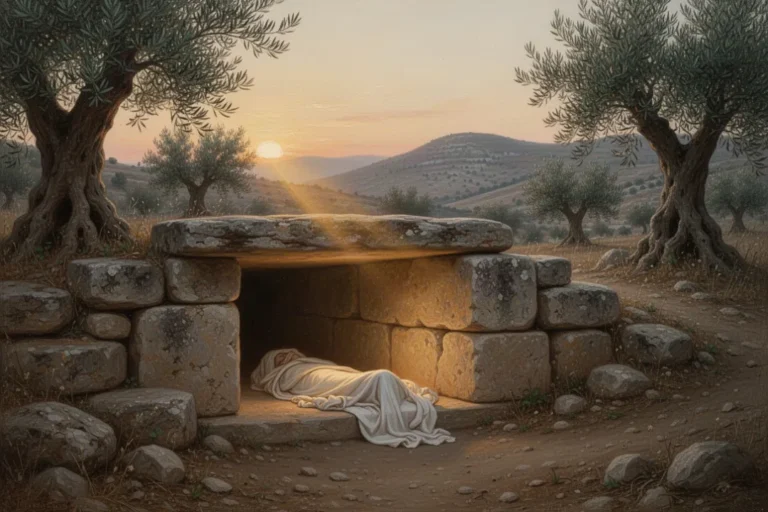
The New Testament presents Jesus’ death as a real death, not an appearance or temporary fainting. He died on the cross, was taken down, and was placed in a tomb. His followers then found the tomb empty on the first day of the week, and the resurrection accounts describe encounters with him afterward.
The Gospels do not provide a continuous, detailed account of every moment between the burial and resurrection. Instead, a few passages are used to discuss this period. They mention the dead, the lower parts, or a proclamation made to spirits, but Christians interpret those references in different ways.
Jesus also speaks to the criminal crucified beside him in Luke 23:43. The statement indicates that the man would be with Jesus in paradise, a term associated with blessedness and God’s presence. Many Christians understand this as evidence that Jesus did not enter a place of punishment after dying.
The central point: Christian teaching focuses on Jesus’ genuine death and bodily resurrection. It does not require the belief that he was tortured in hell after the cross.
Why Christians say “he descended into hell”
The phrase appears in some versions of the Apostles’ Creed, a historic summary of Christian faith. In other versions, the same line is translated as “he descended to the dead.” Those two English phrases can sound very different, even though they may reflect the same older idea.
The creed’s wording developed through early Christian usage and translation. The Latin phrase commonly associated with it is descendit ad inferos, which means that Christ descended to those below or to the dead. It does not necessarily mean that Jesus went to the final place of punishment commonly called hell.
Older English translations sometimes used “hell” for the place of the dead. As a result, a person may hear the creed and imagine a scene of Jesus enduring fire and punishment, even though the intended meaning in many Christian traditions is that he entered the condition of death.
The phrase can therefore affirm several ideas: Jesus really died, he fully shared the human experience of death, and death could not hold him. It may also express the belief that Christ’s saving work reaches into the deepest consequences of human sin and mortality.
What “hell” means in the Bible
Several biblical words are translated as “hell” in English Bibles, but they do not all mean exactly the same thing. Understanding them helps prevent a single English word from controlling the entire discussion.
Sheol: In the Hebrew Bible, this generally refers to the grave or the realm of the dead. It is not always presented as a place of final punishment.
Hades: In the New Testament, this Greek term can refer to the realm of the dead. It is sometimes associated with judgment, but its meaning depends on the passage.
Gehenna: This term is used in teachings about final judgment and punishment. It is closer to what many modern readers mean by “hell.”
Tartarus: This uncommon term appears in 2 Peter 2:4 in connection with rebellious angels. It is not the ordinary word used to describe Jesus’ destination.
These distinctions do not settle every theological question, but they show why the question cannot be answered accurately by finding every occurrence of the English word “hell.” The original terms and their surrounding passages matter.
When the Apostles’ Creed says that Jesus descended to the dead, many theologians are referring to Sheol or Hades, not Gehenna. That interpretation means Jesus entered death itself. It does not mean that he was condemned or needed punishment for his own sins.
What 1 Peter says about Jesus preaching to spirits
The most debated passage is 1 Peter 3:18-20. It says that Christ was put to death in the flesh and made alive in the spirit, then connects him with a proclamation to “spirits in prison.” Because of its unusual language, Christians have proposed several explanations.
One interpretation is that Jesus descended to the dead and proclaimed his victory to imprisoned spirits. On this reading, the passage describes a declaration of triumph, not an offer of salvation or a period of suffering. Christ announces that his death and resurrection have defeated the powers opposed to God.
Another interpretation connects the passage with the days of Noah. In that view, Christ preached through Noah to people living before the flood, and the “spirits in prison” are understood in a particular way rather than as human souls visited after Jesus’ death.
A third interpretation understands the passage as a proclamation to rebellious spiritual beings. The language about imprisoned spirits and Noah can be read as referring to supernatural beings who are awaiting judgment. This view appears in some scholarly and church traditions.
The passage is difficult because it is brief, unfamiliar, and closely linked to other themes in 1 Peter. It should not be treated as a simple sentence stating, “Jesus went to hell and suffered there.” It says something about a proclamation and the realm of imprisoned spirits, but it does not clearly describe Jesus being punished.
How 1 Peter 4:6 is understood
First Peter 4:6 mentions the gospel being preached to those who are now dead. Some readers understand this as another reference to Jesus preaching in the underworld after his crucifixion. Others read it as referring to people who heard the gospel while alive and had died by the time Peter wrote.
The immediate context is about believers being judged by human standards but living before God. That context allows the verse to be read as encouragement for Christians who face suffering and death. It does not by itself establish a detailed doctrine of Jesus’ descent into hell.
As with 1 Peter 3, the passage has generated several interpretations because the wording is compact and the larger argument is theological rather than chronological. It is safer to say that the text has been connected with Christ’s descent than to claim that all Christians agree about its meaning.
What Ephesians means by “the lower parts”
Ephesians 4:8-10 says that Christ descended to the lower regions and then ascended above the heavens. Some readers take the descent as a journey to the realm of the dead. Others understand it as Christ’s descent from heaven to earth, especially his incarnation and earthly ministry.
The passage is discussing Christ’s exaltation and his giving gifts to his people. Its main emphasis is that the one who descended is also the one who ascended, filling all things. It does not describe a scene of torment or explain what Jesus did in an underworld.
The phrase can therefore support the traditional belief that Jesus entered the realm of the dead, but it is not decisive on its own. The meaning depends on how someone understands “the lower regions” and how that phrase relates to the rest of the letter.
Why Jesus’ suffering is usually placed before death
Christian teaching about Jesus’ suffering normally points to the crucifixion, not to a later punishment in hell. The Gospel accounts describe betrayal, abandonment, beating, mockery, execution, and death. The New Testament presents these events as central to Jesus’ work of salvation.
Many Christians understand the cross as the place where Jesus bore sin, judgment, or its consequences on behalf of others. Different traditions explain that teaching in different terms, including sacrifice, reconciliation, victory over evil, and the revelation of God’s love. These explanations concern what happened through his death, not a claim that Jesus was personally guilty.
If Jesus had been condemned for his own wrongdoing, that would conflict with the New Testament’s portrayal of him as righteous and sinless. For that reason, Christians who believe Jesus descended to the dead generally distinguish between entering death and being punished in hell.
“He descended to the dead” can mean that Jesus truly entered death, not that he was condemned as a sinner.
How Catholic, Orthodox, and Protestant traditions describe the descent
Christian traditions share the belief that Jesus died and rose again, but they give different weight to the descent language. The differences often concern the meaning of the creed and the interpretation of a few biblical passages.
Catholic teaching: Catholic theology commonly describes Christ’s descent as his entering the state or realm of the dead. He did not descend to condemn himself or suffer the punishment of the damned. The teaching emphasizes that he brought the announcement of redemption to the righteous who had died before him, while the full meaning is distinguished from the hell of final condemnation.
Eastern Orthodox teaching: Orthodox worship and theology strongly emphasize Christ’s descent into Hades and his defeat of death. Icons and liturgical texts often portray Christ raising Adam and Eve from the grave. The emphasis is on victory, liberation, and the destruction of death’s power rather than on Jesus enduring punishment.
Protestant teaching: Protestant views vary considerably. Some churches interpret the creed as saying that Jesus died and remained in the grave. Others accept a descent to the dead, a proclamation of victory, or a spiritual experience connected with the cross. Some reject the idea that Scripture clearly teaches a postmortem descent at all.
These labels describe broad tendencies, not every individual belief. A Catholic, Orthodox, or Protestant Christian may explain the passages differently from the common position in that tradition.
What Jesus’ resurrection changes about the question
The resurrection is the decisive event in the Christian message. Whatever one concludes about the intermediate state, the New Testament does not present Jesus as remaining in the realm of the dead. God raised him, and the resurrection is described as the defeat of death.
This is why many ancient Christian sermons and prayers speak of Christ breaking the gates of Hades or destroying death. Such language is theological and poetic rather than a map of the afterlife. It communicates that death did not have the final word over Jesus.
The resurrection also distinguishes Jesus from ordinary human experience. Christians believe he entered death but emerged bodily, never to die again. The question “Did Jesus go to hell?” is therefore less important in Christian theology than the larger claim that he overcame death and opened the way to life with God.
Common mistakes when reading the biblical passages
The topic becomes clearer when you avoid a few common assumptions. The following mistakes can make the evidence appear more definite than it is.
Assuming every use of “hell” means the same place: English translations may use one word for several Hebrew and Greek terms.
Equating descent with punishment: Going to the realm of the dead is not the same as being condemned in the final hell.
Treating the Apostles’ Creed as a full timeline: The creed summarizes Christian belief; it does not explain every detail between the burial and resurrection.
Building the entire doctrine on one difficult verse: First Peter 3:19 and 4:6 require attention to context and have multiple historic interpretations.
Ignoring the resurrection accounts: The New Testament’s central emphasis is not where Jesus remained, but that he rose from the dead.
Assuming all Christians use “hell” in the same way: Catholic, Orthodox, Protestant, and independent churches may use identical words with different meanings.
Helpful reading tip: Compare the passage in several reliable Bible translations, check the footnotes for terms such as “Hades” or “the dead,” and read the surrounding verses before drawing a conclusion.
Does the Bible say Jesus descended before or after the resurrection?
The New Testament does not give a single, detailed sequence that every Christian tradition accepts. Some interpretations place the descent between Jesus’ death and resurrection. Others understand the descent as his coming from heaven to earth, his death and burial, or a proclamation associated with his risen victory.
The familiar wording of the creed places the descent after the death and before the resurrection: Jesus was crucified, died, and was buried; he descended to the dead; then he rose again. That sequence explains why many Christians connect the descent specifically with the time his body lay in the tomb.
Even within that interpretation, the purpose remains debated. Some see a proclamation of triumph, some see the liberation of the righteous dead, and some see a statement that Jesus fully shared human death. None of these views requires the conclusion that the Father punished Jesus in hell after the cross.
What Christians can say with confidence
Several claims are clear across the main Christian traditions. Jesus was executed under Roman authority, died, and was buried. His followers proclaimed that God raised him bodily from the dead. The resurrection is tied to forgiveness, salvation, and Jesus’ authority over death.
Christians also agree that Jesus’ death was not accidental or meaningless. It is presented as part of God’s saving purpose, even though different churches describe that purpose in different ways. The New Testament connects the cross with reconciliation, victory, and the removal of sin’s power.
Beyond those points, Christians may disagree about the meaning of “descended into hell,” the identity of the spirits in 1 Peter, and what happened in the unseen realm between death and resurrection. A careful answer should preserve those distinctions rather than forcing every passage into one interpretation.
So, did Jesus go to hell?
If “hell” means the final place of punishment for the damned, the New Testament does not clearly say that Jesus went there to suffer. Christian theology generally rejects the idea that Jesus was punished for his own sins, because he is understood to be righteous and without sin.
If “hell” means the realm of the dead, then many Christians say yes: Jesus truly entered death. That is the meaning conveyed by “he descended to the dead” in many translations of the Apostles’ Creed. Other Christians believe the Bible does not establish a literal descent and prefer to say only that Jesus died, was buried, and rose again.
The most careful answer is therefore: Jesus certainly died and rose again; whether he “went to hell” depends on the meaning assigned to that word and on how difficult passages are interpreted. The Christian proclamation centers on his victory over death, not on a period of punishment after the crucifixion.
Frequently asked questions
Did Jesus suffer in hell after he died?
The New Testament does not clearly teach that Jesus suffered in the final place of punishment after his death. Christians who believe in a descent usually understand it as Jesus entering the realm of the dead or proclaiming victory there. The suffering associated with Jesus’ saving work is generally connected with his crucifixion and death, not with later punishment for personal sin.
What does the Apostles’ Creed mean by “he descended into hell”?
In many translations, the phrase means that Jesus descended to the dead. The underlying expression can refer to the realm below or the state of the dead rather than the final place of condemnation. Some churches retain “hell,” while others use “the dead” to prevent readers from assuming that Jesus was punished after the cross.
Did Jesus preach to people in hell?
Two passages in 1 Peter are sometimes read as describing a proclamation to imprisoned spirits or the dead. Interpretations differ: some see a victory announcement, others refer the language to Noah’s generation or rebellious spiritual beings. The passages do not plainly say that Jesus offered every person in hell a second opportunity for salvation.
Where was Jesus on the day he died?
Jesus’ words to the criminal beside him refer to being together in paradise, which many Christians understand as a blessed state with God. The New Testament also says Jesus died and was buried. Christians differ over how these descriptions relate to the realm of the dead, but they do not generally view Jesus as separated from God or condemned for wrongdoing.











Leave a Reply