Solomon’s Portico: Meaning, Location, and Bible References
Solomon’s Portico: Meaning, Location, and Bible References
If you are reading the book of Acts and wonder where the apostles met, or why Jesus was walking in a place called Solomon’s Portico, the short answer is this: Solomon’s Portico was a covered walkway at the Jerusalem temple. It had rows of columns supporting a roof and provided shelter for people gathering near the temple courts.
The name appears in John 10:23, Acts 3:11, and Acts 5:12. In those passages, it is connected with Jesus’ teaching, Peter’s public ministry, the healing of a man unable to walk, and the gathering of believers. The portico was more than an architectural detail. It functioned as a visible, accessible setting where religious discussion and public testimony could take place.
What Solomon’s Portico was at the Jerusalem temple
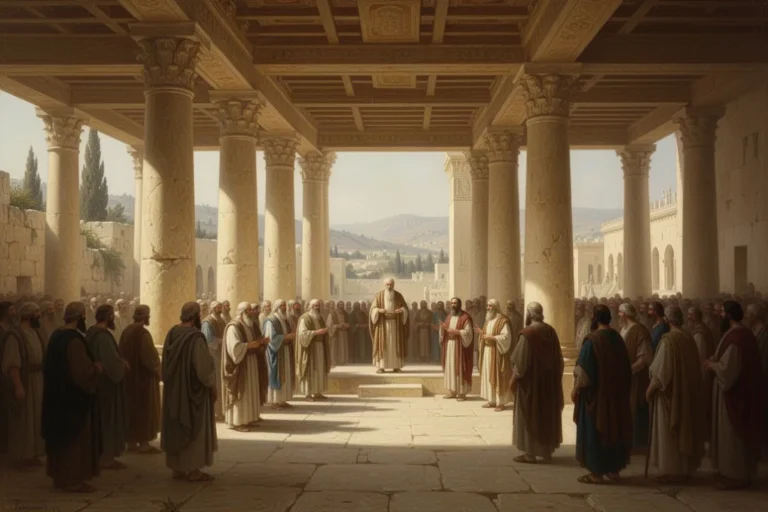
A portico is a roofed entrance or passage supported by columns. Solomon’s Portico was therefore a covered colonnade, not a separate temple building or an enclosed room. It likely offered shade and protection from rain while leaving the area open on one side or several sides to the temple courts.
The New Testament calls it “Solomon’s Portico” or “Solomon’s Porch,” depending on the English translation. The difference comes from translating the same basic architectural idea with different English terms. Portico emphasizes a columned walkway, while porch can sound like a smaller entrance attached to a house.
The Greek expression used in the New Testament is commonly transliterated as Stoa Solomonos, meaning the colonnade associated with Solomon. The biblical passages do not provide a complete architectural description. They identify the place by name and show how people used it, but they do not tell readers the exact number of columns, the dimensions, or the full arrangement of the surrounding structures.
The setting was the temple complex in Jerusalem during the period of the Second Temple. By the time of Jesus and the apostles, the temple complex had been greatly expanded and renovated under Herod the Great and later rulers. It contained courts, gates, covered walkways, and other spaces that supported worship, teaching, commerce, and public gathering.
Key distinction: Solomon’s Portico was associated with Solomon’s name, but the New Testament does not say that the visible colonnade in Jesus’ and the apostles’ time was an unchanged structure built by Solomon.
Why the portico was associated with Solomon
Solomon’s name naturally points back to Solomon’s temple, the first temple in Jerusalem described in the Hebrew Bible. Solomon ruled Israel after David and oversaw the construction of that temple. It was later destroyed by the Babylonians, and a second temple was built after the Jewish exiles returned.
The temple standing in the time of Jesus was not Solomon’s original temple. It belonged to the later Second Temple period, although it was extensively enlarged and improved under Herod. The name Solomon’s Portico may have preserved a tradition that this particular area, or an earlier colonnade in the same general location, survived from Solomon’s temple.
Ancient Jewish and Christian readers did not always use a building’s name in precisely the same way modern historians would. A structure could retain an older traditional name even after repairs, rebuilding, or major changes. The label may have pointed to a remembered location, an inherited architectural feature, or a belief that part of the original construction remained.
Several explanations have been suggested for the name:
An older surviving section: Some interpreters have proposed that the portico preserved part of an earlier temple structure.
A traditional location: The name may have referred to a place associated with Solomon even if the visible columns belonged to a later construction phase.
A remembered architectural tradition: The colonnade may have been understood as connected with Solomon’s temple without being entirely original.
A later designation: The name may have developed through local usage and continued during the temple’s later history.
The available evidence does not settle the question with complete certainty. Scripture gives the name but does not explain its origin. Archaeological remains from the temple complex also do not allow historians to identify a surviving section confidently as the exact portico mentioned in John and Acts.
That uncertainty does not affect the main biblical point. In the New Testament, Solomon’s Portico is a recognizable public area of the temple where people could encounter teachers, hear claims about Jesus, and observe the growing activity of his followers.
What happens at Solomon’s Portico in the Gospel of John
John 10:23 places Jesus at Solomon’s Portico during the Festival of Dedication, commonly known as Hanukkah. The passage says that Jesus was walking in the temple area, in Solomon’s Portico, when some Jewish leaders gathered around him and questioned him about whether he was the Messiah.
This scene presents the portico as a place where Jesus could be approached in public. The conversation was not a private exchange in a distant room. It took place in the temple setting, among people who knew the importance of the location and the religious questions being discussed.
Jesus’ response in John 10 connects his identity with his relationship to the Father and with the care he gives to his “sheep.” The passage also describes conflict over his claims. Some listeners accuse him of blasphemy because they understand his words as making himself equal with God. Others struggle to explain the signs associated with his ministry.
The location contributes to the meaning of the scene. The temple was central to Jewish worship and national memory. Meeting there during the Festival of Dedication placed the discussion within a setting shaped by themes of holiness, restoration, faithfulness, and opposition to forces that threatened the temple’s proper use.
John does not say that Jesus delivered a long sermon at Solomon’s Portico on this occasion. Instead, the portico serves as the place where an important confrontation occurs. It shows that Jesus’ identity was being debated openly in a setting where religious authority and public expectation were especially strong.
John 10:23 locates Jesus in the temple at Solomon’s Portico while he is questioned about his identity and mission.
The passage also helps explain why a covered colonnade mattered in the ancient city. It was suitable for movement, conversation, and gathering. A teacher could be seen and approached there, while listeners could remain near the central temple courts without entering a private house or a restricted inner area.
How Solomon’s Portico features in Acts
Solomon’s Portico appears twice in Acts, and both references connect the space with the public ministry of the apostles. The first occurs after Peter and John encounter a man who had been unable to walk from birth. The second describes the believers gathering there as the apostles performed signs and wonders.
Peter and John after the healing at the temple
In Acts 3, Peter and John go to the temple at the time of prayer. At the temple gate, they meet a man who asks them for money. Peter tells him that he does not have silver or gold to give, but he commands him in the name of Jesus Christ to walk. The man is healed and enters the temple with them, walking, leaping, and praising God.
The crowd reacts with amazement because the man was known to them. Acts then says that he holds on to Peter and John at Solomon’s Portico, where the people gather around them. Peter uses the moment to address the crowd and explain that the healing did not come from the apostles’ own power or godliness.
Peter directs attention to Jesus’ death and resurrection. He explains that the God of Abraham, Isaac, and Jacob has glorified Jesus, whom the people had rejected. He also connects the event with the prophets and calls the listeners to turn back to God.
Solomon’s Portico is significant here because the healing becomes a public sign. The man is not hidden away, and the apostles do not treat the event as a private experience. The gathering at the portico creates an opportunity for witnesses to hear an explanation of what happened.
The account does not require the reader to imagine every person in the temple complex standing in one tightly packed group. The temple area was large and active, and the text focuses on the crowd that gathered around Peter, John, and the healed man. The portico provided a recognizable place for that assembly.
The believers gathering together
Acts 5:12 says that many signs and wonders were being performed through the apostles, and that the believers were together in Solomon’s Portico. The verse presents the portico as a regular or at least important meeting place for the early Christian community in Jerusalem.
This gathering took place in a public temple environment rather than in an exclusively private Christian building. The earliest followers of Jesus were Jewish men and women living in Jerusalem, and the temple remained a central place of prayer and public religious life for them. Their presence there shows that the movement was proclaiming the fulfillment of God’s promises within Israel’s story.
Acts also describes a mixed public reaction. People respected the believers, while others were reluctant to join them openly. At the same time, many men and women came to faith. The portico therefore became associated with both public visibility and social tension.
The wording in Acts does not mean every believer lived at the temple or that the community used Solomon’s Portico as a permanent residence. Other passages describe believers meeting in homes and sharing life in different settings. The portico was one important public location among several places where the early church prayed, taught, ate, and testified.
Reading Acts carefully: Solomon’s Portico was a meeting place for public ministry, but it was not the apostles’ headquarters or a Christian church building in the later institutional sense.
Where Solomon’s Portico may have been located
The New Testament places Solomon’s Portico within the temple complex, but it does not give enough information to reconstruct its exact position with absolute certainty. Many historians and interpreters associate it with the eastern side of the temple platform, often connecting it with a covered walkway along the outer edge of the complex.
This proposed location fits several features of the biblical accounts. A covered walkway on the eastern side would have been part of the larger temple precinct, accessible to crowds, and suitable for shelter from the weather. It would also have allowed people to gather near the temple without entering the areas reserved for specific religious functions.
The temple complex was not a single compact room. It included open courts and colonnades, and access varied according to the area and the person entering. The outer courts could accommodate large numbers of visitors, while inner areas had more restricted access. Solomon’s Portico should be understood within this layered arrangement.
Some ancient sources describe the temple’s colonnades and retaining walls, but they do not remove every uncertainty about the portico named in the New Testament. Descriptions of the Herodian temple must be handled carefully because different writers may emphasize different sections, use different names, or describe structures from different periods.
The Royal Stoa, a large colonnaded building associated with the southern part of Herod’s temple platform, is sometimes confused with Solomon’s Portico. They should not automatically be treated as the same place. The names refer to different traditions, and the New Testament does not identify Solomon’s Portico as the Royal Stoa.
Likewise, modern drawings and models of the temple can be useful for visualizing the setting, but they often include reconstructions that go beyond what the biblical text directly states. A responsible explanation distinguishes between:
What Scripture explicitly says: Jesus and the apostles were in a place called Solomon’s Portico within the temple area.
What the name suggests: It was a covered, column-supported passage or gathering space associated with Solomon.
What historical reconstruction proposes: It may have stood along the eastern side of the temple platform.
What remains uncertain: Its exact dimensions, appearance, construction history, and relationship to earlier structures.
Jerusalem’s later destruction and rebuilding also complicate the investigation. The temple was destroyed by Roman forces in A.D. 70, and the surviving archaeological landscape does not preserve the entire Herodian complex in its original form. This is why location discussions often use phrases such as “probably” or “commonly identified with,” rather than presenting a precise map coordinate as certain.
Why Solomon’s Portico matters for understanding the New Testament
Solomon’s Portico helps readers see that the events in John and Acts occurred in concrete public places. Jesus was not speaking in an undefined religious setting, and the apostles were not carrying out their earliest ministry in isolation. Their words and actions were heard and observed in the temple environment of Jerusalem.
The portico also illustrates the connection between space and public witness. A covered colonnade made it possible for people to gather, listen, ask questions, and respond. In John, the space frames a dispute about Jesus’ identity. In Acts, it frames an explanation of a healing and the visible growth of the Christian movement.
Its name links the New Testament setting with Israel’s older history. Solomon represented the first temple and the height of the united monarchy in biblical memory, while the temple of Jesus’ day stood in a later period marked by foreign rule, restoration, and expectation. The traditional name therefore carried historical and religious associations even if the physical structure had been rebuilt or altered.
The portico also shows that the first Christians remained connected to Jewish worship and Scripture during the earliest stage of the movement. Acts portrays the apostles praying at the temple, speaking about Israel’s God, and presenting Jesus as the one through whom God’s promises were being fulfilled. Their activity at Solomon’s Portico belongs to that setting.
For readers studying the Bible, the most balanced understanding is both specific and modest. Solomon’s Portico was a real covered colonnade in the Jerusalem temple complex. It was a public gathering place used in accounts about Jesus and the apostles. Its exact appearance and history are less certain, and the text does not support claims that go beyond those limits.
When you encounter the name, picture an open-sided, roofed walkway supported by columns, located within the busy temple precinct. Imagine people moving through the area, worshipers gathering, teachers being questioned, and crowds listening to testimony. That setting captures why Solomon’s Portico matters: it was a visible meeting place where questions about Jesus were raised and answered in public.
Frequently asked questions
Is Solomon’s Portico the same as Solomon’s Temple?
No. Solomon’s Temple was the first temple in Jerusalem, built during Solomon’s reign and later destroyed. Solomon’s Portico was a colonnaded walkway in the temple complex that existed during the time of Jesus and the apostles. Its name may have preserved a connection with Solomon or an earlier temple tradition, but the New Testament does not identify it as the original temple itself.
Where is Solomon’s Portico mentioned in the Bible?
It is mentioned in John 10:23 and in Acts 3:11 and 5:12. John places Jesus there during a discussion about his identity at the Festival of Dedication. Acts describes the area as a gathering place after the healing of a man at the temple and as a public meeting place for the early believers.
Did Jesus teach regularly at Solomon’s Portico?
The Bible specifically places Jesus at Solomon’s Portico in John 10:23, where he is approached and questioned by Jewish leaders. That passage does not say it was his regular teaching location. Acts clearly associates the portico with public apostolic ministry, but the New Testament does not provide a complete schedule of Jesus’ activities there.
Can visitors see Solomon’s Portico today?
The original temple complex was destroyed in A.D. 70, so the portico is not preserved as an intact, clearly identifiable structure that visitors can simply enter. Some proposed locations relate to surviving sections of Jerusalem’s temple platform, but the exact remains cannot be identified with certainty as the Solomon’s Portico named in the New Testament.








Leave a Reply