Seraph definition: Meaning, biblical context, and symbolism
Seraph definition: Meaning, biblical context, and symbolism
If you have seen a painting of an angel with six wings and wondered what kind of angel it represents, you may have encountered a seraph. In the Bible, a seraph is a heavenly being most clearly described in Isaiah’s throne-room vision, where seraphim surround God, proclaim his holiness, and participate in the prophet’s purification.
The basic seraph definition is “a fiery or burning heavenly being.” The word comes from a Hebrew root associated with burning, and its plural form is seraphim. Seraphim are not simply another word for every angel in the Bible. They are a particular class or type of heavenly being connected with God’s presence, reverence, fire, and worship.
Short definition: A seraph is a heavenly being described in Isaiah 6 as having six wings and serving before God’s throne. The plural is seraphim, although “seraphs” is also used in English.
Seraph is the English singular form of a Hebrew word commonly transliterated as śerāph or saraph. Its connection with a verb meaning to burn explains why translations and commentators often describe seraphim as “burning ones” or fiery beings.
The word’s meaning is tied to more than physical flame. Fire can represent holiness, judgment, power, and purification in biblical imagery. A seraph therefore evokes a being associated with the overwhelming holiness of God rather than a pleasant, humanlike figure with wings.
The singular and plural forms can be confusing because biblical Hebrew uses a different plural ending from ordinary English:
Seraph refers to one being.
Seraphim refers to two or more beings.
Seraphs is an acceptable English plural, though “seraphim” is more common in religious writing.
English also uses seraphic as an adjective. It can mean “related to a seraph” or describe someone or something exceptionally angelic, pure, or radiant. That figurative use comes from the biblical image, but it does not add a separate biblical definition.
Where seraphim appear in the Bible
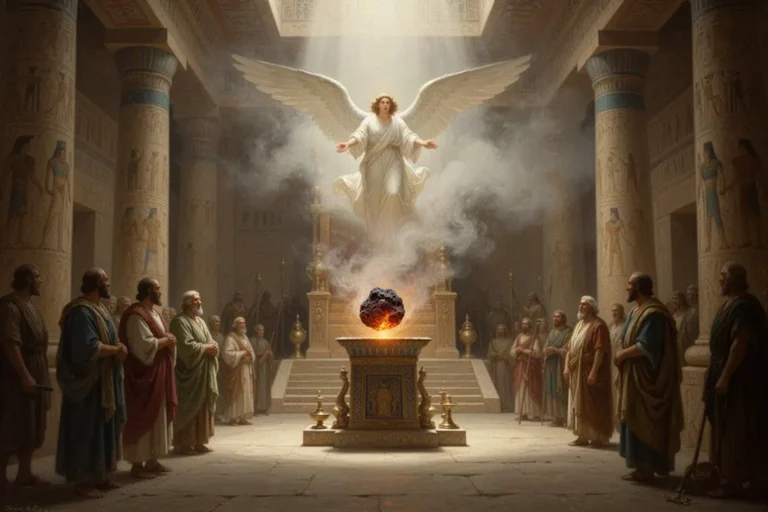
The clearest biblical description of seraphim appears in Isaiah 6:1–7. Isaiah sees the Lord seated on a high throne, with the edges of the divine robe filling the temple. Above or around the throne are seraphim, each with six wings.
Isaiah describes the wings as serving different purposes. Two cover the seraph’s face, two cover its feet, and two are used for flight. The arrangement communicates reverence and humility in the presence of God. Even these powerful heavenly beings do not present themselves casually before the divine throne.
The seraphim call to one another, proclaiming the holiness of the Lord and declaring that the whole earth is filled with his glory. Their worship causes the temple to shake and fills it with smoke. The scene presents the seraphim as active participants in a heavenly liturgy rather than silent decorations surrounding a throne.
One seraph then takes a live coal from the altar and touches Isaiah’s mouth. The act responds to Isaiah’s confession that he is unclean and lives among people who are unclean. The seraph announces that Isaiah’s guilt has been removed and his sin atoned for, preparing him for the prophetic commission that follows.
Isaiah 6 presents the seraphim as proclaimers of divine holiness and agents in the prophet’s purification.
Outside Isaiah 6, the Bible does not provide a long series of narratives about seraphim. The term appears in other passages in a different context, especially in references to fiery serpents. This is one reason the word can be difficult to define using only a simple picture of an angel.
How seraphim relate to fiery serpents
In several Old Testament passages, a form of the same Hebrew root is associated with serpents described as fiery or poisonous. Numbers 21, for example, describes the Israelites being afflicted by fiery serpents in the wilderness. Moses is instructed to make a bronze serpent, which becomes a means of healing when the people look at it.
Similar language appears in passages such as Deuteronomy 8:15 and Isaiah 14:29. In these contexts, the word does not plainly describe winged heavenly beings. It refers to serpentine creatures, with “fiery” potentially describing their venom, appearance, or frightening effect.
This creates an important distinction. The Hebrew term behind seraph can be connected with both fiery serpents and the heavenly beings in Isaiah 6, but the passages do not necessarily mean that the seraphim in Isaiah are ordinary snakes with wings. The shared language points to an association with burning or fiery qualities, while the context determines the creature being described.
Some readers connect Isaiah’s seraphim with serpent imagery because of this vocabulary and because ancient religious art sometimes portrayed supernatural beings with animal features. That is a possible area for study, but the biblical passage itself focuses on the seraphim’s wings, worship, and role in purification, not on giving a full zoological description.
Context matters: In Isaiah 6, seraphim are heavenly throne attendants. In some other Old Testament passages, related Hebrew terms describe fiery serpents. The same root does not make every reference identical.
What Isaiah’s seraphim do
The seraphim’s actions in Isaiah 6 reveal their role more clearly than the word alone. They are positioned near God’s throne, where they continually acknowledge divine holiness. Their worship is not a casual song in the background; it is the central response to the overwhelming reality of God’s presence.
They also serve as messengers and ministers. One seraph communicates the meaning of the altar coal to Isaiah, explaining that the prophet’s guilt has been taken away. This shows that the seraphim are not merely symbolic figures in the vision. They interact with Isaiah and carry out a divine purpose.
Their work can be understood through four connected functions:
Worship: They proclaim God’s holiness before the throne.
Reverence: Their covered faces and feet express humility before God.
Service: They respond to the needs of the heavenly vision and carry out an assigned task.
Purification: One seraph applies the altar coal as a sign that Isaiah’s guilt has been removed.
The passage does not say that every seraph performs each of these functions in every biblical reference. It does show that the seraphim in Isaiah are closely associated with holy presence and divine service. Their proximity to the throne does not make them independent divine beings; they remain servants who act within God’s authority.
Why seraphim have six wings in Isaiah 6
The six wings are among the most recognizable features of a seraph. Isaiah assigns each pair a distinct use: one pair covers the face, another covers the feet, and the final pair enables flight. The description emphasizes the seraph’s posture before God rather than supplying a complete physical portrait.
Covering the face can represent modesty or reverence. The seraph does not presume to look directly upon the divine glory. Covering the feet may likewise indicate humility. Biblical references to feet can sometimes function as a modest way of referring to the lower part of the body, so the gesture may communicate both respect and restraint.
The two wings used for flight show that worship and service are joined together. The seraphs are not frozen in one position. They proclaim holiness, respond to the altar, and move in obedience. Their wings therefore contribute to the vision’s sense of ordered activity around the throne.
Later artists have often arranged the six wings in symmetrical patterns, sometimes surrounding a face or a humanlike body. Those artistic conventions can help viewers recognize a seraph, but they are interpretations rather than a complete biblical portrait. Isaiah describes the wings and actions, while leaving many visual details unspecified.
How seraphim differ from cherubim and angels
Seraphim, cherubim, and angels are often grouped together in popular speech, but the Bible does not treat the terms as interchangeable. The word angel generally describes a messenger or heavenly servant, while seraphim and cherubim identify particular kinds of heavenly beings in specific passages.
Cherubim appear in places such as Genesis 3, where they guard the way to the tree of life, and Exodus 25, where cherubim are represented above the ark of the covenant. Ezekiel 1 and 10 also contain elaborate visions of living creatures associated with the divine chariot and throne. Their appearance and symbolism differ from Isaiah’s description of the seraphim.
The Bible uses the word angel in a broader way. Angels frequently deliver messages, protect, guide, or carry out judgment. Not every heavenly being described in Scripture is called an angel, and not every angel is called a seraph. Using “angel” as a general label may be understandable in conversation, but it can hide useful distinctions in the biblical text.
Later Christian writers developed more detailed systems for classifying heavenly beings. Some traditions place seraphim at the highest level of an angelic hierarchy because of their closeness to God’s throne. Such systems have influenced theology, poetry, music, and art, but they go beyond the limited direct descriptions found in the Bible.
For a careful reading, keep these points separate:
Seraphim: Six-winged throne attendants described especially in Isaiah 6.
Cherubim: Heavenly guardians or throne-associated creatures described in several biblical visions and sanctuary images.
Angels: Heavenly messengers or servants, a broader category in biblical language.
Archangels: A term used in some biblical and later Christian traditions for a chief or prominent angelic figure; it is not another name for seraphim.
What seraphim symbolize in religious interpretation
Seraphim are commonly interpreted as symbols of purity, burning devotion, and the holiness of God. Their fiery association suggests an intensity that is not merely emotional. In Isaiah’s vision, divine holiness exposes human uncleanness, and the altar coal represents cleansing that makes prophetic service possible.
Their worship also communicates that holiness is not a minor attribute among many. The repeated proclamation in Isaiah 6 places holiness at the center of the vision. The seraphim recognize what Isaiah initially struggles to comprehend: standing before God is an encounter with overwhelming moral and spiritual reality.
The altar coal adds another layer of meaning. Fire can destroy, but in this scene it also purifies and prepares. The coal does not become a magical object or an independent source of power. Its significance comes from the altar and from the divine declaration that follows its touch.
Many Christian interpreters therefore see the seraphim as an image of devotion joined to service. They worship God, respond to his presence, and participate in the restoration of a person called to serve. The vision does not present holiness as passive separation from the world; it leads to Isaiah’s willingness to accept a difficult mission.
Jewish and Christian readers may approach the passage with different traditions and interpretive emphases. The text itself remains the foundation: seraphim appear in a prophetic vision centered on God’s throne, human unworthiness, cleansing, and calling.
How the word seraph is used today
In modern English, seraph can be used in several related ways. Religious writing may use it for the biblical being in Isaiah 6. Poetry and literature may use it as a symbol of a radiant or exceptionally pure person. Some writers use “seraphic” to describe an angelic appearance, a high singing voice, or an expression of serene beauty.
These extended uses are metaphorical. Calling someone “a seraph” does not usually claim that the person is literally a six-winged heavenly creature. It invokes associations with brightness, purity, beauty, or spiritual intensity.
Because the word is less familiar than “angel,” it can also appear in names of fictional characters, religious music, fantasy settings, and works of art. Such uses may borrow only one aspect of the biblical image, such as fire or wings. To understand the original meaning, return to the biblical context rather than assuming that every modern depiction follows Isaiah closely.
Common mistakes when defining seraph
The word is easy to oversimplify. A few careful distinctions prevent the most common errors:
Do not define a seraph as any angel. Seraphim are a specific group of heavenly beings, especially associated with Isaiah 6.
Do not assume the Bible describes them as attractive humans with wings. Isaiah gives a symbolic throne-room vision, not the familiar modern image of a winged person.
Do not treat seraphim and cherubim as synonyms. Both are heavenly beings, but their biblical descriptions and roles differ.
Do not ignore the fiery-serpent meaning. Related Hebrew language is used for serpents in other passages, although those references need not identify the same beings as Isaiah’s seraphim.
Do not claim that six wings appear in every reference. The six-winged description comes specifically from Isaiah’s vision.
Do not confuse “seraphim” with a personal name. It is normally the plural noun for seraph, not the name of one particular angel.
Do not treat later angelic hierarchies as direct biblical descriptions. They are theological developments built from biblical imagery and later interpretation.
A precise definition can remain simple: a seraph is a fiery heavenly being described in Isaiah 6, where seraphim worship before God’s throne and one participates in Isaiah’s purification. The wider word family also refers to fiery serpents in certain Old Testament passages, so context determines the meaning.
How to explain seraph in one sentence
If you need a short explanation for a study group, classroom, sermon, or conversation, say: “A seraph is a heavenly being in Isaiah 6, pictured with six wings and associated with worship, God’s holiness, and the purification of Isaiah.”
If you need to explain the plural, add: “Seraphim is the plural of seraph.” If the discussion turns to other passages, clarify that related Hebrew terms also describe fiery serpents. This wording is brief enough for everyday use while preserving the most important biblical distinctions.
The image of the seraph ultimately directs attention away from the creature itself and toward the scene it serves. The seraphim proclaim holiness, bow in reverence, carry out an act of cleansing, and stand within a vision of divine glory. Their significance lies in what they reveal about God’s presence, human unworthiness, and readiness for service.
Frequently asked questions
Is a seraph an angel?
A seraph is a heavenly being, and many religious traditions describe seraphim as a type of angelic being. However, the Bible does not use “seraph” and “angel” as identical terms in every passage. Seraphim are specifically associated with the throne-room vision in Isaiah 6, while “angel” is a broader term often referring to heavenly messengers or servants.
What does seraphim mean?
Seraphim is the plural form of seraph. The word is commonly connected with a Hebrew root meaning “to burn,” so it is often explained as “burning ones” or “fiery ones.” In Isaiah 6, the seraphim are six-winged heavenly beings who worship before God’s throne and participate in Isaiah’s purification.
Are seraphim and cherubim the same?
No. Seraphim and cherubim are distinct kinds of heavenly beings in biblical descriptions. Seraphim appear most clearly in Isaiah 6, where they have six wings and proclaim God’s holiness. Cherubim appear in passages involving guardianship, sacred objects, and throne visions. Later religious art sometimes groups them together, but the biblical terms are not interchangeable.
What do the six wings of a seraph represent?
In Isaiah 6, two wings cover the seraph’s face, two cover its feet, and two are used for flying. The arrangement is generally understood as expressing reverence, humility, and readiness to serve. The passage does not provide a complete physical description, so later artistic portrayals should be treated as interpretations rather than exact biblical illustrations.




Leave a Reply