The stripping of the altars: what Eamon Duffy argues
The stripping of the altars: what Eamon Duffy argues
The Stripping of the Altars is Eamon Duffy’s influential history of the English Reformation and the religious culture it transformed. Published in 1992, the book argues that late medieval English Catholicism was not a hollow system waiting to disappear: it was a deeply practiced, locally supported form of Christianity sustained by prayer, ceremony, images, charity, and remembrance.
Duffy’s central claim is that the Reformation did not simply reveal widespread Protestant convictions. Instead, religious change was often imposed through royal policy, legislation, official visitation, and the removal or destruction of traditional worship. The “stripping” in the title refers both to the physical dismantling of churches and to the loss of an entire religious world.
The book examines English religious life from the late Middle Ages through the Tudor Reformation, concentrating on the years before, during, and after the break with Rome. Duffy uses parish records, churchwardens’ accounts, wills, devotional texts, images, monuments, and official inquiries to reconstruct what ordinary people did in and around their churches.
Rather than treating theology as something confined to priests and scholars, Duffy studies religion as a social and material practice. He asks how people prayed for the dead, marked feast days, funded candles, commissioned images, maintained church buildings, joined fraternities, and understood the Mass. These activities reveal beliefs that may not appear clearly in formal theological writing.
The book’s argument challenges an older picture of the Reformation as the natural victory of enlightened Protestantism over an exhausted medieval church. Duffy does not claim that every English person was equally devoted to traditional Catholicism, nor that the pre-Reformation church had no serious problems. He shows instead that religious dissatisfaction and religious attachment could exist at the same time.
Central idea: The Reformation changed English religion not only by altering doctrine, but also by removing the objects, ceremonies, institutions, and habits through which communities had expressed their faith.
Historical context before the English Reformation
Late medieval English parish life centered on the church building as a shared religious and social space. The building contained altars dedicated to saints, painted images, statues, screens, stained glass, memorials, and objects used in worship. These features were not merely decoration. They helped communicate biblical stories, honor saints, focus prayer, and connect local communities with the wider Christian tradition.
The Mass stood at the heart of worship, especially the belief that Christ was truly present in the Eucharist. People also participated in processions, blessings, prayers for the dead, pilgrimages, confession, penance, and the observance of the liturgical calendar. The religious year gave structure to community life through celebrations such as Christmas, Easter, Corpus Christi, and saints’ days.
Laypeople supported this system in practical ways. Churchwardens collected money for repairs and equipment, while parishioners left bequests for candles, anniversaries, prayers, and charitable purposes. Guilds and fraternities organized worship and mutual assistance. Wills frequently requested prayers for the deceased, showing that belief in purgatory and intercessory prayer remained meaningful to many people.
That evidence matters because the Reformation was often described as a movement that brought religion to a population previously excluded from meaningful participation. Duffy’s records suggest a more complicated reality. Parishioners were not passive spectators: they helped fund, organize, maintain, and adapt the religious life of their communities.
How Duffy builds his argument from parish evidence
Duffy’s method is one of the book’s most important features. Instead of relying only on royal proclamations or writings by leading reformers, he studies the ordinary administrative traces left by local churches. Those records can show what a parish purchased, repaired, removed, or continued to use.
His evidence includes:
Churchwardens’ accounts, which record spending on candles, vestments, repairs, images, bells, books, and other church needs.
Wills and probate records, which reveal requests for burial, prayers, religious bequests, and memorial observances.
Inventories, which list sacred objects before or after official changes.
Visitation records, which show what bishops and commissioners inspected, condemned, or ordered parishioners to change.
Devotional books and popular literature, which provide evidence about prayer, saints, morality, and the afterlife.
Surviving church interiors, monuments, fragments, and architectural features, which preserve physical evidence of medieval worship and its destruction.
These sources do not provide a perfect transcript of personal belief. A churchwardens’ account, for example, may show that a parish bought a candle but not precisely what every parishioner thought about that candle. Duffy uses the records cumulatively. Repeated patterns across different kinds of evidence make a stronger case than any single entry would.
Duffy presents English religious change as a series of disruptions rather than one clean event. The process unfolded across several reigns, and policies changed direction more than once. A useful way to follow the transformation is to trace the major stages.
Late medieval Catholic practice: Parishes maintained a layered religious culture of Masses, saints’ cults, images, prayers for the dead, charitable foundations, and seasonal ceremonies.
Royal supremacy under Henry VIII: The Crown broke with papal authority and dissolved the monasteries, but did not immediately create a consistently Protestant religious system in every parish.
Edward VI’s Protestant reforms: More radical measures restricted traditional worship, replaced the Latin Mass, removed images, suppressed chantries, and altered church interiors.
Mary I’s restoration: Traditional Catholic worship was restored for a short period, demonstrating that the earlier changes had not automatically erased Catholic practice or memory.
Elizabethan settlement: Protestant worship and royal control were re-established, with further pressure against traditional Catholic observance and a new religious identity for the English church.
Long-term adjustment: Parishioners gradually adapted to new services, doctrines, furnishings, and expectations, while some older practices survived privately or in altered form.
This sequence prevents a common misunderstanding. Henry VIII’s break with Rome, Edward VI’s Protestant reforms, Mary’s Catholic restoration, and Elizabeth’s settlement were related but distinct developments. The meaning of a church’s changes depended on which monarch ruled, what officials required, and how local people responded.
Why images and church furnishings mattered
One of Duffy’s strongest themes is the religious importance of material objects. Medieval Christians encountered faith through visible and physical forms: crucifixes, statues, wall paintings, rood screens, stained glass, altars, relics, vestments, bells, candles, and books. These objects helped shape attention and memory during worship.
Reformers often criticized such objects as distractions, superstitious aids, or violations of biblical teaching. Some objected to the honor given to saints’ images; others rejected the idea that physical things could mediate divine grace. In response, reforming authorities ordered the destruction, concealment, or removal of many traditional features.
For the people who had funded those objects, their removal could feel like more than a change in interior design. A statue might have been associated with a guild, a family donation, a local miracle, or generations of prayer. A chantry altar could represent an ongoing obligation to remember a deceased parent or benefactor. A painted screen could organize the visual focus of the entire church.
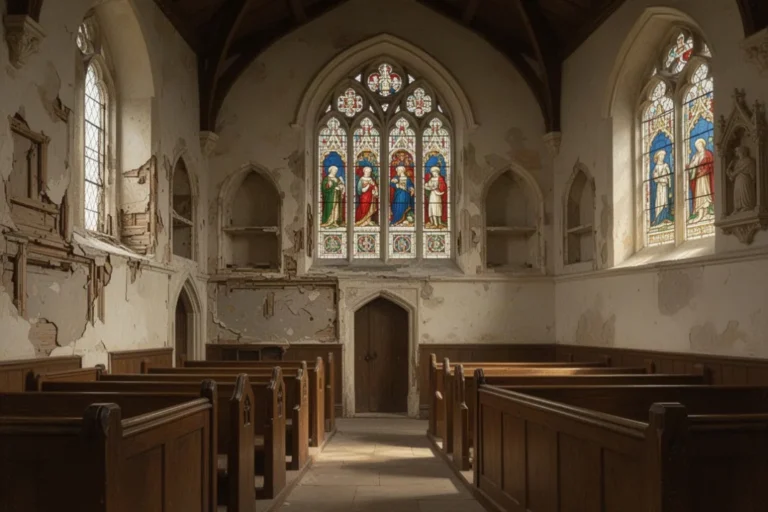
“Stripping” therefore describes a physical and emotional rupture. The altered church looked different, sounded different, and directed worship differently. Empty niches, whitewashed walls, removed altars, destroyed books, and silent chantry chapels made doctrinal change visible in everyday surroundings.
Prayer for the dead and the loss of purgatory
Prayer for the dead is central to Duffy’s account because it linked theology, family memory, charity, and parish institutions. Medieval Christians commonly believed that the souls of the dead might need purification before entering heaven. Living people could assist them through Masses, prayers, almsgiving, and other good works.
This belief helped explain the growth of chantries and commemorative foundations. A chantry priest might be supported to celebrate Masses for a benefactor’s soul. A family could leave money for a priest, candles, or charitable distributions. These arrangements created a continuing relationship between the living and the dead within the parish.
Protestant reformers rejected purgatory and condemned many associated practices. Once prayers for the dead were declared ineffective or unscriptural, the institutional structures built around them became vulnerable. Chantries were dissolved, memorial obligations were interrupted, and the religious purpose of certain altars disappeared.
The change affected more than clerical income. It altered the way people understood memory, responsibility, grief, and the afterlife. A parish church had been a place where the dead remained spiritually present through names, tombs, anniversaries, and regular prayer. Reform removed much of that framework.
How ordinary parishioners responded
Duffy does not portray local people as responding in one uniform way. Some welcomed reform, especially where dissatisfaction with clergy, religious images, or traditional practices already existed. Others resisted openly, quietly preserved older customs, or complied outwardly while continuing to value Catholic beliefs.
Active support for Protestant preaching, English services, scripture reading, and the removal of images.
Practical compliance with official orders while privately retaining older prayers or devotional habits.
Passive resistance, such as delaying the removal of objects, hiding books, or failing to carry out instructions promptly.
Open opposition to changes in worship, particularly when reform threatened local traditions or communal rights.
Adaptation over time, as younger generations became familiar with new services and religious language.
Resistance was not always a simple defense of every medieval practice. Parishioners could object to one reform while accepting another. They might oppose the destruction of an image because it belonged to the community, yet accept changes to clerical discipline or preaching. Local reactions were shaped by economics, social tensions, family loyalties, regional traditions, and the strength of official enforcement.
The short Catholic restoration under Mary I is especially significant. It showed that the religious culture removed under Edward VI could be reintroduced, at least temporarily. Vestments, altars, Latin worship, images, and traditional ceremonies returned in many places. The restoration also demonstrated how quickly religious policy could change when authority changed at the top.
The role of government and official enforcement
The English Reformation was not simply a debate among theologians. It was driven to a considerable extent by the power of the Crown and the state. Royal injunctions, parliamentary statutes, episcopal visitations, commissioners, and local officials translated religious policy into practical orders for parishes.
Churchwardens were often placed in a difficult position. They had to account for objects that had been purchased by parishioners and maintained through local funds, while also carrying out instructions that could require their sale or destruction. Their records may show both cooperation and reluctance, including payments for removing images or storing materials that had previously been displayed.
Official language also shaped the meaning of reform. Traditional objects might be labeled superstitious, idolatrous, or abused. Once that language became authoritative, a statue that had represented a saint’s intercession could be reclassified as an unlawful image. The change was not merely visual; it changed what the object was allowed to mean.
Read the records carefully: An item’s disappearance from an inventory proves that it was removed, but not always why parishioners accepted, opposed, or emotionally experienced its removal. Duffy’s broader argument comes from comparing many kinds of evidence.
What Duffy challenges in older Reformation histories
Earlier accounts often treated the Reformation as a story of progress from medieval superstition toward modern religious or national consciousness. In that version, Catholic practices were frequently described as empty formalism, while Protestant reformers represented a more sincere and intellectually advanced faith.
Duffy questions that narrative on several grounds. First, he argues that it can mistake the later success of Protestantism for proof that Protestant ideas were already dominant. Second, it tends to focus on prominent leaders rather than parish communities. Third, it may judge medieval religion by Protestant assumptions instead of asking what its practices meant to the people who used them.
His approach is not an argument that medieval religion was perfect. Clerical misconduct, disputes over money, uneven education, and criticism of religious institutions all existed. The point is that criticism should not be confused with total rejection. A church could face complaints while still providing a framework that people valued.
The book also broadens the definition of religious evidence. Architecture, household objects, wills, inventories, and financial records can reveal religious commitment just as sermons and theological treatises can. This makes the history of the Reformation more local, tangible, and socially complex.
Why the title refers to more than altars
Altars are the most visible symbol of the transformation, but Duffy’s subject is much larger. The stripping affected the whole structure of parish religion: its calendar, language, music, images, sacred spaces, commemorative practices, and relationship with the dead.
The title captures a process in which traditional meanings were dismantled layer by layer. The altar represented the Mass; the image supported devotion; the chantry sustained prayers for the dead; the guild organized collective religious life; the feast day connected worship to the community’s annual rhythm. Removing one feature could weaken the institutions and habits connected with it.
At the same time, the title should not be read as evidence that every church was stripped in exactly the same way. Timing, local wealth, regional politics, and the zeal of officials varied. Some medieval objects survived because they were overlooked, hidden, reused, or later valued for artistic reasons. Others vanished completely.
How to understand the book’s historical significance
The Stripping of the Altars remains important because it changed the questions historians ask about religious change. Instead of asking only which doctrine won, readers can ask what happened to buildings, objects, families, charities, memories, and daily routines.
It also demonstrates the value of studying religion from the ground up. A royal law may announce a sweeping transformation, but parish records show how that transformation entered real communities. They reveal delays, negotiations, local priorities, and the practical work required to make a new religious order visible.
The book’s influence extends beyond Tudor history. Its method can be applied to other cases in which governments or religious authorities change public worship. When examining such a transformation, consider:
Who created and paid for the religious objects being removed?
What beliefs and social relationships did those objects support?
How quickly did official instructions reach local communities?
Did people resist, adapt, or combine old and new practices?
What evidence survives from ordinary households and parishes?
Which later accounts may have simplified or idealized the change?
These questions keep the focus on lived religion rather than on official policy alone. They also explain why the book is more than a narrative of church destruction. It is an examination of how a society’s understanding of worship and community can be reshaped through changes to familiar places and practices.
What readers should remember about Duffy’s interpretation
Duffy’s main contribution is his insistence that pre-Reformation English religion deserves to be taken seriously on its own terms. Late medieval Catholicism was not simply a collection of superstitions waiting for correction. It was an organized and participatory culture with its own theology, emotional force, artistic language, and social institutions.
The Reformation then did more than replace Latin with English or the pope with the Crown. It changed the relationship between worship and material culture, reduced the religious role of saints and the dead, redirected authority toward scripture and preaching, and created new expectations for parish behavior.
The result was not an instant transformation. It was a prolonged process of destruction, restoration, enforcement, adaptation, and memory. That complexity is why The Stripping of the Altars remains a useful guide to the English Reformation: it shows that religious change is experienced not only in beliefs, but also in the things people see, hear, touch, fund, remember, and lose.
Frequently asked questions
Who wrote The Stripping of the Altars?
The book was written by Eamon Duffy, a historian of Christianity and the English Reformation. It was first published in 1992 and became widely known for challenging older interpretations that portrayed late medieval Catholicism as stagnant or broadly rejected before Protestant reform arrived.
Does Duffy argue that every English person opposed the Reformation?
No. Duffy presents a varied picture of local responses. Some people supported Protestant changes, some resisted them, and others adapted outwardly while retaining older beliefs. His argument is that historians should not assume that official reform automatically reflected the religious convictions of every parishioner.
What does “stripping” mean in the book’s title?
The term refers to the removal or destruction of altars, images, statues, books, vestments, chantries, and other features of traditional worship. It also suggests the wider loss of practices connected to saints, the Mass, prayers for the dead, and the visual character of medieval parish churches.
Is The Stripping of the Altars suitable for someone new to Tudor history?
Yes, although it is a substantial scholarly work with extensive historical detail. A new reader can follow its main argument by focusing on the contrast between late medieval parish religion and the reforms introduced under Henry VIII, Edward VI, Mary I, and Elizabeth I.








Leave a Reply