If you have seen the title Who Moved the Stone?, you may wonder whether Frank Morison was a real person, a fictional character, or simply another name for the book’s publisher. Frank Morison was the pen name of Albert Henry Ross, an English writer who examined the evidence surrounding Jesus’ death, burial, and reported resurrection.
Ross published Who Moved the Stone? in 1930. He reportedly began the project intending to challenge the resurrection accounts, but his investigation led him to accept the resurrection as the best explanation of the evidence. The book became a widely read work of Christian apologetics, although its arguments remain debated and should be distinguished from established historical facts.
Frank Morison was the literary name of Albert Henry Ross. Public information about Ross’s private life is limited, and many popular accounts repeat the same basic story without supplying much independent biographical detail. He is generally described as an English writer or advertising professional rather than as a trained academic historian or New Testament scholar.
The name “Frank Morison” appeared on the cover of Who Moved the Stone?, which helped give the book a distinct public identity. Some readers assume Morison was a separate author because the book’s title page and later references commonly use that name. In practice, Frank Morison and Albert Henry Ross were the same person.
Ross’s background matters because his book was not written as a technical work of modern biblical scholarship. He approached the Gospel narratives as a reader testing a historical case. His method was shaped by questions about sequence, motive, testimony, and probability. He wanted to ask what explanation best accounted for the events described in the New Testament.
Accounts of Ross’s conversion often present a dramatic version of his story: he supposedly set out to write a short argument against Christianity, then found that the evidence for the resurrection changed his mind. The broad outline is associated with the book’s famous opening section, but the details of his personal journey are not documented as fully as the popular retellings suggest.
A useful distinction: the claim that Ross became a Christian through his investigation is a biographical and interpretive account, while the historical arguments in Who Moved the Stone? must be assessed separately.
That distinction helps prevent two common mistakes. One is to dismiss the book because its author was not an academic historian. The other is to treat Ross’s personal change of belief as proof of the resurrection by itself. A person’s conversion may explain why a book was written, but it does not settle the historical question.
What Who Moved the Stone? tries to explain
The book focuses on the events connected with the first Easter morning, especially the report that Jesus’ tomb was found open and empty. Its central question is simple: what happened to Jesus’ body? Ross examines the burial accounts, the discovery of the empty tomb, the conduct of Jesus’ followers, and the reports that Jesus appeared alive afterward.
Ross does not treat the resurrection as an isolated religious statement. He presents it as the explanation of a group of connected claims. In simplified form, the evidence he considers includes:
Jesus died by crucifixion and was placed in a tomb associated with Joseph of Arimathea.
Women followers discovered the tomb open and reported that Jesus’ body was missing.
The disciples came to believe they had encountered Jesus alive after his death.
The early Christian movement began in Jerusalem, the place where Jesus had been executed and buried.
The Gospel accounts do not tell the story in identical language or with exactly the same arrangement of details. Ross treats those differences as clues to investigate rather than automatically as evidence that the entire account is false. He tries to reconstruct a plausible sequence behind the four narratives.
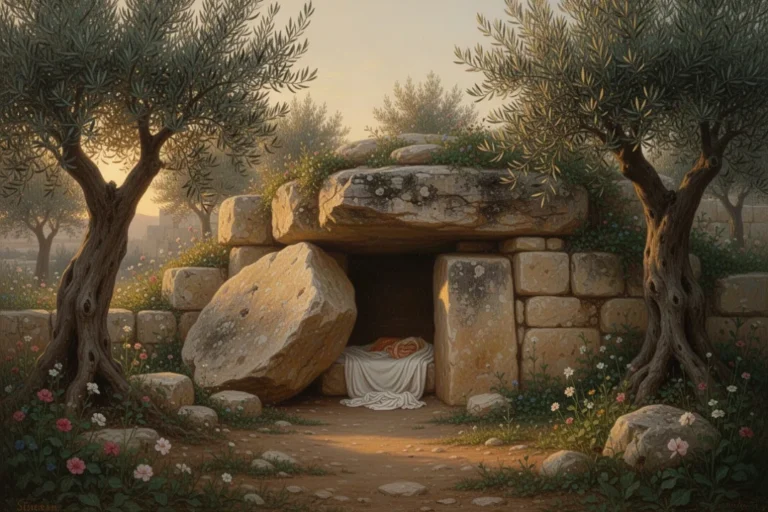
The title’s stone refers to the large stone associated with the tomb entrance. The question is not merely who physically rolled it away. Ross is asking which explanation accounts for the stone’s movement, the empty burial place, the behavior of the disciples, and the rise of resurrection faith more convincingly than its alternatives.
His approach is similar to a legal or detective investigation in one respect: he compares competing explanations. That approach can make the book accessible to general readers, but it also has limits. Historical events are not crime scenes with surviving physical evidence that can be tested in a laboratory. The available material consists mainly of ancient texts and later historical inferences.
The book examines several explanations that have been offered instead of a bodily resurrection. Ross asks whether each theory fits all the known details or leaves major questions unanswered. His argument generally favors an explanation that can account for the empty tomb and the disciples’ conviction together.
Among the possibilities he considers are:
The wrong-tomb theory: perhaps the women and later the disciples went to the wrong burial place.
The swoon theory: perhaps Jesus was still alive when placed in the tomb and later escaped.
The theft theory: perhaps disciples, authorities, or another person removed the body.
The hallucination theory: perhaps the disciples experienced visions or psychological impressions rather than encounters with a risen Jesus.
A deliberate story or legend: perhaps the resurrection accounts developed later without a genuine empty tomb or appearances.
Ross argues that each alternative has serious weaknesses. He therefore concludes that the resurrection offers the most coherent explanation of the evidence. That is the book’s basic apologetic case.
Why the empty tomb is central to Morison’s case
For Ross, the empty tomb is more than a dramatic detail. It connects the burial of Jesus with the later proclamation that he had risen. If Jesus’ body had remained in the tomb, a claim of resurrection could have been challenged in the same city where the execution and burial occurred.
Ross gives special attention to the fact that the first discoverers in the Gospel narratives are women. In the social setting of the first century, women’s testimony was often given less public weight than men’s testimony. Ross reasons that if someone were inventing a story to make it persuasive, choosing women as the initial witnesses might seem an unlikely strategy.
That argument is still used by Christian apologists, but it is not decisive on its own. Ancient authors could preserve a tradition because they believed it was true, because the detail was remembered, or because it served a narrative purpose. The presence of women at the tomb may support the authenticity of a tradition for some readers, but it does not independently prove the resurrection.
Ross also considers the condition of the tomb. The accounts describe the stone as moved and the body as absent, with details about burial cloths in some passages. He argues that this picture is difficult to explain through simple theft. A thief would have had to enter the tomb, remove the body, and leave the burial arrangements in a way that did not fit an ordinary hurried removal.
Critics respond that the Gospel descriptions are not detailed enough to establish exactly what the burial cloths looked like or how the tomb was arranged. The narratives also differ in their presentation of the visitors, messengers, and sequence of events. The argument from the empty tomb therefore depends on judgments about the reliability and dating of the sources.
Read the claim carefully: Ross argues that the empty tomb is historically significant; he does not provide modern physical evidence from the tomb itself. The case depends on interpreting ancient testimony.
The identity of the tomb also matters. The Gospels connect it with Joseph of Arimathea, a named figure who is presented as a member of the council involved in Jesus’ condemnation. Ross suggests that a known burial place would make a false claim easier to expose. If opponents could point to Jesus’ body, the resurrection proclamation would have faced an immediate obstacle.
That reasoning assumes that the Gospel burial account is historically reliable and that the tomb’s location was known to the relevant groups. Some scholars accept parts of this argument, while others question whether the burial traditions can be established with the same confidence. The debate is not settled simply by repeating the empty-tomb story; it depends on how each source is evaluated.
How Morison answers alternative explanations
The strength of Who Moved the Stone? lies in its sustained comparison of competing theories. Ross wants the reader to see that denying the resurrection is not the same as explaining the evidence. A substitute theory must account for the empty tomb, the disciples’ belief, and the subsequent Christian proclamation.
The wrong-tomb explanation
The wrong-tomb theory proposes that the women went to an incorrect location and mistakenly concluded that Jesus had risen. Ross argues that this would not explain why the disciples later came to believe in resurrection or why opponents did not simply produce Jesus’ body. The theory also depends on several people making or maintaining the same mistake.
The weakness in the argument is that our knowledge of the tomb’s exact location is limited. The Gospel writers do not provide a modern map or independently verifiable site. A wrong-tomb theory may be unlikely, but historical analysis cannot reject it merely by assuming that everyone knew the location precisely.
The swoon explanation
The swoon theory says that Jesus survived crucifixion, recovered inside the tomb, moved the stone, and persuaded his followers that he had conquered death. Ross considers this implausible because a person severely injured by crucifixion would not be expected to escape from a sealed tomb and appear as a triumphant conqueror.
Most modern historians agree that Jesus’ death by crucifixion is one of the strongest points in the historical background. The question is not only whether survival was medically possible in the abstract. It is whether survival fits the circumstances described and explains the disciples’ belief better than other options.
The stolen-body explanation
Ross evaluates the possibility that the disciples stole Jesus’ body and then announced a resurrection. He argues that the disciples had little obvious reason to create a story that could expose them to hostility and danger. He also considers whether the disciples’ later behavior appears consistent with deliberate fraud.
That line of reasoning has limits. People can act from many motives, including sincere but mistaken belief, group pressure, religious expectation, or a desire to preserve a leader’s legacy. A person’s willingness to suffer does not prove that every claim they make is true, although it may indicate that they were convinced of their message.
The vision or hallucination explanation
Ross questions whether private visions can explain the reported encounters, especially when the tradition includes appearances to groups. He argues that hallucinations are usually individual experiences and would not account for an empty tomb. From his perspective, the appearance reports and the missing body are stronger when considered together.
Modern discussion is more cautious about using the word “hallucination” as a complete explanation. Bereavement experiences, religious visions, collective interpretation, and memory formation are complex subjects. A psychological explanation might address some appearance reports, but it still has to explain how the empty-tomb tradition originated and why it became central.
Ross’s larger point is cumulative: no single alternative satisfies every part of the case. Readers who accept his conclusion usually find the combined argument persuasive. Readers who reject it often challenge the reliability of the sources or argue that the evidence is too limited to support a supernatural conclusion.
What historians can and cannot establish about the resurrection
Who Moved the Stone? is best understood as an apologetic work, not as a neutral account accepted by every historian. It raises serious historical questions, but its conclusion also depends on a philosophical judgment: whether a miracle is a possible explanation of historical evidence.
Historians can investigate claims such as these:
Jesus was crucified under Roman authority.
His followers soon proclaimed that he had risen.
Some of his followers believed they had seen him alive after his death.
The Christian movement developed rapidly in the setting of first-century Judaism.
Early Christian preaching centered on Jesus’ death and resurrection.
These points do not automatically establish that a supernatural resurrection occurred. Historical method normally compares natural explanations using evidence from texts, context, chronology, and testimony. A miracle claim involves an additional judgment about whether God acted in a unique event.
That is why two thoughtful readers can agree on much of the historical background and still reach different conclusions. One reader may say that the resurrection best explains the evidence. Another may accept the disciples’ sincere belief but remain uncertain about what caused it. A third may regard the Gospel accounts as too late, too shaped by theology, or too internally varied to establish the event.
The dating and relationship of the New Testament sources are central to this debate. Paul’s letters are earlier than the written Gospels and include traditions about Jesus’ death, burial, resurrection, and appearances. The Gospels provide fuller narratives, but scholars continue to debate their precise dates, sources, editorial shaping, and relationship to one another.
Ross writes for readers who are willing to treat the Gospel narratives as substantially reliable historical testimony. His conclusions are therefore stronger for readers who already share that starting point. Readers approaching the subject from a more skeptical position may find the book’s treatment of source criticism incomplete.
Even so, the book remains useful because it makes the competing explanations visible. It shows that the central question is not simply whether someone accepts a doctrine. The question is how to interpret a cluster of early claims about Jesus’ death, the tomb, the disciples, and the beginnings of Christian faith.
How to read Frank Morison’s book today
Readers approaching Who Moved the Stone? today should remember that it was published in 1930. Discussions of ancient history, Gospel sources, archaeology, psychology, and historiography have continued to develop. The book can still be read for its structure and arguments, but it should not be treated as the last word on the subject.
A careful reading can separate three layers:
The ancient evidence: what the New Testament texts actually say about burial, the empty tomb, and appearances.
Ross’s reconstruction: how he arranges those details into a historical sequence.
Ross’s theological conclusion: why he believes the resurrection is the best explanation.
That separation makes the book easier to evaluate. You can agree that Jesus was crucified and that his followers believed he appeared to them without yet agreeing that the resurrection has been historically demonstrated. You can also find Ross’s cumulative case persuasive while recognizing that other scholars assess the sources differently.
It helps to read the relevant Gospel passages alongside the book, paying attention to both common elements and differences. Compare the accounts of the burial and the empty tomb in Matthew 27–28, Mark 15–16, Luke 23–24, and John 19–20. For Paul’s early resurrection tradition, examine 1 Corinthians 15, while remembering that biblical quotations vary by translation.
Several questions can guide your reading:
What facts are widely accepted independently of the resurrection conclusion?
Which details depend on one Gospel account rather than multiple sources?
Does a proposed explanation account for both the empty tomb and the appearance claims?
Are you evaluating a historical argument, a theological argument, or both?
What assumptions about miracles and divine action are shaping the conclusion?
The title question remains powerful because it forces the reader to consider explanation rather than merely dismissal. Yet the answer cannot be established by the title, the author’s conversion story, or one argument alone. Frank Morison’s lasting contribution is to present the resurrection as a historical question that deserves careful examination, while the final assessment depends on evidence, interpretation, and one’s view of miraculous events.
Frequently asked questions
Was Frank Morison a real person?
Yes. Frank Morison was the pen name of Albert Henry Ross, the English writer who published Who Moved the Stone? in 1930. The use of a pen name sometimes causes readers to assume Morison was fictional or that the book had multiple authors, but the two names refer to the same individual.
Did Frank Morison begin as an atheist?
Popular accounts often say Ross intended to disprove Christianity and became a believer during his investigation. That general story is associated with the book, but detailed independent documentation of his earlier beliefs is limited. It is safer to say that he presented his project as an investigation that led him to accept the resurrection.
Is Who Moved the Stone? accepted by all historians?
No. The book is influential Christian apologetics, not a consensus historical study. Some readers value its cumulative case for the empty tomb and resurrection. Other historians criticize its assumptions about Gospel reliability, source evidence, and the way it evaluates natural and supernatural explanations.
What is the main question in Who Moved the Stone?
The main question is how to explain the reported empty tomb, the stone moved from the entrance, and the disciples’ belief that Jesus appeared alive after his crucifixion. Morison compares several alternatives, including theft, mistaken location, survival, and visions, before arguing for the resurrection.



Leave a Reply