Christianity in the Roman Empire: From Sect to State
Christianity in the Roman Empire: From Sect to State
When you picture Christianity in the Roman Empire, you may wonder how a small movement from a remote province became a faith followed by emperors and millions of people. The change did not happen overnight. Christianity began among Jews in Roman Judea, spread through cities connected by imperial roads and sea routes, faced suspicion and periodic persecution, and gradually became one of the empire’s most influential institutions.
By the fourth century, Christians were no longer a marginal minority in many parts of the Mediterranean world. Emperor Constantine gave the religion public protection, later rulers supported it more strongly, and Emperor Theodosius I made Nicene Christianity the empire’s official religion in the late fourth century. Even then, Roman society remained religiously diverse, and the transition involved conflict, compromise, and centuries of cultural change.
Christianity began in Roman Judea during the first century
Christianity emerged in the eastern Mediterranean during the first century CE, when Judea was under Roman control. Jesus of Nazareth preached within the Jewish religious world, and his earliest followers were also Jews. They proclaimed that Jesus was the Messiah and that his death and resurrection had opened a path to reconciliation with God.
Roman authorities executed Jesus by crucifixion, a punishment used against people considered dangerous, rebellious, or socially disruptive. His followers continued to meet in Jerusalem and other communities, convinced that God had raised him from the dead. The movement soon spread beyond Judea, especially through the work of missionaries such as Paul, whose letters provide some of the earliest surviving Christian writings.
The first Christian communities were not separate from the wider Roman world. They lived under Roman law, used Greek and Latin alongside local languages, traveled on imperial roads, and gathered in ordinary homes. Their beliefs, however, challenged several assumptions of Roman public life, especially the expectation that residents would honor the traditional gods and show loyalty to the emperor through religious ceremonies.
Christianity also grew because it addressed people from different social backgrounds. Some early believers were merchants, artisans, household workers, widows, soldiers, enslaved people, and members of wealthy households. The movement did not immediately eliminate social distinctions, but Christian communities taught that all believers belonged to one spiritual family and should support one another.
A useful distinction: Christianity began inside the Roman Empire, but it was not originally a Roman state religion or a movement created by Roman leaders. Its earliest centers were Jewish and eastern Mediterranean communities.
Roman cities and networks helped Christianity spread
The Roman Empire unintentionally provided conditions that made long-distance religious growth easier. Roads, shipping routes, relatively stable travel across many provinces, and common languages connected communities from Syria and Egypt to Greece, Italy, North Africa, and Gaul. Missionaries could move between cities, while letters and visiting leaders helped separate congregations remain connected.
Urban communities played a particularly important role. Christianity often appeared first in major population centers, including Jerusalem, Antioch, Ephesus, Corinth, Alexandria, and Rome. From those cities, believers carried their practices into smaller towns and rural districts. The faith’s geographical growth was uneven, but urban networks gave it a durable base.
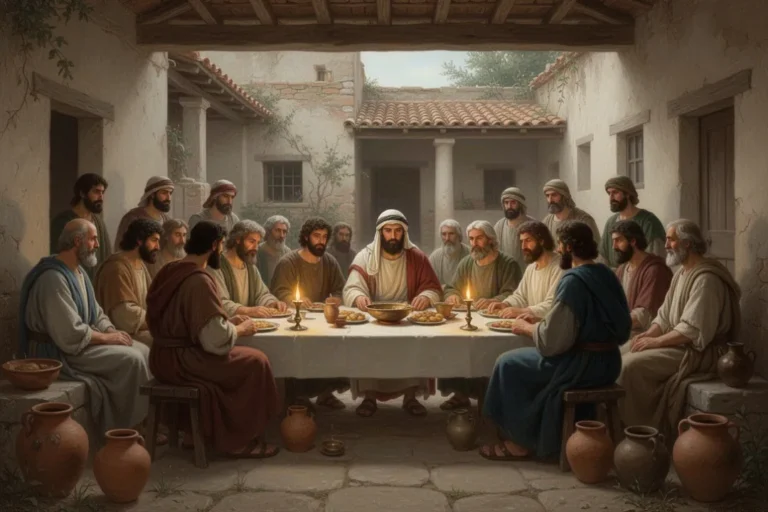
Early Christian gatherings usually took place in private homes rather than purpose-built churches. A household might provide a dining room or courtyard for prayer, teaching, shared meals, and the celebration of baptism and the Eucharist. Wealthier members could offer space and resources, while other believers contributed food, money, labor, or care for people in need.
Christian leaders developed systems of organization as communities expanded. By the second century, many churches recognized bishops as primary teachers and overseers, assisted by presbyters and deacons. Bishops communicated with one another, handled disputes, supervised charitable assistance, and defended what they regarded as reliable Christian teaching.
Several features made the movement attractive to some people in Roman society:
Mutual aid: Congregations supported widows, orphans, the sick, travelers, and members facing poverty.
Shared worship: Christians gathered across some social boundaries, even though Roman status distinctions did not disappear.
A universal message: The faith presented itself as open to people from many ethnic and social backgrounds.
Hope beyond death: Christian teaching offered resurrection and eternal life rather than treating death as the end of personal existence.
Strong community identity: Regular worship, moral instruction, baptism, fasting, and shared meals created lasting bonds.
Women also played significant roles in the growth of many Christian communities. They hosted meetings, supported missionaries, participated in charitable work, and passed the faith through households. Christian teaching did not produce complete equality between men and women, and church leadership was generally dominated by men, but women were essential patrons, members, and organizers in local congregations.
Christianity’s growth was not simply a result of appealing ideas. It also depended on persistence. New believers received instruction, formed relationships with other Christians, and belonged to communities that could survive the death or departure of individual missionaries. Over time, bishops, written texts, liturgical practices, and charitable networks helped turn scattered groups into a recognizable religious movement.
Why Roman authorities sometimes persecuted Christians
Persecution was real, but it was not constant across the entire Roman Empire. For much of the first three centuries, Christian communities experienced a mixture of local hostility, legal uncertainty, public suspicion, and periods of relative peace. Some persecutions were limited to particular cities or provinces; others were ordered across a broader part of the empire.
Roman religion was generally inclusive in practice. People could honor many gods and add new deities to an existing religious world. The difficulty was that traditional worship was connected to civic identity. Public sacrifices were not viewed only as private acts of belief; they could express loyalty to a city, a community, or the emperor’s rule.
Christians refused to sacrifice to the traditional gods or to treat the emperor as divine. From a Christian perspective, worship belonged to the one God. From the perspective of some Roman officials and neighbors, this refusal could look like stubbornness, impiety, or disloyalty. Christians were sometimes accused of undermining the community because they would not participate in ceremonies that others considered necessary for public stability.
Rumors also shaped public opinion. Outsiders misunderstood Christian meetings, especially because the Eucharist was described using the language of eating Christ’s body and drinking his blood. Private gatherings and unfamiliar rituals encouraged false accusations. Christian moral teaching, including criticism of sexual exploitation, violence, and idolatry, could also create tension with established customs.
Some Roman governors treated Christianity as a legal problem rather than launching a search for believers. The correspondence between Pliny the Younger, a provincial governor in Bithynia-Pontus, and Emperor Trajan shows this approach. Pliny asked how to handle Christians, and Trajan’s response indicated that officials should not actively seek them out but should punish those formally accused who refused to abandon the faith.
Other persecutions were more organized. Emperor Decius required inhabitants in many parts of the empire to perform public sacrifices and obtain certificates confirming that they had done so. The policy placed Christians under severe pressure and created lasting disputes over how churches should receive back believers who had sacrificed or obtained certificates under compulsion.
Emperor Diocletian and his colleagues launched the most extensive imperial persecution in the early fourth century. Beginning in 303 CE, authorities ordered the destruction of church buildings and Christian scriptures, removed some Christians from office, and imprisoned or punished others. The campaign did not destroy the movement, and its enforcement varied by region.
Stories of martyrs became central to Christian memory. A martyr was someone who died or suffered rather than renounced the faith. These accounts encouraged believers, shaped worship calendars, and gave local communities heroic figures. Some surviving stories contain legendary elements, so historians evaluate them carefully rather than assuming every detail is equally reliable.
Persecution was uneven: A Christian in one province might live quietly for decades while Christians elsewhere faced arrest or pressure to sacrifice. The empire did not maintain one uninterrupted policy of persecution from the time of Jesus to Constantine.
Constantine changed Christianity’s legal and political position
The decisive shift began during the civil wars of the early fourth century. Constantine became emperor in the western part of the empire after defeating his rival Maxentius at the Battle of the Milvian Bridge in 312 CE. Ancient Christian sources connect Constantine’s victory with his support for Christianity, although accounts differ about the exact vision or sign he experienced.
Constantine did not instantly make Christianity the only religion of the empire. Instead, he and Licinius issued an agreement commonly associated with the Edict of Milan in 313 CE. It granted Christians and other religious groups permission to worship, restored confiscated property, and ended official persecution. Christianity gained legal recognition and imperial favor, but traditional religions remained active.
Constantine supported Christian communities in practical ways. He returned property, provided financial assistance, sponsored church construction, and favored bishops at various moments. His patronage helped Christianity move from private houses into large public basilicas. It also increased the importance of church leaders, who now had closer relationships with the imperial government.
Imperial support brought advantages and new pressures. Christians could worship openly, but disagreements within the church now had political consequences. Constantine called the Council of Nicaea in 325 CE to address a major dispute concerning the relationship between the Father and the Son. The council produced a creed that became a foundation for later Nicene Christianity, although disagreement continued for decades.
Constantine himself was baptized near the end of his life. His religious policy was complex, and he did not simply erase traditional Roman practices. Coins, monuments, titles, and ceremonies continued to reflect older imperial traditions, even as Christian symbols and church patronage became increasingly prominent.
After Constantine, later emperors took different approaches. Some supported Nicene Christianity, while others favored alternative Christian theological positions. Emperor Julian, who ruled briefly in the 360s, attempted to revive traditional religious practices and reduce Christian influence. His reign shows that Constantine’s conversion had not made the empire uniformly Christian.
The legalization of Christianity also changed the social meaning of conversion. Before imperial favor, becoming Christian could involve legal and social risk. Afterward, it could bring access to influential networks and public institutions. Some people converted from personal conviction, while others responded to changing political and social conditions. Both motives existed, and religious change cannot be explained by a single cause.
Christianity became the empire’s official religion in the late fourth century
Christianity gained an even stronger official position under Theodosius I, who ruled the eastern and western parts of the empire at different times. In 380 CE, the Edict of Thessalonica declared support for the faith associated with the bishops of Rome and Alexandria, often described as Nicene Christianity. The policy identified that form of Christianity with imperial orthodoxy.
Later measures restricted some public expressions of traditional sacrifice and reduced the official space available to older cults. The pace and extent of change differed by region. Temples were not all destroyed at once, and traditional religious practices continued in many places for generations. Some sacred buildings were converted, some fell into disuse, and others remained active or were protected by local circumstances.
Christianity’s official status affected public life in several ways:
Church leaders gained influence: Bishops became important figures in cities, sometimes acting as advocates for the poor and as negotiators during political crises.
Christian festivals shaped calendars: Feasts connected with Jesus, Easter, and local saints became more visible in civic life.
Charity expanded institutionally: Churches organized food distribution, assistance for widows, care for the sick, and burial support.
Religious law influenced legislation: Imperial laws increasingly reflected Christian moral concerns, although Roman law remained a mixture of older traditions and new policies.
Disputes became public conflicts: Theological disagreements could involve bishops, emperors, city populations, and sometimes violence.
Christianization did not mean that every Roman became a committed Christian or that older customs disappeared immediately. People often combined inherited local practices with Christian observance. Rural areas could preserve older rituals longer than major cities, while some urban populations moved back and forth between religious traditions.
The church itself was not a single, perfectly unified institution. Christians argued over theology, baptism, clerical authority, asceticism, and the treatment of people who had compromised during persecution. Donatist communities in North Africa, Arian and semi-Arian groups in parts of the empire, and other movements contested what counted as true Christianity.
These conflicts demonstrate that imperial support did not remove disagreement. It raised the stakes. A theological dispute that once affected a local congregation could become an empire-wide controversy when emperors intervened, bishops traveled to councils, and government officials enforced one side’s decisions.
Christian institutions reshaped Roman society and survived the western empire
Christianity influenced Roman society not only through official decrees but also through ordinary institutions. Churches became places for worship, teaching, dispute resolution, charity, burial, and community organization. Bishops often developed reputations as protectors of vulnerable people, especially when local government was weak or distant.
Christian moral teaching addressed wealth, sexuality, marriage, violence, slavery, and care for the poor. The results were mixed. Some wealthy Christians funded hospitals, churches, monasteries, and charitable foundations. At the same time, slavery continued, social inequality remained deep, and Christian leaders disagreed about how far moral ideals should shape public policy.
Monasticism became another major force. In Egypt, Syria, Palestine, and elsewhere, men and women sought intense religious discipline through solitude, fasting, prayer, and communal life. Monks became respected spiritual figures, and monasteries later served as centers of worship, learning, charity, agriculture, and manuscript preservation.
Christian writers also helped redefine Roman identity. Authors such as Augustine of Hippo reflected on the relationship between earthly political communities and the Christian church. After the sack of Rome in 410 CE, Augustine argued in The City of God that Christianity should not be blamed for Rome’s troubles and that no earthly empire was eternal.
The western Roman imperial government ended in the fifth century, traditionally dated to 476 CE, but Christianity did not end with it. Bishops, churches, monasteries, Christian schools, and theological traditions continued across former Roman territories. In the eastern empire, centered on Constantinople, Roman imperial rule and Christianity remained closely connected for many more centuries.
In the long term, Christianity in the Roman Empire developed through several overlapping processes:
Jewish origins: The movement began in Roman Judea within the world of Second Temple Judaism.
Urban expansion: Missionaries and congregations used the empire’s cities, roads, ports, and languages.
Community formation: Bishops, scriptures, worship, charity, and shared identity gave local churches stability.
Conflict with traditional expectations: Refusal to sacrifice to the gods sometimes brought suspicion or punishment.
Imperial protection: Constantine ended persecution and gave Christianity legal and financial support.
Official preference: Theodosius and later rulers strengthened Nicene Christianity’s position in public life.
Institutional survival: Churches and Christian leaders remained influential after western imperial rule fragmented.
The history is therefore more complicated than a simple story of persecuted believers suddenly taking control. Christianity grew through personal conviction, family networks, charity, missionary work, political patronage, intellectual debate, and changing imperial policies. By the end of antiquity, it had become deeply woven into the institutions and identities of the Mediterranean world.
Frequently asked questions
How long was Christianity illegal in the Roman Empire?
Christianity was not illegal under one continuous empire-wide law for its first three centuries. Enforcement varied by emperor, governor, province, and local circumstances. Some Christians faced punishment for refusing public sacrifices, while others lived without serious interference. Imperial persecution became especially severe under Diocletian, and legal toleration was established under Constantine and Licinius in 313 CE.
Did Constantine make Christianity the official religion of Rome?
No. Constantine legalized Christianity, supported churches, and gave Christian leaders important privileges, but traditional religions remained legal and widely practiced during his reign. Christianity gained an official and preferred position later, especially under Theodosius I, whose policies in the late fourth century supported Nicene Christianity as the empire’s authorized form of faith.
Why did some Romans view Christians as disloyal?
Roman public religion was closely tied to civic identity and imperial loyalty. Christians refused to sacrifice to traditional gods or honor the emperor in ways they considered worship. Some Romans interpreted that refusal as a rejection of community obligations rather than as a private religious choice. Rumors about Christian meetings also contributed to suspicion.
What happened to Christianity after the Western Roman Empire fell?
Christianity remained a major institution after western imperial government weakened. Bishops continued to lead urban communities, monasteries preserved religious and intellectual traditions, and churches provided charity and local administration. In the eastern Roman Empire, Christian imperial rule continued from Constantinople. Former western Roman territories developed distinct Christian kingdoms and church structures over time.







Leave a Reply