What does Protestant mean? Beliefs, history, and worship
What does Protestant mean? Beliefs, history, and worship
If someone says, “I’m Protestant,” you may wonder whether that describes one church, a set of beliefs, or a broad Christian tradition. Protestant is not the name of a single denomination. It refers to a large family of Christian churches that emerged from the Reformation in 16th-century Europe and developed around shared convictions about Scripture, faith, and the church.
Today, Protestant churches include Baptists, Lutherans, Methodists, Presbyterians, Pentecostals, Anglicans, Reformed churches, and many independent congregations. They can differ considerably in worship style and doctrine, yet they generally identify with the Reformation’s call to measure Christian teaching by the Bible and to emphasize salvation through faith in Jesus Christ.
The word Protestant comes from a formal “protest” made by several German princes and cities in 1529. They objected to a decision that would have restricted support for the reform movement within the Holy Roman Empire. Over time, the term came to describe Christians and churches associated with the broader Protestant Reformation.
The word does not simply mean someone who is protesting against religion, the Catholic Church, or a particular political system. It refers to a historical Christian movement that challenged certain teachings and practices of the Western church and sought significant reform. The movement was shaped by theologians, pastors, scholars, rulers, and ordinary Christians in different regions.
Protestant Christianity is best understood as a family of traditions rather than a single institution. A Lutheran congregation in Minnesota, a Baptist church in Texas, an Anglican parish in Virginia, and a Pentecostal church in California may all be Protestant while having different services, leadership structures, and views on baptism.
Simple definition: A Protestant is a Christian who belongs to a tradition that grew out of the Reformation and generally emphasizes the authority of the Bible and salvation by grace through faith in Jesus Christ.
Not every Protestant church uses the same language to describe itself. Some prefer the names of their denominations, such as Methodist or Presbyterian. Others call themselves evangelical, Reformed, non-denominational, or simply Christian. “Protestant” is often useful as a broad category, but it does not tell you everything about a person’s beliefs.
How the Protestant Reformation began
The Protestant Reformation began in the early 1500s amid concerns about the theology, leadership, and practices of the Western Latin-speaking church. Christians had disagreed about church teaching for centuries, but printing, universities, political change, and growing access to biblical and theological writings helped reform ideas spread more widely than before.
Martin Luther, a German monk and professor, became one of the movement’s most influential early figures. In 1517, he raised objections to the sale of indulgences and other issues in church life. His arguments were circulated through printing and public debate, eventually leading to his separation from the Roman Catholic Church.
Luther’s central concern was how sinners are made right with God. He argued that people receive salvation by God’s grace through faith, rather than earning it through religious achievements. He also insisted that church teaching should be accountable to Scripture. These ideas became especially important in Lutheran churches.
Reform movements developed independently in other places. In Switzerland, Huldrych Zwingli and later John Calvin shaped Reformed Christianity. In England, the Church of England separated institutionally from Rome under King Henry VIII, although its theological development involved many people and changed over time. Reformers in Scotland, the Netherlands, France, and other regions created additional Protestant traditions.
The Reformation was not one peaceful or uniform event. It involved public arguments, church councils, political conflicts, wars, government decisions, and disagreements among reformers themselves. Protestants differed over baptism, communion, church government, worship, and the relationship between church and state from the beginning.
Lutheran churches grew from Martin Luther’s reforms and strongly emphasize justification by faith and the promises of God in the gospel.
Reformed churches developed through figures such as John Calvin and often emphasize God’s sovereignty, covenant theology, and structured teaching.
Anglican churches emerged from the English Reformation and combine elements of historic liturgy with Protestant theology.
Anabaptist traditions emphasized voluntary faith, believer’s baptism, and a church made up of committed disciples.
Baptist churches generally practice baptism for professing believers and emphasize the independence of local congregations.
Methodist churches grew from the ministry of John Wesley and stress personal faith, holiness, discipleship, and practical service.
Several Catholic reforms also took place during the same broad period, especially through the Council of Trent. As a result, the 16th century reshaped Western Christianity but did not produce a simple split between one unchanged church and one new movement. Historical relationships remain complex, and Protestant, Catholic, and Eastern Orthodox Christians share many foundational Christian beliefs despite significant differences.
What most Protestant churches believe
Protestants do not share a single statement of faith, but many churches hold several broad convictions in common. These beliefs are expressed differently across denominations, and some Protestant groups place greater emphasis on certain doctrines than others.
The Bible as the highest written authority
Many Protestants affirm sola Scriptura, a Latin phrase commonly translated as “Scripture alone.” In practice, this means the Bible is the highest or final written authority for Christian doctrine. It does not necessarily mean that Protestants reject history, tradition, reason, scholarship, or the guidance of church leaders. Rather, those sources must remain accountable to Scripture.
Protestants usually encourage regular Bible reading, preaching, teaching, and study. The Bible is commonly translated into the language people speak, and congregations often place a sermon or exposition of Scripture at the center of Sunday worship. Churches differ in how they interpret difficult passages and how they understand the relationship between biblical teaching and modern questions.
Salvation by grace through faith
A central Protestant conviction is that salvation is a gift of God’s grace. People do not save themselves by accumulating good deeds, religious status, money, or moral accomplishments. They are reconciled to God because of Jesus Christ and receive that gift through faith.
Protestants also differ in how they explain predestination, free will, conversion, and the possibility of losing faith. A Reformed church may emphasize God’s initiative in salvation, while a Wesleyan or Arminian church may emphasize human response and the universal offer of grace. Both may still affirm that salvation begins with God’s grace and is centered on Christ.
Jesus Christ as the center of Christian faith
Protestant churches generally affirm the historic Christian belief that Jesus Christ is the Son of God, truly divine and truly human, whose death and resurrection are essential to salvation. His life, teaching, crucifixion, and resurrection shape Protestant preaching, worship, prayer, and ethics.
Most Protestants also affirm the Trinity: one God who exists as Father, Son, and Holy Spirit. They share this belief with Roman Catholic and Eastern Orthodox Christians. The specific vocabulary used in sermons and worship may vary, but the Trinity remains foundational for most Protestant denominations.
The priesthood of all believers
Many Protestant traditions teach the priesthood of all believers. This does not mean every church has no pastors or trained leaders. It means that every Christian has direct access to God through Christ and a meaningful role in prayer, service, witness, and the life of the church.
Because of this emphasis, Protestants often encourage laypeople to read the Bible, participate in ministry, lead small groups, teach children, care for neighbors, and share their faith. Churches still organize leadership in different ways. Some have bishops and ordained clergy, while others are governed by elders or by the members of a local congregation.
How Protestant worship and church life differ
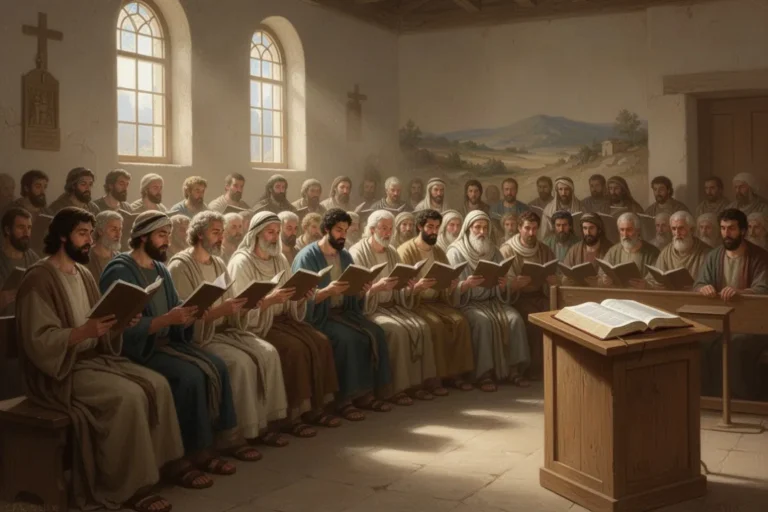
A Protestant service may take place in a traditional sanctuary, a rented school, a home, or a large auditorium. Worship can include hymns, contemporary music, Scripture readings, a sermon, prayers, confession, Communion, and opportunities for personal testimony. The setting and atmosphere depend heavily on the denomination and local congregation.
Preaching is especially prominent in many Protestant services. A pastor or another leader may explain a passage of Scripture, connect it to the Christian gospel, and apply it to daily life. In some churches, the sermon follows a planned sequence through a biblical book; in others, it addresses a theme or immediate pastoral concern.
Music also varies widely. Lutheran and Anglican churches may use historic hymns and formal liturgy. Reformed churches may include psalms and carefully structured worship. Baptist, evangelical, and non-denominational churches may use a worship band, projected lyrics, and several contemporary songs. Pentecostal services may include extended singing, spontaneous prayer, healing ministry, or speaking in tongues, depending on the congregation.
Most Protestant churches recognize two practices as especially important: baptism and Communion, also called the Lord’s Supper or the Eucharist. The meaning and administration of these practices are among the clearest differences between denominations.
Infant baptism: Lutheran, Anglican, Presbyterian, Methodist, and some other churches baptize infants as a sign of God’s covenant and welcome into the visible church.
Believer’s baptism: Baptist, Pentecostal, and many non-denominational churches usually baptize people who personally profess faith, often by immersion.
Communion as a sign of grace: Some Protestants believe Christ is truly present in a special way during Communion, while explaining that presence differently from Roman Catholic teaching.
Communion as remembrance: Other churches place greater emphasis on remembering Jesus’ death and publicly affirming faith.
Frequency: Congregations may celebrate Communion weekly, monthly, quarterly, or according to another local pattern.
Church governance is another major distinction. Episcopal systems use bishops to oversee congregations and clergy. Presbyterian systems use councils of elders at local, regional, and national levels. Congregational systems give substantial authority to the members of each local church. Some independent churches have a pastor-led structure with an advisory board.
Protestant churches also express faith through service. Food distribution, disaster relief, addiction recovery, prison ministry, refugee assistance, counseling, schools, hospitals, and overseas missions are common forms of Protestant activity. The extent and style of this work differ, but most traditions connect Christian faith with love of neighbor and care for vulnerable people.
Why Protestant denominations disagree
The large number of Protestant denominations can be confusing. The movement’s emphasis on Scripture and local church responsibility contributed to a culture in which Christians could establish new denominations when they reached different conclusions about doctrine, worship, or church organization.
Some disagreements are theological. Churches may differ over baptism, spiritual gifts, women in church leadership, predestination, the role of bishops, the timing of Christ’s return, or the relationship between faith and works. Other divisions have involved language, ethnicity, national history, cultural practice, or disagreements about how a denomination should respond to social questions.
Denominational labels provide useful clues, but they are not complete descriptions. Two churches with the same name may have different preaching styles and local priorities. Two congregations with different names may share very similar beliefs and worship practices.
When comparing Protestant churches, these questions can help:
What does the church teach about the Bible? Ask how Scripture is interpreted and how it guides doctrine and daily life.
How does it explain salvation? Listen for its teaching about grace, faith, repentance, good works, and the person of Jesus.
Who may be baptized? Find out whether the church baptizes infants, professing believers, or both.
What does it believe about Communion? Churches use the same practice but may explain its meaning in different ways.
How is the congregation governed? Leadership may involve a pastor, elders, bishops, a denominational body, or the congregation as a whole.
How does it treat people? Healthy church life includes honesty, accountability, care for members, and respect for people who ask difficult questions.
A useful distinction: “Protestant” identifies a broad Christian tradition, while a denomination describes a more specific church family. To understand a person’s beliefs, ask about their denomination or congregation rather than assuming all Protestants believe exactly the same things.
Disagreement does not make every distinction unimportant. Some differences affect how people understand salvation, the church, baptism, Communion, and Christian authority. At the same time, Protestants often recognize one another as fellow Christians despite these disagreements, especially when they share belief in the triune God and the central importance of Jesus Christ.
How Protestant Christianity compares with other Christian traditions
Protestant, Roman Catholic, and Eastern Orthodox Christians share the Bible, belief in the Trinity, belief in Jesus Christ, and many elements of historic Christian teaching. Their differences concern authority, church structure, sacraments or ordinances, worship, and the interpretation of certain doctrines.
Roman Catholic Christianity recognizes the authority of Scripture together with Sacred Tradition and the teaching office of the church, especially the bishops in communion with the pope. Protestant churches typically give the Bible the highest authority and do not recognize the pope as the universal head of the church.
Eastern Orthodox churches also place strong emphasis on historic tradition, bishops, liturgy, and the continuity of the ancient church. Protestant worship is often less centrally governed by a shared liturgical tradition, although Anglican, Lutheran, and some other Protestant churches retain highly structured forms of worship.
Many Protestant churches speak of two ordinances, baptism and Communion, because they understand these practices as commands given by Jesus and signs of the gospel. Roman Catholic and Eastern Orthodox churches ordinarily speak of seven sacraments. Protestant views of Communion range from a strong affirmation of Christ’s real presence to a primary emphasis on remembrance and public faith.
Protestants also differ among themselves when comparing their theology with Catholic or Orthodox beliefs. For example, some Protestants reject the veneration of saints and the use of icons, while others retain historical art, feast days, and prayers that honor Christian examples without treating them as divine. The broad label alone cannot answer every question about a church’s practice.
If you are visiting a Protestant church, you can usually expect Scripture to be read or preached, prayers to be offered, and Christians to gather around some form of singing or spoken worship. You do not need to know every denominational distinction before attending. A church’s website, welcome team, or pastor can explain its beliefs about baptism, Communion, membership, and participation.
Frequently asked questions
Is Protestant a denomination?
No. Protestant is a broad category that includes many denominations and independent churches. Baptists, Lutherans, Methodists, Presbyterians, Anglicans, Pentecostals, and many non-denominational congregations may be Protestant. The term describes a shared historical family, but individual churches can differ widely in doctrine, worship, leadership, and views on baptism and Communion.
Are Protestants considered Christians?
Yes. Protestant churches are Christian churches. Most affirm the Trinity, the divinity and humanity of Jesus, his death and resurrection, the authority of the Bible, and salvation through Christ. Protestant Christians differ on many teachings and practices, but those disagreements occur within the wider Christian tradition.
Do all Protestants believe in the Bible?
Protestant churches generally regard the Bible as the highest written authority for Christian faith and practice. They do not all interpret it in the same way, however. Denominations may disagree about baptism, spiritual gifts, church leadership, predestination, social issues, and how particular passages should be applied.
Can a Protestant attend a Catholic or Orthodox church?
A Protestant can usually visit a Catholic or Orthodox service as a guest, although rules about receiving Communion may differ. Participation in membership, baptism, or sacraments depends on the specific church. If you plan to attend, asking the congregation about its customs and expectations is the clearest approach.

Leave a Reply