Martin Luther was a German monk and theologian whose criticisms of the late medieval Catholic Church helped begin the Protestant Reformation in the 16th century.
Born in 1483, Luther became one of Europe’s most influential religious writers and teachers. His arguments about faith, forgiveness, and the authority of Scripture challenged the power structures of his time, divided Western Christianity, and influenced education, politics, language, and culture far beyond Germany.
Martin Luther was born on November 10, 1483, in Eisleben, in the region of Saxony in the Holy Roman Empire. His parents, Hans and Margarethe Luther, came from a hardworking middle-class family. His father worked in the mining industry and hoped that Martin would pursue a respectable career in law.
Luther studied at the University of Erfurt, where he earned degrees in the liberal arts. In 1505, he began studying law, apparently following his father’s wishes. That plan changed after a frightening storm near the town of Stotternheim. Luther vowed to become a monk if he survived, and soon afterward he entered the Augustinian monastery in Erfurt.
As a monk, Luther took religious discipline seriously. He fasted, prayed, confessed his sins, and performed acts of penance. Yet these practices did not give him the spiritual peace he wanted. He worried intensely about whether he had done enough to satisfy God and receive forgiveness.
Those concerns shaped his later theology. Luther gradually became convinced that people could not earn acceptance with God through religious achievements, payments, or good works. Instead, he emphasized that people receive salvation through God’s grace and faith. This idea became known as justification by faith, although Luther’s understanding of faith also included trust in God’s promise rather than merely agreeing with a set of beliefs.
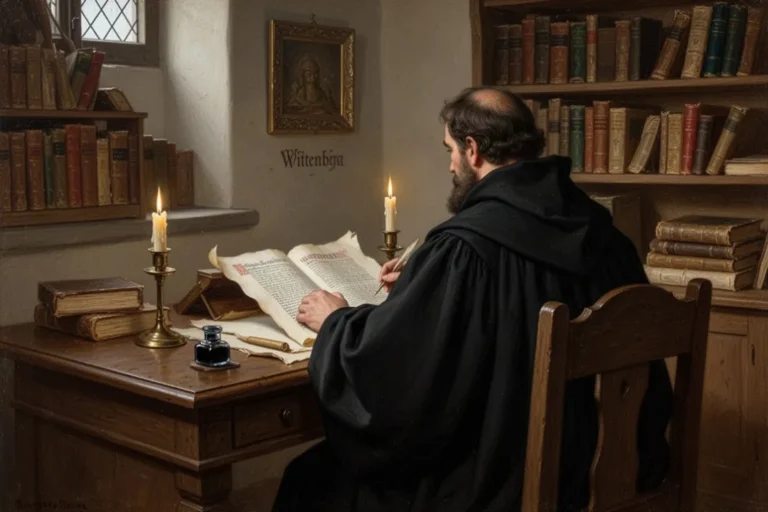
Luther was ordained as a priest in 1507. He later studied theology and became a professor at the University of Wittenberg, a relatively new university founded by Frederick the Wise, the elector of Saxony. Luther remained connected to Wittenberg for much of his life, teaching, preaching, writing, and advising religious and political leaders.
The central question for Luther: How can a sinful person stand right with God? His answer increasingly focused on God’s grace received through faith, rather than on purchasing spiritual benefits or earning salvation through human effort.
Why Luther challenged the Catholic Church
Luther did not initially set out to create a new church. His earliest objections focused on particular practices and teachings within the late medieval Catholic Church, especially the sale and promotion of indulgences.
An indulgence was connected to the church’s teaching about the forgiveness of temporal punishment for sin. Over time, indulgences became associated with financial contributions and fundraising campaigns. Some preachers used forceful slogans and emotional appeals to encourage people to contribute money, including funds for major building projects in Rome.
One prominent preacher, Johann Tetzel, promoted indulgences in German territories. Luther objected to the impression that a financial payment could secure forgiveness for oneself or reduce punishment for a dead relative. He believed genuine repentance involved a changed life and trust in God, not a transaction.
On October 31, 1517, Luther sent a document called the Ninety-Five Theses to Albert of Mainz, a powerful church leader who was involved in the indulgence campaign. The document presented topics for an academic debate about indulgences and related issues. A later tradition says Luther nailed the theses to the door of the Castle Church in Wittenberg.
Historians continue to discuss the exact details of the posting story, including whether the event happened as later accounts described it. The broader point is clear: Luther’s objections circulated rapidly after being translated, copied, and printed. The new printing press allowed his arguments to reach readers across German-speaking lands with remarkable speed.
The theses were written in Latin for scholars, but Luther soon produced material in German for a wider audience. His pamphlets were short, direct, and often sharply worded. They reached priests, university students, merchants, urban readers, and political leaders who already had complaints about church authority and financial demands.
Luther’s dispute expanded beyond indulgences. He questioned the pope’s authority to control forgiveness and argued that the Bible should have the highest authority in Christian teaching. He also criticized the idea that ordained priests were spiritually superior to all other Christians in every respect.
Luther’s theology is often summarized with phrases such as Scripture alone and faith alone. These expressions can be misleading if treated as slogans without context. Luther did not claim that Christians should ignore history, reason, worship, or church teachers. Rather, he argued that Scripture was the final standard for doctrines that bound the conscience.
He also did not teach that faith made ethical conduct irrelevant. In his view, good works followed genuine faith as the natural fruit of a changed relationship with God. They were not a way to purchase salvation, but they mattered as expressions of love and service to other people.
His position challenged a system in which church authorities, sacramental practices, and acts of penance were closely connected with a person’s hope of forgiveness. It also challenged the pope’s claim to settle the dispute. That made the controversy both theological and institutional.
How Luther became the leading figure of the Reformation
The controversy surrounding Luther intensified between 1518 and 1521. He was questioned by church officials, debated theologians, and asked to explain or withdraw his claims. In 1518, he defended his position before Cardinal Cajetan in Augsburg, but the meeting did not resolve the disagreement.
Luther also debated Johann Eck, a skilled Catholic theologian, in Leipzig in 1519. The debate pushed Luther toward more direct criticism of the papacy and church councils. He began arguing that popes and councils could make serious errors and that church authority had to be tested against Scripture.
In 1520, Luther published several major works. In To the Christian Nobility of the German Nation, he called on secular rulers to help reform the church. In The Babylonian Captivity of the Church, he criticized the medieval sacramental system and defended a smaller number of sacraments as clearly grounded in the New Testament. In The Freedom of a Christian, he described the Christian as spiritually free before God and therefore called to serve others in love.
These writings made Luther a famous and controversial public figure. Pope Leo X issued a document warning that Luther’s teachings conflicted with church doctrine. Luther publicly burned the document in December 1520, along with books of church law. In January 1521, the pope formally excommunicated him.
That did not end the dispute. Holy Roman Emperor Charles V summoned Luther to the Diet of Worms, an imperial meeting held in 1521. Luther was asked to identify whether he had written the books placed before him and whether he would retract their contents.
Later accounts give a dramatic version of Luther’s reply, including the famous words often translated as “Here I stand.” The exact wording and setting of that phrase are debated. The reliable historical point is that Luther refused to withdraw his teachings unless he could be shown from Scripture and sound reasoning that he was wrong.
After the meeting, the Edict of Worms declared Luther an outlaw. This meant that authorities could legally arrest him, and his writings were banned. Frederick the Wise, who ruled Saxony, arranged for Luther to be taken secretly to the Wartburg Castle for protection.
Luther’s translation of the Bible
During his time at Wartburg, Luther worked on a German translation of the New Testament. It was published in 1522 and became known as the September Testament because of its publication date. He later helped revise and complete a German Bible with colleagues, including Philipp Melanchthon.
Luther’s translation was not the first German Bible. Earlier German translations existed, but his version used vivid, accessible language and benefited from the printing press. He tried to express biblical ideas in language ordinary German speakers could understand rather than relying on stiff academic wording.
The translation had consequences beyond church worship. It helped establish a widely influential form of written German and encouraged the idea that ordinary Christians should be able to read Scripture. Luther also wrote a small catechism to teach the faith through explanations of the Ten Commandments, the Apostles’ Creed, the Lord’s Prayer, baptism, and communion.
His work contributed to a broader growth in literacy and religious publishing. Still, literacy was uneven, and many people encountered Luther’s ideas through sermons, public readings, songs, pictures, and conversations rather than by reading his books themselves.
How Luther’s movement changed Christian worship and church life
Luther’s teaching spread through towns and territories in the Holy Roman Empire. Some city councils and territorial rulers supported reform, while others defended Catholic practice. This meant that religious change was shaped not only by theology but also by local politics, economic interests, and competition among rulers.
Reformed churches associated with Luther removed or altered practices they viewed as unsupported by Scripture. Worship was increasingly conducted in the vernacular language rather than only in Latin. Preaching became central, and congregational singing gained a larger role. Luther himself wrote or adapted hymns, including “A Mighty Fortress Is Our God,” though the hymn’s meaning and influence are more important here than its later cultural associations.
Luther did not reject every traditional practice. He retained baptism and communion as central sacraments, although he rejected the medieval Catholic understanding of how those sacraments operated. He also kept many elements of church music, liturgy, and the church calendar where he believed they did not conflict with Scripture.
The movement also changed religious institutions. Monasteries were closed in areas that adopted the reform, and some clergy married. Luther himself married Katharina von Bora in 1525. She had been a nun who left her convent during the Reformation. Their household became an important example of a Protestant pastor’s family life, and Katharina helped manage the home, finances, visitors, and family responsibilities.
Luther supported education for both boys and girls because he believed communities needed educated Christians and responsible civic leaders. He encouraged towns to maintain schools and argued that rulers should provide opportunities for children to learn. His educational ideas helped connect religious reform with literacy and public administration.
At the same time, Luther’s movement was not uniformly democratic or tolerant by modern standards. He believed political authorities should protect public order and support church reform. He often expected ordinary people to follow established rulers rather than create religious change through popular revolt.
Luther and the German Peasants’ War
In 1524 and 1525, large numbers of peasants in German territories rebelled against economic burdens, local abuses, and restrictions imposed by landlords and authorities. Some rebels used language connected with Christian freedom and appealed to the Bible to support their demands.
Luther initially urged both rulers and peasants to address legitimate grievances. As the conflict became violent, however, he strongly condemned the rebellion and called on authorities to suppress it. His response has been widely criticized as harsh and as a failure to defend people suffering under unjust conditions.
The Peasants’ War exposed a limit in Luther’s understanding of Christian freedom. He emphasized freedom from guilt and condemnation before God, but he did not interpret that freedom as a broad political program for social equality. His close relationship with territorial rulers also helped determine the later shape of Lutheran churches.
Why Martin Luther remains controversial
Luther’s influence cannot be measured only by the religious reforms he supported. He also produced writings that contain severe attacks on groups he opposed. His statements about Jews became increasingly hostile, especially in later life, and included recommendations for discriminatory and violent treatment.
These writings have been used by antisemites, including some Nazi propagandists, although Luther lived centuries before modern racial antisemitism and did not create that later political movement. Historical context can help explain his ideas, but it does not excuse them. His anti-Jewish writings are a serious and permanent part of his record.
Luther also expressed contempt toward Muslims, Anabaptists, and Catholic opponents. His language often reflected the polemical culture of the 16th century, when religious disputes could carry political and legal consequences. That context matters, but modern readers should still evaluate his words critically rather than treat them as harmless products of their time.
A balanced assessment: Luther helped challenge abuses and expand access to Scripture, yet he also supported harsh measures against opponents and wrote deeply prejudiced material. His importance does not require ignoring the damage caused by his ideas.
Another controversy concerns Luther’s relationship with political authority. He defended the authority of rulers during periods of upheaval and helped create a model in which princes and city governments organized church life within their territories. This arrangement protected reform in some places, but it also tied religion closely to state power.
For these reasons, historians describe Luther in different ways: as a courageous religious reformer, a gifted biblical theologian, a political realist, a divisive polemicist, or all of these at once. The evidence supports a complex portrait rather than a simple hero-versus-villain story.
Luther’s protest contributed to the permanent division of Western Christianity. Churches that followed his teachings became known as Lutheran churches. Other Protestant movements developed from different leaders and theological traditions, including the Reformed churches associated with Huldrych Zwingli and John Calvin, the Anglican tradition in England, and later Anabaptist and Baptist communities.
It is therefore inaccurate to call Luther the founder of all Protestant Christianity. He was the most important early figure in one major branch of the Reformation, and his actions helped create the conditions in which many other reform movements could develop.
The Catholic Church responded with its own reforms, including the Council of Trent, which met in several periods between 1545 and 1563. The Catholic Reformation clarified Catholic teaching, addressed some abuses, improved clerical training, and strengthened church discipline. The division between Catholic and Protestant Christians became lasting, although later ecumenical conversations have produced areas of agreement.
Luther’s theology continues to shape Christian denominations, especially through its emphasis on grace, faith, and Scripture. Lutheran churches differ among themselves on worship, church governance, communion, biblical interpretation, and social issues, but they generally trace their tradition to Luther’s reforming work.
His influence also reached the English-speaking world and many other regions through translations, missionary activity, education, and church partnerships. The Lutheran tradition is now global rather than limited to Germany and Scandinavia.
Luther’s writings remain important to scholars studying theology, church history, German literature, political authority, education, and the development of print culture. His translation of the Bible helped shape German language and religious vocabulary, while his hymns and catechisms influenced Protestant worship for generations.
For a reader asking who Martin Luther was, the clearest answer is that he was a 16th-century Catholic monk who became a reforming theologian and the central figure of the German Reformation. He challenged the church’s teaching and authority, defended salvation as God’s gracious gift received through faith, translated Scripture into accessible German, and helped create a new Christian tradition.
His legacy also carries serious warnings. Religious conviction can inspire needed criticism, but polemics can become persecution, and reform can become entangled with political power. Understanding Luther requires holding together both sides: his enormous historical influence and the real harm caused by some of his beliefs and actions.
Important dates in Martin Luther’s life
1483: Martin Luther is born in Eisleben in the Holy Roman Empire.
1505: He enters the Augustinian monastery in Erfurt after abandoning his legal studies.
1507: He is ordained as a priest.
1512: He earns a doctorate in theology and begins teaching at the University of Wittenberg.
1517: His Ninety-Five Theses challenge the sale and promotion of indulgences.
1520: He publishes major reform writings and is formally condemned by Pope Leo X.
1521: He appears before the Diet of Worms and later takes refuge at Wartburg Castle.
1522: His German New Testament is published.
1525: He marries Katharina von Bora during the period of the German Peasants’ War.
1546: He dies in Eisleben on February 18.
These dates show how quickly Luther’s private religious struggle became a public conflict with consequences across Europe. They also show why the Reformation cannot be reduced to a single dramatic event in 1517; it developed through years of teaching, debate, printing, political decisions, and religious change.
Frequently asked questions
Was Martin Luther Catholic?
Yes. Luther was born and educated within the Roman Catholic Church, became an Augustinian monk, and was ordained a Catholic priest. His reform movement began as a dispute within the church, but his refusal to retract his teachings led to excommunication and the formation of separate Lutheran churches.
Did Martin Luther really nail the Ninety-Five Theses to a church door?
The traditional story says he nailed them to the Castle Church door in Wittenberg on October 31, 1517. Historians debate the details because the earliest surviving evidence confirms that he sent the theses to church officials, while the door-posting account became prominent later.
What is the main teaching associated with Martin Luther?
The central teaching is that people are justified before God by grace through faith, not by purchasing indulgences or earning salvation through religious achievements. Luther also gave Scripture final authority in matters of Christian doctrine and encouraged worship and Bible reading in languages ordinary people could understand.
Did Martin Luther start Protestantism?
Luther was the leading figure in the early German Reformation and is often treated as the founder of the Lutheran tradition. He did not create every Protestant church. Other reformers developed distinct movements, including Reformed, Anglican, Anabaptist, and later Baptist traditions.






Leave a Reply