If you see the phrase “Feast of Dedication” in the Bible, you may wonder whether it refers to a Christian holiday, a Jewish observance, or a particular event in Israel’s history. The answer is that it refers to Hanukkah, the Jewish festival commemorating the rededication of the Jerusalem Temple after it had been defiled by foreign rule.
The festival appears by name in John 10:22, where Jesus is described as being in Jerusalem during the Feast of Dedication. It is also called the Festival of Lights in Jewish tradition. Hanukkah lasts eight days and usually falls in November or December on the Gregorian calendar because its date is set by the Hebrew calendar.
The Feast of Dedication remembers the restoration of the Jerusalem Temple in the second century BCE. The Temple had been damaged and desecrated during the reign of Antiochus IV Epiphanes, a Seleucid ruler who controlled Judea and attempted to impose aspects of Greek culture and religion on the Jewish population.
Antiochus’s policies created deep conflict. Jewish religious practices were restricted, and the Temple was used in a way that violated Jewish worship. Ancient Jewish sources describe the suppression of practices such as keeping the Sabbath and following dietary laws, along with the introduction of pagan worship at the Temple.
A Jewish priest named Mattathias and his sons led a revolt against Seleucid control. One of his sons, Judas Maccabeus, became the most prominent military leader of the rebellion. The name “Maccabeus” is commonly associated with the Hebrew or Aramaic idea of a hammer, reflecting Judas’s reputation as a forceful fighter.
After military victories, the rebels regained control of Jerusalem and cleansed the Temple. In 164 BCE, they rededicated it for Jewish worship. The celebration of that rededication became the annual festival known as Hanukkah, which means dedication or consecration.
The central meaning: Hanukkah celebrates the restoration of the Temple and the renewal of Jewish worship after a period of persecution and desecration.
The story is preserved most fully in 1 Maccabees and 2 Maccabees, books included in Catholic and Orthodox Bibles and in the Apocrypha of many Protestant editions. The Jewish historian Josephus also discusses the festival and connects it with the lighting of lamps, which helps explain why Hanukkah later became known as the Festival of Lights.
Why it is called Hanukkah and the Feast of Dedication
The Hebrew word Hanukkah means “dedication.” The name points directly to the Temple’s renewed dedication after it had been reclaimed and purified. “Feast of Dedication” is a more literal English rendering of the same basic idea.
The festival is sometimes transliterated as Chanukah, with other spellings also in use. These differences come from representing Hebrew sounds with English letters. Hanukkah and Chanukah refer to the same Jewish holiday.
Dedication in this setting was not merely the opening of a building. The Temple was the center of Jewish sacrifice and national religious life. Its defilement represented a serious attack on the community’s covenantal worship, while its restoration signaled that Jewish religious life could be renewed.
The festival therefore carries several connected themes:
Faithfulness under pressure: Jewish communities resisted efforts to erase or replace their religious practices.
Restoration: The Temple was cleansed, repaired, and returned to its intended purpose.
Religious freedom: The story recalls the struggle to worship according to Jewish law.
Hope after desecration: A place associated with loss and oppression became a place of renewed worship.
Light: Lamps and candles became an enduring symbol of God’s presence, memory, and perseverance.
Hanukkah is not one of the festivals commanded in the Torah, such as Passover, the Feast of Weeks, or the Feast of Booths. It was established later to remember a particular event in Jewish history. That distinction helps explain why the holiday has a different origin from the major festivals described in the books of Moses.
How Hanukkah developed as an eight-day festival
The ancient accounts connect the celebration with the length of the Feast of Booths, also called Sukkot. Because the Temple had been unavailable during the conflict, the rededication celebration was observed for eight days, resembling a delayed observance of that important pilgrimage festival.
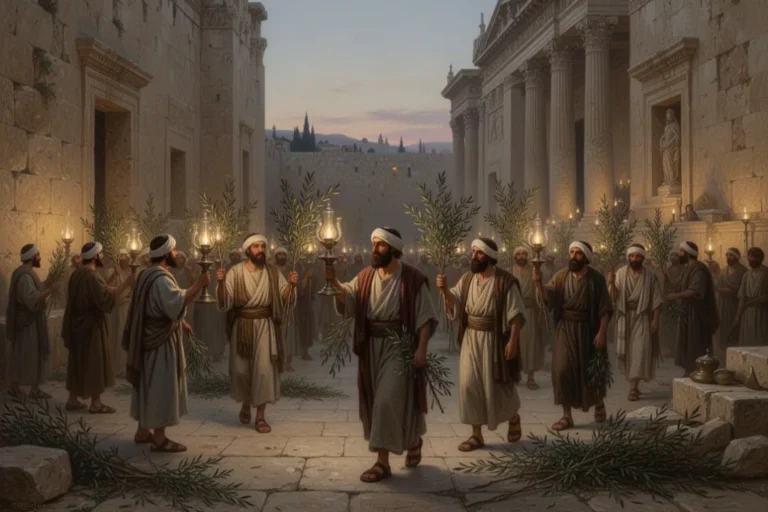
2 Maccabees 10 describes the people celebrating the rededication with joy, carrying branches and praising God. The account compares the gathering to the celebration of Sukkot. This is one reason the eight-day length is associated with the Temple’s restoration rather than with an ordinary one-day dedication ceremony.
A later rabbinic tradition, recorded in the Talmud, gives another well-known explanation for the eight days. According to that tradition, the Jews found only enough consecrated oil to keep the Temple lamp burning for one day, but it continued burning for eight days, allowing time to prepare more oil.
This oil story is central to the way many Jewish people understand Hanukkah today. It explains the custom of lighting the hanukkiah, a nine-branched lamp used during the holiday. Eight branches represent the eight nights, while a separate helper candle, called the shamash, is used to light the others.
The earliest historical accounts focus strongly on the Temple’s purification and dedication. The later rabbinic tradition places greater emphasis on the miracle of the oil. These are not necessarily competing meanings. They represent different layers in the festival’s development and help explain why both the historical victory and the symbolism of light remain important.
Each night, one additional candle is lit. The number of lights increases from one on the first night to eight on the final night. Jewish families may say blessings, sing traditional songs, display the lights, exchange gifts, play with a dreidel, and eat foods cooked in oil.
Common foods include latkes, or potato pancakes, and sufganiyot, jelly-filled doughnuts. Their use of oil recalls the oil tradition associated with Hanukkah. Customs vary among Jewish communities, and not every family observes the holiday in exactly the same way.
What John 10 says about the Feast of Dedication
The New Testament mentions the Feast of Dedication only in John 10:22. The verse places Jesus in Jerusalem during winter and says that he was walking in the Temple area at Solomon’s Colonnade, a covered walkway connected with the Temple complex.
The setting matters because the conversation that follows concerns Jesus’ identity and authority. Some Jewish leaders ask him to state plainly whether he is the Messiah. Jesus responds by pointing to his works, the relationship between himself and his followers, and his unity with the Father. The discussion becomes increasingly intense, and his opponents accuse him of blasphemy.
The passage does not record Jesus instituting Hanukkah as a Christian festival. It does show that Jesus was present in Jerusalem during the Jewish Feast of Dedication. The Gospel places his teaching within a real Jewish calendar and a meaningful national-religious setting.
John’s use of the festival may also contribute to the passage’s imagery. Hanukkah is associated with lamps, restored worship, and the Temple. John’s Gospel frequently uses themes of light, life, shepherding, and divine presence. Those themes appear elsewhere in the Gospel, although John 10 itself does not directly explain the festival as a symbol or provide a formal interpretation of its candles.
Readers should avoid claiming more than the text says. John 10 does not say that Jesus celebrated the holiday in a specific modern form, because the later customs of Hanukkah developed over time. It does establish that the Feast of Dedication was a recognized Jewish observance during Jesus’ ministry and that he was in the Temple during it.
The passage can be read with attention to several details:
Historical setting: Jesus lived within Jewish religious life and observed the rhythms of the Jewish calendar.
Temple setting: His teaching took place in the sacred space connected with the festival’s historical meaning.
Public identity: The question about whether Jesus is the Messiah forms the center of the dispute.
Shepherd imagery: Jesus describes his relationship with his followers using language of hearing, knowing, and protection.
Conflict over authority: The exchange shows how claims about Jesus’ identity were received by some of the leaders around him.
Reading John 10 carefully: The Feast of Dedication supplies the time and setting for the conversation; the passage itself focuses on Jesus’ identity, his works, his followers, and his relationship with the Father.
How the Feast of Dedication differs from other biblical festivals
People sometimes confuse Hanukkah with one of the Old Testament festivals because it is connected with the Temple. Its origin and purpose are different. Hanukkah remembers events from the period between the Old and New Testaments, while festivals such as Passover and Sukkot were established in the Torah.
Passover commemorates the Israelites’ deliverance from slavery in Egypt. Its central themes include redemption, sacrifice, covenant, and the Exodus. Hanukkah, by contrast, remembers the recovery and rededication of the Temple after the Maccabean revolt.
Sukkot remembers Israel’s wilderness years and celebrates God’s provision. It lasts seven days, followed by an additional sacred assembly in the biblical calendar. Hanukkah lasts eight days, and its length is associated with the rededication celebration and later with the oil tradition.
Purim remembers the deliverance of the Jewish people from the threat described in the Book of Esther. Like Hanukkah, it is a later Jewish festival not commanded in the Torah. The two holidays commemorate different dangers and use different customs, readings, and calendar dates.
Christmas is a Christian observance of Jesus’ birth and is not the same holiday as Hanukkah. They may occur near each other on the Gregorian calendar, but they come from different histories and religious traditions. The phrase “Feast of Dedication” in John 10 refers to Hanukkah, not to Christmas.
Understanding these distinctions helps prevent a common mistake: treating every biblical or Jewish festival as if it had the same origin. The Bible reflects a long history of Jewish worship, including festivals established in the Torah and later commemorations connected with important events.
What the Feast of Dedication means for readers today
For Jewish communities, Hanukkah remains a living religious and cultural observance. It is not simply a memorial to an ancient military victory. The holiday keeps alive the memory of a community protecting its worship, preserving its identity, and restoring a sacred center after destruction and defilement.
The candles provide a visible way to mark the passage of the eight nights. In Jewish practice, the lights are generally displayed where they can be seen, making the act of remembering public rather than private. Families and communities may also gather for prayer, meals, songs, study, and traditional games.
For Christians reading John 10, Hanukkah offers historical context for Jesus’ words. It reminds readers that Jesus taught within a Jewish world shaped by the Temple, Scripture, religious festivals, foreign occupation, and debates about Israel’s hope. The passage should not be detached from that setting.
Christians may draw personal themes from Hanukkah, such as faithfulness, courage, remembrance, and renewed worship. Those reflections should be made respectfully, without claiming that Hanukkah is a Christian holiday or replacing its Jewish meaning with a purely Christian interpretation.
The festival can also prompt careful questions about religious memory. What does a community preserve when its traditions are threatened? How does a place recover after being dishonored? Why do rituals of light, food, music, and gathering remain powerful long after the original events?
Those questions do not require the reader to flatten the differences between Judaism and Christianity. They allow the historical meaning of Hanukkah to remain clear while recognizing why the Feast of Dedication matters in the Gospel of John.
If you are studying the biblical reference, a useful approach is to read the surrounding section of John 10 rather than isolating one phrase. You can then compare the Gospel’s account with the historical descriptions in 1 and 2 Maccabees and with later Jewish traditions about the oil and the hanukkiah.
Read John 10:22-39 to understand the conversation taking place during the festival.
Read 1 Maccabees 4 for a historical account of the Temple’s cleansing and rededication.
Read 2 Maccabees 10 for another account of the celebration and its connection with Sukkot.
Distinguish early and later traditions, especially the historical account of the rededication and the later story of the oil.
Respect the festival’s Jewish identity when applying spiritual or theological reflections.
The Feast of Dedication is therefore both a historical remembrance and a continuing Jewish festival. In the Bible, it gives the setting for a major conversation about Jesus in the Temple. In Jewish life, Hanukkah remembers the rededication of the Temple, the endurance of Jewish worship, and the light that continues from one generation to the next.
Frequently asked questions
Is the Feast of Dedication the same as Hanukkah?
Yes. The Feast of Dedication is an English name for Hanukkah, also spelled Chanukah. The name refers to the rededication of the Jerusalem Temple after the Maccabean revolt in the second century BCE. The holiday lasts eight days and is commonly associated with the lighting of the hanukkiah, or Hanukkah menorah.
Where is the Feast of Dedication mentioned in the Bible?
It is mentioned by name in John 10:22. The passage places Jesus in Jerusalem during the festival, walking in the Temple area at Solomon’s Colonnade. The conversation that follows focuses on Jesus’ identity, his works, his followers, and his relationship with the Father.
Is Hanukkah one of the festivals commanded in the Old Testament?
No. Hanukkah was established after the Torah period to commemorate the rededication of the Temple in 164 BCE. It is different from Passover, Sukkot, and other festivals commanded in the Torah. Its history is described in 1 and 2 Maccabees, with additional traditions developing in later Jewish writings.
Why does Hanukkah last eight days?
Ancient accounts connect the eight-day celebration with the Feast of Booths, which had not been properly observed while the Temple was under foreign control. A later rabbinic tradition connects the eight days with oil that supposedly lasted for eight days in the Temple lamp. Both explanations influence Jewish understanding of the holiday.


Leave a Reply