What is a timbrel? Meaning, history, and Bible references
What is a timbrel? Meaning, history, and Bible references
If you have seen the word timbrel in the Bible, you may wonder what kind of instrument it describes. Was it a tambourine, a drum, or something else? In most biblical passages, a timbrel was a small handheld frame drum played by striking or shaking it, often while people sang, danced, or celebrated.
The word is an older English term found especially in the King James Version and some other traditional translations. Modern translations may use tambourine, hand drum, or simply drum. The exact ancient design cannot be reconstructed with complete certainty, but the biblical context gives a clear picture: a timbrel was a portable percussion instrument associated with communal music and joyful occasions.
A timbrel probably consisted of a round wooden frame covered with animal skin. The player could hold it in one hand and strike the head with the other, tap it against the palm, or move it rhythmically while playing. Some related frame drums in the ancient Mediterranean world had metal pieces or small disks attached to the frame, although the Bible does not describe every timbrel as having jingles.
This distinction matters because readers often picture a modern tambourine automatically. A biblical timbrel may have resembled a tambourine, but the word does not prove that every example had metal jingles. The safest description is a handheld frame drum used for rhythm.
The Hebrew term commonly translated “timbrel” is tof, also spelled toph in transliteration. It refers to a percussion instrument connected with singing, dancing, festal processions, and public celebration. The same basic instrument could appear in religious worship, a victory celebration, a family gathering, or a royal procession.
Plain definition: A timbrel was an ancient hand-played frame drum, often used by women and groups accompanying singing, dancing, or worship.
Why the Bible mentions the timbrel
The timbrel appears in scenes where music expresses a strong communal response. It is not usually presented as a quiet solo instrument. Instead, it helps mark a shared moment: a people rescued from danger, a family celebration, a victory, a procession, or worship before God.
Several patterns appear in the biblical references:
Women frequently played timbrels while singing and dancing.
The instrument often accompanied celebration after deliverance or victory.
Timbrels could form part of organized musical worship.
The sound could also represent ordinary festivity, dancing, and social joy.
Not every reference is positive; prophetic passages sometimes mention the timbrel in warnings about excessive luxury or judgment.
These uses show why the timbrel carries more meaning than “an old musical instrument.” In biblical writing, it can signal movement from sorrow to joy, danger to safety, or waiting to celebration. Its sound belongs to public life rather than private listening.
How the timbrel appears in major Bible passages
Miriam’s timbrel after the Red Sea crossing
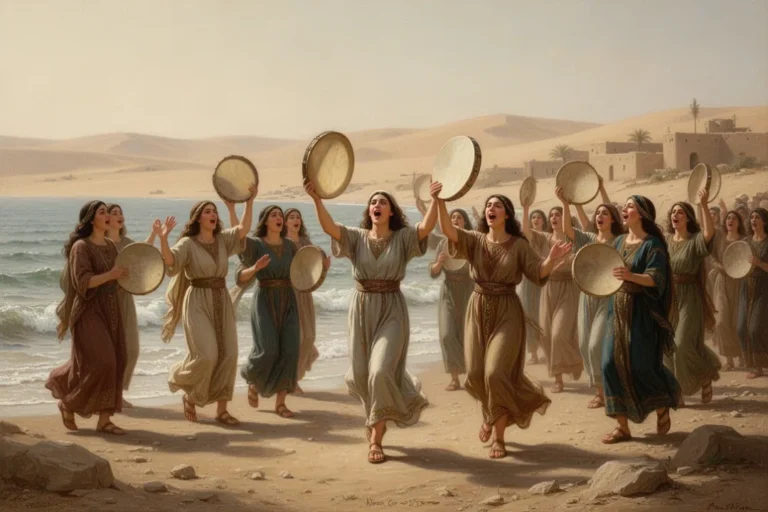
The best-known timbrel passage is Exodus 15:20-21. After the Israelites passed through the sea and escaped Pharaoh’s army, Miriam the prophet took a timbrel. Other women followed her with timbrels and dancing while they responded to the song celebrating God’s victory.
This scene explains several features of the instrument at once. The timbrel was portable, suitable for a large group, and closely connected with dancing. It also shows women taking an active public role in leading a musical response. Miriam is not described as playing alone in a private setting; she leads a community celebration.
The context gives the timbrel a strong association with deliverance and thanksgiving. The instrument does not cause the victory. It gives physical and audible expression to the people’s response after the danger has passed.
Jacob’s departure from Laban
In Genesis 31:27, Laban complains that Jacob left without allowing him to send Jacob away with songs, tambourine-like instruments, and a harp. The setting is a family departure, though the relationship between Jacob and Laban is tense and complicated.
This reference is useful because it places the timbrel outside a formal worship service. Music involving the instrument could accompany a farewell feast or household celebration. The verse also suggests that stringed instruments and percussion could be played together, creating a broader musical ensemble.
In 1 Samuel 10:5, Samuel tells Saul that he will meet a group of prophets coming down from a high place with a harp, a timbrel, a flute, and a lyre. The scene presents several instruments played together during prophetic activity.
That passage shows that the timbrel was part of a recognizable musical vocabulary in ancient Israel. It was not an unusual object brought out only for one famous celebration. People knew it as one instrument among several that could support singing, procession, or prophetic expression.
Celebrations after military victories
First Samuel 18:6 describes women coming out from Israelite towns to meet Saul and David after a victory. They sing and dance with songs of joy, accompanied by timbrels and other instruments. The passage emphasizes the public nature of victory music and the way communities honored returning warriors.
The timbrel’s sound here is celebratory and social. It joins voices, movement, and public recognition. The scene also helps explain why later readers may associate the instrument with women’s dance music, although the Bible’s references should not be reduced to a rule that only women played it.
Timbrels in the Psalms
Several Psalms mention the timbrel as part of praise. Psalm 81:2 calls for instruments including the timbrel in a festival setting. Psalm 149:3 connects praise, singing, and dancing with the timbrel and lyre. Psalm 150:4 names the timbrel among instruments used to praise God.
These passages place percussion within the full range of worship. The timbrel is not treated as spiritually inferior to a stringed instrument. Its rhythm supports bodily movement and communal participation, making it especially suited to festal praise.
Psalm 150 is particularly broad in its invitation to use different kinds of instruments. Its list includes wind, stringed, and percussion instruments. The point is not to create a modern technical inventory but to portray praise as expansive, audible, and physically expressive.
How to identify a timbrel from the biblical context
When you encounter the word in a Bible passage, you can usually understand its role by looking at the surrounding action. The instrument itself is only part of the meaning. The people playing it, the occasion, and the accompanying movements often tell you more.
Check the translation. Compare the word “timbrel” with a modern translation, where it may appear as “tambourine” or “hand drum.”
Read the surrounding verses. Look for clues such as singing, dancing, feasting, marching, victory, worship, or mourning.
Notice who plays it. Some passages specifically mention women, while others describe groups of musicians more generally.
Compare nearby instruments. A harp, lyre, flute, or trumpet can help establish the musical setting, even when the exact sound of the timbrel is uncertain.
Separate the object from its symbolism. The timbrel may represent celebration in one passage and worldly luxury or impending judgment in another.
This method prevents a common mistake: assuming that every mention of a timbrel means a worship service. Biblical references include household gatherings, national celebrations, prophetic scenes, temple-related praise, and poetic descriptions of life and judgment.
How a timbrel was probably played
Ancient frame drums can be played in several ways, so a timbrel probably did not have one fixed technique. A musician might strike the center of the drumhead for a deeper tone, tap near the edge for a sharper sound, or use the fingers to produce quick rhythmic patterns.
The player could also hold the instrument upright or at an angle while dancing. If the frame carried small metal pieces, movement could add a rattling sound. However, biblical passages do not give enough construction details to establish whether jingles were standard on every timbrel.
The instrument’s size made it practical for outdoor events and processions. Unlike a large stationary drum, a timbrel could be carried while walking or dancing. Its sound would help a group maintain a beat and coordinate movement, especially when many people were singing together.
Its musical role was probably rhythmic rather than melodic. A timbrel does not normally produce a series of fixed pitches like a harp or flute. Instead, it supplies pulse, accents, and energy, allowing voices and other instruments to remain connected.
Translation caution: “Timbrel” and “tambourine” are useful modern equivalents, but neither word tells us every detail about the ancient instrument’s size, frame, drumhead, or jingles.
The timbrel’s place in worship reflects the Bible’s broad understanding of praise. Worship could involve the voice, instruments, movement, procession, and the gathered community. A percussion instrument made rhythm audible and helped turn individual praise into a shared act.
In Psalm 150, the timbrel appears alongside several other instruments. This suggests that biblical worship was not limited to one approved musical texture. Different instruments could contribute different qualities: strings offered melodic support, wind instruments added a strong public sound, and percussion supplied rhythm and physical momentum.
That does not mean every worship tradition must use a timbrel or a modern equivalent. Biblical descriptions of instruments are not always direct instructions for every later community. They do show, however, that joyful physical expression and varied musical accompaniment can belong within biblical praise.
The timbrel also connects worship with the body. A person does not simply hear its beat; the rhythm invites clapping, stepping, dancing, and coordinated movement. In the biblical imagination, praise can be something a whole community does with voice, hands, feet, and instruments.
Why women are often associated with timbrels
Several famous passages feature women playing timbrels. Miriam leads women after the Red Sea crossing, and women play them while celebrating military victories. These scenes have shaped the popular image of the timbrel as a women’s instrument.
The association is understandable, but it should be stated carefully. The passages show that women played timbrels publicly in important celebrations. They do not necessarily establish an exclusive gender restriction. Other references describe the timbrel as one instrument in a broader musical setting without specifying who plays it.
The repeated appearance of women with timbrels may reflect the social forms of procession and dance common in the ancient Near East. Women’s singing and dancing could mark births, weddings, departures, victories, religious festivals, and other major communal moments. In these settings, the timbrel made their participation visible and audible.
Miriam’s role is especially significant because she is identified as a prophet. Her leadership links music with public testimony and spiritual authority. She does not merely provide background sound; she helps lead the community’s response to deliverance.
How “timbrel” differs from “tambourine”
In everyday American English, tambourine is the word most people recognize. A tambourine generally means a shallow frame drum, often with metal jingles set into the frame. It can be played by striking the head, tapping the frame, shaking it, or combining these techniques.
“Timbrel” is an older English word that often translates the Hebrew tof. In many contexts, “tambourine” communicates the general idea well. The difference is that the modern instrument has a familiar standardized design, while the ancient biblical instrument may have varied in construction.
It is better to say that a timbrel was tambourine-like than to insist that it was identical to a modern concert or folk tambourine. Archaeological evidence from the ancient Near East includes frame drums and related percussion instruments, but identifying one surviving object as the exact instrument named in every biblical verse is difficult.
The spelling can also create confusion. “Timbrel” is singular, while “timbrels” is plural. Some translations use “tabret,” “tabret” being another older English term related to a small drum. Modern readers may encounter all of these words for instruments within the same general family.
Places where the timbrel signals ordinary celebration
Not every biblical use of the timbrel is connected to sacred praise. In Job 21:12, for example, the timbrel appears in a description of people enjoying music and celebration. The passage is part of a larger reflection on the apparent prosperity of the wicked, so the instrument contributes to a picture of ordinary pleasure rather than endorsing everything about the people described.
Isaiah 5:12 also mentions the timbrel among instruments used at feasts. The problem in that passage is not the mere existence of music. The prophet criticizes a self-indulgent attitude that enjoys feasting while failing to recognize God’s work and the serious condition of the nation.
These examples are useful because they prevent an overly narrow interpretation. A timbrel could accompany worship, but it could also appear at a feast or a social celebration. Its moral meaning depends on the scene in which it is used.
When the timbrel appears in warnings and prophecy
Prophetic books sometimes use the timbrel in language about judgment, mourning, or the collapse of luxury. Isaiah 24:8 describes the cessation of joyful sounds, including the timbrel, as part of a larger picture of the land’s devastation. The silence of the instrument represents the loss of normal celebration.
Jeremiah 31:4 uses the timbrel in a hopeful promise of restoration. The image is of people going out again with dancing and timbrels after a period of loss. Here, the instrument represents renewed community life and joy.
These contrasting passages show how a sound can carry symbolic weight. When the timbrel is heard, it may suggest freedom, festivity, worship, or restored life. When it falls silent, the silence can suggest grief, judgment, exile, or the interruption of ordinary human happiness.
What the timbrel can teach modern Bible readers
The timbrel reminds readers that biblical music was often communal and participatory. People sang together, moved together, and marked important events with rhythm. Music was not always performed by a distant specialist for a silent audience.
It also offers a more complete picture of biblical worship. The Bible includes solemn prayer and lament, but it also includes dance, instruments, processions, and loud celebration. The timbrel belongs to that physical, public side of praise.
At the same time, the instrument should not be romanticized. The Bible does not treat music as automatically holy simply because it is loud or festive. In prophetic passages, celebration can become empty when people ignore justice, humility, or responsibility. The instrument’s value depends on the meaning and conduct surrounding its use.
As a historical object: the timbrel was a portable frame drum.
As a musical tool: it supplied rhythm for singing, dancing, and processions.
As a social symbol: it marked shared joy, victory, feasting, and public celebration.
As a worship instrument: it joined the voice and body in communal praise.
As a poetic image: its sound could represent restoration, while its silence could represent judgment or loss.
How to explain “timbrel” in one sentence
If you need a concise definition for Bible study, teaching, or personal reading, you can say: A timbrel was an ancient handheld frame drum, similar in general form to a tambourine, used to accompany singing, dancing, worship, processions, and celebrations.
That definition preserves what is clear while avoiding claims the biblical evidence cannot prove. It identifies the instrument’s family, how it was played, and the settings in which it commonly appeared. It also explains why the word remains vivid in passages about Miriam, victory, praise, and restored joy.
Frequently asked questions
Is a timbrel the same thing as a tambourine?
A timbrel was probably similar to a tambourine because both belong to the family of handheld frame drums. The difference is mainly one of historical precision. Modern tambourines commonly have metal jingles, while the Bible does not establish that every timbrel had them. “Tambourine” is a reasonable modern translation, but “frame drum” is a more cautious description.
Who played the timbrel in the Bible?
Women are especially prominent in the best-known accounts. Miriam and the women with her played timbrels after the Red Sea crossing, and women used them while celebrating military victories. Other verses mention the instrument without identifying the players. The biblical evidence supports a strong association with women’s public singing and dancing, not necessarily an exclusive rule about who could play it.
What does the timbrel symbolize in Scripture?
Its meaning depends on the passage. A sounding timbrel can represent victory, thanksgiving, worship, communal joy, or restored life. Its absence or silence may suggest judgment, mourning, or the loss of ordinary celebration. The instrument itself is not always presented as morally good or bad; its significance comes from the event and behavior surrounding its use.
Where should I read about the timbrel first?
Exodus 15:20-21 is the clearest starting point because it describes Miriam and the women celebrating with timbrels and dancing. Psalm 150:4 shows the instrument in praise, while Psalm 149:3 connects it with dancing. First Samuel 18:6 gives another vivid example of timbrels accompanying public celebration after a victory.











Leave a Reply