When you hear about Solomon in the Bible, you may wonder how the same king could be famous for extraordinary wisdom and yet end his reign in spiritual failure. The biblical answer is that Solomon was both a gifted ruler and a deeply divided man. He became Israel’s third king, built the first temple in Jerusalem, wrote or inspired important wisdom literature, and brought the kingdom extraordinary wealth. He also allowed political alliances and personal desires to pull him away from wholehearted faithfulness to God.
Solomon was the son of David and Bathsheba. He ruled over the united kingdom of Israel after David and before the nation split into the northern kingdom of Israel and the southern kingdom of Judah. His story appears mainly in 1 Kings 1–11 and 2 Chronicles 1–9, with additional connections to Proverbs, Ecclesiastes, and Song of Songs.
Solomon’s birth followed a painful period in David’s life. David’s relationship with Bathsheba and the death of her first child are described in 2 Samuel 11–12. Afterward, Bathsheba gave birth to Solomon, and the text says that the Lord loved him. The prophet Nathan gave him the name Jedidiah, meaning “beloved of the Lord,” although the king is normally called Solomon throughout the biblical account.
Solomon was not David’s oldest son, so his succession was not automatic. Near the end of David’s life, Adonijah, another son, presented himself as the next king. Bathsheba and Nathan reminded David of his earlier promise that Solomon would rule after him. David then instructed the priest Zadok and the prophet Nathan to anoint Solomon as king. This public anointing made clear that Solomon, rather than Adonijah, would inherit the throne.
The beginning of Solomon’s reign involved serious political danger. Adonijah had supporters among prominent leaders, including Joab and Abiathar the priest. Solomon initially showed mercy, but he later dealt firmly with threats against his rule. According to 1 Kings 2, Adonijah, Joab, and Shimei were removed from the political scene, while Abiathar was sent away from the priesthood. These events established Solomon’s authority, though they also show that his reign began in an atmosphere of rivalry and bloodshed.
A useful distinction: The Bible presents Solomon’s accession as part of God’s provision for David’s dynasty, but it does not portray every action taken during the transition as morally simple or emotionally comfortable.
What Solomon asked God to give him
After becoming king, Solomon went to Gibeon, where the main sanctuary was located before the temple was built. There, God appeared to him in a dream and invited him to ask for what he wanted. Solomon did not ask for a long life, personal riches, or victory over his enemies. He asked for an understanding heart so he could govern God’s people and distinguish right from wrong.
In 1 Kings 3, Solomon’s request is presented as a sign of humility. He recognized that ruling Israel was too serious for human cleverness alone. God granted him unusual wisdom and also promised riches and honor. The passage connects wisdom with the ability to judge fairly, not simply with intelligence, academic knowledge, or the skill to solve riddles.
The famous judgment involving two women who claimed the same baby illustrates this wisdom. Solomon proposed dividing the child, knowing that the true mother would rather give up the baby than see it harmed. The judgment exposed the genuine mother’s compassion and caused the people to respect the king’s ability to administer justice.
Solomon’s wisdom also extended into the natural world and the study of life. First Kings 4 describes his knowledge of plants and animals, as well as his many sayings and songs. The passage says that people from other nations came to hear him. The point is not that Solomon knew every fact, but that his reputation for discernment reached far beyond Israel.
How Solomon’s wisdom appears in Proverbs, Ecclesiastes, and Song of Songs
The Bible connects Solomon especially with wisdom literature. Proverbs 1:1 identifies Solomon as the son of David and king of Israel, and several sections of the book are associated with him. Proverbs gathers short teachings about speech, work, money, discipline, friendship, sexual integrity, family life, and the fear of the Lord. It is not a collection of promises that every wise choice produces immediate success. Instead, it teaches patterns of wise living while recognizing that life can be unjust and unpredictable.
Solomon’s name also appears in the headings of some psalms, including Psalm 72 and Psalm 127. These headings associate him with royal prayer and practical wisdom, though biblical scholars discuss how each heading relates to authorship, dedication, or later use. The safest description is that Solomon stands at the center of Israel’s royal wisdom tradition, while not every piece of literature linked with him can be assigned to him with certainty.
Ecclesiastes is traditionally associated with Solomon because its speaker describes himself as a son of David and a king in Jerusalem who possessed unusual wealth, wisdom, and opportunities. The book does not simply celebrate wisdom as a solution to every problem. It examines death, injustice, work, pleasure, aging, and the limits of human control. Its repeated reflection on the “vanity” or fleeting character of life leads readers to take God seriously rather than treating human achievement as ultimate.
Song of Songs is traditionally connected with Solomon as well. It is a poetic celebration of love and desire between a bride and groom. Some readers interpret it only as an allegory of God’s relationship with his people, but its immediate language honors marital affection and the goodness of embodied love. The connection to Solomon should be handled carefully because the book’s title and traditional association do not settle every question about its composition.
Why Solomon built the temple in Jerusalem
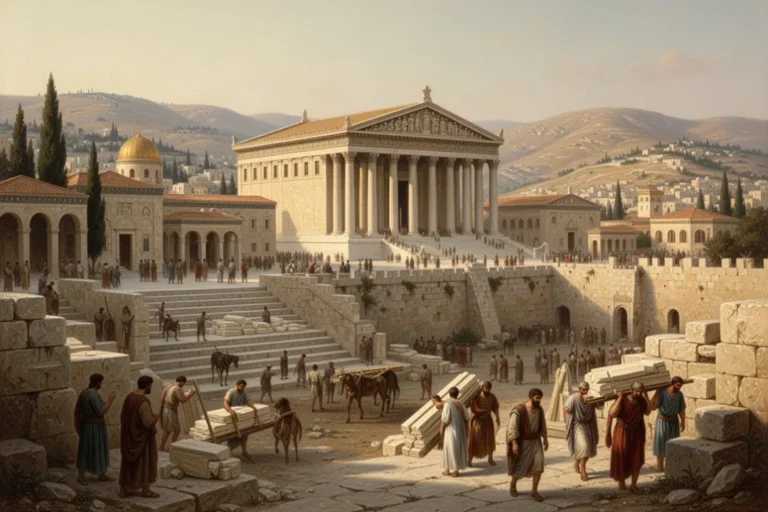
David wanted to build a permanent house for the Lord, but God told him that his son would carry out that work. Solomon fulfilled this role by building the temple in Jerusalem. Construction began during the fourth year of his reign, according to 1 Kings 6, and the work took seven years. The building replaced the portable tabernacle as the central sanctuary of Israel, although God was never presented as being confined to a structure.
The temple was an enormous religious and national project. Solomon obtained cedar and other materials through cooperation with Hiram, king of Tyre. Skilled workers shaped stone and wood, while craftsmen created furnishings associated with worship. The inner sanctuary, known as the Most Holy Place, contained the ark of the covenant. Cherubim and other decorative features emphasized the holiness and majesty of the place.
At the dedication, Solomon prayed before the people. His prayer in 1 Kings 8 praises God’s faithfulness to David, asks God to hear prayers directed toward the temple, and recognizes that even the highest heavens cannot contain God. He also asks for mercy when Israel sins, suffers defeat, experiences drought, or faces other trouble. The temple therefore functioned not as a magical guarantee of national success but as a place connected with repentance, worship, covenant, and prayer.
Solomon’s prayer includes concern for foreigners who turn toward the Lord. That detail matters because it shows a vision of the temple extending beyond Israel’s private national interests. At the same time, later events reveal that Solomon himself did not consistently live according to the exclusive worship that the temple represented.
How Solomon’s kingdom gained wealth and influence
Solomon’s reign brought Israel considerable prosperity and international visibility. First Kings 4 describes a kingdom with administrative districts, organized provisions for the royal household, security, and peace with surrounding areas. The biblical writer presents Judah and Israel as numerous and well supplied, with people living securely during much of Solomon’s rule.
Trade helped strengthen Solomon’s kingdom. He developed relationships with neighboring rulers and participated in commercial activity involving horses, chariots, timber, metals, spices, and luxury goods. The account of the queen of Sheba in 1 Kings 10 portrays a foreign monarch who traveled to test Solomon with difficult questions. She was impressed by his wisdom, his administration, the food at his table, the organization of his officials, and the temple and palace complex.
Solomon’s wealth was also displayed through gold, silver, imported goods, royal furnishings, and military equipment. The description is intentionally lavish, presenting him as the most prosperous king of Israel’s united monarchy. Yet the same details raise a moral question: Does prosperity show faithfulness? In Solomon’s case, material success and spiritual obedience did not always move together.
His building program included more than the temple. He constructed a royal palace, government facilities, fortified cities, storage centers, and military installations. These projects strengthened the state, but they required labor, taxes, and administrative control. The splendor seen by the queen of Sheba depended on an economic system that placed heavy demands on the population.
What Solomon’s marriages and alliances reveal
First Kings 11 says that Solomon loved many foreign women and gives the striking figures of 700 wives and 300 concubines. These relationships were not described merely as private romantic choices. They were tied to diplomacy, royal power, and alliances with neighboring peoples. The biblical concern is that many of these wives turned Solomon’s heart toward other gods.
The law given to Israel’s kings in Deuteronomy 17 warned against multiplying wives, horses, and silver and gold. Solomon accumulated all three. His marriages therefore represented more than a departure from one isolated rule; they revealed a pattern in which royal power, military strength, wealth, and political alliances became ends in themselves.
First Kings 11 says Solomon built worship sites for deities associated with some of his wives. The text names Ashtoreth, Milcom, Chemosh, and Molek. It does not say that Solomon abandoned every form of worship of the Lord. The tragedy is his divided loyalty: he continued to stand within Israel’s religious life while also permitting and supporting worship that violated the covenant.
The central warning in Solomon’s story: A person can begin with a sincere desire for wisdom, accomplish important good, and still drift through repeated compromises. The biblical account treats divided loyalty as a gradual danger, not merely a sudden change of belief.
How Solomon’s policies contributed to the kingdom’s division
Solomon’s reign looked strong from the outside, but discontent was growing underneath. The forced labor system and taxation required by his building projects placed pressure on the tribes. First Kings 5 describes labor arrangements for the temple, while 1 Kings 9–10 describes additional construction and administration. These policies helped create a powerful kingdom, but they also increased the burden carried by ordinary people.
After Solomon died, the people asked his son Rehoboam to reduce the heavy yoke imposed by his father. Rehoboam rejected the advice of older counselors and promised even harsher rule. The northern tribes then rebelled under Jeroboam, leaving Rehoboam with control mainly over Judah and Benjamin. This became the division between the northern kingdom of Israel and the southern kingdom of Judah.
The split cannot be blamed on one conversation alone. First Kings explains it within a larger pattern: Solomon’s idolatry, the Lord’s judgment, political opponents, economic pressure, and Rehoboam’s unwise response all contributed. The biblical narrative holds together divine judgment and human responsibility rather than reducing the event to a single cause.
Jeroboam’s rebellion was supported by the prophet Ahijah, who symbolically tore a new garment into pieces and gave ten pieces to Jeroboam. Solomon’s failure did not erase God’s earlier promise to David, but it did change the form and stability of the kingdom. The united monarchy would not continue after Solomon as it had during his reign.
Common mistakes when interpreting Solomon’s story
Calling Solomon flawless because he was wise: The Bible praises his gift but also records his serious disobedience.
Assuming wealth proves God’s approval: Solomon’s prosperity coexisted with forced labor, political tension, and idolatry.
Reducing wisdom to cleverness: Biblical wisdom includes moral judgment, humility, reverence for God, and practical obedience.
Treating the temple as a magic shield: Solomon’s dedication prayer emphasizes repentance and God’s freedom rather than automatic protection.
Claiming every book associated with Solomon was certainly written by him: Proverbs, Ecclesiastes, and Song of Songs have traditional connections to him, but questions of composition and authorship remain.
Ignoring the political cost of his achievements: The kingdom’s impressive buildings and wealth depended on systems that burdened the people.
Assuming the Bible gives a clear final statement about his salvation: Scripture records his drift and God’s judgment, but it does not provide a simple final verdict about his eternal destiny.
What the Bible says about Solomon’s final years
First Kings 11 shifts from Solomon’s achievements to the consequences of his divided heart. The Lord raised adversaries against him, including Hadad the Edomite and Rezon of Damascus. Jeroboam, one of Solomon’s officials, also became a future opponent. These threats signaled that the kingdom’s peace and security were not permanent.
The text says God was angry with Solomon because his heart had turned away from the Lord, who had appeared to him twice and commanded him not to follow other gods. Solomon’s failure was therefore especially serious because it came after direct blessing, extraordinary wisdom, and clear instruction. His knowledge did not automatically produce obedience.
Even while announcing judgment, God preserved a remnant of the kingdom for David’s sake. The promised line would continue in Jerusalem, though it would be disciplined. Solomon died after reigning for forty years, and his son Rehoboam succeeded him. The account does not describe a dramatic repentance scene near Solomon’s death, which leaves readers with a deliberate tension: his accomplishments were real, his wisdom was remarkable, and his later unfaithfulness was also real.
How later biblical writers use Solomon as an example
Solomon’s reputation continued beyond the historical books. Jesus referred to “Solomon in all his glory” in Matthew 6:29 while teaching that God’s care is greater than human display. The comparison shifts attention away from royal clothing and toward trust in God’s provision. In Matthew 12:42, Jesus referred to the queen of the South, commonly identified with the queen of Sheba, who traveled to hear Solomon’s wisdom. Jesus used her response to challenge people who were failing to respond to someone greater than Solomon.
These references do not deny Solomon’s greatness. They place it in proper proportion. His wisdom, wealth, and temple were impressive, but they were not the highest revelation of God’s purposes. The New Testament presents Jesus as greater than Solomon, especially in wisdom and authority.
Solomon also remains a major example in biblical reflection on leadership. A ruler may have education, resources, prestige, and the ability to make excellent decisions, yet still need a faithful heart. His story warns against separating public success from private character. It also shows why institutions and achievements require moral boundaries if they are to serve people rather than consume them.
Practical lessons from Solomon for modern readers
Solomon’s life is useful for more than answering a Bible trivia question. It raises questions about how you define success, how you respond to abundance, and how small compromises shape long-term character. His story does not suggest that wisdom, wealth, marriage, or political cooperation are inherently wrong. It shows that good gifts become dangerous when they displace loyalty to God and responsibility toward others.
Ask for wisdom that leads to action. Solomon requested discernment for governing well. Seek understanding that helps you make fair, truthful, and compassionate decisions, not merely information that makes you sound informed.
Measure success by faithfulness, not appearance. A growing career, impressive home, or respected reputation cannot by itself show that your life is spiritually healthy.
Watch gradual compromise. Solomon’s decline involved a pattern of choices involving alliances, wealth, wives, and worship. Review repeated habits before they become controlling loyalties.
Consider who bears the cost of your achievements. Large goals may appear admirable while placing unreasonable pressure on family members, coworkers, employees, or communities.
Keep wisdom connected to humility. Solomon began by admitting his need for help. Continue listening to correction, especially when success makes you less willing to receive it.
Read difficult biblical portraits honestly. The Bible does not need to make Solomon consistently admirable in order to show that God gave him real gifts and used his reign for important purposes.
For personal study, read 1 Kings 3, 1 Kings 8, 1 Kings 10–11, and 2 Chronicles 1–9 together. Then compare those passages with selected sections of Proverbs, Ecclesiastes, and Song of Songs. Pay attention to the difference between what Solomon accomplished, what Solomon desired, and how Solomon responded to God. That distinction captures the complexity of his life better than a simple label such as wise king or failed king.
Why Solomon still matters in the Bible
Solomon matters because his story brings together many biblical themes: promise and failure, wisdom and folly, worship and compromise, prosperity and injustice, leadership and responsibility. He built the temple that David envisioned, made Jerusalem a center of international attention, and gave Israel a lasting place in the wisdom tradition. Yet the king who understood the danger of divided loyalty eventually practiced it himself.
The most searching question raised by Solomon is not whether you possess gifts. It is whether your gifts remain directed toward God and the good of others. Wisdom can be requested, developed, and admired, but it must also be obeyed. Solomon’s life shows that a strong beginning and remarkable achievements do not remove the need for daily faithfulness.
Frequently asked questions
Was Solomon the richest person in the Bible?
Solomon is portrayed as extraordinarily wealthy, especially in 1 Kings and 2 Chronicles, but the Bible does not provide a complete ranking of every wealthy person. Its descriptions emphasize his gold, trade, royal buildings, horses, and international gifts. The purpose is to show the scale of his royal prosperity, not to establish a modern financial estimate or prove that wealth equals divine favor.
Did Solomon write all of Proverbs?
No. Proverbs identifies Solomon with several collections, but the book also names or refers to other contributors and editors, including the men of Hezekiah, Agur, and King Lemuel. Solomon was a major figure in Israel’s wisdom tradition, yet the biblical book’s final form appears to include material gathered over time. Traditional attribution should not be treated as proof that he personally composed every proverb.
Why did Solomon have so many wives?
Solomon’s marriages likely served political and diplomatic purposes as well as personal desires. Royal marriages could secure alliances with neighboring nations, but Deuteronomy warned Israel’s kings against multiplying wives because they could turn the king’s heart toward other gods. First Kings presents Solomon’s many relationships as a major cause of his divided worship and spiritual decline.
Did Solomon repent before he died?
The historical account in 1 Kings does not describe a clear, final repentance by Solomon. Ecclesiastes has traditionally been read by some as evidence of later reflection, but the text does not explicitly identify its speaker as Solomon in a direct historical statement. It is best to distinguish between possible interpretation and what Scripture plainly records: Solomon’s wisdom, accomplishments, idolatry, judgment, and death are described, while his final spiritual state is not clearly settled.





Leave a Reply