When you hear a church lesson mention the 12 apostles, you may remember a few names—Peter, John, or Judas—but not the complete list. The original group chosen by Jesus included fishermen, a tax collector, political idealists, and men whose backgrounds are barely described in the New Testament.
The 12 apostles of Jesus were Simon Peter, Andrew, James son of Zebedee, John, Philip, Bartholomew, Matthew, Thomas, James son of Alphaeus, Thaddaeus, Simon the Zealot, and Judas Iscariot. After Judas Iscariot died, Matthias was chosen to take his place among the apostles in Acts 1.
The names appear in lists in Matthew 10, Mark 3, Luke 6, and Acts 1. The order changes slightly, and some apostles are known by more than one name, but the core group is clear.
Simon Peter — A fisherman from Galilee and one of Jesus’ most prominent disciples.
Andrew — Peter’s brother, who brought Peter to Jesus according to John 1.
James son of Zebedee — A fisherman and brother of John, sometimes called James the Greater.
John — James’ brother and one of the three apostles especially close to Jesus.
Philip — An apostle from Bethsaida who appears in several important conversations in John’s Gospel.
Bartholomew — Usually associated by Christian tradition with Nathanael, although the New Testament does not directly state that the two names belong to the same person.
Matthew — A tax collector whom Jesus called to follow him; he is also called Levi in some Gospel passages.
Thomas — Also called Didymus, a name meaning “twin”; he is remembered for questioning reports of Jesus’ resurrection.
James son of Alphaeus — A less-documented apostle, sometimes called James the Lesser or James the Younger.
Thaddaeus — The name used in Matthew and Mark; Luke and Acts list a figure called Judas son of James, commonly understood as the same apostle.
Simon the Zealot — An apostle identified with the description “the Zealot,” distinguishing him from Simon Peter.
Judas Iscariot — The apostle who betrayed Jesus to the authorities and later died before Matthias was selected.
These men were not all equally visible in the Gospel narratives. Peter, James, and John appear frequently, while several others are mentioned only by name or in a small number of scenes. Their limited treatment in the text does not mean they were unimportant to the group’s mission.
Quick distinction: Judas Iscariot was one of the original 12 apostles. Matthias was not part of the original group during Jesus’ ministry; he was chosen later to fill the vacancy Judas left.
What “apostle” means and how the 12 were chosen
The word apostle comes from a Greek term meaning a person who is sent. In the Gospels, Jesus selected the Twelve for a particular role: they would stay with him, learn from him, represent his message, and later proclaim it publicly.
The apostles were also disciples, but the two words are not identical. A disciple is a learner or follower, while an apostle is a disciple commissioned or sent for a specific purpose. The New Testament refers to many followers of Jesus as disciples, but only a particular group is repeatedly identified as “the Twelve.”
Before naming the Twelve, Jesus spent time in prayer, according to Luke 6. He then appointed 12 men and gave them authority to preach, confront evil, and minister to people in need. Mark 3 and Matthew 10 describe similar commissioning scenes, including Jesus’ instruction that the apostles should announce that God’s kingdom was near.
The number 12 carries religious meaning. It recalls the 12 tribes of Israel, the descendants of Jacob. By forming a group of 12, Jesus signaled a renewed people of God centered on his teaching and mission. The apostles were therefore more than a casual group of friends; they represented a foundational community.
Jesus did not choose the Twelve because they had identical personalities, education, or social positions. Their differences are part of the picture. Matthew was associated with tax collection, Simon was identified as a Zealot, and several others worked as fishermen. The Gospels present them as ordinary people who had to learn through experience, correction, failure, and service.
Who the best-known apostles were
Peter, Andrew, James, and John
Simon Peter is the most prominent apostle in the Gospel accounts. Jesus gave him the name Peter, related to the idea of a rock or stone. Peter often speaks for the group, declares faith in Jesus as the Messiah in Matthew 16, and appears at major events such as the raising of Jairus’s daughter, the Transfiguration, and Jesus’ prayer in Gethsemane.
Peter also experienced serious failure. During Jesus’ arrest and trial, Peter denied knowing him three times, as described in all four Gospels. After the resurrection, John 21 portrays Jesus restoring Peter and entrusting him with pastoral responsibility. In Acts, Peter becomes a leading public witness in Jerusalem.
Andrew was Peter’s brother. John’s Gospel presents him as one of the first followers to recognize Jesus and then bring Peter to meet him. Andrew is less prominent than Peter, but he appears as someone who helps connect people with Jesus, including the boy whose food is used in the feeding of the multitude in John 6.
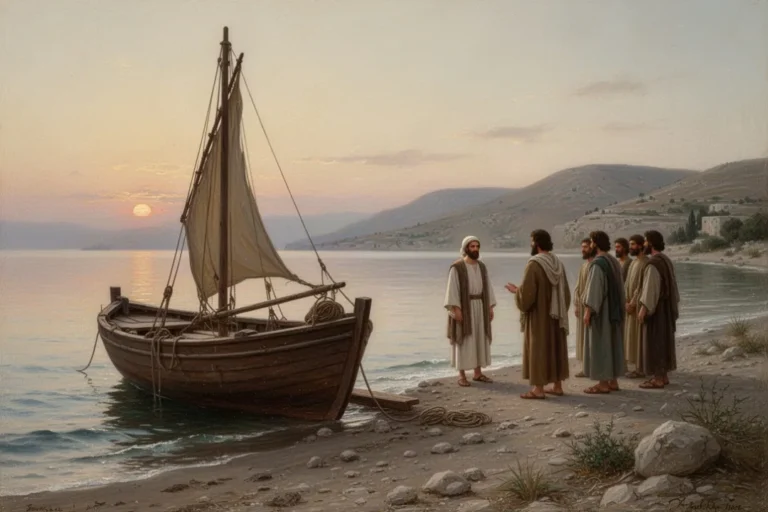
James son of Zebedee and John were brothers who worked as fishermen. Jesus called them while they were with their father and hired workers in a boat, according to Mark 1. Jesus gave the brothers the nickname Boanerges, explained as “sons of thunder,” suggesting a forceful or intense temperament.
James, John, and Peter formed an especially close group within the Twelve. They witnessed the raising of Jairus’s daughter, Jesus’ Transfiguration, and his anguish in Gethsemane. James was the first of the Twelve known to be killed for his faith; Acts 12 reports that King Herod Agrippa had him executed by the sword.
John is traditionally associated with the “disciple whom Jesus loved” in the Fourth Gospel, although the text does not name that disciple directly. Christian tradition also connects John with several New Testament writings, but the Gospel itself should be read carefully rather than assuming every traditional identification is stated explicitly in the text.
Philip, Bartholomew, Matthew, and Thomas
Philip appears prominently in John’s Gospel. He was from Bethsaida, the same town associated with Peter and Andrew, and he told Nathanael about Jesus. When Nathanael expressed doubt that anything significant could come from Nazareth, Philip responded by inviting him to meet Jesus rather than trying to win the argument.
Philip also appears in the feeding of the multitude, when Jesus asks him where bread could be purchased for the crowd. Later, during Jesus’ final teaching, Philip asks Jesus to show the disciples the Father. The exchange reveals that the apostles were still trying to understand Jesus’ relationship with God even after extended time with him.
Bartholomew is named in the apostolic lists but receives little individual attention. The name may be a family designation meaning “son of Tolmai.” Many Christians identify Bartholomew with Nathanael, who appears in John 1 and John 21, because Philip brings Nathanael to Jesus and the Synoptic lists place Philip and Bartholomew together. Still, the New Testament does not explicitly equate them.
Matthew is called a tax collector in Matthew 9, and the parallel account in Mark 2 names the tax collector Levi. Many Christian readers understand Matthew and Levi to be the same person, but the Gospel texts use different names. Tax collectors worked within a system connected to Roman administration, so many Jewish people viewed them with suspicion.
Jesus’ call of Matthew illustrates the social breadth of the apostolic group. Instead of treating a tax collector as permanently disqualified, Jesus called him to become a follower and host a meal for other tax collectors and people described as sinners. The episode emphasizes mercy, repentance, and Jesus’ willingness to associate with people considered religiously or socially unacceptable.
Thomas is called Didymus in John, which means “twin.” He first appears as a courageous but somewhat pessimistic follower. In John 11, when Jesus decides to return to Judea despite danger, Thomas says that the disciples should go with him, even if it means dying with him.
Thomas is best known for asking for evidence after the other disciples report that they have seen the risen Jesus. John 20 presents his hesitation and subsequent confession of faith. Calling him “Doubting Thomas” can reduce a more complex character to one moment, since the Gospel also shows Thomas speaking honestly, seeking understanding, and remaining part of the apostolic community.
Who the less-documented apostles were
Some members of the Twelve appear only briefly, which can make their names difficult to remember. The lack of detailed stories does not indicate that they had no role. The Gospel writers focus on particular events and leaders rather than offering a full biography of every apostle.
James son of Alphaeus is often called James the Lesser or James the Younger. Those labels help distinguish him from James son of Zebedee, but the New Testament does not explain exactly what “lesser” means. It may refer to age, stature, or prominence, and the text does not provide enough information to decide.
Thaddaeus appears in Matthew 10 and Mark 3. In Luke 6 and Acts 1, the list instead includes “Judas son of James.” Most Christian interpreters understand Thaddaeus and Judas son of James as the same apostle, partly because Judas Iscariot’s name needed to be distinguished from this other Judas.
John 14 includes a question from “Judas, not Iscariot,” who asks why Jesus will reveal himself to the disciples but not to the world. This person is commonly identified with Thaddaeus or Judas son of James. Jude, the name used in some English Bibles and in the letter of Jude, is another form connected with the same name, although precise authorship questions should not be treated as settled by the apostolic lists alone.
Simon the Zealot is identified by his title rather than by a family relationship or occupation. The title may indicate association with a zealous religious outlook or group, but the New Testament does not give enough detail to reconstruct his political activities. He should not be confused with Simon Peter, who is also one of the Twelve.
The presence of Simon the Zealot alongside Matthew is striking because their presumed political associations could have placed them on opposite sides of debates about Roman rule and Jewish cooperation. The Gospels do not describe conflict between them. Their inclusion in the same group shows that allegiance to Jesus created a community that crossed previous divisions.
Many later traditions describe where these lesser-known apostles traveled, preached, or died. Some traditions are ancient and meaningful to particular churches, but they are not all equally supported by the New Testament. A careful answer separates what Scripture directly reports from later accounts and local traditions.
Why Judas Iscariot was replaced by Matthias
Judas Iscariot belonged to the original Twelve, but he betrayed Jesus by identifying him to the authorities. The Gospel accounts connect the betrayal with money and describe Judas using a sign of greeting so the arresting group could recognize Jesus. Jesus’ arrest followed, leading to his crucifixion.
The New Testament gives more than one account of Judas’ death. Matthew 27 describes Judas returning the money, expressing remorse, and dying by hanging. Acts 1 describes the aftermath in different terms while explaining why the apostolic vacancy had to be addressed. The accounts share the central point that Judas died after the betrayal.
Acts 1 says the remaining apostles gathered with other believers in Jerusalem and considered candidates who had accompanied Jesus from the time of John’s baptism until the ascension. Two men, Joseph Barsabbas called Justus and Matthias, were put forward. After prayer, the group cast lots, and Matthias was counted with the apostles.
Matthias is not described as one of the Twelve during Jesus’ public ministry. His selection shows how seriously the early Christian community viewed the symbolic and practical role of the number 12. It also establishes the usual New Testament distinction: Judas was an original apostle, while Matthias became an apostle after the resurrection.
Do not substitute Paul for Matthias: Paul was a major apostle and missionary in the early church, but he was not one of the original 12 chosen during Jesus’ earthly ministry. Matthias filled Judas’ place in the group called the Twelve.
How the apostolic lists differ in the New Testament
The four lists are not identical in order or wording. Matthew and Mark use the name Thaddaeus, while Luke and Acts use Judas son of James. Matthew calls the tax collector Matthew, while Mark and Luke call him Levi in the story of his call. These differences do not necessarily mean that the lists describe different groups.
The names can be organized by the ways the Gospel writers identify them:
Simon Peter is also called Cephas in some New Testament passages, a name associated with Peter.
Thaddaeus is commonly linked with Judas son of James and Jude.
Bartholomew is commonly linked with Nathanael, though the identification is traditional rather than explicit.
Matthew may be the same person called Levi in the tax-collector call narratives.
James son of Zebedee and James son of Alphaeus are two different apostles.
Simon Peter and Simon the Zealot are also two different apostles.
The ordering also varies. Peter is consistently near the beginning, and Judas Iscariot is consistently at the end when he is included, but the middle names move. That pattern suggests that the lists may reflect different purposes rather than a fixed seating chart or ranking system.
Acts 1 is a special case because it names the apostles after Judas’ death and before the wider church’s missionary expansion. Matthias is added to the group, but the passage does not provide a long account of his later ministry. The main focus is the continuity of the apostolic witness to Jesus’ resurrection.
Paul later calls himself an apostle because he believed he had been commissioned by the risen Christ. Barnabas is also called an apostle in Acts 14, and other New Testament passages use the word more broadly than the phrase “the Twelve.” For that reason, “apostle” can refer to both the specific Twelve and other authorized messengers of the early Christian movement.
What the 12 apostles did after Jesus’ resurrection
After Jesus’ resurrection and ascension, the apostles became public witnesses and teachers. Acts describes them preaching in Jerusalem, caring for the growing community, facing opposition, and explaining how Jesus’ death and resurrection fulfilled God’s purposes. Peter is especially visible in the early chapters, while John appears alongside him.
Their work included more than public speeches. The apostles prayed, taught new believers, helped organize community life, and addressed disputes. In Acts 6, the Jerusalem church appoints seven men to oversee a practical distribution so the apostles can continue focusing on prayer and the ministry of the word.
The apostolic mission also moved beyond Jerusalem. Acts describes the message reaching Samaria and Gentile communities, while later New Testament writings show Christian groups across the Mediterranean world. Peter’s encounter with Cornelius in Acts 10 represents a major step in recognizing that Gentiles could receive the Holy Spirit and join the people of God.
Traditions about the apostles’ later journeys differ. The New Testament clearly records the deaths of James son of Zebedee and Judas Iscariot, and it provides substantial information about Peter and John. It gives much less direct information about the final years of most of the others.
That uneven evidence is why responsible descriptions of the apostles distinguish between biblical testimony and later tradition. The New Testament presents the Twelve as witnesses, servants, and messengers of Jesus. It does not provide a complete travel itinerary or verified biography for every individual.
Their importance comes from the role they were given, not from a claim that they never misunderstood Jesus or made mistakes. Peter denied Jesus, Thomas questioned the resurrection report, and the disciples repeatedly struggled to understand Jesus’ teaching. Their stories show a group being formed and corrected as it learned to carry the message beyond its original setting.
Seen together, the Twelve represent the beginning of a community centered on Jesus. Their names preserve a mixture of prominent leaders and almost unknown followers. Some are remembered through dramatic stories, while others are remembered simply because they faithfully belonged to the group Jesus sent.
Frequently asked questions
Were the 12 apostles the same as the 12 disciples?
In most Gospel passages, “the Twelve” and “the 12 apostles” refer to the same appointed group. “Disciple” is a broader term for anyone who followed Jesus and learned from him, while “apostle” emphasizes being sent or commissioned. Jesus had more followers than the Twelve, including women and other named disciples mentioned in the Gospels and Acts.
Was Mary Magdalene one of the 12 apostles?
Mary Magdalene was not one of the Twelve named in the apostolic lists. She was, however, a significant follower of Jesus and a witness to his crucifixion, burial, and resurrection. The Gospel accounts portray her as one of the first people to announce the resurrection to Jesus’ other followers, giving her an important role even though she was not part of the Twelve.
Did all 12 apostles write books of the Bible?
No. The New Testament does not say that every member of the Twelve wrote a biblical book. Matthew is traditionally connected with the Gospel bearing his name, and John is traditionally connected with several writings, but the biblical texts do not provide a writing list for all the apostles. Several apostles are not associated with any surviving New Testament book.
Why are there different names in the lists of apostles?
Some differences come from alternate names, translations, or family descriptions. Thaddaeus is commonly identified with Judas son of James, and Matthew may be the same person called Levi in another Gospel account. The lists also use different orders. These variations are not enough to show that the Gospel writers were describing entirely different groups.








Leave a Reply