If you are asking whether King David died in battle, was murdered, or succumbed to a named illness, the Bible gives a simpler answer: David died of old age after a long reign over Israel. Scripture does not identify a specific disease, injury, or dramatic event as the cause of his death.
The clearest description appears in 1 Kings 2:10–11 and 1 Chronicles 29:26–28. David died after ruling for 40 years, and Chronicles describes him as dying at a good old age, with a full life, wealth, and honor. His son Solomon succeeded him as king.
Short answer: King David died naturally in advanced age. The Bible indicates that he was physically frail near the end, but it does not give a medical diagnosis or name a precise cause of death.
The account of David’s death is brief. After describing the struggle over who would inherit the throne, 1 Kings 2:10 says that David “rested with his ancestors,” a respectful biblical expression for death. His son Solomon then took the throne.
1 Chronicles 29:28 provides the most complete assessment of David’s final years. It portrays him as dying in a condition of old age and fullness of days, while also mentioning his wealth and honor. That wording presents his death as the end of a long life rather than the result of violence or a sudden catastrophe.
The Bible does not say that David died because of the injuries he suffered as a warrior, the consequences of his conflicts, or judgment for his sins. Those events shaped his life, but the death accounts do not connect them to his final illness or passing.
Cause given: natural death in old age.
Medical diagnosis: none is provided.
Length of reign: 40 years over Israel.
Approximate age: about 70, based on the ages and reign lengths recorded in the biblical narrative.
Successor: Solomon, David’s son.
Burial: in the City of David, according to 1 Kings 2:10.
How David’s final days unfolded
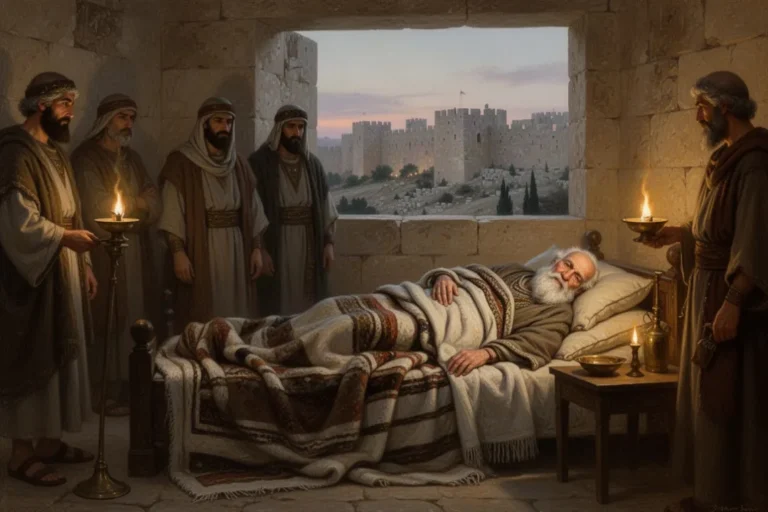
The final episode of David’s life begins with a sign of serious physical weakness. 1 Kings 1:1–4 says that David was old and could not keep warm, even when covered with blankets. His attendants brought a young woman named Abishag from Shunem to care for him and keep him warm.
This passage shows that David was physically declining, but it does not state that hypothermia, fever, or a named disease killed him. The description concerns his inability to maintain body heat, a condition that can accompany advanced age or illness, but assigning a modern diagnosis would go beyond what the text says.
David’s weakness created a political crisis because his son Adonijah began presenting himself as the next king. Adonijah gathered supporters and held a feast, apparently acting as though the succession had already been decided. The account makes clear that David’s physical decline did not mean that the question of succession was settled.
When Bathsheba and the prophet Nathan informed David of Adonijah’s actions, David responded decisively. He confirmed his earlier promise that Solomon would become king, instructed that Solomon be publicly anointed, and ordered the people to recognize him as Israel’s ruler.
David became advanced in age and could no longer stay warm without assistance.
Adonijah attempted to claim the throne while David was weak.
Bathsheba and Nathan appealed to David for a decision about the succession.
David ordered Solomon’s anointing as the next king.
Solomon took the throne, and the political transition began before David died.
David gave Solomon final instructions and then died peacefully, according to the narrative.
Was David sick when he died?
David was clearly frail and near the end of life, but the Bible never tells readers exactly what was wrong with him. The detail about his inability to keep warm is the only physical symptom described in the immediate death narrative.
Some readers interpret this symptom as evidence of a serious illness. Others understand it as a natural consequence of advanced age. Both observations recognize the same limit: the biblical text does not identify the condition, so no specific diagnosis can be stated with confidence.
David’s weakness should also be separated from his earlier health problems and injuries. Throughout his life, he endured battles, physical danger, emotional distress, and family conflict. The Bible records several episodes in which his life was threatened, but none is presented as the direct cause of his death.
The phrase “he could not keep warm” should not be treated as a complete medical report. Ancient biblical narratives often provide a few meaningful details rather than a full account of symptoms, treatment, and cause. In David’s case, the detail emphasizes that his strength had declined and that his death was approaching.
The Bible does not give a sentence that directly says, “David died at age 70.” His approximate age can be worked out from information in the historical books. 2 Samuel 5:4 says David was 30 years old when he became king, and that he ruled for 40 years.
Using those figures, David would have been approximately 70 years old at his death. The calculation is straightforward, although biblical chronology can involve interpretive questions in other contexts. For David’s age, however, the commonly understood figure is based directly on the ages and reign length supplied by the text.
That age also fits the way the final chapters portray him. David had lived through a long period of warfare and political upheaval, governed a growing kingdom, and reached a stage in which he needed personal care. The narrative presents him as an elderly king whose authority remained important even though his body had become weak.
Age versus cause: Saying that David was about 70 describes the length of his life. It does not reveal a specific medical cause of death, because Scripture never names one.
Did David die peacefully or violently?
David did not die in battle, and the Bible does not describe him as being assassinated. His death follows the transfer of royal authority to Solomon and is described with the restrained phrase that he “rested with his ancestors.” In context, this indicates a normal death after old age and physical decline.
That peaceful ending is notable because David’s life included repeated threats. King Saul pursued him, rival groups challenged his rule, foreign armies fought against him, and even members of his family became involved in rebellions. David also faced the consequences of his own actions, including the events involving Bathsheba and Uriah.
Yet none of those conflicts caused the final event recorded in 1 Kings. David lived long enough to see Solomon established as king. He then gave Solomon advice about governing, loyalty to God, and dealing with unresolved political threats before his death.
The passage therefore distinguishes between a dangerous life and a natural death. David’s years were often violent, but the biblical account does not say that violence ended his life.
What David told Solomon before he died
Before David died, he gave Solomon a final charge recorded in 1 Kings 2:1–9. David urged his son to be strong, act with maturity, and follow God’s commands. He connected the stability of Solomon’s kingdom with faithfulness and obedience.
David also mentioned specific people and unresolved matters from his reign. He told Solomon to show loyalty to the sons of Barzillai, who had supported David, and he addressed Joab and Shimei. These instructions reflect the difficult political circumstances surrounding the transition of power.
The final speech is not a description of David’s physical death. Instead, it shows that David remained mentally engaged in the government and future of the kingdom shortly before he died. He was weak in body, but the narrative portrays him as still able to make decisions and give detailed instructions.
David’s words to Solomon also connect his personal death with the wider story of Israel’s monarchy. His life was ending, but the kingdom was continuing under a new ruler. The succession, rather than the mechanics of David’s final breath, receives most of the narrative attention.
Why Solomon became king before David died
Solomon’s accession took place during David’s final illness. Adonijah had attempted to establish himself as king, but Bathsheba, Nathan, Zadok the priest, and other supporters acted to carry out David’s stated choice of Solomon.
David ordered Solomon to ride on the king’s mule and be taken to Gihon, where Zadok anointed him. The people celebrated, and the sound of the celebration reached Adonijah’s gathering. Once the new king was publicly recognized, Adonijah’s attempt to seize the throne collapsed.
This sequence matters because it explains why David’s death did not produce an immediate succession crisis. Solomon had already been publicly installed before David died. The transition was politically significant, even though later events showed that the kingdom still faced tension and competing loyalties.
David’s final actions therefore had two dimensions. Personally, he was an elderly man whose physical condition was deteriorating. Politically, he was still the reigning king, and he used his remaining authority to establish the succession.
Where was David buried?
After David died, 1 Kings 2:10 says that he was buried in the City of David. The same passage places his burial after his death and before the account continues with Solomon’s reign. The City of David refers to the part of Jerusalem associated with the earliest royal settlement of the city.
Acts 2:29 also refers to David as having died and been buried, and it mentions that his tomb was known among the people. That later reference shows the continuing importance of David’s burial place in Jewish memory during the first century.
The biblical text does not provide a detailed description of the burial ceremony, the tomb’s design, or the exact location that modern visitors could identify with certainty. It simply records that David was buried in the royal city connected with his name.
Several later traditions and archaeological claims have associated locations with David’s tomb, but those claims should be distinguished from the concise biblical statement. The Bible identifies the City of David as the place of burial without supplying enough detail to settle every later question about the site.
What David’s death means in the larger biblical story
David’s death marks the end of one stage of Israel’s monarchy. He had united the tribes under his rule, established Jerusalem as the political center, and expanded Israel’s influence. His reign also included serious moral failures, family disasters, and political unrest.
The biblical writers do not present David as flawless. They remember his trust in God and his role as king, while also preserving accounts of adultery, deception, violence, and the consequences that followed. His death does not erase those events, nor does the description of his old age suggest that every part of his life was peaceful.
At the same time, the death notices use a positive evaluation. Chronicles describes David as dying with honor, wealth, and fullness of days. That statement reflects the overall significance of his reign, not a claim that he had avoided suffering or wrongdoing.
Solomon inherited both David’s achievements and the unresolved problems of his kingdom. The next chapters of 1 Kings focus on Solomon’s consolidation of power, the treatment of rival figures, and the building of the temple. David’s death opens the way for a new phase rather than ending the story of the royal line.
How the New Testament refers to David’s death
David’s death is also mentioned in the speech attributed to Peter in Acts 2. Peter points out that David died, was buried, and had a tomb known to the people. The reference supports the argument that David himself was not the ultimate fulfillment of the promise concerning an everlasting throne.
In that passage, David’s physical death becomes part of a broader theological argument about Jesus’ resurrection. Peter contrasts David, whose body remained in the tomb, with Jesus, whom the early Christian message proclaimed as raised from the dead.
This New Testament use does not add a new cause of David’s death. It confirms the basic historical point already found in the Old Testament: David died and was buried. The emphasis is on the significance of his death and burial within the argument, not on the illness that preceded it.
What can and cannot be concluded about David’s cause of death
A careful reading of the passages allows several conclusions, but it also sets clear limits. The narrative gives enough information to describe David’s final condition and approximate age, yet not enough to identify a precise disease.
It can be concluded that David died after reaching advanced age.
It can be concluded that he was physically weak and unable to keep warm shortly before death.
It can be concluded that he died after Solomon had been established as king.
It can be concluded that he was buried in the City of David.
It cannot be concluded that he died from a particular infection, heart condition, or other modern diagnosis.
It cannot be concluded that a specific battle wound or earlier sin directly caused his death.
It cannot be concluded that the Bible intended the warming treatment to identify a particular illness.
This distinction matters because readers sometimes try to convert a brief ancient description into a modern medical diagnosis. The text’s purpose is primarily historical and theological: it records David’s decline, the succession to Solomon, and the end of David’s reign.
Why the Bible gives so few details about David’s death
Ancient biblical narratives often focus on events that affect the covenant community, the monarchy, and the next stage of the story. David’s death is important because it confirms the end of his reign and the beginning of Solomon’s, not because the writers intend to provide a clinical account.
The sparse description also creates a contrast with the many dramatic episodes of David’s life. His rise from shepherd to king, his conflict with Saul, his military victories, and his family tragedies receive extensive attention. His death is presented more quietly: he grows old, gives final instructions, and is buried.
That quiet ending answers the central question without speculation. David lived a long life, weakened with age, and died naturally. The text leaves the medical details unstated while directing attention to his legacy, his successor, and God’s continuing purposes in Israel’s history.
How to answer “How did King David die?” accurately
A concise and accurate answer would be: King David died of old age after ruling Israel for 40 years. Near the end of his life, he was so frail that he could not keep warm, but the Bible does not name a specific illness or medical cause. He was buried in the City of David, and Solomon succeeded him.
If more detail is needed, add that David was probably about 70, based on his age when he began to reign and the length of his reign. Also mention that his final days included the public establishment of Solomon as king, which occurred before David’s death.
This wording stays close to the biblical evidence. It avoids claiming that David died from a disease the text never names, while still acknowledging the physical decline described in the final account.
Frequently asked questions
Did King David die from an illness?
The Bible does not identify a specific illness. It says David was very old and could not keep warm, which shows serious physical frailty near the end of his life. That symptom may reflect general decline or illness, but the text does not provide enough information for a precise medical diagnosis.
How old was David when he died?
David was probably about 70 years old. The biblical account says he was 30 when he began ruling and reigned for 40 years. Adding those figures produces the commonly accepted estimate, although Scripture does not state his age at death in a single direct sentence.
Was Solomon king before David died?
Yes. David formally ordered Solomon’s anointing and public recognition as king while David was still alive. This happened because Adonijah had tried to claim the throne. Solomon’s installation established the succession, after which David gave him final instructions before dying.
Where was King David buried?
David was buried in the City of David, according to 1 Kings 2:10. This was the royal area associated with Jerusalem’s earliest settlement. Acts 2 also refers to David’s tomb as known among the people, but the biblical text does not give enough detail to confirm every later claim about its exact location.










Leave a Reply