In the Bible, “Ethiopia” usually refers to Cush, an ancient region south of Egypt rather than exactly the modern country of Ethiopia.
That distinction helps make sense of the Bible’s references to Ethiopia. English translations often use “Ethiopia” where the original Hebrew says Cush, while the Greek New Testament uses a related term for the land associated with the Ethiopian official in Acts 8. The biblical references reach from Genesis to the New Testament and include family history, international politics, prophecy, and the spread of faith.
The word translated as Ethiopia does not always describe the same borders people associate with Ethiopia today. In the Old Testament, Cush generally points to lands south of Egypt, especially the region of Nubia along the Nile. This area included territory connected with parts of present-day Sudan and, depending on the passage and period, areas farther south and east.
Ancient geography did not use modern national boundaries. Names could describe a people, a kingdom, a river region, or a broader area known to the writer. For that reason, a reference to Ethiopia in one passage should be read in its historical and literary context, rather than automatically being mapped onto the modern Republic of Ethiopia.
The Hebrew word Cush is also a personal name in Genesis. Genesis 10:6 lists Cush among the sons of Ham, alongside Egypt, Put, and Canaan. This genealogy connects Cush with a group of peoples known to Israel, but it should not be treated as a modern racial classification or as a complete political history of Africa.
Several biblical passages use Cush as a geographical reference:
Genesis 2:13 mentions a land called Cush in connection with the Gihon River, although its exact location is debated.
Genesis 10:6-12 connects Cush with peoples and rulers in the ancient world, including Nimrod.
Isaiah, Jeremiah, Ezekiel, and Zephaniah refer to Cush in prophecies involving nations, judgment, or restoration.
Acts 8:26-40 describes an official from Ethiopia who encountered the gospel while traveling home from Jerusalem.
Reading tip: When a Bible translation says “Ethiopia,” check whether the passage is describing ancient Cush, a particular kingdom, or the individual from Ethiopia in Acts. The surrounding verses usually provide the answer.
How Ethiopia appears in the Old Testament
Cush appears repeatedly in the Old Testament as a real and influential region known to Israel. The references do not present Ethiopia as a single biblical theme. Instead, they show how Cush was viewed in different settings: as part of humanity’s early history, as a powerful neighboring land, as a military force, and as one of the nations accountable to God.
Cush in Genesis and the early biblical world
Genesis 10 places Cush within the table of nations after the flood. The passage is concerned with the spread of peoples and the origins of major groups known in the biblical world. It also mentions Nimrod, who is described as a significant ruler associated with kingdoms in Mesopotamia. The genealogy therefore shows Cush within the Bible’s broad account of the nations, not outside it.
Genesis 2:13 refers to the Gihon as winding through the land of Cush. Identifying this Cush with the African region is difficult because the passage describes a primeval setting and the locations of the rivers are uncertain. Some interpreters have proposed an African location, while others have connected the name with a different region. The verse should not be used as firm proof of a modern map.
Moses’ wife is called a Cushite in Numbers 12:1. The text says that Miriam and Aaron criticized Moses because of her. The passage focuses on their challenge to Moses’ authority and God’s response, not on a detailed biography of his wife. Readers have debated whether “Cushite” identifies her as an African woman or refers to another group associated with the name Cush, but the verse clearly shows that the term could identify a person connected with Cush.
Cush as a military and political power
In several historical passages, Cush appears alongside Egypt or as a force capable of influencing events in the region. Second Chronicles 14 describes an army associated with Zerah the Cushite during the reign of King Asa of Judah. The account presents the force as formidable, while also emphasizing that Judah’s survival depended on trust in God rather than military strength.
Isaiah 20 refers to the political powers of Egypt and Cush during a period of international pressure. Isaiah’s symbolic action warned Judah not to place its confidence in foreign alliances. The message was not that Cush was insignificant; it was that even powerful nations could not provide ultimate security.
Other passages mention Cush in lists of nations, armies, or territories. Second Kings 19 and Isaiah 37 mention Tirhakah, king of Cush, in the context of the Assyrian crisis. The biblical account places him among the rulers involved in the political struggles surrounding Judah. These references give a glimpse of Cush as an organized kingdom with regional importance.
Historical records outside the Bible also show that powerful kingdoms developed along the Nile south of Egypt. The kingdom commonly called Kush had important centers at Napata and later Meroë. The biblical references do not provide a continuous history of that kingdom, but they fit a world in which the lands south of Egypt were known and politically significant.
What biblical prophecy says about Ethiopia and Cush
Prophetic references to Cush include both warnings and promises. The prophets often name Cush with Egypt, Assyria, Babylon, or other nations to show that God’s authority extends beyond Israel. Cush is not portrayed as irrelevant or invisible; it stands among the nations that act, suffer consequences, and may ultimately turn toward God.
Isaiah 18 addresses a land of whirring wings beyond the rivers of Cush. Interpreters differ over the precise location and political situation behind the oracle, but the passage clearly concerns an internationally connected people and their relationship to events involving Judah. Isaiah’s language highlights the limits of human planning before God’s purposes.
Isaiah 43:3 mentions Egypt, Cush, and Seba in a statement about nations given in exchange for Israel. The point is theological rather than a simple valuation of human lives. The passage uses recognizable nations to emphasize God’s commitment to redeem and preserve his people.
Isaiah 45:14 describes the wealth and labor of Egypt and the Cushites coming toward God’s people, with the nations acknowledging God’s uniqueness. The imagery suggests that political and economic power will not remain independent of God forever. It also anticipates a future in which outsiders recognize the God of Israel.
Isaiah 11:11 names Cush among the distant places from which God will gather the remnant of his people. This image expands the horizon of restoration beyond nearby territories. Cush represents a far-reaching direction and a reminder that God’s work is not limited to one local community.
Jeremiah 46:9 mentions Cush in a description of armies connected with Egypt. Jeremiah 13:23 uses a Cushite as an example of something humans cannot alter by their own ability, emphasizing the deep-rooted nature of Judah’s wrongdoing. The verse is a comparison about moral habits, not a statement that one ethnic group is inferior or cursed.
Ezekiel 29 and 30 include Cush among the nations affected by judgment against Egypt. The prophecy portrays a major regional upheaval in which Egypt’s allies and surrounding territories are also touched. Ezekiel 30:4, 9, and related passages show that Cush belongs to the network of nations linked with Egypt’s political power.
Amos 9:7 makes a striking comparison: Israel’s movement from Egypt does not give the nation a monopoly on God’s concern, because God also directed the movements of other peoples, including the Philistines and Arameans. Cush appears here as a reminder that God governs the history of all nations, not only Israel’s history.
Zephaniah 2:12 warns the Cushites that they too will face the day of judgment. Yet Zephaniah 3:10 later speaks of worshipers coming from beyond the rivers of Cush to bring an offering to God. Taken together, these references show both accountability and hope. Cush is included in the prophetic vision of nations that can respond to God.
Central theme: Biblical prophecy treats Cush as part of the nations under God’s authority. The passages include judgment, but they also leave room for worship, restoration, and inclusion.
Who was the Ethiopian in Acts 8?
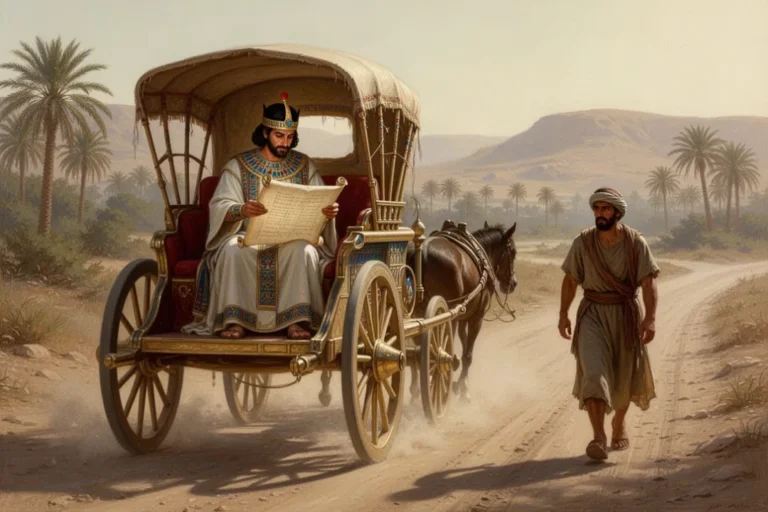
The best-known Ethiopian in the Bible is the official described in Acts 8:26-40. He was an important administrator serving under Candace, the queen of the Ethiopians. “Candace” is generally understood as a title for the ruling queen or queen mother of the kingdom, rather than a personal name.
The official had gone to Jerusalem to worship and was traveling home in a chariot. On the road, he was reading from Isaiah. The Spirit directed Philip, one of the early Christian missionaries, to approach the chariot and speak with him. This meeting became one of the clearest examples in Acts of the gospel reaching someone from outside the Jewish people.
The official was reading a passage from Isaiah 53 about a suffering servant who is treated unjustly and does not defend himself. He asked Philip whether the prophet was speaking about himself or someone else. Philip began with that passage and explained how it pointed to Jesus’ death and resurrection.
As they traveled, the official noticed water and asked to be baptized. Philip baptized him, after which the official continued his journey with joy. Acts does not give his name, describe his later work, or provide a detailed account of the church in Ethiopia. It does, however, emphasize several important facts:
He was a person of high social and political responsibility.
He was actively seeking God and had traveled to Jerusalem for worship.
He was reading Scripture and was willing to ask for help understanding it.
He received the message about Jesus and requested baptism.
His conversion shows the gospel crossing ethnic, geographic, and social boundaries.
The description of the man as a eunuch also matters for reading the story in its ancient setting. Eunuchs could hold trusted positions in royal courts, but Jewish law contained restrictions concerning certain forms of participation in the assembly. Acts does not pause to explain every legal or social question, yet the story’s placement is meaningful: someone from a distant nation and a complicated social category is welcomed through faith in Christ and baptism.
His return toward Ethiopia also gives the scene a geographical direction. The official was not merely an anonymous foreign traveler; he was connected to a recognized African kingdom and carried the message he had received back toward his own homeland. Acts presents the encounter as part of the gospel’s movement outward from Jerusalem toward the nations.
What the Ethiopian official teaches about faith
The story in Acts 8 offers a practical pattern for understanding how people respond to Scripture. The official already had questions and was reading seriously, but he needed someone to help connect the prophetic text with Jesus. Philip did not begin with a political argument or demand that the traveler know everything first. He started with the passage the man was already considering.
That pattern has several implications for readers today:
Questions can be part of sincere faith. The official asked for guidance rather than pretending to understand the passage.
Scripture should be read in context. Philip explained the meaning of Isaiah by connecting it with the story of Jesus.
Faith leads to a response. After hearing the message, the official asked about baptism and acted on what he had learned.
Christian welcome is broader than geography or ethnicity. The first Christian communities were being pushed to recognize God’s work among people from many nations.
New believers can carry faith into their own communities. The official returned home rather than remaining permanently in Jerusalem.
Acts 8 does not say that the official founded the Ethiopian church, so that claim should not be presented as a direct biblical fact. Later Christian traditions connect his story with Christianity’s early arrival in Africa, but the passage itself simply records his conversion, baptism, and continued journey.
Is Ethiopia connected with the Queen of Sheba?
The Bible does not call the Queen of Sheba Ethiopian. First Kings 10 and Second Chronicles 9 say that she came from Sheba to test Solomon with difficult questions and brought valuable gifts. Sheba is often associated with the ancient kingdom of Saba in southern Arabia, though the broader history of trade and migration across the Red Sea has led to different cultural traditions about her identity.
Ethiopian tradition strongly connects the Queen of Sheba with the country’s royal history and with King Solomon. That tradition is culturally important, but it should be distinguished from what the biblical text directly says. The Bible identifies her as the queen of Sheba, not as the queen of Cush or the ruler of the Ethiopian kingdom named in Acts.
Psalm 68:31 says that envoys will come from Egypt and that Cush will stretch out its hands to God. The verse has often encouraged readers who see it as a picture of African peoples turning toward worship. Psalm 68 uses poetic imagery, so it should not be treated as a modern political prediction, but it does place Cush within a hopeful vision of the nations recognizing God.
Similarly, Zephaniah’s references to worshipers from beyond the rivers of Cush and the Ethiopian official’s baptism in Acts fit a broader biblical pattern. The Bible repeatedly shows that God’s purposes extend beyond Israel’s immediate borders. Ethiopia is not merely a distant location in these passages; it represents a people who are seen, addressed, judged, and invited into worship.
What Christians can learn from the Bible’s references to Ethiopia
The references to Ethiopia challenge the assumption that the Bible’s story is limited to the Middle East. Africa appears throughout the biblical record through Egypt, Cush, Libya or Put, and other peoples and regions. The Ethiopian official in Acts gives this wider geography a personal face: he is educated, influential, spiritually interested, and ready to respond when Scripture is explained.
These passages also caution against forcing modern ideas into ancient terms. “Ethiopia” in an English Bible may refer to Cush, a territory south of Egypt, or the kingdom associated with the Acts official. The precise boundaries are not always recoverable, and different passages may reflect different historical periods.
A careful reading holds together several truths:
Cush was a real ancient region and people with political importance.
The Bible’s use of “Ethiopia” does not always mean the borders of modern Ethiopia.
Cush appears in genealogies, historical accounts, poetry, and prophecy.
The prophets speak of both judgment on Cush and hope for its worshipers.
The Ethiopian official in Acts is one of the clearest examples of the gospel reaching a person from Africa.
The Bible does not explicitly say that this official established a church in Ethiopia, even though later tradition gives his story great significance.
For many readers, Acts 8 is the most personally meaningful passage connected with the keyword “Bible about Ethiopia.” It shows a man from a distant land reading Scripture, receiving an explanation centered on Jesus, and entering the Christian community through baptism. Alongside the Old Testament’s references to Cush, the story presents Ethiopia as part of the Bible’s account of God’s concern for every nation.
Frequently asked questions
Does the Bible mention modern Ethiopia by name?
Many English translations use “Ethiopia,” but the Old Testament usually translates the Hebrew name Cush. Cush generally referred to lands south of Egypt, while the modern nation of Ethiopia lies farther east and south. The New Testament’s Ethiopian official was connected with a kingdom known by that name in Greek usage. Exact geography varies by passage, so modern borders should not be imposed on every reference.
Was the Ethiopian eunuch the first Christian from Africa?
Acts 8 records one of the earliest named African converts to Christianity, but it does not call him the first Christian from Africa. The account says he believed Philip’s message about Jesus and was baptized. It does not identify him by name or describe his later ministry. Claims that he founded the Ethiopian church belong to later tradition rather than the details stated in Acts.
Is the Queen of Sheba the same person as the Ethiopian queen?
The Bible identifies her as the Queen of Sheba, not as an Ethiopian queen. Sheba is commonly associated with southern Arabia, although historic connections across the Red Sea helped shape Ethiopian traditions linking her with the country. First Kings 10 and Second Chronicles 9 describe her visit to Solomon, but they do not identify her as the ruler of Cush or as Candace from Acts.
Does the Bible promise that Ethiopia will become Christian?
Some passages describe Cush in hopeful terms, including Psalm 68:31 and Zephaniah 3:10, where people from distant regions are pictured turning toward God. These are poetic and prophetic texts, not a direct statement about a modern nation’s religious future. Acts 8 does show an Ethiopian official embracing faith in Jesus, offering a concrete example of the gospel reaching Africa.







Leave a Reply