Archangels in the Bible: Michael, Gabriel, and the others
Archangels in the Bible: Michael, Gabriel, and the others
Michael is the only being explicitly called an archangel in the Bible. Jude 9 refers to him as “the archangel” during a dispute with the devil. First Thessalonians 4:16 also mentions the voice of an archangel, but it does not identify that archangel by name.
Gabriel is an angel, not explicitly an archangel, in the biblical text. He appears in Daniel and Luke as a messenger who delivers important revelations. Other names, including Raphael and Uriel, come from books or traditions that are not part of every Christian Bible, so they should be identified with care.
The word archangel comes from a Greek term that combines the ideas of a chief or ruling angel and a messenger. Scripture gives only limited information about this rank or role. It does not provide a complete hierarchy of angels or a detailed list of every archangel.
The clearest reference appears in Jude 9. Michael is described as “the archangel” when he contends with the devil over Moses’ body. Jude’s point is not to satisfy curiosity about the angelic world. Instead, the passage contrasts Michael’s restraint with the arrogance of people who speak recklessly about spiritual authorities.
A second reference appears in 1 Thessalonians 4:16. Paul describes the return of Christ as being accompanied by a commanding call, the voice of an archangel, and the trumpet of God. The verse does not say that the archangel is Michael, although many Christians connect the two references.
Precise answer: Scripture names Michael as an archangel. It mentions the voice of an archangel without naming the speaker. Gabriel is called an angel, but the Bible does not call him an archangel.
How to identify the Bible’s archangel references
A careful reading helps distinguish what the Bible states directly from what later tradition infers. Use these steps when you encounter a claim about archangels:
Check the exact passage. Look at the verse being cited rather than relying on a list or popular description.
Separate names from titles. Michael is named and called an archangel in Jude 9. Gabriel is named but is called an angel or described as one who stands in God’s presence.
Notice whether the text is explicit. Daniel presents Michael as a chief prince and protector, but it does not use the word archangel there.
Identify the biblical collection involved. Tobit, 2 Esdras, and other books are accepted in some traditions and not included in others.
Distinguish Scripture from later teaching. Lists of seven archangels and detailed angelic ranks often come from Jewish and Christian writings outside the standard Protestant Bible.
This approach prevents two common mistakes: reducing every important angel to an archangel and treating later religious tradition as though it were a direct biblical statement. Both errors can make the subject seem clearer than the sources actually allow.
Michael’s identity and role in Scripture
Michael is the Bible’s named archangel. His name generally means “Who is like God?” and his appearances consistently place him in conflict with forces opposed to God. He is not presented as a rival deity or an independent spiritual power. His authority is received and exercised in service to God.
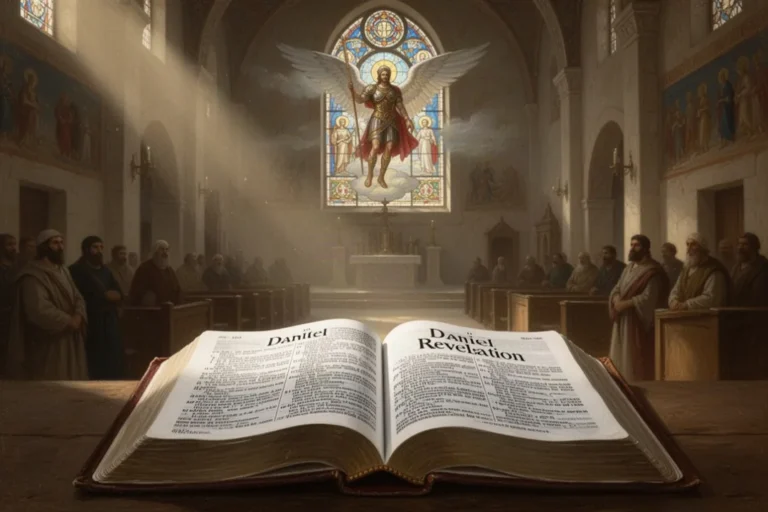
In Daniel 10, Michael is called one of the chief princes and comes to help another heavenly messenger. The chapter presents a conflict involving spiritual “princes” connected with earthly kingdoms, although interpreters differ over how literally or symbolically those figures should be understood. Michael is associated with Israel as its prince in this passage.
In Daniel 12:1, Michael is described as the great prince who stands guard over Daniel’s people during a period of unparalleled distress. The surrounding chapter links this crisis with deliverance and resurrection. Michael’s role is therefore protective, but the passage does not portray him as the source of salvation. God remains the ultimate judge and deliverer.
Jude 9 gives Michael the title archangel. The passage refers to a dispute with the devil over Moses’ body and says that Michael does not pronounce a hostile judgment on his own authority. Instead, he appeals to the Lord’s judgment. This detail emphasizes humility, restraint, and dependence on divine authority.
Revelation 12 describes Michael and his angels fighting the dragon and his angels. The dragon is identified with the devil and Satan later in the chapter. The vision uses vivid symbolic imagery to describe the defeat and expulsion of the accuser. Michael leads the heavenly forces in the scene, but God’s larger purpose controls the outcome.
Daniel 10: Michael is one of the chief princes and helps another heavenly messenger.
Daniel 12: Michael protects Daniel’s people during a future time of distress.
Jude 9: Michael is explicitly called the archangel.
Revelation 12: Michael leads angels in battle against the dragon and its angels.
Why Michael is associated with spiritual warfare
Michael’s biblical appearances explain why Christian teaching often connects him with spiritual warfare, protection, and opposition to evil. Daniel places him in a conflict involving spiritual powers. Jude places him in direct opposition to the devil. Revelation shows him commanding angels against the dragon.
Still, the Bible does not encourage people to treat Michael as an object of worship or as a spiritual force they can control. In Jude, Michael’s own response points away from self-reliance. He does not claim ultimate authority over the devil; he leaves judgment to the Lord.
This distinction matters in prayer and teaching. Christians may recognize Michael’s role in the biblical story, but Scripture directs worship toward God. Angels are servants and messengers, not replacements for God or independent sources of redemption.
The New Testament also places Christ above all created spiritual powers. Passages such as Colossians 1:16 describe all things in heaven and on earth as created through and for Christ. Hebrews 1 contrasts the Son’s unique status with that of angels, who serve those who will receive salvation. These passages keep angelic activity within a broader theology centered on God and Christ.
What the Bible says about Gabriel
Gabriel is one of the best-known angels in the Bible, but he is never explicitly called an archangel. His name is associated with the strength or power of God. The biblical accounts present him as a messenger who explains divine revelation at important moments.
In Daniel 8, Gabriel is instructed to help Daniel understand a vision involving future events. In Daniel 9, he comes to Daniel while he is praying and gives an explanation concerning the vision and the future of Jerusalem. These passages associate Gabriel with interpretation, revelation, and communication from God.
Gabriel also appears in Luke 1. He announces the birth of John the Baptist to Zechariah and later tells Mary that she will bear Jesus. When speaking to Zechariah, Gabriel identifies himself as one who stands in God’s presence. That description conveys a high and honored position, but it still does not use the title archangel.
Some Christian traditions call Gabriel an archangel because of his importance and because later Jewish and Christian writings assign him that rank. That description may be meaningful within those traditions, but it should not be presented as an exact biblical designation. The safest wording is that Gabriel is a prominent biblical angel and messenger of God.
Reading tip: “Important angel” and “archangel” are not automatically synonyms. Gabriel carries major messages, but the Bible’s explicit title “archangel” is applied to Michael.
Does 1 Thessalonians identify the archangel as Michael?
Many readers connect 1 Thessalonians 4:16 with Michael because Michael is the only named archangel in the Bible. That connection is understandable, but the verse itself does not provide his name. It refers to the voice of an archangel as one feature accompanying the Lord’s return.
Interpretations differ. Some readers understand the archangel in Thessalonians to be Michael because of his prominent role in Daniel, Jude, and Revelation. Others maintain that the text intentionally leaves the identity unstated. Both positions should be distinguished from the direct wording of the passage.
The main emphasis of 1 Thessalonians 4 is not the identity of the archangel. Paul is reassuring believers about those who have died and describing the Lord’s return, the resurrection of the dead in Christ, and the gathering of believers to be with him. The angelic announcement serves that larger message.
What Daniel teaches about Michael and heavenly rulers
Daniel provides the fullest background for Michael’s role. In chapters 10–12, angelic messengers describe resistance from the “prince” of Persia and the “prince” of Greece. These figures appear in a spiritual context related to earthly empires. Michael is identified as one of the chief princes and as the protector of Daniel’s people.
Interpreters do not all explain these passages in exactly the same way. Some understand the princes as spiritual beings associated with nations. Others emphasize the symbolic or apocalyptic character of the vision. The text clearly presents an unseen dimension to the conflict, but it does not give enough information to construct a complete map of spiritual beings.
Daniel also shows that angelic conflict does not mean God has lost control. The messenger’s delay is explained within God’s wider plan, and the visions move toward God’s judgment and the vindication of his people. Michael’s strength serves that purpose rather than competing with it.
Readers should also avoid assuming that every reference to a “prince” in Daniel describes an archangel. Michael is called one of the chief princes, but the title archangel appears explicitly only in Jude 9. The connection is strong in Christian interpretation, yet the terms should not be treated as interchangeable without qualification.
Are there seven archangels in the Bible?
The standard Protestant Bible does not name seven archangels. The idea of seven exalted angels appears in several Jewish and Christian writings, but the lists and names vary. The biblical books that directly mention Michael and Gabriel do not provide a complete set of seven archangels.
Tobit, which is included in Catholic and Orthodox biblical collections but not in the Protestant Old Testament, presents Raphael as one of seven angels who stand before God. Because Tobit is accepted as Scripture in some traditions, Catholics and Orthodox Christians may discuss Raphael differently from Protestants.
Other names, especially Uriel, appear in writings such as 1 Enoch and 2 Esdras. These works have different statuses across Jewish and Christian communities. Some are valued as ancient religious literature; some are included in particular biblical canons; others are not treated as Scripture by most churches.
For that reason, statements such as “the Bible names Michael, Gabriel, Raphael, and Uriel as the four archangels” need clarification. They may reflect a particular tradition, but they do not accurately describe the shared wording of all Christian Bibles.
Michael: explicitly called an archangel in Jude 9.
Gabriel: a named angel and divine messenger in Daniel and Luke.
Raphael: identified as one of seven angels in Tobit, depending on the biblical canon used.
Uriel: named in some ancient Jewish and Christian writings, but not in the standard Protestant Bible.
How different Christian traditions use the term archangel
Christian traditions agree that angels are created spiritual beings who serve God, but they do not organize angelic ranks in exactly the same way. The word archangel may be used narrowly for Michael or more broadly for a small group of high-ranking angels.
Many Protestant teachers emphasize the limited biblical evidence and say that Michael is the only archangel named in Scripture. They may mention Gabriel as a major angelic messenger while avoiding the title archangel because the Bible does not apply it to him directly.
Catholic teaching commonly recognizes Michael, Gabriel, and Raphael as archangels. Raphael’s inclusion is connected to Tobit, which belongs to the Catholic Old Testament. Catholic devotion may also refer to named archangels in prayer and feast-day observance, while still maintaining that worship belongs to God alone.
Eastern Orthodox traditions likewise honor Michael, Gabriel, Raphael, and other archangels, often within a larger list drawn from Scripture, the Septuagint, and ancient church tradition. The names and number can vary by local tradition and source.
These differences do not all represent disagreement about the central biblical message. They often reflect different canons of Scripture, historical practices, and ways of using the word archangel. When comparing sources, identify the tradition before evaluating the claim.
What archangels do and do not do in the Bible
Across the relevant passages, archangelic figures are associated with service to God, communication, protection, and opposition to evil. Michael protects and fights in passages concerning Israel and the defeat of the dragon. Gabriel delivers explanations and announcements. The unnamed archangel in Thessalonians is connected with the events surrounding Christ’s return.
The Bible does not describe archangels as beings who grant salvation, answer prayers independently, or possess authority equal to God. Their actions are always subordinate to divine purposes. Even when they appear powerful, they remain creatures who carry out God’s will.
Scripture also warns against turning heavenly beings into objects of worship. Colossians 2:18 warns about practices involving the worship of angels, and Revelation 19:10 and 22:8–9 depict an angel refusing worship and directing it toward God. Those passages provide a clear boundary for Christian interest in angels.
Angels can be important to the biblical narrative without becoming the center of faith. The central subjects remain God’s character, Christ’s saving work, the resurrection, judgment, and the hope of God’s people.
Common mistakes when discussing archangels
Several popular claims go beyond what the biblical text says. Correcting them does not make the subject less interesting; it makes the discussion more reliable.
Calling Gabriel an archangel as a direct Bible quotation: Gabriel is named in Daniel and Luke, but the title is not applied to him in those books.
Assuming every angel in authority is an archangel: Scripture describes powerful angels and heavenly rulers without always assigning them the title.
Claiming that the Bible lists seven archangels: the standard Protestant Bible does not provide such a list.
Equating Michael with Jesus without qualification: some groups teach this identification, but mainstream Christian interpretation generally distinguishes Michael, a created angelic being, from Christ.
Treating angelic names as sources of spiritual power: biblical passages direct worship and trust toward God rather than toward angels.
The identification of Michael with Jesus deserves special care. Michael is called one of the chief princes in Daniel and an archangel in Jude, while the New Testament presents Jesus as the eternal Son and Lord over creation. Some religious groups interpret the passages differently, but readers should recognize that this is a theological position, not an uncontested biblical fact.
What Christians can learn from Michael’s example
Michael’s appearances emphasize faithful service rather than personal glory. He stands against evil, protects God’s people, and acts within the limits of God-given authority. Even in conflict with the devil, he does not present himself as the ultimate judge.
That pattern offers a practical lesson for reading biblical accounts of spiritual conflict. Courage and humility are not opposites. Michael is portrayed as strong in opposition to evil while remaining restrained in his speech and dependent on the Lord’s authority.
The passages also encourage confidence in God’s final rule. Daniel’s visions include frightening political and spiritual conflicts, yet they move toward judgment and deliverance. Revelation’s battle imagery likewise ends with the defeat of the dragon. The focus is not on fascination with hidden beings but on the certainty that evil will not have the last word.
When you study archangels in the Bible, keep the hierarchy of attention clear: God is the object of worship, Christ is central to salvation, and angels are servants within God’s work. Michael’s role is significant precisely because it points beyond himself to the authority of the Lord.
Key Bible passages for further study
These references provide the main biblical material for understanding Michael, Gabriel, and the archangel references:
Daniel 8:15–27: Gabriel helps explain Daniel’s vision.
Daniel 9:20–27: Gabriel brings an answer while Daniel is praying.
Daniel 10:1–21: Michael is described as one of the chief princes and a protector of Daniel’s people.
Daniel 12:1–3: Michael stands guard during a time of distress associated with deliverance and resurrection.
Luke 1:5–38: Gabriel announces the births of John and Jesus.
1 Thessalonians 4:13–18: an archangel’s voice accompanies the Lord’s return.
Jude 9: Michael is explicitly called the archangel.
Revelation 12:7–12: Michael and his angels fight the dragon and his angels.
Tobit 12:15: Raphael identifies himself among seven angels, in traditions that include Tobit in the biblical canon.
Read these passages in context rather than combining every later description into one system. The Bible gives enough information to identify Michael’s unique title and to recognize the importance of Gabriel, while leaving many details about angelic ranks undisclosed.
Frequently asked questions
Is Michael the only archangel named in the Bible?
Yes. Michael is explicitly called “the archangel” in Jude 9. The Bible mentions an archangel’s voice in 1 Thessalonians 4:16 but does not give that figure’s name. Other Christian traditions may identify additional archangels from books such as Tobit or from later writings, but Michael is the only archangel directly named with that title in the standard Protestant Bible.
Does the Bible call Gabriel an archangel?
No. Gabriel is called an angel and appears as a messenger in Daniel and Luke. He explains visions to Daniel and announces the births of John the Baptist and Jesus. Because he has an exalted role, some Jewish and Christian traditions describe him as an archangel, but that title is not explicitly applied to him in the biblical passages where he appears.
Are Michael and Jesus the same person?
Most Catholic, Orthodox, and Protestant Christians distinguish Michael from Jesus. Michael is presented as an angelic servant and is called an archangel, while the New Testament gives Jesus a unique status as the Son, Lord, and creator of all things. Some groups identify Michael with Christ, but that interpretation is not accepted across Christianity.
What is the difference between an angel and an archangel?
An angel is a heavenly messenger or servant of God. Archangel suggests a chief or leading angel, but the Bible does not provide a detailed universal ranking system. Michael receives the title explicitly, while other important angels, including Gabriel, are not given that designation in the biblical text. Later traditions offer broader classifications.



Leave a Reply