God first gives the rainbow as a covenant sign after the flood
The Bible’s first mention of a rainbow appears after the flood in Genesis 9:8–17. Noah, his family, and the animals have left the ark, and God establishes a covenant with them and with every living creature. The covenant follows a devastating judgment, but its purpose is to provide a promise about the earth’s future.
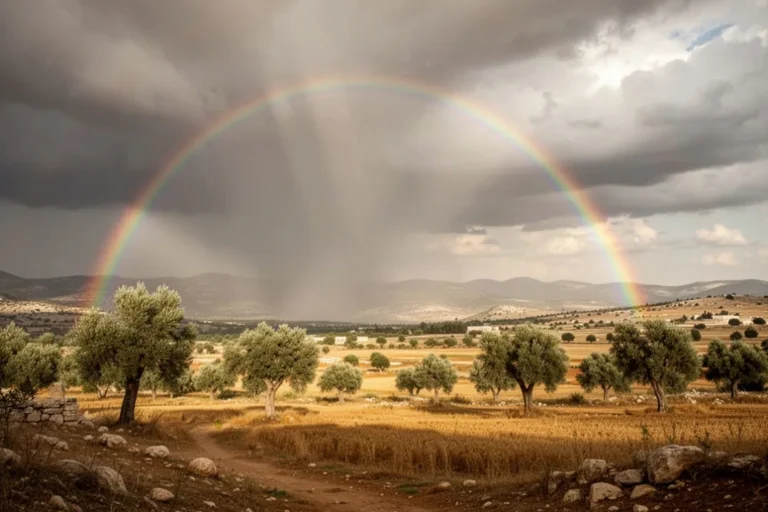
God says that he is setting his bow in the clouds as a sign of the covenant between himself and the earth. When clouds gather and the bow appears, the passage connects it with God’s promise that floodwaters will not again destroy all life or devastate the earth in the same way. The rainbow therefore carries the meaning of restrained judgment and preserved creation.
The covenant is unusually broad. It is not made only with Noah, his descendants, or the people of Israel. It includes every living creature and the earth itself. That detail shows that the rainbow represents God’s care for the created world as a whole, not merely a private religious experience.
Genesis describes the rainbow as appearing in the clouds, where it can be seen. The sign is visible and public rather than hidden. It points people back to a divine promise, but the text also speaks of God seeing the bow and remembering his covenant. In biblical language, God’s “remembering” does not mean that he had forgotten the promise. It means that he acts faithfully according to what he has pledged.
Central meaning: The rainbow in Genesis is a sign of God’s covenant with the earth, promising that a flood will not again destroy all flesh in the same way.
The rainbow should not be separated from the story surrounding it. Before the sign appears, Genesis presents the flood as a response to widespread human violence and corruption. After the flood, God gives the covenant as an assurance that the earth will continue under his care. The sign joins together judgment, mercy, promise, and patience.
That combination matters. The rainbow does not mean that wrongdoing is irrelevant or that the Bible denies divine judgment. Instead, it shows that judgment does not have the final word over creation in the flood narrative. God commits himself to sustaining the world even though human sin remains a reality.
The Hebrew word connects the rainbow with a warrior’s bow
The Hebrew word translated as “rainbow” in Genesis is qeshet, a word that can also mean a bow used in battle. The text does not pause to explain every possible image, so readers should avoid treating this connection as a complete interpretation. Still, the word choice offers a meaningful picture: the bow is placed in the clouds as part of God’s covenant sign.
Many readers understand the image as a weapon no longer aimed at the earth. A battle bow points toward an enemy, while the bow in the clouds is associated with God’s promise not to destroy the world through another universal flood. On this reading, the sign communicates peace after conflict and a deliberate limitation on judgment.
This interpretation should be held alongside the plain wording of Genesis. The passage directly emphasizes the covenant and the promise concerning floodwaters. The “weapon laid aside” idea is a theological implication from the word and the surrounding imagery, not a sentence that the biblical author states in those exact terms.
The image also helps explain why the rainbow has such emotional force in the narrative. A bow is associated with power and danger, but God places this sign in the sky in connection with a promise of preservation. The same image can therefore remind readers that God is powerful and that he chooses to act with covenant restraint.
Genesis does not say that the rainbow is a symbol of luck, a prediction of personal success, or a guarantee that believers will avoid every future disaster. Its meaning is more specific. It points to the promise that the earth will continue and that a worldwide destruction by flood will not occur again as it did in Noah’s day.
Covenant: God binds the sign to a promise involving the earth and every living creature.
Mercy: The rainbow follows judgment and marks God’s decision not to repeat that destruction through a universal flood.
Faithfulness: The sign calls attention to God’s continuing commitment to what he has promised.
Creation: Its scope reaches beyond one nation or family to the whole living world.
Rainbows around God’s glory appear in Ezekiel and Revelation
The rainbow appears again in visions associated with God’s heavenly glory. These later passages do not replace the meaning established in Genesis, but they broaden the image. The rainbow becomes part of a vision of divine majesty, holiness, and authority.
In Ezekiel 1:26–28, the prophet sees a radiant likeness connected with the appearance of a human form above the living creatures and the wheels. The vision ends by comparing the surrounding brilliance to a rainbow in the clouds on a rainy day. Ezekiel responds by falling facedown and hearing the voice of someone speaking.
The comparison gives the rainbow a role in displaying divine radiance. It is not merely a natural object in the sky. Within the vision, it helps communicate the overwhelming glory of God. The color and brightness suggest splendor, but Ezekiel’s response also shows that this glory is not casual or decorative. It inspires reverence.
Revelation uses similar imagery. In Revelation 4:2–3, John sees the throne of God, and a rainbow resembling an emerald surrounds it. The scene includes flashes of lightning, thunder, and heavenly beings, creating a picture of awesome authority. The rainbow around the throne links God’s rule with the covenant sign from Genesis.
That connection is significant because Revelation is filled with scenes of judgment. Even when the book presents God’s holiness and judgment, the rainbow remains near the throne. Readers can therefore see an image of mercy within majesty: the God who judges is also the God who has made and keeps covenant promises.
A rainbow also appears in Revelation 10:1, where a mighty angel is described with a cloud around him and a rainbow over his head. The passage presents the angel as clothed with heavenly signs and carrying a message connected with God’s purposes. The rainbow contributes to the scene’s sense of authority, mystery, and divine commission.
These appearances do not mean that every rainbow seen today contains a new prophetic message. Biblical visions use familiar images to communicate truths about God. The rainbow’s presence in these visions recalls God’s covenant character while emphasizing his glory and sovereignty.
Read the later visions in context: Ezekiel and Revelation use rainbow imagery to portray divine glory and covenant faithfulness; they do not teach that every ordinary rainbow predicts a specific event.
What the rainbow symbolizes throughout the Bible
When the biblical passages are read together, several related themes emerge. The rainbow is not given a long list of official meanings, but its settings make certain ideas clear. It points first to God’s faithfulness, because it is attached to a promise that God himself establishes.
It also symbolizes mercy after judgment. In Genesis, the sign comes after the flood. In Revelation, a rainbow appears in the setting of God’s throne while the book addresses judgment, perseverance, and the final defeat of evil. The image does not erase judgment; it places judgment within the larger reality of God’s covenant purposes.
The rainbow can also represent hope for creation. The promise in Genesis concerns the earth, the seasons, and the continuation of life. The sign reminds readers that God does not abandon the world after confronting its violence. Creation remains under divine care.
Another theme is God’s presence. In Ezekiel and Revelation, the rainbow is associated with visions of heaven and the throne. It helps the prophets describe something beyond ordinary human sight. The image says that the God who made the covenant is not distant from his purposes; he is present as ruler and keeper of his word.
The rainbow’s meaning can be described through these connected ideas:
Promise: God makes a binding commitment concerning the future of the earth.
Remembrance: The sign calls attention to the covenant whenever it appears in the clouds.
Mercy: God limits the form of destruction described in the flood account.
Glory: Prophetic visions use the rainbow to portray the radiance surrounding God’s presence.
Hope: The sign points toward the continued preservation of life and the reliability of God’s purposes.
These themes should not be turned into disconnected slogans. The rainbow means mercy because it is part of a covenant. It means hope because God promises to preserve the earth. It reflects glory because prophetic visions place it near the divine throne. The biblical meaning comes from the relationship between the sign and the passages where it appears.
What the rainbow does not mean in the biblical text
Modern readers may attach meanings to the rainbow that are not stated in the Bible. A careful reading begins by separating biblical symbolism from later cultural associations. Genesis does not say that the rainbow guarantees an easy life, confirms a particular personal decision, or signals that a person will receive a desired blessing.
The rainbow is also not presented as a promise that God will never judge sin again in any form. The flood covenant is specific: God promises not to destroy all flesh through another flood of that kind. Other biblical passages continue to speak about moral accountability, judgment, and the consequences of human actions.
Nor does the Bible say that each color has a separate spiritual meaning. Some traditions assign symbolic interpretations to red, orange, yellow, green, blue, indigo, and violet. Those ideas may have devotional value for some people, but they should not be described as teachings of Genesis, Ezekiel, or Revelation.
The text likewise does not identify the rainbow as a sign that people can control or use for magical purposes. Its authority comes from God’s covenant, not from human interpretation. A person may see a rainbow and respond with gratitude or reflection, but the visible sign does not give power to rituals, predictions, or superstitions.
These boundaries make the central message clearer. The biblical rainbow is not mainly about personal fortune or hidden codes. It is about who God is and what he has pledged to do. It directs attention away from the object itself and toward the faithful God who gives the sign.
How Christians can understand the rainbow today
For Christians, a rainbow can serve as a useful reminder of God’s covenant faithfulness. Seeing one may prompt reflection on Genesis 9, gratitude for the continued gift of creation, and confidence that God does not treat his promises casually. That response is consistent with the biblical use of signs, which direct people toward what God has said and done.
The sign can also encourage a balanced view of suffering. The flood story does not pretend that evil is harmless, yet the covenant shows that judgment is not the only truth about the world. God’s mercy sustains life even in a damaged creation. A rainbow may therefore remind Christians to hold together seriousness about sin and confidence in divine mercy.
It can further shape how Christians think about care for the earth. Genesis presents the covenant as involving living creatures and the ground itself, not only human beings. The rainbow does not provide a complete environmental program, but it supports the conviction that creation matters to God and should not be treated as disposable.
Christians may also use the rainbow as a prompt to remember God’s presence during uncertainty. The biblical sign does not promise that storms, loss, illness, or injustice will never occur. It offers a broader assurance: God remains faithful to his covenant purposes, and the future of creation is not outside his care.
A thoughtful response to a rainbow might include several simple actions:
Recall the biblical passage: Read or review Genesis 9:8–17 rather than relying only on general symbolism.
Give thanks for creation: Recognize the earth and living creatures as included in God’s covenant concern.
Remember mercy: Let the sign point to God’s patience and faithfulness after judgment.
Avoid superstition: Do not treat the rainbow as a personal prediction or magical guarantee.
Practice faithful hope: Respond to God’s promise with trust, humility, and care for others.
The rainbow may also invite respectful conversation across different communities. People use the image in many cultural and social settings, and those uses are not all identical to its biblical meaning. Christians can explain the Genesis covenant accurately while treating other people with dignity and avoiding assumptions about what a rainbow means to them.
At its deepest level, the biblical rainbow directs attention to the character of God. It recalls a promise made after catastrophe, a commitment that reaches the whole living world, and a glory that surrounds the heavenly throne. Its message is not that life will be free from every storm. It is that God’s mercy and faithfulness remain present even in a world marked by judgment, danger, and change.
Frequently asked questions
Why did God put a rainbow in the sky after the flood?
According to Genesis 9:8–17, God placed the rainbow in the clouds as a sign of his covenant with Noah, his descendants, the earth, and every living creature. It marked his promise never again to destroy all life through a flood like the one described in Genesis. The sign therefore represents covenant faithfulness and preservation.
Is the rainbow a symbol of God’s promise to every person?
The Genesis covenant has a universal scope, including the earth and all living creatures, so the sign concerns humanity as a whole rather than one nation alone. However, it promises specifically that a universal flood will not again destroy all flesh. It does not promise that every individual will avoid suffering, danger, or moral consequences.
What does the rainbow around God’s throne mean?
In Revelation 4:3, the rainbow surrounding God’s throne recalls the covenant sign from Genesis while adding an image of heavenly glory. It shows that God’s authority and judgment exist alongside his faithfulness and mercy. The rainbow in this vision helps portray the majesty of the God who keeps his promises.
Does the Bible assign meanings to the rainbow’s individual colors?
No. The biblical passages mention the rainbow as a whole but do not give separate spiritual meanings to its colors. Interpretations connecting particular colors with specific virtues or doctrines come from later traditions, not directly from Genesis, Ezekiel, or Revelation. The Bible emphasizes the rainbow’s covenant significance rather than a color-by-color code.




Leave a Reply