Rabat is the main place to visit Malta’s catacombs, with St. Paul’s Catacombs and St. Agatha’s Catacombs offering the most accessible and significant underground burial sites. They lie just outside Mdina’s historic walls and can be visited together in one outing.
These sites are not simply tunnels. They are networks of ancient rock-cut burial chambers, family rooms, passageways, and shared spaces that reveal how communities in Malta treated the dead during the Punic, Roman, and early Christian periods. Allow at least two hours for the principal sites, and wear comfortable shoes because the floors can be uneven and the stairways narrow.
Rabat stands beside Mdina, the fortified city often called Malta’s former capital. In antiquity, the settlement around Mdina was known as Melite, and its burial grounds developed outside the inhabited area, following the common practice of placing cemeteries beyond city limits.
The soft limestone beneath the area made it possible to cut chambers into the ground. Over many centuries, people expanded existing burial areas, added new rooms, and reused sections of older complexes. That process created the layered underground landscapes you see today.
The catacombs reflect several religious and cultural traditions rather than one single community. Archaeologists have identified Punic and Roman influences, as well as features associated with Jewish and Christian burial practices. The sites therefore offer evidence of changing customs across a long period, not a snapshot from one exact year.
Rabat is especially valuable for visitors because several archaeological remains are concentrated within a walkable area. You can combine the catacombs with Mdina, the Domus Romana, St. Paul’s Church, and other historic places without spending the day traveling between distant attractions.
Plan around the two main complexes. St. Paul’s Catacombs is the larger and more extensive visit, while St. Agatha’s combines underground chambers with a small museum and a decorated crypt. Seeing both gives you a much fuller understanding of Rabat’s burial traditions.
What you see at St. Paul’s Catacombs
St. Paul’s Catacombs is the largest publicly accessible catacomb complex in Rabat. Its name comes from Malta’s strong tradition connecting the area with St. Paul, although the underground burial chambers are part of a wider archaeological setting and should not be treated as proof of a particular biblical event.
The complex contains interconnected underground spaces cut into the limestone. Some rooms are relatively open and easy to understand, while others lead into tighter passages and smaller burial areas. The layout shows that the site grew gradually as families and communities modified the rock over time.
Burial chambers and shared funerary rooms
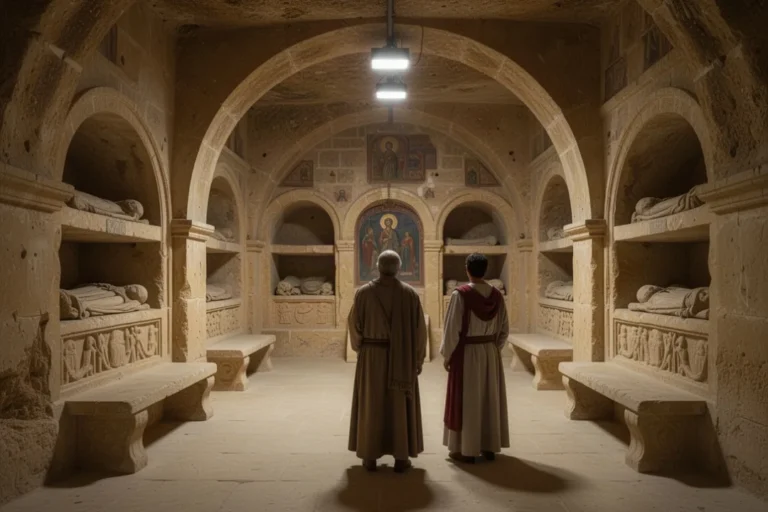
Many chambers contain arcosolia, which are curved, arched recesses cut into the walls to hold burials. Other graves appear as horizontal openings or floor burials. The different forms help archaeologists study how burial practices changed and how much space was available within each chamber.
One of the most recognizable features is the agape table, a low, raised table carved from the limestone. These tables are associated with commemorative meals or rituals held in connection with the dead. They are not dining furniture in the ordinary domestic sense, and visitors should never sit on or touch them.
Several rooms contain benches around the edges, allowing people to gather during memorial observances. Their presence suggests that funerary customs could involve community participation rather than only the private placement of a body.
How St. Paul’s Catacombs is arranged
The visit usually involves moving through a designated route with stairs, narrow passages, and chambers at different levels. Signs and displays help explain the main architectural features, but the atmospheric spaces themselves can be difficult to interpret without some preparation.
Look for differences in chamber size, ceiling height, wall recesses, and floor plans. These details help you distinguish a large family burial area from smaller spaces intended for individual or limited use. The absence of elaborate decoration in many rooms is also meaningful: much of the site’s significance comes from its layout and construction rather than visible artwork.
The complex includes more than one burial network, and not every visible space belongs to exactly the same period. Avoid assuming that all chambers were built at once. Rabat’s underground sites were repeatedly adapted, and later visitors may have reused or altered earlier areas.
What makes St. Agatha’s Catacombs different
St. Agatha’s Catacombs offers a more compact but distinctive experience. It is connected with a small museum and an underground crypt, making it useful for visitors who want both archaeological context and religious art in one stop.
The catacomb rooms contain examples of burial chambers and carved features similar to those at St. Paul’s. Their smaller scale can make the spaces feel more intimate, and the guided or interpretive material often helps visitors understand how the underground complexes relate to the wider history of Rabat.
The underground crypt and painted decoration
The crypt associated with St. Agatha’s is known for religious paintings and frescoes. These works have been affected by age, humidity, and the difficult underground environment, so some details may be faint or partially preserved. The subdued lighting is part of the conservation approach and can make the paintings easier to miss if you hurry.
Take time to look at the organization of the painted surfaces rather than expecting the clarity of a newly restored church interior. The images reflect the devotional history of the site, while the surrounding catacombs show the practical side of burial and remembrance.
St. Agatha’s also helps explain the difference between a catacomb and a later devotional space. The burial chambers and the crypt may be close together, but they do not serve the same function or necessarily belong to the same phase of the site’s development.
Why visitors often pair St. Agatha’s with St. Paul’s
St. Paul’s gives you a broad sense of the scale and complexity of Rabat’s underground cemeteries. St. Agatha’s adds a different perspective through its museum material, more intimate chambers, and painted religious heritage.
If you visit only one site, choose according to your interests. St. Paul’s is generally the better choice for understanding the size and variety of Malta’s catacomb architecture. St. Agatha’s may appeal more if you are especially interested in frescoes, religious history, and a shorter archaeological visit with interpretive displays.
How the catacombs were used
Catacombs were primarily places of burial and remembrance, not underground cities where large populations lived. The chambers were designed for funerary purposes, and their architecture reflects the needs of burial communities rather than ordinary domestic life.
Families or groups could use shared chambers over extended periods. As new burials were required, existing spaces could be expanded or adapted. This explains why a single complex may contain different grave styles, uneven passages, and rooms that do not follow a simple symmetrical plan.
Funeral customs could include gatherings in which relatives and members of the wider community remembered the dead. The carved tables and benches found in some rooms are commonly linked with these commemorative practices. Their presence does not mean that every chamber hosted the same ritual or that every group used the spaces in an identical way.
The catacombs also show how burial traditions could continue across religious and cultural change. Some features are associated with earlier Punic or Roman practices, while others reflect later Christian use. Archaeology often identifies patterns of influence rather than assigning every chamber to one neatly separated category.
Why there are no grand underground tombs everywhere
Malta’s catacombs are impressive because of their extent, but they are not all monumental in the way a large aboveground mausoleum might be. Many chambers are functional, cut from local stone, and shaped by the available space.
This modest appearance is part of their value. The sites preserve evidence of ordinary burial communities, including the ways people organized family spaces, commemorated relatives, and reused limited underground areas. They can tell you about daily social customs as well as religious belief.
Malta has a deeply established tradition that St. Paul was shipwrecked on the island and stayed there for a period described in the New Testament. Rabat’s St. Paul’s Church and the nearby grotto are important pilgrimage and heritage locations associated with that tradition.
The catacombs themselves are archaeological burial complexes. Their name reflects the religious and local history of the area, but it should not be taken to mean that these chambers were the place where St. Paul lived or preached. Keeping those distinctions clear makes the visit more informative.
You can visit the church and grotto after the catacombs if you want to explore the tradition further. The combination also shows how different layers of Rabat’s history overlap: ancient burial grounds, early Christian memory, medieval urban development, and later devotional practice all exist within a short distance.
How to visit the catacombs in Rabat
St. Paul’s Catacombs and St. Agatha’s Catacombs are located in Rabat, close to Mdina. The exact entrance arrangements, ticket prices, opening hours, and tour schedules can change, so check the official site for each attraction before you travel.
Most visitors can reach the area by bus, taxi, rental car, or organized excursion. Rabat and Mdina are well-known destinations, but road access and parking conditions can be less convenient during busy periods. If you drive, allow extra time to find a legal parking space and walk to the entrances.
A practical visit usually works best in this order:
Start with St. Paul’s Catacombs while you have the most energy for stairs and underground passages.
Continue to St. Agatha’s Catacombs for the museum, crypt, and additional burial chambers.
Walk through Rabat or Mdina afterward, when you can place the underground sites within their wider historic setting.
Visit St. Paul’s Church and the grotto if religious history is part of your interest.
Allow more time than the minimum if you like reading displays or photographing architectural details. A rushed visit can make the chambers seem repetitive, while a slower pace reveals differences in grave forms, room design, and preservation.
Practical tips and common mistakes to avoid
The underground environment is manageable for most visitors, but it is not the same as walking through a level museum gallery. Preparation will make the experience more comfortable and help protect the fragile remains.
Wear secure, comfortable shoes. Limestone floors can be uneven, and some steps may be worn or steep.
Bring a light layer. Underground temperatures and airflow can feel different from the warmer streets outside.
Check accessibility before booking. Historic catacombs often include stairs, narrow routes, and areas that are difficult or impossible for wheelchairs.
Confirm opening hours and admission details. Seasonal schedules, maintenance work, and guided-tour arrangements can change.
Do not touch the walls, paintings, graves, or carved tables. Oils and moisture from hands can damage old surfaces.
Keep your voice low. Quiet helps preserve the character of the site and prevents other visitors from losing the explanatory parts of their tour.
Use your phone carefully. Flash photography may be restricted, and bright screens can disturb others in dark chambers.
Do not treat the catacombs as a shortcut. Follow the marked route and staff instructions, especially where passages narrow.
Allow for heat above ground. Rabat and Mdina can be sunny and exposed, even when the underground rooms feel cool.
Do not rely on the name alone. St. Paul’s Catacombs are not the same as St. Paul’s Grotto or the church associated with the saint.
Important access tip: Contact the attraction directly if you have limited mobility, claustrophobia, or difficulty with stairs. A staff member can explain the current route and whether an alternative experience is available.
How much time to spend in Rabat
A focused catacomb visit can fit into a half day, but Rabat deserves more time if you want to see its other historic sites. Visiting both principal catacomb complexes may take roughly two to three hours depending on queues, guided tours, and how closely you study the displays.
For a broader itinerary, set aside at least half a day for St. Paul’s Catacombs, St. Agatha’s Catacombs, Rabat’s streets, and Mdina. A full day gives you time to visit museums, churches, the Domus Romana, and viewpoints without constantly watching the clock.
Try to avoid placing the catacombs at the very end of an exhausting sightseeing day. The underground routes require attention, and the historical details are easier to appreciate when you are not rushing toward your next reservation.
What to see around the Rabat catacombs
Mdina is immediately adjacent to Rabat and is the most obvious addition to your itinerary. Enter through the historic gate, walk along the narrow streets, and look for the contrast between the enclosed medieval city and the more open modern streets of Rabat.
St. Paul’s Church and Grotto are closely tied to Malta’s Christian traditions. The grotto is a devotional site rather than a catacomb, so visiting both helps clarify the difference between a place associated with a saint’s story and an archaeological cemetery.
The Domus Romana, also known as the Roman Villa, offers another perspective on life in ancient Melite. Its surviving domestic remains and mosaics complement the catacombs, which focus on burial practices and the use of underground spaces.
Rabat’s streets also contain smaller chapels, traditional limestone buildings, cafés, and quiet corners that are easy to miss if you move directly between major attractions. Give yourself time to walk rather than treating the area as a sequence of entrances and exits.
Why the catacombs matter beyond sightseeing
The catacombs provide unusually direct evidence of how people understood death, family, community, and religious identity. A carved grave is not only an architectural feature; it can indicate how much space a group controlled, how it organized remembrance, and how burial customs changed over time.
They also show the importance of Malta’s limestone geology. The material made underground construction possible, but it also creates conservation challenges. Water movement, salt, humidity, human contact, and natural deterioration can all affect carved surfaces and painted decoration.
Preserving the catacombs requires balancing public access with protection. Walking only on designated routes, avoiding contact, and following photography rules are small actions that help keep the sites available for future visitors.
The most rewarding way to visit is to combine curiosity with restraint. Look closely at the architecture, read the interpretation, and remember that these are burial places as well as archaeological monuments. Rabat’s catacombs are valuable not because they are mysterious tunnels, but because they preserve the physical evidence of communities that lived, mourned, and remembered their dead in Malta across many centuries.
Choosing between St. Paul’s and St. Agatha’s Catacombs
If your schedule allows only one visit, your choice depends on what you want to learn. St. Paul’s is the stronger option for visitors interested in the scale, variety, and organization of Malta’s underground burial complexes.
St. Agatha’s is a good choice for those who prefer a more compact site with a museum and decorated crypt. The paintings add a visual and devotional dimension that is different from the largely architectural experience at St. Paul’s.
When possible, visit both. Their differences are not a problem to overcome; they are the reason the pair works so well. Together, they show how burial spaces, religious memory, artistic expression, and local geology shaped Rabat’s distinctive archaeological character.
Frequently asked questions
Are Malta’s catacombs in Rabat suitable for children?
Older children who can manage stairs and remain quiet usually enjoy the sense of discovery, especially when an adult explains the burial chambers. Younger children may find the dark, narrow spaces unsettling. Check the current route before visiting with a stroller, because underground access commonly includes steps and uneven surfaces.
Can you visit the Rabat catacombs without a guided tour?
Access arrangements differ by site and can change with the season. Some areas may be self-guided with signs, while other sections may use scheduled tours or staff-led explanations. Check the official visitor information before arriving so you know whether a time slot or advance booking is needed.
Are photographs allowed inside St. Paul’s and St. Agatha’s Catacombs?
Photography rules are set by each attraction and may differ between archaeological chambers, museum spaces, and painted areas. Flash photography can be restricted because it may disturb visitors or affect sensitive surfaces. Follow posted instructions and ask staff if you are unsure rather than photographing automatically.
Is Rabat a good base for visiting Mdina and the catacombs?
Yes. Rabat and Mdina sit next to each other, so you can combine the main catacomb sites with the walled city, churches, museums, and the Domus Romana on foot. Plan for warm weather above ground, allow time for walking, and verify attraction hours before setting out.









Leave a Reply