Nazareth is a historic city in northern Israel and one of Christianity’s most important pilgrimage destinations. It is traditionally identified as the hometown of Jesus, and visitors come to see churches, archaeological sites, lively markets, and viewpoints across the Galilee.
The city can be visited as a day trip, but staying overnight gives you more time for its religious landmarks, Old City lanes, local food, and nearby attractions. The most useful starting point is the Basilica of the Annunciation, followed by the surrounding churches, market, and hills overlooking Nazareth.
Nazareth’s importance comes from its place in the New Testament and from its long history as a town in Galilee. Christian tradition connects the city with the Annunciation, when Mary is told that she will become the mother of Jesus, and with Jesus’ childhood and early adult life.
Modern Nazareth is not only a pilgrimage destination. It is a predominantly Arab city with a strong Palestinian Arab cultural identity, a large Christian community, Muslim residents, historic neighborhoods, restaurants, shops, and active everyday life. Religious heritage and ordinary city life exist side by side.
The city sits in a hilly area of Lower Galilee. Its streets rise and fall around the Old City, so comfortable shoes make a noticeable difference. Several major sights are within walking distance of one another, although some viewpoints and museums require a short ride or a steeper climb.
Plan around opening hours: Churches and museums may close for services, holidays, restoration, or local events. Check current schedules before setting out, especially if you are visiting on a Sunday or during a major religious festival.
How to plan a visit to Nazareth step by step
Choose your base. Stay in Nazareth if you want a slower visit, or use Haifa, Tiberias, or another Galilee destination as a base for a day trip.
Start in the Old City. Visit the Basilica of the Annunciation and the nearby churches before exploring the market and side streets.
Allow time for worship. Many sites are active places of prayer, not simply museums. Build in quiet time and expect services to affect access.
Explore beyond the main basilica. Add Nazareth Village, the market, Mount of Precipice, or another Galilee attraction to see more than the central pilgrimage route.
Organize transportation in advance. Use a navigation app, confirm bus or train connections, and allow extra time for hills, traffic, and parking.
Dress and behave respectfully. Cover shoulders and knees where requested, keep voices low in churches and mosques, and ask before photographing people.
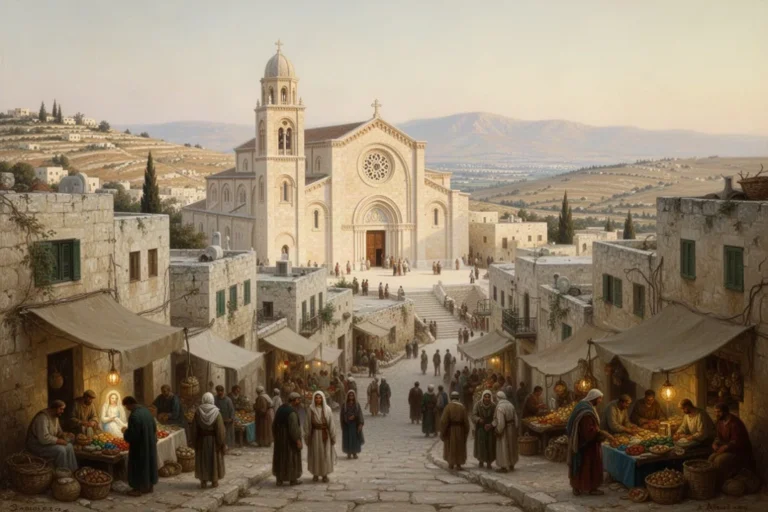
What to see in Nazareth’s historic center
Basilica of the Annunciation
The Basilica of the Annunciation is the city’s best-known landmark. Its modern structure rises above an older archaeological and religious site traditionally associated with Mary’s home and the Annunciation. The building combines contemporary architecture with artwork contributed by Christian communities from different parts of the world.
Inside, look at the large collection of Marian mosaics displayed around the church. Many portray Mary in the artistic style of a particular country or culture, giving the basilica a visually varied character. The lower level is quieter and more intimate, while the upper church provides a broader view of the building’s design.
The basilica is a working church, so access can change during Masses, feast days, and private prayer. Modest clothing is appropriate, and visitors should follow signs about photography. Even when you are primarily interested in architecture or history, the building deserves a respectful approach because pilgrims are there for worship.
Church of Saint Joseph
The Church of Saint Joseph stands close to the Basilica of the Annunciation. Christian tradition associates the site with Joseph’s workshop and with the home of the Holy Family, although the exact historical details belong to religious tradition rather than independently verifiable biography.
The church includes underground areas and remains from earlier structures. These lower spaces help show how later churches were built over places that communities had already considered sacred. The setting is generally more subdued than the main basilica, making it a useful stop for visitors who want a quieter atmosphere.
Mary’s Well and the Greek Orthodox Church of the Annunciation
Mary’s Well is traditionally connected with the water source used by Mary. The visible fountain is in the center of the city, while the Greek Orthodox Church of the Annunciation stands nearby. Orthodox tradition places the Annunciation at a spring, and the church reflects that interpretation.
The church’s interior has a different character from the Roman Catholic basilica, with Orthodox icons, lamps, and devotional artwork. Visiting both churches shows how different Christian traditions interpret and commemorate the same city and biblical events.
The Synagogue Church
The Synagogue Church is a small, simple site in the Old City. Local tradition identifies it with the synagogue where Jesus read from Scripture and spoke to the people of Nazareth. The building’s precise historical continuity is debated, but its importance comes from the tradition associated with the location.
Because the space is small, visitors may need to wait if another group is inside. The surrounding Old City streets can be more interesting than expected, with stone walls, narrow passages, small shops, and glimpses of daily life beyond the major monuments.
Nazareth’s Old City market
The Old City market is a practical place to experience Nazareth as a living city rather than only a religious destination. Depending on the time and day, you may find produce, spices, sweets, coffee, household goods, clothing, and souvenirs. Some sections are highly active, while others are quiet and residential.
Walk without rushing and pay attention to the architecture. Stone buildings, vaulted passages, old doors, and remnants of historic commercial spaces appear alongside modern businesses. Ask before photographing shopkeepers or residents, particularly when children are present.
Food is another reason to spend time in the market area. Local restaurants and cafés may serve dishes such as hummus, falafel, grilled meats, stuffed vegetables, salads, pastries, and Arabic coffee. Menus vary, and some establishments focus on Christian, Muslim, or broader regional culinary traditions.
How to understand Nazareth’s religious and cultural layers
Nazareth is best understood as a place where religion, local identity, and urban history overlap. A church may stand above archaeological remains; a market may occupy streets shaped by centuries of trade; and a modern café may sit near a site visited by pilgrims for generations.
The Christian story is central to the city’s international reputation, but Nazareth is not a museum preserved in one historical period. Its residents work, study, shop, worship, and celebrate there. Treating the city as a living community will make your visit more thoughtful and usually more enjoyable.
There are also differences among Christian traditions. Roman Catholic, Greek Orthodox, Melkite, Anglican, and other communities may maintain distinct churches and interpretations. You do not need to resolve those differences to appreciate them. Simply identify which tradition operates each site and read the explanations provided locally.
Visitors should also understand that Nazareth is part of a region with a complex modern political history. The city’s residents have varied backgrounds and views, and terminology about identity, borders, and history can be sensitive. Listening carefully and avoiding assumptions is more respectful than trying to force every experience into a simple political explanation.
Best places for views and outdoor time
Mount of Precipice
Mount of Precipice, also called Mount Kedumim, lies outside the central church district and offers broad views over Nazareth and the surrounding Galilee. Christian tradition associates the mountain with an episode in which people from Nazareth led Jesus to a cliff.
The site is especially worthwhile for travelers who want open space after walking through dense streets. Bring water in warm weather and allow time for the journey there. Visibility is affected by haze, so the view may be clearest earlier in the day or after weather passes through.
Walking through the hills around Nazareth
Nazareth’s hills provide changing views of apartment buildings, church domes, roads, and green areas outside the city. The terrain is not uniformly difficult, but central streets can be steep and uneven. A short walk may take longer than the map suggests because of stairs, traffic, and stops at small sites.
Wear shoes with good grip for stone paving and sloping streets.
Carry water, especially from late spring through early fall.
Use daylight for unfamiliar routes and avoid assuming every shortcut is open to pedestrians.
Check the weather before planning a viewpoint walk in hot or rainy conditions.
How to reach Nazareth from other parts of Israel
Nazareth does not have a passenger railway station in the city center, so rail travelers generally connect through a nearby city and continue by bus, taxi, or rental car. Routes and travel times change, making a current transit check essential before you leave.
From Haifa, public transportation can be a practical option, and the journey also works well by car. From Tiberias, travelers often combine Nazareth with other Galilee sites. From Tel Aviv or Jerusalem, the trip is longer, so an early departure or an overnight stay is more comfortable than trying to see every major sight in a few hours.
Driving gives you flexibility for Mount of Precipice and nearby attractions, but parking in the historic center can be limited. If you rent a car, avoid leaving valuables visible and confirm where overnight parking is allowed at your accommodation.
Taxis can save time on steep routes or when public transportation is inconvenient. Agree on the destination and, where appropriate, the fare or meter before beginning the ride. Ride-hailing availability can vary, so do not depend on one app without a backup plan.
Allow more time than the map suggests: A route that appears short may involve hills, crowded streets, a delayed bus, or a church service. A flexible schedule is more useful than packing the day with back-to-back stops.
When to visit Nazareth
Nazareth can be visited throughout the year, but the best timing depends on your priorities. Spring and fall usually offer comfortable conditions for walking, while summer can be hot, particularly during the middle of the day. Winter is often suitable for sightseeing, although rain may make steep streets slippery.
Christian holidays can be meaningful times to visit, but they also bring crowds, processions, altered opening hours, and limited accommodation. Christmas is especially significant, as are Easter-related observances and the Feast of the Annunciation. If you want a quiet visit, choose dates outside major festivals.
Weekly patterns matter as well. Some businesses close or reduce hours on particular days, and religious services can restrict access to churches. Muslim, Christian, and Jewish holidays may all affect transportation, business hours, or crowd levels across the region.
Morning is often the easiest time for major church visits. Temperatures are lower, tour groups may not yet have arrived, and natural light can be better for observing architectural details. Use the afternoon for the market, a meal, or a nearby viewpoint.
What to eat and buy in Nazareth
Local food is part of the city’s appeal. Look for fresh hummus, falafel, grilled dishes, salads, flatbreads, pastries, and strong coffee, while remembering that every restaurant has its own menu and style. A meal in the Old City market area can be a convenient way to rest between sights.
Vegetarian travelers generally have many options, although you should ask about ingredients, shared cooking surfaces, and sauces if you have allergies or dietary restrictions. English may be available in tourist-oriented restaurants, but carrying the written name of an allergy or dietary requirement can help.
Shopping choices include spices, sweets, olive-wood items, ceramics, religious objects, textiles, and regional foods. Quality and pricing vary. Examine handmade products carefully, ask where an item was made, and compare prices before buying a costly souvenir.
Bargaining may be accepted in some market settings but is not appropriate everywhere. A polite question is better than assuming that every price is negotiable. Purchases of food, antiques, or natural materials may also involve customs restrictions when you return home.
How to dress and behave at religious sites
Visitors should wear clothing that covers the shoulders and knees when entering churches and other sacred spaces. Some sites provide coverings, but it is better to arrive prepared. Comfortable, modest clothing also makes it easier to move between religious landmarks and neighborhoods without drawing unnecessary attention.
Silence or silence your phone inside churches and prayer areas.
Follow posted photography rules, including restrictions on flash or photography during services.
Ask before photographing worshippers, clergy, shopkeepers, or residents.
Do not touch religious objects unless the site clearly invites visitors to do so.
Follow instructions at entrances, including separate routes or temporary closures.
Friday, Saturday, and Sunday can each have different implications depending on the community and the site. A church may have a busy Sunday service, while Muslim neighborhoods may have a particularly important Friday prayer. Respectful visitors observe local instructions rather than expecting tourist access at every moment.
How long to stay in Nazareth
A focused day trip can cover the Basilica of the Annunciation, Church of Saint Joseph, Mary’s Well, the market, and one additional site. This schedule works best if you arrive early and accept that you will experience the city’s highlights rather than every museum, viewpoint, and neighborhood.
One night in Nazareth creates a more relaxed visit. You can see the main churches, eat locally, explore the Old City after many day visitors have left, and visit Mount of Precipice or Nazareth Village without rushing back to another city.
Two nights make sense if Nazareth is part of a wider Galilee itinerary. You can combine it with nearby natural, archaeological, and historic destinations, depending on current transportation and opening hours. Use Nazareth as a base only if the connections suit your plans; some regional trips are easier by car than by bus.
Practical advice for a smoother visit
Bring a small day bag, water, sun protection, and a portable phone charger. Cash can still be useful for small purchases, taxis, or businesses that do not accept every card. Keep passports and valuables secure, particularly in crowded markets and transportation areas.
Accommodation ranges from small guesthouses and hostels to hotels. A place near the Old City reduces walking between major landmarks, but a property farther uphill may offer better views. Read recent information about parking, stairs, accessibility, breakfast hours, and late check-in before booking.
Accessibility varies considerably. Historic streets can have steps, uneven surfaces, narrow entrances, and steep grades. Contact a hotel or site directly if you need an accessible route, and allow extra time for transportation between locations.
Mobile coverage is generally available, but maps can be less reliable in narrow streets. Save your accommodation’s address in English and, if possible, in a locally used script. Ask your hotel for the best taxi pickup point instead of giving a driver only the name of a large complex.
Suggested one-day itinerary for Nazareth
Begin at the Basilica of the Annunciation while you have the most energy and before services or crowds complicate the visit. Continue to the Church of Saint Joseph, then walk through the nearby streets toward the Synagogue Church and market.
Stop for lunch in or near the Old City, leaving enough time to explore rather than treating the meal as a quick break. Afterward, visit Mary’s Well and the Greek Orthodox Church of the Annunciation if they are open, then choose either Nazareth Village or Mount of Precipice.
End with a viewpoint, café, or unhurried walk through the city. If you are driving onward, check the route before dark. If you are using public transportation, confirm the final departure rather than relying on an approximate schedule.
A thoughtful visit to Israel’s Nazareth combines the city’s famous Christian landmarks with its markets, food, neighborhoods, and living communities. The result is more than a checklist of churches: it is a chance to see how a historic Galilee city continues to function as a home, a place of worship, and a destination for travelers from around the world.
Frequently asked questions
Is Nazareth worth visiting if I am not religious?
Yes. The city offers historical architecture, archaeological layers, local food, markets, viewpoints, and insight into Arab life in northern Israel. Religious sites remain central, but you can appreciate their design, art, and history without practicing a faith. A visit to Nazareth Village, the Old City, and Mount of Precipice can provide a balanced experience beyond church tourism.
Can I visit Nazareth as a day trip?
Yes, especially from Haifa or another nearby Galilee destination. A day trip can cover the main churches, Old City market, and one additional attraction. Travel from Tel Aviv or Jerusalem takes longer, so an overnight stay is more comfortable. Check return transportation carefully because schedules, traffic, and religious events can affect the timing.
What language is spoken in Nazareth?
Arabic is the primary local language, while Hebrew is widely used in Israel. English is common in hotels, many religious sites, and businesses that serve international visitors, but not everyone will speak it fluently. Learning a few polite Arabic or Hebrew expressions and using clear, simple language can make everyday interactions easier.
Are the churches in Nazareth free to enter?
Many churches do not charge a standard admission fee, but policies vary by site and special attractions may have separate costs. Donations may be welcomed. Opening hours can change for worship services, holidays, or maintenance, so confirm details locally rather than assuming that a site will be open throughout the day.



Leave a Reply