St. John Lateran is the cathedral of Rome, making it the pope’s church as bishop of Rome and one of the most important Christian churches in the world.
Visitors often assume that St. Peter’s Basilica is Rome’s cathedral because it is the city’s best-known church and the pope’s principal pilgrimage destination. The cathedral, however, is the Archbasilica of the Most Holy Savior and of Saints John the Baptist and John the Evangelist at the Lateran, commonly called St. John Lateran.
The church stands southeast of Rome’s historic center, near the Caelian Hill and the ancient Aurelian Walls. Its position reflects the importance of the Lateran estate, which became imperial property associated with the Christian community after Emperor Constantine recognized Christianity in the Roman Empire. The basilica was built there in the early fourth century and has served as the pope’s cathedral for many centuries.
St. John Lateran also holds the senior rank among Rome’s four major basilicas. The other three are St. Peter’s Basilica, St. Mary Major, and St. Paul Outside the Walls. Its formal status as an archbasilica signals that it is not simply a historic church or a large place of worship: it is the mother church of the Diocese of Rome.
The essential distinction: St. Peter’s Basilica is in Vatican City, but St. John Lateran is Rome’s actual cathedral. The pope’s role as Bishop of Rome is expressed especially through this church.
How the Lateran complex developed
The basilica is part of a larger group of historic buildings rather than an isolated monument. The original church was connected with the Lateran Palace, which became the principal papal residence for centuries before the papacy moved to Avignon in the fourteenth century. When the popes returned to Rome, the Vatican gradually became the main papal residence and administrative center.
St. John Lateran suffered from earthquakes, fires, neglect, and repeated rebuilding. The church you see today combines its ancient foundation with major medieval and early modern alterations. This layered history explains why its exterior and interior do not look like a single-period building.
The basilica’s present appearance reflects several important stages:
Constantinian foundation: the first major Christian basilica was established in the early fourth century on the Lateran property.
Medieval rebuilding: popes and architects repaired and expanded the church after damage and changing liturgical needs.
Baroque interior: Francesco Borromini transformed much of the interior for the Jubilee of 1650.
Eighteenth-century façade: Alessandro Galilei designed the monumental front completed in the 1730s.
Modern preservation: restoration work continues to protect the structure, artworks, chapels, and archaeological remains.
The result is a church where ancient Christian history, medieval papal history, Renaissance traditions, and Baroque design appear in the same setting. Looking at only one period can make the building seem confusing; seeing it as an evolving complex makes its appearance easier to understand.
What to see first inside St. John Lateran
A visit becomes more meaningful when you know which features deserve your attention. The basilica is vast, but several elements explain its religious and artistic significance particularly well.
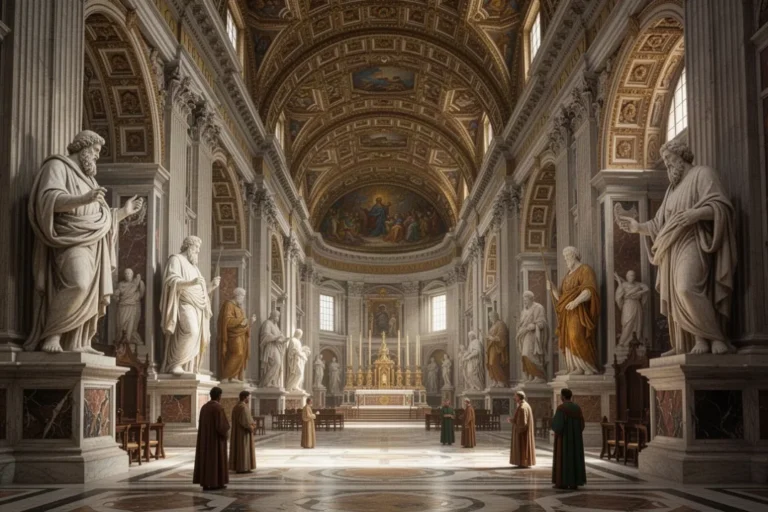
The monumental nave: enter through the central section and look along the long axis toward the high altar. The scale emphasizes the church’s role as a cathedral and major pilgrimage basilica.
Borromini’s architectural framework: notice the large niches along the nave, the rhythm of the piers, and the way the Baroque design organizes ancient and modern sculpture.
The statues of the Apostles: the monumental figures in the nave represent the Apostles and create one of the basilica’s most recognizable interior features.
The high altar: the altar stands beneath a tall Gothic-style baldachin. Tradition associates relics of Saints Peter and Paul with the altar area, making it a focus of devotion as well as architecture.
The apse and mosaics: the apse preserves a celebrated mosaic tradition centered on Christ, the cross, and the heavenly setting of the liturgy, although parts of the decoration have been restored and reconstructed over time.
The cloister: the adjacent cloister offers a quieter space with medieval architectural details, carved columns, and fragments connected with the basilica’s long history.
Allow your eyes time to adjust after entering. The enormous nave can initially seem dominated by white stone and sculpture, but the composition becomes clearer when you identify the repeating niches, the upper windows, the ceiling, and the movement toward the altar.
How Borromini changed the interior
Francesco Borromini’s work is one of the strongest reasons to visit the basilica even if you have already seen Rome’s better-known churches. His seventeenth-century redesign did not erase the church’s ancient identity. Instead, it enclosed the older structure in a more coherent Baroque arrangement.
The nave is divided by substantial piers containing deep niches. These niches hold the colossal Apostles, while smaller architectural details guide the eye upward. The design combines dramatic scale with controlled repetition, so the basilica feels ceremonial without becoming visually chaotic.
Many of the sculptures now seen in the niches were created by different artists, which gives the interior a broader artistic history than the name Borromini alone suggests. The statues present the Apostles as monumental witnesses surrounding the cathedral’s central liturgical space.
Look for the contrast between the warm, richly patterned ceiling and the lighter surfaces of the nave. The ceiling, associated with the late Renaissance, carries a more formal and flat decorative language, while Borromini’s architecture gives the lower church a stronger sense of depth and movement.
What the high altar and apse represent
The high altar is not merely the largest object in the church. It marks the liturgical heart of the cathedral. Its baldachin rises above the altar and creates a visual canopy that separates the sanctuary from the long nave.
According to longstanding tradition, the altar contains relics associated with Saints Peter and Paul. The tradition connects the basilica with the earliest Roman Christian community and with the apostolic foundations of the church. Visitors should distinguish between a devotional tradition and the kind of archaeological claim that can be proven in every detail; the meaning of the relics is part of the basilica’s religious identity.
The apse contains one of the church’s most important visual statements. Its mosaic presents a heavenly and theological scene in which the cross, Christ, and the saints convey the relationship between divine glory and the worshipping community. Water, light, and symbolic figures play important roles in the composition.
Some of the mosaic work has been altered or reconstructed during the basilica’s long history. That does not make it less significant. It shows how major churches preserve a living tradition through conservation, repair, and reinterpretation rather than remaining completely unchanged.
Why the façade looks different from the interior
The main façade was designed by Alessandro Galilei and completed in the eighteenth century. Its broad classical front, giant columns, and upper loggia give the church a palace-like appearance. The statues above the façade include Christ and saints, creating a dramatic skyline visible from the piazza.
At street level, the façade can appear more restrained than the interior. The exterior uses order and symmetry to communicate the basilica’s official status, while the interior relies on sculpture, depth, and liturgical focus. This contrast is typical of Rome’s major churches, where the front often functions as a civic and ceremonial face.
Stand across the piazza if space allows and examine the façade as a complete composition. The enormous central figure of Christ and the surrounding saints help communicate that this is not a parish church of ordinary scale. It is a cathedral and a major destination for pilgrims.
What stands near the basilica
Several nearby buildings form part of the same pilgrimage setting. The most famous is the Scala Santa, or Holy Stairs, located across the street in the building traditionally associated with the former papal chapel. According to Christian tradition, the steps came from Jerusalem and were brought to Rome in late antiquity.
Many visitors climb the stairs on their knees as an act of devotion, while others use a separate staircase for ordinary access. The practice is religiously meaningful, so visitors should follow the site’s instructions and behave quietly.
The Lateran Baptistery stands a short distance from the basilica. It is traditionally associated with the baptisms of early Roman Christians and is one of the most influential surviving baptismal buildings in Christian architecture. Its octagonal form became a model for later baptisteries in Italy and beyond.
The area also contains traces of Rome’s ancient landscape, including the nearby Aurelian Walls and the remains of the former Lateran complex. A visit to the basilica can therefore be combined with an exploration of early Christian, medieval, and imperial Rome.
St. John Lateran: Rome’s cathedral and principal church of the pope as Bishop of Rome.
Holy Stairs: a nearby devotional site connected by tradition with Jerusalem.
Lateran Baptistery: an early Christian building with an octagonal plan and major architectural influence.
Lateran Palace area: the historic setting of papal residence and administration before the Vatican became central.
How to plan a visit to St. John Lateran
St. John Lateran is easy to reach from central Rome, but it is not directly beside the Vatican. The basilica is served by Rome’s Metro Line A at San Giovanni, with additional bus connections and walkable routes from neighborhoods around the Colosseum and Esquilino.
Opening hours, Mass schedules, security procedures, and access to associated buildings can change. Check the official information close to your visit, especially if you want to see the cloister, baptistery, or Holy Stairs rather than only the main basilica.
A practical visit usually works best in this order:
Check the schedule first: avoid arriving during a major liturgy if your goal is quiet sightseeing, and remember that parts of the complex may have separate hours.
Dress for a working church: shoulders and knees should generally be covered, and hats should be removed inside unless worn for religious reasons.
Begin at the main entrance: take in the façade and piazza before going inside so the exterior’s monumental scale has context.
Walk the nave slowly: identify the Apostles, ceiling, side chapels, and relationship between the entrance and high altar.
Spend time at the apse: look beyond the altar to the mosaic and the symbolic use of light, water, and the cross.
Add nearby sites if time permits: visit the Holy Stairs and Baptistery, allowing for separate queues, rules, or admission arrangements.
Plan around worship: St. John Lateran is a functioning cathedral, not only a museum. Keep conversations low, do not block entrances or chapels, and follow staff directions when a liturgy or ceremony is taking place.
Photography rules may vary by area and can be suspended during services. Avoid flash unless it is clearly permitted, and do not photograph people who are praying without their consent. Large bags may be restricted, and security checks can take longer during busy pilgrimage periods.
When to visit for a quieter experience
The basilica is generally calmer early in the day and outside major feast days. Mornings can provide better conditions for studying the interior, while the broad piazza is often more comfortable before the strongest afternoon heat during summer.
Religious celebrations, pilgrimages, and special Holy Year events can change the atmosphere quickly. On such days, the basilica may be crowded but also especially meaningful as a place of worship. If you want detailed architectural viewing, choose an ordinary day; if you want to experience the church’s living ceremonial role, a scheduled celebration may be appropriate.
Do not plan your timing too tightly if you want to visit the surrounding sites. The Holy Stairs and Baptistery may require more time than expected, and the basilica itself rewards a slower pace. Two hours can cover the main complex at a basic level, while a longer visit is better for travelers interested in architecture, mosaics, and Christian history.
How St. John Lateran differs from St. Peter’s Basilica
The two churches have different roles. St. Peter’s Basilica is built over the traditional burial place of Saint Peter and is closely associated with Vatican City, papal ceremonies, and the tomb of the Apostle. St. John Lateran is the pope’s cathedral and represents his diocesan role as Bishop of Rome.
The buildings also create different visual experiences. St. Peter’s is a vast Renaissance and Baroque complex with a monumental dome and a grand approach through St. Peter’s Square. St. John Lateran has a more layered appearance, combining a Constantinian foundation, medieval associations, Borromini’s Baroque interior, and an eighteenth-century façade.
Neither church replaces the other in a thoughtful Rome itinerary. Seeing both helps explain the distinction between the pope’s universal role and his particular responsibility as pastor of the Diocese of Rome.
The Lateran name is also associated with the agreements signed in 1929 between the Holy See and the Kingdom of Italy. These agreements helped resolve the long political dispute that followed the loss of the Papal States and established the legal framework for Vatican City.
The treaties were signed at the Lateran Palace, not in the main basilica. That distinction matters because visitors sometimes assume that the church itself was the location of the agreement. The shared name reflects the historic Lateran complex and its continuing importance to the relationship between Rome, Italy, and the Holy See.
How to approach the basilica respectfully
Because St. John Lateran is both a monument and an active cathedral, respectful behavior improves the experience for everyone. Some visitors arrive for art and history, while others come for prayer, confession, pilgrimage, or Mass.
Speak quietly inside the nave and side chapels.
Keep clear of areas reserved for worshippers or clergy.
Turn off flash and follow posted photography rules.
Dress modestly, even during hot weather.
Do not touch sculptures, mosaics, altars, or protective barriers.
Give priority to people attending services or devotional practices.
Check whether a chapel or nearby building has a separate entrance or schedule.
A short pause at the entrance can help you shift from sightseeing to observation. Notice the church’s scale, then focus on a few features rather than trying to absorb every chapel and decoration at once. The most rewarding visit usually combines the building’s official role, its artistic history, and the continuing religious life that gives the space its purpose.
What makes St. John Lateran worth visiting
St. John Lateran is essential for understanding Rome because it brings together several stories that are often presented separately. It is the city’s cathedral, one of the earliest major Christian basilicas, a papal center, a Baroque masterpiece, and part of a wider pilgrimage complex.
Its importance is not based only on age or size. The church explains why Rome has more than one major basilica and why the pope’s identity includes both a global ministry and a local episcopal office. The building’s changing layers also show how Christian monuments survive: through rebuilding, reinterpretation, ritual, and careful preservation.
If you remember only one point, remember that St. John Lateran is Rome’s cathedral. Once that fact is clear, the basilica’s grand façade, apostolic statues, high altar, nearby Holy Stairs, and long papal history all fit into a more coherent picture.
Frequently asked questions
Is St. John Lateran inside Vatican City?
No. St. John Lateran is in Rome, outside the borders of Vatican City. It is nevertheless closely connected with the Holy See and serves as the cathedral of the pope in his role as Bishop of Rome. Its status as Rome’s cathedral is separate from St. Peter’s Basilica’s location and role in Vatican City.
Can tourists attend Mass at St. John Lateran?
Visitors can generally attend public liturgies, but schedules and access may change for feast days, ceremonies, or special events. Arrive early, dress modestly, and follow the instructions of ushers. During worship, remain in the areas open to the congregation and avoid sightseeing behavior such as extensive photography or conversation.
How long should I spend at St. John Lateran?
Plan about one hour for the main basilica if you want a focused visit, and allow two or more hours if you include the cloister, Holy Stairs, and Baptistery. Visitors especially interested in mosaics, architecture, or church history may prefer a slower visit with time to study individual chapels and the apse.
Is St. John Lateran free to enter?
Entry to the main basilica is commonly free, as it is a working church, but associated spaces or special areas may have separate arrangements. Rules, opening hours, and access policies can change. Check current official information before visiting, particularly if you want to enter the cloister, Baptistery, or other nearby sites.












Leave a Reply