If you searched for a Leviathan Bible verse, you may be trying to understand whether Leviathan was a real animal, a symbol of evil, or a creature from ancient mythology. The clearest answer is that the Bible uses the name in several different poetic settings, and each passage contributes something to its meaning.
Leviathan appears most fully in Job 41, where God describes a terrifying creature that humans cannot capture or control. The name also appears in Psalm 74:14, Psalm 104:26, and Isaiah 27:1, with another poetic reference in Job 3:8. Taken together, these passages show Leviathan as a powerful sea creature associated with danger, chaos, and forces beyond human strength—yet always beneath God’s authority.
Quick answer: The main Leviathan passage is Job 41. It presents Leviathan as an uncontrollable creature and uses that image to teach that God’s power and wisdom exceed anything people can master.
The word Leviathan occurs in a small group of Old Testament passages. Some describe the creature directly, while others use its image in poetry. Reading the references together is more helpful than treating one verse as a complete explanation.
Job 3:8: Job speaks poetically about people who might awaken Leviathan while cursing the day of his birth.
Psalm 74:14: The psalm portrays God as breaking the heads of Leviathan and giving it as food to desert creatures.
Psalm 104:26: Leviathan is described as a creature God formed to play or move in the sea.
Isaiah 27:1: God defeats Leviathan, described as a fleeing serpent and a twisting serpent, and kills the sea monster.
Job 41: God gives the longest description, focusing on Leviathan’s strength, armor-like scales, fearsome mouth, and resistance to capture.
These references do not all use Leviathan in exactly the same way. In Psalm 104, it belongs to the ordered world God created. In Isaiah 27, it represents a hostile force that God will decisively defeat. In Job, the creature demonstrates how limited human power is when compared with the Creator.
What Job 41 says about Leviathan
Job 41 is the central biblical passage about Leviathan. God asks Job whether he can draw Leviathan out with a hook, bind it like a domesticated animal, or make an agreement with it. These questions are not requests for information. They expose the distance between human confidence and actual control.
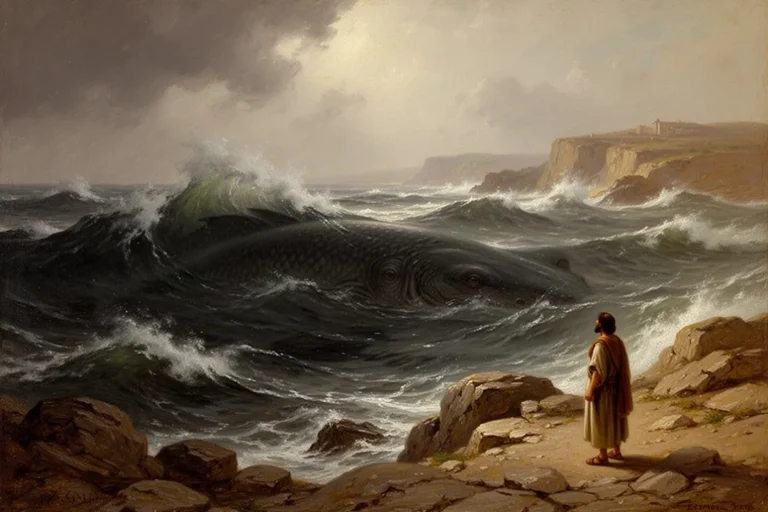
The chapter describes Leviathan as having formidable defenses. Its back is covered with rows of shields or closely joined scales, and its body is presented as so powerful that weapons have little effect. The imagery emphasizes a creature that cannot be safely approached, subdued, or used for ordinary human purposes.
God also describes Leviathan’s mouth and breath with dramatic fire imagery. The passage speaks of flashes, smoke, and heat in poetic language. Readers have sometimes treated those details as a technical description of a fire-breathing animal, but the chapter is written as wisdom poetry, not as a modern zoological report.
The creature’s appearance is only part of the point. Job 41 repeatedly stresses human helplessness. A person who cannot stand before Leviathan cannot reasonably claim the ability to challenge God’s governance of the entire world.
Job 41 does not give Job a method for defeating Leviathan; it gives him a larger view of the power of the One who made and rules it.
How Job 41 fits the book of Job
Job has suffered terribly and wants an explanation for what has happened. His questions are personal, moral, and theological: why has tragedy come to him, and how can God’s justice be understood? When God responds in the later chapters, he does not provide a simple cause for every loss.
Instead, God asks Job questions about the creation and the natural world. The discussion includes weather, wild animals, constellations, and creatures beyond human control. Leviathan appears near the end of that sequence as an especially powerful example of something humans cannot manage.
This does not mean Job’s suffering is dismissed. It means the conversation shifts from human limitation to divine wisdom. Job learns that his inability to see the whole structure of creation does not prove that creation is irrational or outside God’s care.
Job 41 should therefore not be reduced to a debate about whether a particular animal existed. Its larger function is theological. The creature’s terrifying strength makes a point about the Creator: if Leviathan is beyond human control but still within God’s design, then God’s rule extends beyond what Job can see or understand.
Is Leviathan a real animal or a symbolic creature?
The Bible does not give readers a simple modern classification for Leviathan. Some interpreters connect the description in Job 41 with a crocodile, especially because of the references to scales, jaws, and life near water. Others believe the language goes beyond an ordinary crocodile and draws on a traditional image of a monstrous sea creature.
Several possibilities can be considered without forcing every detail into one explanation:
A real aquatic animal: The description may use exaggerated poetic language about a dangerous creature known to ancient people, possibly a crocodile or another large water animal.
A traditional sea monster: The biblical writers may have used familiar ancient imagery of a powerful ocean creature to communicate danger and chaos.
A poetic symbol: Leviathan can represent forces that seem untamable, threatening, and beyond the reach of human authority.
A layered image: The creature may have a natural-world reference while also carrying symbolic meaning in different passages.
These options are not always mutually exclusive. Biblical poetry frequently uses recognizable creatures and dramatic imagery to express theological truth. A passage can refer to a creature in the created world while also using that creature as a picture of disorder, danger, or opposition to God.
The safest reading pays attention to the purpose of each passage. Job 41 is not mainly asking readers to identify an animal. Psalm 104 celebrates God’s creative care. Isaiah 27 uses combat imagery to promise God’s victory. The meaning comes from the role Leviathan plays within each poem.
Reading tip: Do not use one Leviathan reference to explain all the others. Start with the passage’s genre and immediate purpose, then compare it with the remaining references.
What Psalm 74:14 means by Leviathan
Psalm 74 is a communal lament. The worshiping community is facing devastation and asks God to remember his people and act against their enemies. The psalm recalls God’s mighty deeds in creation and in the rescue of Israel from oppression.
Within that setting, the psalm describes God crushing the heads of Leviathan and giving it as food to creatures in the wilderness. The plural imagery of “heads” heightens the picture of a great and dangerous opponent. The scene is not a practical account of hunting or preparing an animal; it is a poetic celebration of God’s overwhelming victory.
The passage connects Leviathan with chaotic waters and hostile powers. The surrounding verses speak of God dividing the sea, breaking the heads of sea monsters, and drying up mighty rivers. The language recalls ancient images in which the sea represented a threatening force that only a supreme deity could control.
Yet Psalm 74 presents Israel’s God as sovereign over that imagery. The point is not that another god is competing successfully with him. The point is that every force associated with chaos is subject to God’s power. This gives the lament a basis for hope: the God who acted in the past is able to act again when his people are in distress.
What Psalm 104:26 reveals about creation
Psalm 104 is a broad hymn celebrating God’s ordering of the natural world. It describes light, clouds, mountains, springs, animals, plants, the moon, the sun, and the sea. Every part of creation is presented as dependent on God’s provision.
In this setting, Leviathan is not a defeated enemy. The psalm says that God formed it to move or play in the sea. That detail is significant because it places the creature within the created order rather than outside God’s control.
The same being that appears terrifying in Job 41 and hostile in Isaiah 27 is viewed here from another angle. The sea may be dangerous to humans, but it is still part of the world God governs. Leviathan is not an independent power threatening the Creator. It is one of the creatures that inhabit the sea God made.
This verse helps prevent an overly narrow interpretation. If Leviathan always symbolized Satan or always represented evil, Psalm 104 would be difficult to read naturally. Here the name contributes to a picture of God’s abundant creation, including creatures too large, wild, or remote for people to control.
How Isaiah 27:1 uses Leviathan
Isaiah 27:1 looks forward to a day when God will punish Leviathan with a severe and decisive blow. The creature is called a fleeing serpent, a twisting serpent, and a monster in the sea. The repeated descriptions emphasize both movement and menace.
In Isaiah, Leviathan is more clearly connected with a force opposed to God’s purposes. The serpent imagery can suggest cunning, danger, and rebellion, although the passage should not be treated as a direct retelling of the serpent in Genesis. Its primary message is that God will defeat whatever power threatens his people and resists his rule.
The verse belongs to a larger prophetic section that addresses judgment, restoration, and God’s care for Israel. The defeat of Leviathan therefore carries a message of future security. Evil and disorder may appear powerful, but they do not have the last word.
Some Christian readers connect Isaiah’s language with later biblical images of Satan and final judgment. That connection can be meaningful as part of a broader theological reading, but Isaiah 27 should first be understood in its own prophetic context. The immediate emphasis is God’s victory over the sea monster and the forces it represents.
Job 3 records Job’s first speech after the extended silence that follows his suffering. He does not curse God. Instead, he curses the day of his birth and wishes that the day had never arrived.
In that intensely poetic speech, Job refers to people who are skilled at awakening or stirring Leviathan. The line expresses a desire for the order of creation to be undone so completely that the powers associated with chaos would be summoned against the day itself.
Job is not giving instructions for calling a sea monster. He is using lament language to express unbearable grief. The reference shows how Leviathan functioned in the imagination of the biblical world: as a frightening power connected with the deep, disorder, and the reversal of ordinary stability.
This passage also demonstrates why individual verses can be misleading when removed from context. Someone reading only the mention of Leviathan might imagine a magical formula or occult practice. The surrounding chapter makes clear that the language is a poetic cry from a man who wishes his suffering had never begun.
What Leviathan symbolizes in the Bible
Leviathan’s meaning changes somewhat from passage to passage, but several themes recur. The creature is always associated with power beyond ordinary human control. It may also represent the dangerous side of the sea, the threat of chaos, or an enemy that God alone can defeat.
The most consistent themes include:
Human limitation: Job cannot capture Leviathan, just as people cannot fully govern creation or demand that God explain every mystery.
Divine sovereignty: God creates, governs, describes, and defeats Leviathan. The creature never becomes an equal rival to him.
Chaos restrained by God: In the Psalms and Isaiah, Leviathan is connected with the dangerous sea and forces that threaten order.
The scale of creation: Psalm 104 shows that the natural world includes creatures beyond human usefulness or control.
Hope for judgment: Isaiah uses Leviathan’s defeat to portray God’s final victory over hostile powers.
These themes explain why Leviathan has attracted so much attention. It sits at the meeting point of nature, poetry, mythology, wisdom, and prophecy. The biblical writers use an image that feels larger than ordinary life in order to say something concrete about God’s authority.
Does Leviathan represent Satan?
Many readers have heard Leviathan described as a name for Satan or as one of the main demons in Christian tradition. That interpretation is common in later religious writing, but the Bible itself does not consistently identify Leviathan as Satan.
In Isaiah 27:1, Leviathan represents a serpent-like sea monster that God will defeat. Christians may read this as part of the Bible’s wider pattern of God conquering evil, and later passages about the devil can make that connection theologically understandable. Still, the verse does not directly use the name Satan.
In Psalm 104:26, Leviathan is one of God’s creatures in the sea. That setting does not support a simple equation between Leviathan and the devil. In Job 41, the creature illustrates God’s creative power and human weakness rather than functioning as a personal tempter.
A careful distinction helps: Leviathan can symbolize opposition, chaos, or destructive power in some contexts without being a personal name for Satan in every context. Christian interpretation may draw broader connections, but those connections should not erase the differences among the biblical passages.
How to study a Leviathan Bible verse carefully
Because Leviathan is unusual and highly symbolic, a few reading steps can prevent confusion. The goal is not to force every passage into the same interpretation, but to see how each writer uses the image.
Read the whole paragraph or poem. Begin with the surrounding verses rather than isolating the name Leviathan.
Identify the genre. Job and the Psalms use poetry, while Isaiah uses prophetic imagery. Neither should automatically be read like a modern scientific description.
Ask who is speaking. Job’s lament, a community’s prayer, a creation hymn, and a prophetic announcement will use the image differently.
Notice what God is doing. God creates Leviathan, controls it, defeats it, or uses its image to question human pride.
Compare the references. Psalm 104 balances the more threatening images in Job, Psalm 74, and Isaiah 27.
Separate the biblical text from later tradition. Later interpretations may be interesting, but they should not be presented as if every detail appears directly in Scripture.
This method also helps when different Bible translations use slightly different wording. Some translations may render a Hebrew term as Leviathan, while others may clarify it with a phrase such as sea monster. The underlying image remains important, but translation choices can affect how strongly a reader imagines a specific animal.
What Leviathan teaches about God’s power
The strongest lesson across the passages is not that people should become experts in monsters. It is that God’s power is greater than the forces that frighten humanity. The Bible presents oceans, storms, wild animals, political enemies, and spiritual opposition as realities that can overwhelm people but cannot overwhelm God.
Job 41 gives this lesson a personal shape. Job has reached the limits of his understanding, and God draws his attention to a creature he cannot master. The argument is not that Job’s pain is insignificant. It is that a limited human perspective cannot measure the wisdom of the Creator.
Psalm 74 turns the same theme into a prayer for help. The community remembers God’s victory over the forces of the deep and asks him not to abandon his people. Psalm 104 turns it into praise: even Leviathan belongs to the world God has made. Isaiah turns it into hope: the power symbolized by Leviathan will ultimately be destroyed.
These different uses produce a balanced picture. God is not merely stronger than Leviathan at one dramatic moment. He is the creature’s Creator, ruler, and judge. The sea monster may appear untamable from a human point of view, but it remains within the boundaries of divine sovereignty.
How Christians can apply the Leviathan passages
Leviathan passages can speak to modern fears without requiring readers to identify a literal monster in their own lives. You may face circumstances that seem too large to manage: grief, injustice, conflict, uncertainty, or the consequences of decisions you cannot undo.
The Bible’s use of Leviathan does not promise that every danger will disappear immediately. Job’s story itself resists a simplistic promise that suffering will always receive a quick explanation. Instead, these passages place frightening realities within a larger vision of God’s authority.
Several practical responses follow from that vision:
Be honest about your limits. Job does not pretend to understand everything. Recognizing what you cannot control can be an act of truth rather than defeat.
Bring fear into prayer. Psalm 74 shows that lament can remember God’s past faithfulness while asking for present help.
Resist exaggerated fear. A force can be dangerous without being ultimate. Biblical poetry repeatedly places Leviathan beneath God’s rule.
Value creation without trying to possess it. Psalm 104 presents a creature that does not need to be useful to humans in order to belong to God’s good world.
Hold on to hope. Isaiah 27 portrays the defeat of hostile power as part of God’s future work.
For personal study, read Job 38–41 together, then compare Psalm 74, Psalm 104, and Isaiah 27. Notice not only the descriptions of Leviathan but also what each passage says about human beings, creation, judgment, and hope.
Which Leviathan passage should you read first?
If you want the fullest description, begin with Job 41. Read it alongside Job 38–40 so that the creature appears within God’s larger speech about creation. This is the best starting point for understanding why Leviathan represents a challenge to human control.
Read Psalm 104:26 next if you want to see Leviathan as part of God’s living creation. Read Psalm 74:14 if you are studying biblical images of God’s victory over chaos. Turn to Isaiah 27:1 when you want to explore prophetic hope and the defeat of hostile powers.
Finally, read Job 3:8 as part of Job’s lament. It shows how the image could express a longing for the world’s order to be undone when suffering becomes unbearable.
Across all these passages, Leviathan remains mysterious, but the central message is clear: what humans cannot tame is not beyond God’s reach. The creature’s power magnifies the Bible’s portrait of the Creator, whose wisdom governs both the ordered world and the forces that appear most threatening.
Frequently asked questions
Is Leviathan mentioned in the New Testament?
The name Leviathan does not appear in the New Testament. Some readers connect its Old Testament imagery with later New Testament descriptions of evil, judgment, or the defeat of Satan, but those connections are theological comparisons rather than direct quotations or explicit identifications. The main biblical references to Leviathan are found in Job, Psalms, and Isaiah.
What is the most important Leviathan verse?
Job 41 is the most important passage because it gives the Bible’s longest description of Leviathan. Its purpose is not simply to identify an animal. God uses the creature’s frightening strength to show Job that human beings cannot control all creation and should not assume they can judge God’s wisdom from a limited viewpoint.
Why do some Bibles call Leviathan a sea monster?
Translators sometimes add a descriptive phrase because Leviathan is a rare Hebrew term associated with a powerful creature of the sea. “Sea monster” helps modern readers understand the image, but it does not settle whether the original passage refers to a particular animal, a traditional monster, or a poetic combination of both.
Is Leviathan evil according to the Bible?
Leviathan is not consistently portrayed as evil. Psalm 104 places it among God’s creatures, while Psalm 74 and Isaiah 27 use it as an image of dangerous or hostile power. Its meaning depends on the passage. The consistent point is that Leviathan, whether creature or symbol, remains subject to God’s authority.


Leave a Reply