King Uzziah was one of Judah’s longest-reigning kings, ruling for 52 years in Jerusalem. He strengthened the nation, expanded its defenses, developed agriculture, and became powerful; however, his pride led him to enter the temple and burn incense, a priestly duty God had not assigned to him.
The biblical account presents Uzziah as both a capable ruler and a serious warning about power. He sought God during much of his reign, but when he became strong, he acted presumptuously. God struck him with a severe skin disease, and Uzziah lived separated from the public until his death, while his son Jotham governed the kingdom.
Uzziah was the son of Amaziah, king of Judah, and his mother was Jecoliah of Jerusalem. The books of 2 Kings and 2 Chronicles identify him as a king of the southern kingdom, Judah, whose capital was Jerusalem. He is also called Azariah in parts of 2 Kings, so readers may see both names in biblical passages.
Uzziah became king after his father’s death. According to the biblical record, he was 16 years old when he began to reign. His long rule covered more than five decades, making him one of the most significant kings in Judah’s history, especially when measured by the size, organization, and prosperity of the kingdom during his reign.
The main accounts of Uzziah appear in 2 Kings 15:1-7 and 2 Chronicles 26. The account in 2 Kings is brief, while Chronicles gives a fuller description of his military projects, agricultural work, and temple offense. Reading both passages together provides a more complete picture of his accomplishments and downfall.
How Uzziah became a successful king
Uzziah’s early success is connected directly to his relationship with God. The Chronicler says that he sought God during the days of Zechariah, a teacher who helped him understand the fear of God. As long as Uzziah sought the Lord, the biblical narrative says that God gave him success.
This does not mean Uzziah was passive or that his achievements came without planning. He was an active administrator and military leader. His reign demonstrates how the biblical writers viewed faithfulness and responsible leadership as compatible with practical work, national defense, economic development, and wise preparation.
Uzziah fought against several neighboring peoples and strengthened Judah’s position in the region. The biblical account says that he defeated the Philistines, broke through parts of their defenses, and established cities in Philistine territory. He also gained influence among surrounding peoples, including groups associated with Ammon, whose tribute reflected Judah’s growing power.
His military strength was carefully organized. Uzziah assembled an army, arranged it into divisions, and placed it under capable commanders. The account in 2 Chronicles also describes a large force equipped with shields, spears, helmets, armor, bows, and sling stones, showing that the kingdom’s military was not merely a collection of local fighters.
He also invested in defensive technology for Jerusalem. Uzziah’s builders placed war machines on the city walls and fortified key areas with towers. These preparations mattered because Jerusalem’s elevated position made it defensible, but a strong location still required trained soldiers, reliable weapons, and maintained fortifications.
A central lesson from Uzziah’s rise: Biblical success did not come from one quality alone. His reign combined dependence on God, disciplined administration, military preparation, and attention to the land.
Uzziah’s agricultural and economic projects
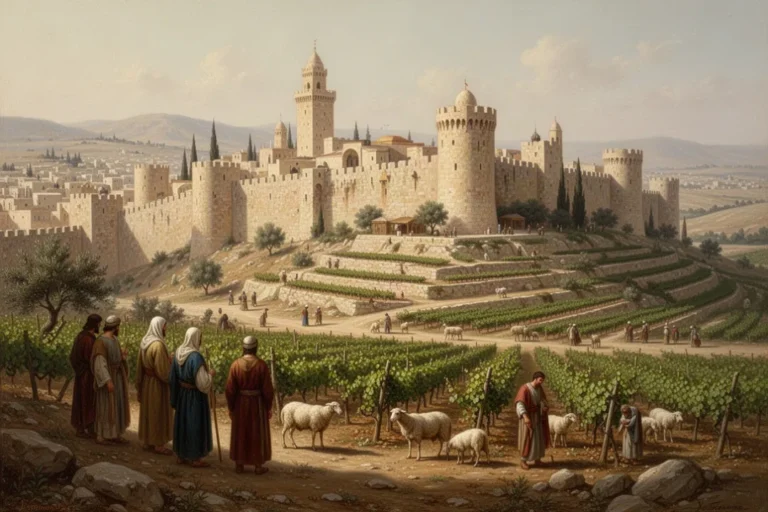
Uzziah’s achievements extended beyond warfare. The biblical record describes him as a ruler who cared about the productivity of Judah’s land. He had workers dig wells in the wilderness because he possessed large herds in the foothills and the plain. Water access was essential for livestock, settlements, and farming in areas where rainfall could be limited or uneven.
He also employed farmers and cultivated vineyards in the hill country and fertile areas. Vineyards were valuable sources of food and trade, and they required long-term planning. By developing land in both the hills and lowlands, Uzziah supported the kingdom’s food supply and helped create a stronger economic base.
These projects reveal another aspect of his leadership: national strength depended on ordinary infrastructure. A kingdom needed more than a well-equipped army. It also needed water, food production, livestock management, skilled workers, and protected communities. Uzziah’s reign was successful in part because he attended to these foundations.
The Bible does not provide a modern economic report for Judah under Uzziah, so claims about exact population growth or wealth should be made cautiously. Still, the descriptions of fortified cities, organized soldiers, extensive herds, and cultivated land clearly portray a period of considerable strength and activity.
Why Uzziah’s pride became his downfall
The turning point in Uzziah’s story appears in 2 Chronicles 26:16. After he became strong, his heart became proud, and that pride led to his destruction. The passage does not condemn strength itself. Instead, it shows how success changed Uzziah’s view of his own authority.
Uzziah entered the temple of the Lord to burn incense on the altar of incense. Under the law given to Israel, this responsibility belonged to the priests descended from Aaron. The king had authority in Judah, but royal power did not erase the boundaries God had established for worship.
The chief priest Azariah confronted him, accompanied by 80 priests. They told Uzziah to leave the sanctuary because he had no authority to perform this priestly service. Their response shows that the priests understood the issue as more than a minor procedural mistake. Uzziah was attempting to cross a boundary between kingship and priesthood.
Uzziah became angry while holding the incense burner. At that moment, a skin disease appeared on his forehead in the presence of the priests near the altar. The account says that the priests hurried him out, and Uzziah himself was eager to leave because he understood that the Lord had struck him.
The narrative emphasizes the connection between pride, unauthorized worship, and judgment. Uzziah did not lose everything because he was an effective king. He fell because success convinced him that his position allowed him to claim a role God had reserved for others.
What happened to Uzziah after he was struck
After the outbreak of his skin disease, Uzziah could no longer enter the temple. He lived in a separate residence for the rest of his life, while his son Jotham took responsibility for governing the people and administering the kingdom. This arrangement allowed Judah to continue functioning even though Uzziah remained the official king.
The condition is sometimes called leprosy in English translations, but readers should be cautious about equating the biblical term automatically with Hansen’s disease, the modern medical condition commonly called leprosy. The original wording refers to a serious skin disorder or disease, and the biblical concern includes ritual and social separation as well as physical symptoms.
Uzziah’s isolation had religious and public consequences. In the biblical world, certain skin conditions could make a person ceremonially unclean and require separation from ordinary communal life. His inability to enter the temple was therefore both a result of the judgment and a visible reminder of the offense that had caused it.
He remained separated until his death. The biblical accounts differ slightly in how they describe his burial. Second Kings says he was buried with his ancestors in the city of David, while 2 Chronicles describes a burial field belonging to the kings and explains that he was not placed directly in the royal tomb because of his disease.
These details are not necessarily contradictory. They may indicate burial near the royal tombs rather than inside them. In either case, the wording preserves the unusual status of a king who remained honored as a ruler but was also marked by judgment and exclusion.
What Uzziah’s story teaches about power and responsibility
Uzziah’s life contains a tension that makes his story especially memorable. He was not portrayed as a useless or consistently wicked ruler. He achieved significant things for Judah and experienced a long period of success. Yet those achievements did not protect him from the consequences of overstepping God’s command.
His story teaches that competence is not the same as character. A person may be gifted, productive, respected, and successful while still becoming vulnerable to pride. The danger is often greatest after a long period of achievement, when victories begin to feel like proof that every decision is justified.
The account also shows that authority has boundaries. Uzziah had real authority as king, but he did not have every kind of authority. He could organize the army and oversee national projects, but he could not redefine the rules of temple worship for himself.
Another lesson concerns the importance of correction. The priests did not silently watch Uzziah proceed. They challenged him directly and explained why his action was wrong. Their resistance was not an attack on the monarchy; it was an attempt to protect the holiness of the temple and the limits established by God.
Uzziah’s response to correction made the situation worse. Instead of accepting the priests’ warning, he became angry. His anger revealed that the issue involved more than a mistaken action. He wanted his royal status to validate his religious act, and he resisted anyone who told him that the king was not above God’s commands.
Uzziah in the historical setting of Judah
Uzziah ruled during a period when Judah had to manage relationships with neighboring kingdoms and peoples. Judah’s position between major regional powers made defense, agriculture, and diplomacy important. His fortified cities and organized army reflect the practical pressures faced by a small kingdom in the ancient Near East.
The prophet Isaiah received his calling in the year of Uzziah’s death, according to Isaiah 6. That reference places Uzziah’s death at an important transition in Judah’s story. Isaiah’s vision of the Lord’s holiness contrasts sharply with Uzziah’s attempt to enter the temple on his own terms, although Isaiah 6 does not retell Uzziah’s offense.
The prophet Amos also mentions an earthquake associated with the days of Uzziah and Jeroboam II. The reference suggests that Uzziah’s reign was remembered as a recognizable historical period in Judah and that a major earthquake occurred during the era, though the biblical text does not provide enough information to establish all of its details.
Uzziah’s long reign also helps explain why his death mattered to later biblical writers. A ruler who had governed for decades represented continuity and stability. His death marked the end of one era, while the rise of Jotham and the prophetic ministry of Isaiah pointed toward a changing and increasingly difficult period for Judah.
Common mistakes when studying King Uzziah
Confusing Uzziah with a different king: Uzziah is also called Azariah in some passages, particularly in 2 Kings. These names refer to the same king of Judah in this context.
Reducing his reign to the temple incident: His offense was central to his downfall, but the Bible also records extensive military, agricultural, and administrative achievements.
Assuming every strong king was fully faithful: Uzziah’s success and later pride belong together in the narrative. The Bible presents both rather than offering a simple hero portrait.
Applying a modern medical diagnosis too confidently: The biblical description of his skin disease should not automatically be identified with a specific modern illness.
Claiming that Uzziah became a priest: He attempted to burn incense, but the account does not say that he was ordained as a priest. The problem was his unauthorized act.
Ignoring Jotham’s role: Uzziah remained king, but Jotham governed during his father’s isolation. This explains how Judah continued under royal leadership.
How to read the accounts in 2 Kings and 2 Chronicles
Second Kings gives a short account of Uzziah’s reign. It identifies him as a generally successful king of Judah, mentions that he did what was right in the Lord’s sight, and notes that the high places remained. It then records his skin disease, his separation, and the beginning of Jotham’s co-regency or administrative leadership.
Second Chronicles 26 provides far more detail. It explains the sources of Uzziah’s strength, describes his military organization, lists his fortifications, and portrays his agricultural projects. It also gives the fullest account of his entry into the temple and the confrontation with the priests.
The books have different purposes and emphases, so the longer account should not be treated as a contradiction of the shorter one. The two passages work together: 2 Kings gives the basic royal record, while Chronicles highlights the religious meaning of Uzziah’s success and failure.
When studying the passages, pay attention to repeated ideas such as seeking God, becoming strong, becoming proud, and being separated. These movements create the structure of Uzziah’s story and show why the biblical writer connects his inner attitude to his public downfall.
Practical ways to apply Uzziah’s warning
Uzziah’s life can be considered without pretending that every modern situation matches an ancient monarchy or temple system. The enduring issue is the misuse of authority. His story asks how you respond when success gives you more influence, more resources, or more confidence.
Examine success honestly. Ask whether achievement has made you more grateful and responsible or more dismissive of correction.
Respect the limits of your role. Authority in one area does not automatically qualify you to control every other area.
Listen when trusted people warn you. A difficult correction may protect you from a much larger failure.
Separate confidence from entitlement. Confidence helps you act wisely; entitlement tells you that ordinary standards no longer apply.
Keep past blessings in perspective. Previous success is not permission to ignore present obedience.
Accept accountability before consequences force it. Uzziah’s anger prevented him from responding humbly when the priests confronted him.
Practical warning: The most dangerous moment in Uzziah’s story came after he had already proved himself capable. Success should increase responsibility, not weaken your willingness to receive correction.
Why King Uzziah still matters to Bible readers
Uzziah remains important because his story avoids simplistic categories. He was not remembered only as a wicked king, and he was not celebrated as an uncomplicated model of faithfulness. He was a ruler who sought God, strengthened his nation, and then allowed his power to reshape his understanding of what he was entitled to do.
His reign shows that long-term success can conceal a growing spiritual problem. Public achievements may continue for years while pride develops beneath the surface. The biblical account therefore evaluates not only what Uzziah built but also how he responded when his authority encountered God’s authority.
His story also gives weight to the biblical view of humility. Humility is not weakness or the refusal to lead. Uzziah led boldly when he worked within his calling. The failure came when he treated his royal position as a reason to disregard limits that applied to him.
For readers studying the history of Judah, Uzziah provides a bridge between the stable strength of an earlier period and the prophetic warnings that followed. For readers considering personal faith and leadership, he offers a lasting caution: the way you handle success may reveal more than the way you handle hardship.
Frequently asked questions
Was King Uzziah the same person as King Azariah?
Yes. Uzziah and Azariah are names used for the same king of Judah in the biblical record. The account in 2 Kings commonly uses Azariah, while 2 Chronicles primarily uses Uzziah. Differences in naming were not unusual in the ancient world, and the surrounding details—his father Amaziah, his long reign, and his skin disease—identify the same ruler.
Why was Uzziah not allowed to burn incense?
Burning incense in the temple was assigned to the priests descended from Aaron. Uzziah was king, but he did not have priestly authority. When he entered the temple and attempted the ritual, the priests confronted him. His offense was not simply entering a building; it was claiming a sacred role that God had assigned to another group.
Did Uzziah rule Judah for 52 years by himself?
The biblical books count his reign as 52 years, but the record also says that his son Jotham governed the people after Uzziah was struck with the skin disease. Uzziah remained the recognized king while Jotham handled administration. This arrangement explains how Judah continued to function during the latter part of Uzziah’s life.
What was Uzziah’s most important achievement?
The Bible highlights several achievements rather than naming only one. Uzziah strengthened Judah’s army, fortified Jerusalem, developed military defenses, expanded livestock and farming operations, and gained influence over neighboring peoples. His greatest religious lesson, however, comes from his failure: national strength and personal success did not excuse him from obeying God’s limits.










Leave a Reply