Gregorius VII: the pope who reshaped medieval church power
Gregorius VII: the pope who reshaped medieval church power
If you have encountered the name Gregorius VII in a medieval history text, a church document, or a list of popes, you may wonder why this pope remains so significant. Gregorius VII is the Latin name for Pope Gregory VII, one of the most forceful and controversial leaders of the 11th-century Catholic Church.
He served as pope from 1073 to 1085 and is best known for opposing the practice of lay rulers appointing bishops and other church officials. His struggle with the German king and future emperor Henry IV produced the Investiture Controversy, a conflict that reshaped the relationship between religious and political authority in medieval Europe.
Gregorius VII was born Hildebrand, probably around 1015 or 1020. The exact place and year of his birth are uncertain, but he was likely from central Italy and received an education connected with the church. He later became a monk, a papal adviser, and one of the leading advocates of reform before becoming pope.
His papacy grew out of a broader movement known as the Gregorian Reform. The reformers wanted clergy to follow stricter standards, bishops to be chosen through legitimate church processes, and the church to exercise greater independence from secular rulers. Their program addressed problems that had become common in parts of medieval Europe, including simony, clerical marriage, and political control over church offices.
Simony: the buying or selling of spiritual offices, church positions, or sacred benefits.
Clerical celibacy: the campaign requiring Latin-rite clergy to remain unmarried and observe church discipline.
Free church elections: the principle that bishops and abbots should not simply be appointed by kings or nobles.
Papal authority: the claim that the pope had a central role in directing the church and correcting serious abuses.
Gregorius VII did not create every reform associated with this movement. Earlier popes, monks, bishops, and church councils had already promoted many of them. His importance came from the way he enforced reform, connected separate issues into one program, and challenged rulers who treated church offices as part of their political power.
In one sentence: Gregorius VII believed the church could not reform itself if kings and nobles controlled the appointment of its bishops.
A short context for the Gregorian Reform
During the 10th and 11th centuries, European rulers often exercised strong influence over the church. Kings and emperors could nominate bishops, invest them with the symbols of office, and rely on them as administrators. Bishops were not only religious leaders; many held land, collected revenue, governed territories, and served political governments.
This arrangement gave rulers practical reasons to control episcopal appointments. A king might prefer a loyal administrator over a spiritually respected candidate. A noble family might seek a church office for one of its members. Reformers objected that these practices weakened the church and encouraged simony, favoritism, and the treatment of sacred offices as political property.
The papacy itself had also experienced political interference. Powerful Roman families had influenced papal elections, while rival candidates and competing factions sometimes produced instability. Reform-minded popes and advisers therefore pursued two related goals: improving the conduct of the clergy and creating a church structure capable of acting independently.
Hildebrand became deeply involved in this reform environment. He worked with several popes before his own election, including Leo IX, Victor II, Stephen IX, Nicholas II, and Alexander II. His experience at the center of papal government prepared him to turn reform ideals into a direct challenge to kings.
Gregorius VII’s rise from adviser to pope
Hildebrand was not immediately elected pope after entering public church life. Instead, he served as an influential adviser and papal official. He helped shape policy, took part in diplomatic missions, and supported efforts to strengthen the independence of papal elections.
In 1059, Pope Nicholas II issued a decree giving the cardinal bishops a leading role in choosing the pope. The measure reduced the formal influence of the Roman nobility and the German king, although the exact balance of power remained contested. This reform became part of the institutional background to Hildebrand’s own election.
After the death of Pope Alexander II in 1073, Hildebrand was elected pope and took the name Gregory VII. His election occurred in Rome amid strong public support, and he was ordained and consecrated later that year. From the beginning, he treated the papacy not as a ceremonial office but as a governing center with responsibility for discipline throughout Latin Christianity.
His early letters show a pope concerned with correcting abuses, defending church property, and compelling bishops and rulers to follow reform policies. He also understood that local enforcement mattered. A decree from Rome meant little if bishops, abbots, kings, and nobles could ignore it without consequence.
How to understand Gregorius VII’s central conflict
The dispute with Henry IV can be understood step by step. The conflict was not simply a personal argument between an ambitious pope and a stubborn king. It involved competing ideas about who had the right to appoint church officials and whether the pope could discipline a Christian ruler.
Reformers opposed lay investiture. They objected to kings or nobles giving bishops the ring and staff that represented spiritual office.
Henry IV defended royal influence. The German king depended on bishops as political allies and continued to support candidates for important sees.
Gregorius VII demanded obedience. He ordered rulers and bishops to respect church prohibitions against simony and unauthorized appointments.
The dispute became political. German nobles used the papal conflict to challenge Henry’s authority, while Henry sought support from bishops opposed to Gregory.
Excommunication changed the stakes. Gregory declared that Henry could not safely continue as a Christian ruler while under papal ban.
The conflict outlasted individual confrontations. Even after Canossa, neither side accepted a lasting settlement, and the struggle continued through military campaigns and rival claimants.
The central term is lay investiture. “Investiture” refers to the ceremony by which a person received the symbols and authority of an office. When a secular ruler performed that ceremony for a bishop, reformers saw it as evidence that the ruler claimed control over a spiritual position.
Henry and his supporters did not necessarily see the arrangement as an attack on religion. From their perspective, bishops governed lands and owed service to the king. Removing royal control could weaken the kingdom and allow the pope to interfere in political affairs. The disagreement therefore involved both theology and government.
The Investiture Controversy with Henry IV
Gregorius VII’s confrontation with Henry IV began with disputes over appointments in northern Italy and the German kingdom. The pope warned against practices he considered simoniacal and insisted that rulers could not install bishops in defiance of church law. Henry, still a young ruler, resisted the demand and continued to rely on royal authority.
In 1076, Henry gathered bishops who rejected Gregory’s authority and declared that the pope should no longer hold office. Gregory responded by excommunicating Henry and releasing his subjects from their oaths of loyalty. This was an extraordinary act because it challenged the king’s religious standing and encouraged political opposition among his nobles.
Medieval kings ruled in a Christian society where religious legitimacy mattered. Excommunication did not automatically remove Henry from power, but it created a serious crisis. German princes threatened to elect another ruler unless Henry resolved the dispute, and the possibility of a rival king became immediate.
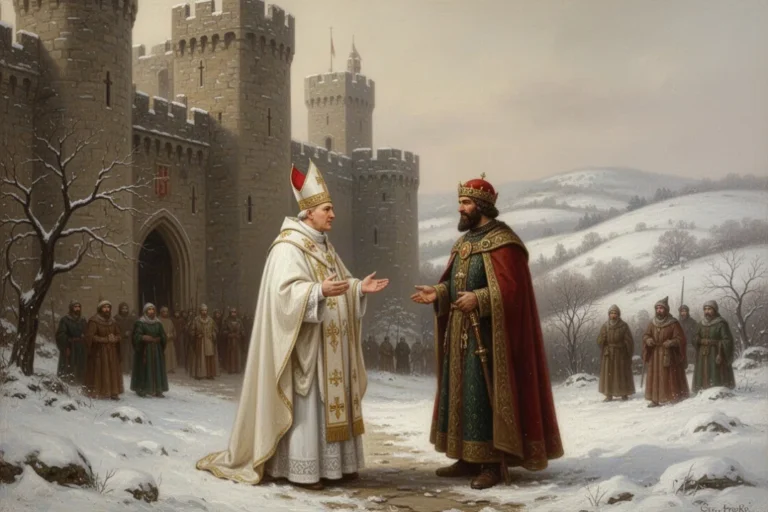
Henry therefore traveled to northern Italy in the winter of 1076–1077. He met Gregory at Canossa, a castle belonging to the countess Matilda of Tuscany. According to the traditional account, Henry waited outside in penitential clothing for several days before the pope lifted the excommunication.
At Canossa, the king sought absolution, but the political conflict did not end there.
Canossa is often reduced to a story of a humbled king and a triumphant pope. The encounter was more complicated. Henry needed reconciliation to protect his position, while Gregory had to decide whether receiving the king’s repentance would restore the conditions for peace. The lifting of the ban did not settle the right to appoint bishops, and it did not end the rivalry between the papacy and the German monarchy.
Why Canossa did not resolve the dispute
After Canossa, German nobles still opposed Henry, and they elected Rudolf of Rheinfelden as a rival king. Gregory initially tried to remain above the competing claims, but the conflict forced him to choose a position. Henry recovered political strength and eventually defeated Rudolf in battle.
As relations worsened, Gregory again excommunicated Henry in 1080. Henry responded by supporting the election of Guibert of Ravenna as an antipope. Guibert took the name Clement III and became the religious focus of Henry’s campaign against Gregory.
Henry marched into Italy and entered Rome. Gregory was forced to seek assistance from the Norman ruler Robert Guiscard. The Normans liberated Gregory from confinement, but their military intervention caused widespread destruction in Rome and damaged the pope’s standing among many Romans.
Gregory left Rome and spent his final years in exile at Salerno. He died there on May 25, 1085. Tradition records his final words as an expression of love for justice and hatred of iniquity, drawn from Psalm 44 in the Latin biblical tradition. Since Bible translations vary, the exact English wording differs between sources.
Gregory’s death did not end the conflict. Henry continued to support Clement III, and later popes continued to contest imperial appointments and authority. The long dispute eventually produced more durable legal and political settlements, especially the Concordat of Worms in 1122, which separated spiritual investiture from the ruler’s role in granting certain temporal rights.
What the Dictatus Papae reveals about Gregory’s papacy
One of the documents associated with Gregorius VII is the Dictatus Papae, recorded in the papal register in 1075. It contains a series of statements about papal authority. Historians debate its exact purpose and whether it was intended as a formal constitutional program, a collection of principles, or a working expression of reform ideas.
The statements emphasize that the Roman Church possesses a unique authority, that the pope can judge major church leaders, and that the pope has a role in correcting rulers. Some propositions go further, suggesting that the pope may depose emperors or release subjects from their allegiance under certain conditions.
The document should not be treated as a complete medieval constitution or as a simple description of how political power actually worked. It is better understood as evidence of Gregory’s expansive view of papal responsibility. He believed the pope had a duty to defend the church, judge serious misconduct, and preserve the unity of Christian society.
The document reflects a strong claim for the independence of the Roman Church.
It presents the pope as the highest judge in major ecclesiastical disputes.
It connects spiritual discipline with the conduct of rulers and governments.
It shows how reform could become a theory of papal supremacy.
It does not by itself prove that every stated power was consistently exercised.
For that reason, the Dictatus Papae is valuable even when read cautiously. It helps explain why Gregory’s opponents regarded his policies as politically dangerous, while his supporters saw them as necessary protections for the church.
Gregory’s reforms concerning clergy and church discipline
The investiture dispute receives most of the attention, but Gregory’s reform program also addressed the daily life of clergy. Reformers opposed clerical marriage and the presence of clergy families who might treat church property as hereditary possessions. They also condemned sexual relationships involving priests and insisted that clergy should observe established disciplinary standards.
Gregory supported movements against married clergy in areas where local practice had become entrenched. Enforcement could be difficult, and not every region changed at the same speed. Some communities resisted, while others feared that sudden measures would disrupt worship and pastoral care.
He also opposed simony, which reformers viewed as a direct corruption of spiritual authority. A bishop should not obtain office by payment or political bargaining. Gregory’s position treated the integrity of the sacrament and the legitimacy of church government as connected issues.
These campaigns were not merely moral regulations. They aimed to establish a clergy that was more accountable to church law than to local families or rulers. That objective required better papal administration, more active legates, stronger communication with bishops, and a network of supporters who could enforce decrees outside Rome.
Historical caution: Medieval reform was uneven. Gregory issued demanding policies, but local customs, political resistance, and limited communication meant that implementation varied widely across Europe.
Gregorius VII’s ideas about church and state
It is tempting to describe Gregory as the first pope to separate church and state in the modern sense. That description would be misleading. Medieval Christians did not usually imagine religion and government as two fully independent spheres. Kings ruled within a Christian order, and the church possessed land, courts, and political influence.
Gregory’s goal was not modern secular separation. He wanted the church to have the freedom to carry out its spiritual mission and to discipline Christians, including rulers, when necessary. He considered the pope responsible for correcting behavior that threatened the moral and religious order of Christian society.
His vision placed the papacy above secular rulers in matters he regarded as spiritual, while also giving the pope influence over political legitimacy. That was a major expansion of papal claims. It challenged the idea that an emperor’s authority flowed independently from royal tradition and military power.
At the same time, Gregory’s position had practical limits. The papacy depended on alliances with nobles, military forces, local churches, and reform-minded rulers. His reliance on Matilda of Tuscany and Robert Guiscard shows that papal independence did not mean political isolation.
How historians assess Gregory VII today
Historians generally view Gregorius VII as a transformative figure rather than as a simple hero or villain. His supporters can point to his determination to resist corruption and protect the church from political domination. His critics can point to the severity of his claims, the disruption caused by his policies, and the suffering produced by the conflict with Henry IV.
His papacy also raises questions about the meaning of reform. A campaign intended to purify the church could increase centralization and papal control. A demand for spiritual independence could become a claim to intervene in royal politics. Gregory’s career shows how efforts to correct abuses may produce new struggles over authority.
His methods were shaped by the institutions of his time. He used letters, councils, legates, excommunication, legal arguments, and alliances. He did not possess a modern bureaucracy or reliable control over distant territories, so his policies depended on personal loyalty and the willingness of local church leaders to act.
That combination of idealism and political realism helps explain his historical importance. Gregory wanted a disciplined church free from lay domination, but achieving that goal required the papacy to become more organized, more assertive, and more involved in the affairs of rulers.
Gregory VII’s legacy in the medieval Catholic Church
The long-term effects of Gregory’s papacy reached beyond the immediate conflict with Henry IV. The papacy became more centralized, church law developed more systematically, and the appointment of bishops increasingly became a matter of formal negotiation rather than simple royal command.
The settlement reached at Worms in 1122 did not make the church independent from all political influence. It distinguished between the spiritual authority of a bishop and the temporal rights connected with lands and offices. That distinction created a framework for reducing direct lay investiture, even though disputes continued.
The reform movement also strengthened the authority of the papal court and contributed to the growth of canon law. Later popes built on Gregory’s claims, sometimes with more successful administration and broader political support. The papacy of Innocent III, more than a century later, would display an even greater reach into European politics.
Gregory also became a model for later debates about papal authority. He was canonized by Pope Paul V in 1606, and his feast is observed on May 25. In Catholic memory, he is often honored as a reforming pope who defended the freedom of the church, although his historical reputation remains more complex than a devotional portrait alone suggests.
How to remember Gregorius VII in a few points
If you need a concise way to identify Gregorius VII, focus on the connection between his personal career, the reform movement, and the conflict with Henry IV.
Name: Gregorius VII in Latin; Pope Gregory VII in English.
Birth name: Hildebrand.
Papal reign: 1073–1085.
Main reform goals: oppose simony, enforce clerical discipline, and limit lay control of church offices.
Most famous confrontation: the Investiture Controversy with Henry IV.
Most famous episode: Henry’s penance at Canossa in 1077.
Important document: the Dictatus Papae, associated with 1075.
Final years: exile in Salerno after Henry’s occupation of Rome.
Historical importance: he helped redefine the authority and independence of the medieval papacy.
Gregorius VII matters because he made a question impossible to avoid: could a ruler govern the church simply because he governed the kingdom? His answer was no. The conflicts that followed did not produce an immediate or complete victory, but they permanently changed the way medieval Europe discussed spiritual authority, royal power, and the government of the church.
Frequently asked questions
Was Gregorius VII the same person as Pope Gregory VII?
Yes. “Gregorius VII” is the Latin form of the name commonly written in English as Pope Gregory VII. Before becoming pope, he was known as Hildebrand. He led the Catholic Church from 1073 until his death in 1085 and is strongly associated with the Gregorian Reform and the Investiture Controversy.
What happened at Canossa?
In 1077, Henry IV traveled to Canossa in northern Italy after Pope Gregory VII had excommunicated him. Henry sought reconciliation to protect his political position. Gregory lifted the excommunication, but the meeting did not settle their disagreement over the appointment of bishops or end the wider struggle between papal and royal authority.
Did Gregory VII abolish lay investiture?
Gregory strongly opposed lay investiture, but he did not permanently eliminate the practice during his lifetime. The dispute continued after his death. A later settlement, the Concordat of Worms in 1122, distinguished the bishop’s spiritual office from the secular authority and property that rulers could grant.
Why is Gregory VII called a reforming pope?
He enforced reforms aimed at ending simony, strengthening clerical discipline, and preventing secular rulers from controlling church appointments. He also promoted a more independent and centralized papacy. His methods and claims were controversial, but they had a lasting effect on church law, papal government, and medieval ideas about political legitimacy.




Leave a Reply