The Orthodox Church is a family of ancient Christian churches united by shared faith, worship, sacraments, and apostolic tradition rather than one worldwide administrative headquarters.
What the Orthodox Church means in Christian history
The name Orthodox Church usually refers to the Eastern Orthodox Church, the communion that includes Greek, Russian, Serbian, Romanian, Antiochian, Bulgarian, Georgian, and other Orthodox churches. “Orthodox” comes from Greek words commonly understood to mean right belief or right worship. The name points to the church’s effort to preserve the faith and worship received from the apostles and the early Christian communities.
Orthodox Christianity developed primarily in the eastern Mediterranean, the Byzantine Empire, Eastern Europe, the Balkans, the Caucasus, and the Middle East. Its worship, theology, architecture, music, and spiritual practices were shaped over many centuries by communities connected to cities such as Constantinople, Antioch, Alexandria, and Jerusalem.
The Orthodox Church shares the central Christian confession that Jesus Christ is the Son of God, became truly human, died, rose from the dead, and brings humanity into communion with God. It also shares the Nicene faith in the Trinity: one God in three persons—Father, Son, and Holy Spirit.
A useful distinction: “Orthodox Church” can sometimes be used broadly for several Eastern Christian traditions. In most everyday American usage, however, it means the Eastern Orthodox Church. The Oriental Orthodox churches are related ancient Christian communities but belong to a different communion.
How the Orthodox Church is organized
The Eastern Orthodox Church is not governed by a single pope or one centralized office. It is a communion of self-governing churches, often called autocephalous churches. Each has its own bishops and administration while sharing the same core faith, sacraments, and communion with the others.
The Ecumenical Patriarch of Constantinople holds a position of first among equals among Orthodox primates. This role has historical and coordinating importance, but it is not equivalent to the universal jurisdiction that the pope holds in the Roman Catholic Church. Orthodox Christians understand authority as exercised through bishops, councils, received tradition, and the life of the whole church.
Local Orthodox parishes may serve people from a particular ethnic background, such as Greek, Russian, Serbian, Romanian, or Antiochian communities. Many parishes in the United States use English extensively or entirely, while also preserving traditional languages in parts of the service.
Parish: The local congregation where people worship, receive pastoral care, and participate in community life.
Priest: The parish’s ordained pastor, who celebrates the Divine Liturgy and administers the church’s sacramental life.
Bishop: The chief shepherd of a geographic area and the guardian of apostolic teaching.
Metropolitan or archbishop: A senior bishop whose title and responsibilities vary by church structure.
Patriarch: The chief bishop of some historic or national Orthodox churches.
Orthodox bishops meet in councils to address matters affecting the church. Orthodox Christians place strong emphasis on conciliarity, meaning that the church’s life is discerned together rather than defined solely by one individual leader.
What Orthodox Christians believe about God and salvation
Orthodox theology begins with the Holy Trinity: the Father, the Son, and the Holy Spirit are one God, sharing one divine nature. The Son, Jesus Christ, is understood as fully divine and fully human. The Holy Spirit proceeds from the Father and is worshiped with the Father and the Son.
The incarnation is central to Orthodox belief. God the Son took human nature in Jesus Christ without ceasing to be divine. Through Christ’s life, death, resurrection, and ascension, human beings are offered healing and restored communion with God. Orthodox writers often describe salvation as theosis, or participation in God’s life by grace—not becoming God by nature, but being transformed into holiness and love.
Orthodox teaching does not treat salvation only as a legal declaration about guilt. It also presents salvation as healing, liberation, forgiveness, and transformation. Sin damages the relationship between humanity and God, other people, and creation. Christ defeats death and opens the way for people to be renewed through faith, repentance, prayer, the sacraments, and love of neighbor.
The Orthodox Church venerates the Virgin Mary as Theotokos, a Greek title meaning “God-bearer” or “Birth-giver of God.” The title protects the belief that the child she bore is truly God incarnate. Mary is honored as the mother of Jesus and a model of faithful obedience, but Orthodox Christians do not worship her; worship belongs to God alone.
Orthodox Christians also honor the saints, including the apostles, martyrs, monastics, and faithful people recognized by the church. Asking a saint to pray is understood as requesting the prayers of a living member of Christ’s body, not treating the saint as a separate deity. The saints’ lives point worshipers toward Christ.
The central Sunday service is the Divine Liturgy. It is both a gathering for prayer and the celebration of the Eucharist. The service includes scripture readings, hymns, litanies, a sermon or homily, the confession of faith, prayers of thanksgiving, and Holy Communion.
The most widely used form is the Liturgy of Saint John Chrysostom. On certain occasions, churches use the Liturgy of Saint Basil the Great, which has longer Eucharistic prayers. During some weekdays in Lent, the Liturgy of the Presanctified Gifts may be celebrated; it is a solemn service centered on Communion that was consecrated earlier.
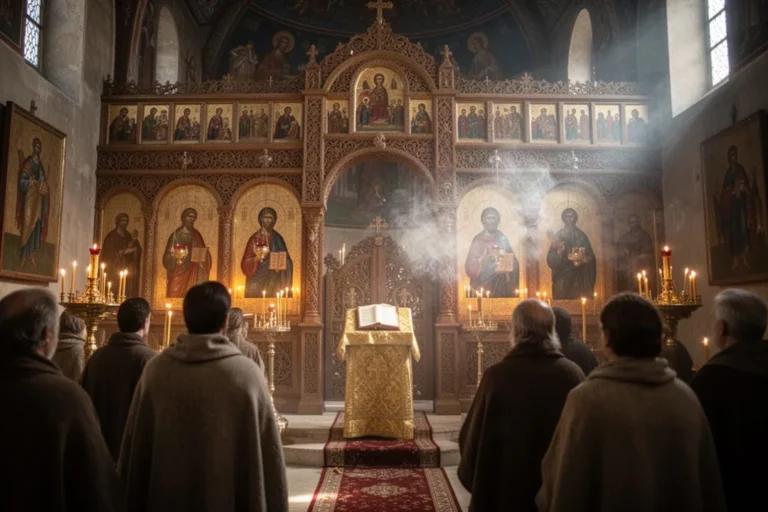
Orthodox worship is strongly liturgical and sensory. The congregation may stand for much of the service, although practices differ by parish and personal need. People hear chanting, see icons, smell incense, make the sign of the cross, bow, and sometimes prostrate during particular prayers or seasons.
The Liturgy is not simply a religious lecture or a private devotional gathering. It brings the local congregation into the church’s worship of God and its remembrance of Christ’s saving work. The Eucharist is understood as a real participation in Christ, not merely a symbolic reminder.
Gathering and preparation: The priest and congregation assemble in prayer, and the bread and wine are prepared for the Eucharist.
Scripture and proclamation: Psalms, hymns, an Epistle reading, and a Gospel reading focus the community on the biblical message.
Prayer and confession: The church offers petitions for the world, the living, the departed, and the needs of the community.
Eucharistic thanksgiving: The priest leads prayers of thanksgiving and invokes the Holy Spirit as the gifts become the Body and Blood of Christ.
Holy Communion and dismissal: Baptized and chrismated Orthodox Christians who are prepared according to church practice receive Communion, followed by prayers and a blessing.
If you are visiting: You may stand, sit, or follow the congregation quietly. Visitors generally do not receive Holy Communion, but may often receive blessed bread afterward, depending on local practice. Ask the priest or an usher if you are unsure.
Why icons are central to Orthodox churches
An icon is a sacred image of Christ, the Virgin Mary, an angel, or a saint. Orthodox Christians do not regard icons as ordinary decoration. They serve as visible reminders of the people and events represented, helping worshipers pray with the awareness that the church includes both the living and the departed.
The distinction between veneration and worship is essential. Worship is offered to God. Icons are venerated, which may include bowing, kissing, lighting candles, or standing before them in prayer. The honor shown to an icon is understood to pass to the person depicted, while worship belongs only to the divine.
The iconostasis is the screen or wall of icons separating the sanctuary from the nave in many Orthodox churches. It is not intended to suggest that God is inaccessible. Instead, it expresses the connection between heaven and earth and the mystery of the church’s worship. The central doors open at particular points in the service, and the arrangement of icons follows established traditions.
Orthodox icons are not usually painted as realistic portraits. Their visual style uses symbolism, deliberate perspective, and recognizable patterns to communicate theological meaning. A saint’s clothing, posture, or hand gesture may help identify the person or convey an aspect of the faith.
What the Orthodox Church means by sacraments
Orthodox Christians commonly speak of seven sacraments, although the church also understands the whole life of the church as sacramental. The traditional seven are baptism, chrismation, Eucharist, confession, marriage, ordination, and anointing of the sick.
Baptism: A person enters the church through baptism, traditionally by triple immersion in water in the name of the Trinity.
Chrismation: Immediately after baptism, the newly baptized person is anointed with holy chrism and receives the gift of the Holy Spirit.
Eucharist: Orthodox Christians receive Communion as the true Body and Blood of Christ under the forms of bread and wine.
Confession: A person turns to God in repentance and receives pastoral guidance and the church’s prayer of reconciliation.
Marriage: A man and woman are united in a sacramental service that asks God to bless their life together.
Ordination: A bishop ordains deacons, priests, and bishops for service in the church.
Anointing of the sick: The church prays for healing of body and soul and anoints the sick with oil.
Infants who are baptized and chrismated normally receive the Eucharist, because Orthodox Christianity sees children as full members of the church rather than people who must wait until a later age. Preparation for Communion still develops over time through family life, catechesis, prayer, fasting, and participation in worship.
How Orthodox Christians use the Bible and Holy Tradition
The Bible has a central place in Orthodox worship and theology. Scripture is read during services, interpreted in sermons, sung in hymns, and used in personal prayer. Orthodox Christians do not generally treat the Bible as detached from the community that preserved, proclaimed, and interpreted it.
Holy Tradition means the living transmission of the apostolic faith through scripture, worship, the teachings of the church fathers, the decisions of councils, the sacraments, the lives of saints, and the church’s prayer. It does not mean that every local custom has equal authority. A custom may be changeable, while the church’s core faith is received as a lasting inheritance.
Important early councils include the seven ecumenical councils recognized by Eastern Orthodox churches. These councils addressed questions about the Trinity, the person of Christ, and the proper use of icons. Their creeds and definitions continue to shape Orthodox worship and teaching.
Orthodox biblical interpretation usually considers the meaning of a passage within the whole life of the church. A verse is not isolated from the church’s worship, the broader scriptural witness, or the teachings of earlier Christian writers. This approach does not reduce the Bible’s authority; it places biblical reading within the community that recites and lives it.
How fasting and prayer shape Orthodox life
Orthodox spiritual practice emphasizes prayer, fasting, almsgiving, confession, and mercy. Fasting is intended to train the heart, not to become a test of personal superiority. It commonly involves abstaining from meat and dairy during designated periods, although exact practices vary and may be adjusted for health, age, pregnancy, work, or pastoral circumstances.
The most prominent fasting period is Great Lent, which prepares believers for Pascha, the Orthodox celebration of Christ’s resurrection. Other fasting periods include the Nativity Fast, the Apostles’ Fast, the Dormition Fast, and regular weekly fasts on Wednesdays and Fridays in many communities.
Prayer may include the Psalms, morning and evening prayers, services from the daily cycle, prayers to Christ and the saints, and the Jesus Prayer. The Jesus Prayer is often repeated in a form that asks Jesus Christ for mercy. Repetition is meant to gather the mind and heart before God, not to function as a magical formula.
Orthodox spirituality also values silence, watchfulness, humility, and repentance. Monastic communities have played a major role in preserving prayer traditions, theological writings, hymnody, and spiritual guidance. Laypeople may draw from monastic wisdom while living ordinary family and working lives.
How Orthodox churches celebrate the church year
The Orthodox calendar centers on Pascha, the feast of Christ’s resurrection. It is the most important celebration of the liturgical year. The services of Holy Week move through Christ’s final days, crucifixion, burial, and resurrection, often with extended prayer and distinctive hymns.
Other major feasts include the Nativity of Christ, Theophany, the Presentation of Christ, the Annunciation, the Transfiguration, and the Dormition of the Virgin Mary. These are often called the Twelve Great Feasts, although the exact way they are presented can vary slightly by tradition.
Some Orthodox churches use the revised Julian calendar for fixed-date feasts, while others use the Julian calendar. As a result, Christmas and other calendar dates may be observed on different civil dates. Pascha is calculated according to the Orthodox calendar tradition and may fall on the same date as Easter in Western churches or on a different date.
These calendar differences do not represent separate beliefs about Christ’s birth or resurrection. They reflect different systems for calculating and observing feast days. The shared center remains the worship of Christ.
How the Orthodox Church differs from Catholic and Protestant churches
Eastern Orthodox, Roman Catholic, and Protestant Christians share core beliefs about Jesus Christ, the Trinity, baptism, scripture, and the resurrection. Their differences concern authority, church structure, theology, worship, and the number and understanding of sacraments.
Authority: Orthodox Christians emphasize scripture within Holy Tradition and the authority of councils and bishops. Roman Catholics give a unique universal role to the pope. Protestant communities vary widely but commonly emphasize the authority of scripture in a distinct way.
Leadership: The Orthodox Church is a communion of self-governing churches. The Roman Catholic Church has a centralized structure under the pope. Protestant churches may be episcopal, presbyterian, congregational, or organized in other ways.
Worship: Orthodox and Catholic worship is liturgical, but the rites, calendars, music, and theological expressions differ. Protestant worship ranges from highly liturgical to informal.
Mary and the saints: Orthodox and Catholics honor Mary and the saints and ask for their prayers, while Protestant views differ considerably by denomination.
Clergy: Orthodox priests may be married if they marry before ordination, but bishops are chosen from celibate clergy or monastics. Roman Catholic practice generally requires celibacy for priests in the Latin Church, with exceptions. Protestant rules vary.
The division between the Eastern Orthodox and Roman Catholic churches is often associated with the East-West Schism of 1054, but the separation developed through a long series of theological, political, cultural, and jurisdictional conflicts. Differences concerning papal authority and the wording of the Nicene Creed became especially significant.
How Eastern Orthodox and Oriental Orthodox churches differ
The Eastern Orthodox Church and the Oriental Orthodox churches are both ancient Christian communions with bishops, liturgical worship, sacraments, monastic traditions, and deep roots in the early church. They are not the same communion, however.
The Oriental Orthodox family includes the Coptic Orthodox Church, Armenian Apostolic Church, Syriac Orthodox Church, Ethiopian Orthodox Tewahedo Church, Eritrean Orthodox Tewahedo Church, and Malankara Orthodox Syrian Church. These churches did not accept the Council of Chalcedon in 451 and developed their own theological and liturgical traditions.
The Eastern Orthodox churches accept the Council of Chalcedon and the later ecumenical councils recognized in their tradition. Modern theological conversations between the two families have found substantial common ground, but they remain institutionally separate and do not share full communion.
What to expect when you visit an Orthodox parish
A first visit can feel unfamiliar because the service may be longer, more sung, and more physically expressive than the worship you know. The congregation may face the altar, cross themselves frequently, bow, kiss icons, and stand during prayers. You do not need to imitate every action immediately.
Arrive a little early if possible. An usher or parish member can explain where to stand and answer questions about candles, printed service books, or local customs. Dress modestly and comfortably; expectations vary, but clothing that is respectful for a formal religious service is a safe choice.
Enter quietly and observe how people pray before the service begins.
Do not take photographs during worship unless the parish clearly permits it.
Remain in the congregation during Communion unless you are an Orthodox Christian prepared to receive.
Accept blessed bread after the service if it is offered, or politely decline if you prefer.
Speak with the priest afterward if you are considering becoming Orthodox or want an explanation of the service.
Becoming Orthodox is normally a process rather than a single informal decision. A person usually attends services, meets with a priest, receives instruction in the faith, and participates in a period of preparation called catechism. The eventual reception into the church depends on the person’s previous Christian baptism and the practice of the receiving jurisdiction.
Because Orthodox churches share communion, an Orthodox Christian may worship in another canonical Orthodox parish when traveling. Parish customs, languages, music, and community culture can differ, but the central faith and Eucharistic life remain connected.
Why the Orthodox Church remains significant for its members
For Orthodox Christians, the church is not only a place to attend on Sunday. It is a way of life shaped by prayer and communion. Family celebrations, fasting seasons, baptisms, weddings, funerals, feast days, charitable work, and personal repentance all belong to the church’s rhythm.
The tradition asks believers to hold theology and practice together. A doctrine is not merely an abstract proposition; it is something sung in worship, expressed through icons, celebrated in the Eucharist, and practiced through forgiveness and service. The church’s goal is the transformation of the whole person—mind, body, relationships, and daily habits—through the grace of God.
That combination of ancient worship, communal faith, sacramental life, and spiritual discipline explains why Orthodox Christianity has continued across many cultures and languages. Its parishes may look different from one country to another, but they share a deep commitment to preserving and living the historic Christian faith.
Frequently asked questions
Is the Orthodox Church the same as the Greek Orthodox Church?
The Greek Orthodox Church is one part of the Eastern Orthodox communion, not a separate religion from it. “Greek Orthodox” may refer to a church’s historical tradition, jurisdiction, language, or cultural community. Other Eastern Orthodox churches include Russian, Serbian, Romanian, Antiochian, Bulgarian, and Georgian churches. They share the same essential faith and Eucharistic communion, although local customs differ.
Can a non-Orthodox person receive Communion at an Orthodox church?
In general, Holy Communion is reserved for baptized and chrismated Orthodox Christians who are prepared according to Orthodox practice. A visitor may attend the service, pray, and often receive blessed bread afterward. Policies can vary in unusual pastoral circumstances, so someone with a specific question should speak privately with the parish priest rather than assume.
Do Orthodox Christians believe in the pope?
Orthodox Christians respect the pope as the bishop of Rome and recognize Rome’s historic importance, but they do not accept the pope’s universal jurisdiction or the later Roman Catholic teachings about papal authority. Orthodox churches are governed through their own bishops and councils. The separation reflects long-developing disagreements about authority, theology, and church structure.
Why do Orthodox Christians celebrate Christmas on a different date?
Some Orthodox churches follow the Julian calendar for fixed-date feasts, so their Christmas celebration falls on a different civil date than December 25 in the Gregorian calendar. Other Orthodox churches use the revised Julian calendar and celebrate Christmas on December 25. The difference concerns calendar calculation, not a different belief about the birth of Jesus.


Leave a Reply