Paul was an early Christian apostle, missionary, and teacher whose letters became part of the New Testament. He was born Saul of Tarsus, a Jewish man with Roman citizenship, and initially opposed the followers of Jesus before becoming one of Christianity’s most influential messengers.
Paul is especially known for announcing Jesus as the Messiah to Gentiles, meaning non-Jewish people. He traveled through parts of the eastern Roman Empire, helped establish Christian communities, endured repeated opposition, and wrote letters to churches and individuals. These letters address faith, ethics, worship, conflict, leadership, and the meaning of Jesus’ death and resurrection.
Paul’s original Jewish name was Saul, a name associated with his Jewish heritage. He came from Tarsus, an important city in the Roman province of Cilicia, in what is now southern Turkey. Acts presents him as a Roman citizen, while Paul’s own letters describe his Jewish ancestry, his connection to the tribe of Benjamin, and his identity as a Pharisee.
Paul’s background brought together several worlds. He was deeply shaped by the Hebrew Scriptures and Jewish tradition, but he also lived in a Greek-speaking and Roman political environment. His education and ability to communicate across cultures later helped him speak to both Jewish and Gentile audiences.
According to Acts, Paul studied under Gamaliel in Jerusalem. The letters and Acts portray him as highly committed to Jewish religious practice before his encounter with Jesus. He did not see himself as a casual observer of the early Christian movement; he regarded its message as a serious threat to the faith and community he was defending.
Paul’s early opposition to Christians is described most clearly in Acts and in his own letters. He says that he persecuted the church of God and tried to destroy it, referring to his zealous efforts against the movement. Acts also connects him with the stoning of Stephen, although the narrative presents Paul as approving the event rather than personally carrying it out.
A useful distinction: Paul’s life story comes from two main sources: Acts, which gives a broad narrative of his ministry, and Paul’s own letters, which provide firsthand information about his beliefs, conflicts, suffering, and calling.
Why Paul was also called Saul
Saul and Paul refer to the same person. Saul was his Jewish name, while Paul was his Roman name. Many people in the Roman world used more than one name, especially when they lived among different ethnic and language groups.
Acts begins by calling him Saul during the account of his persecution of Christians. Around the time of his work among Gentiles, the narrative commonly refers to him as Paul. This change does not necessarily describe a formal name change at the moment of his conversion. It reflects the fact that Paul was increasingly operating in a Greek-speaking and Roman setting.
Paul’s Roman citizenship also mattered in his ministry. Acts says that he used his legal status in certain encounters with local authorities, including when he was arrested and mistreated. His citizenship did not prevent hardship, but it could provide particular legal protections within the empire.
What happened when Paul encountered Jesus
Paul’s conversion is usually associated with the road to Damascus. Acts recounts the event three times, with some differences in emphasis. In the story, Saul was traveling to Damascus to oppose Jesus’ followers when he experienced a powerful revelation of the risen Jesus. He became temporarily blind and was later cared for and baptized through the ministry of a disciple named Ananias.
Paul describes the event in his letters with fewer narrative details. He says that God revealed his Son to him and that he had seen the risen Christ. For Paul, this was not simply a change of personal preference. It was a divine calling that redirected his entire life and gave him a mission to proclaim Jesus among the nations.
The word “conversion” is useful, but it can sometimes make Paul’s experience sound like he simply abandoned one religion for another. Paul continued to understand himself as a Jew and interpreted Jesus through Israel’s Scriptures. His belief was that God had fulfilled his promises through Jesus and had opened the people of God to Gentiles as well.
Paul did not become one of the Twelve disciples who had followed Jesus during his earthly ministry. Instead, he claimed to be an apostle called by the risen Christ. This claim became important because some Christians questioned his authority, particularly when his teaching or independence differed from that of other leaders.
How Paul became a missionary to Gentiles
Paul’s central mission was to proclaim Jesus among Gentiles. The early Christian movement began within Judaism, and many of its first members continued Jewish practices. The growth of Gentile communities raised difficult questions about circumcision, food laws, sacred calendars, and the relationship between Jewish believers and non-Jewish believers.
Paul argued that Gentiles did not need to become Jews in order to belong to Christ. He placed faith in Jesus and the work of the Spirit at the center of membership in the Christian community. His letters repeatedly challenge Christians to avoid treating circumcision or ethnic identity as requirements for salvation.
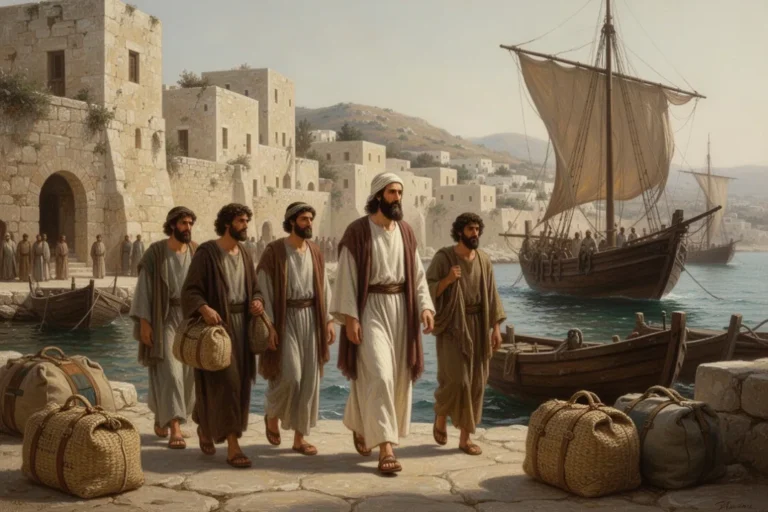
Acts describes Paul working with companions such as Barnabas, Silas, Timothy, and Luke. His ministry included public preaching, synagogue discussions, teaching in homes, baptizing converts, appointing or supporting local leaders, and writing to communities after he had moved on.
Paul’s missionary work was not limited to one city or region. Acts places him in locations including Antioch, Philippi, Thessalonica, Corinth, Ephesus, Athens, and Jerusalem. His letters show that he also maintained relationships with communities across a wide area, often relying on coworkers and messengers to continue the work.
He did not usually think of himself as building a centralized institution under his personal control. Instead, Paul sought to establish communities that could worship, teach, care for one another, and continue the mission locally. He expected those communities to live as one body in Christ despite differences in ethnicity, social position, and spiritual gifts.
What Paul’s missionary journeys involved
Acts presents Paul’s ministry as a series of journeys through the eastern Mediterranean. The exact shape and timing of these journeys are debated by historians, because Acts and Paul’s letters do not provide a complete matching timeline. Still, the broad picture is clear: Paul traveled extensively and used major urban centers as bases for communication and outreach.
Antioch: Paul was associated with the Christian community there and worked with Barnabas.
Philippi: Acts connects Paul with the founding of a Christian community in Macedonia, a region north of Greece.
Thessalonica: Paul addressed both encouragement and concerns about the community’s expectations regarding Jesus’ return.
Corinth: His letters to Corinth discuss divisions, sexual ethics, worship, spiritual gifts, resurrection, and financial support.
Ephesus: Paul’s ministry in this important city became associated with a major center of Christian teaching.
Rome: Paul’s letter to the Romans presents his understanding of the gospel to a community he had not yet visited when he wrote.
Travel in the ancient Mediterranean world was difficult and uncertain. Paul’s letters refer to beatings, imprisonment, dangerous journeys, hunger, exposure, conflict, and opposition. These experiences help explain why he often speaks of ministry as service involving sacrifice rather than as a path to social status.
Paul also supported himself through work. Acts describes him as a tentmaker or leatherworker who worked with Priscilla and Aquila. Scholars discuss the precise trade implied by the term, but the larger point is that Paul had a practical occupation and did not always depend on financial support from the churches he served.
What Paul taught about Jesus and salvation
Paul’s teaching begins with the conviction that Jesus was crucified and raised from the dead. He considered the resurrection essential to Christian faith and repeatedly connected it with the hope of believers. In 1 Corinthians 15, Paul summarizes the message he received and passed on, emphasizing Jesus’ death, burial, resurrection, and appearances to followers.
Paul uses several connected ideas to explain what Jesus accomplished. He speaks of reconciliation with God, forgiveness, justification, redemption, adoption, liberation from sin, and participation in Christ. These terms are not identical, but together they express his belief that God acts through Jesus to restore people and create a new community.
Justification is one of Paul’s most discussed themes. In Romans and Galatians, he argues that people are not made right with God by relying on works of the Jewish law as a boundary marker. Instead, God’s grace is received through faith in Christ. Paul does not use this argument to dismiss moral behavior; he expects faith to produce a transformed life shaped by love.
Paul also teaches that believers are united with Christ in a profound way. Baptism represents participation in Jesus’ death and new life, and the Holy Spirit marks the presence of God within the community. This union creates a new identity that reaches beyond divisions between Jew and Gentile, slave and free, and male and female, as expressed in Galatians 3.
Paul’s understanding of the cross is equally significant. He does not present Jesus’ death merely as a tragic example of injustice. He interprets it as an act through which God deals with sin, reveals divine love, and creates peace between people and God. Different passages emphasize different aspects of this meaning, so Paul’s explanation should not be reduced to one single formula.
How Paul described Christian community and daily life
Paul’s letters show that early Christian communities faced ordinary human problems. Members argued about leadership, wealth, food, worship, sexual conduct, marriage, spiritual gifts, and the treatment of poorer believers. Paul’s teaching is therefore practical as well as theological.
He describes the church as a body with many members. No individual has every gift, and no member should consider another unnecessary. This image supports his concern for cooperation, mutual care, and responsible use of spiritual gifts. In 1 Corinthians 12–14, he places love above displays of spiritual ability.
Paul also emphasizes generosity. He organized a collection for believers in Jerusalem and encouraged Gentile churches to share their resources. This collection had practical value, but it also symbolized unity between Christians from different cultural and geographic backgrounds.
His moral instruction includes honesty, sexual faithfulness, care for the vulnerable, patience, reconciliation, humility, and resistance to greed. Paul calls Christians to live differently from the surrounding culture, but he does not describe holiness as withdrawal from society. His communities remained embedded in households, workplaces, marketplaces, and civic life.
Paul’s teachings about marriage and singleness appear especially in 1 Corinthians 7. He acknowledges different callings and circumstances rather than presenting one life arrangement as universally required. His statements must be read within the concerns of the first-century communities he addressed, including his expectation that the present age was approaching its fulfillment.
Which books of the New Testament are linked to Paul
Thirteen New Testament letters bear Paul’s name. Seven are widely accepted by scholars as authentic letters from Paul: Romans, 1 Corinthians, 2 Corinthians, Galatians, Philippians, 1 Thessalonians, and Philemon. These letters are the clearest direct evidence for Paul’s own voice and thought.
Other letters—2 Thessalonians, Colossians, Ephesians, 1 Timothy, 2 Timothy, and Titus—have been debated. Some Christians and scholars accept them as Pauline, while others believe they were written by later followers using Paul’s authority and continuing his teaching. The debate considers vocabulary, writing style, theology, church organization, and historical circumstances.
Paul’s letters were not written as a single systematic theology textbook. They responded to specific situations. Romans presents a sustained explanation of the gospel, while Philemon is a short personal appeal concerning Onesimus. First Corinthians addresses a troubled congregation, and Philippians combines encouragement, gratitude, warning, and personal news.
The letters often include greetings, travel plans, requests, financial matters, and references to coworkers. These details make Paul’s writing personal and situational. They also show that his ministry depended on a network of women and men who hosted churches, carried letters, provided support, and worked alongside him.
Paul’s relationships with other early Christian leaders
Paul was not the only important leader in the first Christian generation. He interacted with figures such as Peter, James, John, Barnabas, Apollos, Priscilla, Aquila, Phoebe, and Timothy. His letters show both cooperation and serious disagreement.
One major conflict concerned whether Gentile believers had to adopt Jewish practices. Acts describes a meeting in Jerusalem that addressed this issue, while Galatians gives Paul’s own account of disputes with other leaders. Paul respected the importance of Jerusalem but strongly defended his conviction that Gentiles should not be required to become Jewish.
Paul also describes a confrontation with Peter at Antioch in Galatians 2. He objected to Peter’s withdrawal from shared meals with Gentile believers when certain visitors arrived. For Paul, the issue was not merely social etiquette; it contradicted the gospel’s claim that Jewish and Gentile believers had equal standing in Christ.
These conflicts show that the early Christian movement was not completely uniform. Leaders shared central convictions about Jesus, but they differed over authority, practice, identity, and the best way to relate to Judaism and the wider Roman world.
Paul’s letters repeatedly mention imprisonment. Acts describes arrests in places such as Philippi, Jerusalem, Caesarea, and Rome. Paul used imprisonment as an opportunity to teach, correspond with churches, and receive visitors, although the conditions could be severe and varied from one location to another.
Acts ends with Paul living under guarded residence in Rome and proclaiming the kingdom of God. It does not narrate his death. Later Christian tradition commonly places his martyrdom in Rome, sometimes during the reign of Nero, but the exact circumstances and date are not established with the same confidence as the events described in his letters.
Some readers assume that Paul’s death is recorded in the Bible because Acts ends in Rome. It is not. The ending may reflect the book’s literary purpose, the spread of the message to Rome, or an unfinished historical narrative. Paul’s later movements and death remain subjects of historical discussion.
Common mistakes when learning about Paul
Paul can be misunderstood when a single passage is separated from his Jewish background, his missionary situation, or the problems faced by the churches he addressed. These distinctions help you read him more accurately.
Do not treat Paul as one of the original Twelve. He became an apostle through an encounter with the risen Jesus rather than through Jesus’ pre-crucifixion ministry.
Do not assume Saul and Paul were two different people. They are two names used for the same man.
Do not describe Paul as simply rejecting Judaism. He remained deeply shaped by Jewish Scripture and argued within a Jewish theological world, even while proclaiming that Gentiles could belong to God’s people through Christ.
Do not reduce Paul’s message to “faith instead of good works.” Paul opposed relying on law observance as the basis for status before God, but he strongly expected love, generosity, self-control, and ethical conduct.
Do not treat every letter bearing Paul’s name as equally certain in authorship. The letters share a Pauline tradition, but scholars debate the authorship of several.
Do not assume Acts and Paul’s letters provide identical details. They overlap substantially but have different purposes, perspectives, and narrative emphases.
Do not ignore Paul’s coworkers. His mission depended on a broad network that included women and men who served as hosts, teachers, messengers, patrons, and fellow workers.
Why Paul remains important to Christianity
Paul remains important because his letters offer some of the earliest surviving Christian writings and address questions that continue to shape Christian belief. He explains the meaning of Jesus’ death and resurrection, the role of grace and faith, the work of the Spirit, the unity of the church, and the hope of resurrection.
His influence extends beyond doctrine. Paul helped create a vision of a community in which Jewish and Gentile believers shared one faith, even though that unity was difficult to achieve. His churches were imperfect, but his letters preserve an ongoing effort to form communities marked by worship, mutual responsibility, reconciliation, and love.
Paul has also been debated because some of his writings are difficult and have been used in arguments about women, slavery, sexuality, government, marriage, and religious authority. Responsible interpretation requires attention to the specific letter, the original audience, the ancient setting, and the difference between Paul’s own words and later interpretations of them.
At the center of Paul’s life is a striking reversal: a man who once tried to suppress the Jesus movement became one of its leading messengers. His story, preserved through Acts and his letters, explains why he became a central figure in the expansion of Christianity and why his writings continue to be read, debated, and interpreted across Christian traditions.
Frequently asked questions
Was Paul one of Jesus’ original disciples?
No. Paul was not one of the Twelve who accompanied Jesus during his earthly ministry. He became a Christian leader after experiencing what he understood as a revelation of the risen Jesus. Paul called himself an apostle because he believed Christ had personally commissioned him to proclaim the gospel, especially among Gentiles.
Did Paul personally meet Jesus before the crucifixion?
The New Testament does not say that Paul met Jesus during Jesus’ earthly life. Paul’s calling came through an encounter with the risen Christ, which he describes as a revelation. His authority rested on that experience and on his mission, not on having been an eyewitness to Jesus’ public ministry before the crucifixion.
What is Paul’s most famous teaching?
Paul is widely associated with teaching that people are made right with God through God’s grace and faith in Christ, rather than through ethnic identity or observing Jewish boundary practices. He also emphasized the resurrection, the unity of Jewish and Gentile believers, the work of the Holy Spirit, and love as the highest expression of Christian life.
How many letters did Paul write?
Thirteen New Testament letters are traditionally attributed to Paul. Scholars widely agree that seven come directly from him, while authorship of the remaining six is debated. Even the disputed letters were preserved within communities that regarded Paul’s teaching as authoritative and sought to apply it to later Christian circumstances.








Leave a Reply