Christians in Iran: faith, history, and daily life
Christians in Iran: faith, history, and daily life
When people search for Christians in Iran, they are often asking two questions at once: how many Christians live there, and what happens to them in everyday life? The answer depends greatly on a person’s church, ethnicity, language, family background, and whether they were Christian before or after the 1979 Islamic Revolution.
Iran has ancient Christian communities, especially Armenian Apostolic and Assyrian Christians. The country also has Catholic, Protestant, and other congregations, along with Iranian Muslims who have converted to Christianity. These groups do not all receive the same treatment. Historic minorities have limited legal recognition, while converts and unregistered house churches can face much more serious pressure.
Christianity has been present in the Iranian region since the earliest centuries of the faith. The largest historic communities today are generally associated with Armenian Christians and Assyrian Christians, whose traditions, schools, languages, and institutions developed over many generations.
Armenian Christians are mainly connected with the Armenian Apostolic Church, an ancient church with its own theology, liturgy, calendar, and clergy. Some Armenian Iranians belong to Armenian Catholic or Protestant congregations. Their religious identity is closely linked with Armenian heritage, although not every Armenian Iranian is Christian and not every Armenian Christian lives in Iran.
Assyrian Christians include members of churches with roots in the ancient Christian communities of Mesopotamia and Persia. Depending on their church affiliation, they may worship in traditions connected with the Assyrian Church of the East, the Chaldean Catholic Church, or other historic bodies. Many speak Assyrian Neo-Aramaic within their families and communities, while Persian is central to public life.
Smaller groups include Roman Catholics, Orthodox Christians, and Protestant congregations. Some churches serve foreign residents, including diplomats, businesspeople, and other expatriates. These congregations may have a different legal and practical position from churches whose members are Iranian citizens.
A separate category consists of Iranian converts from Islam to Christianity. Some join registered congregations, although access may be restricted. Others meet privately in homes, often using Persian-language worship and Bible study. Authorities commonly view conversion and organized evangelism among Muslims as a security or political issue rather than solely as a matter of personal belief.
The central distinction: A Christian from a recognized historic minority may have limited official religious rights, while a Muslim-born convert may have no comparable legal protection in practice.
Numbers are difficult to establish with confidence. Iran’s official population records identify recognized religious minorities, but they do not capture every convert, private believer, migrant Christian, or person who avoids identifying publicly. Estimates from outside organizations therefore vary, sometimes substantially. A precise total should be treated cautiously rather than presented as settled fact.
How Iranian law recognizes Christians
Iran’s constitution defines the country as an Islamic republic and gives Islam a privileged position in public and legal life. At the same time, it recognizes certain religious minorities, including Armenian and Assyrian Christians, as protected religious communities. This recognition provides a legal framework for some communal activities, but it does not create equal treatment in every area.
Recognized Christian minorities are generally allowed to operate churches, manage some community institutions, and observe their religious practices within established boundaries. They may elect representatives to reserved seats in Iran’s parliament, known as the Majlis. Armenian and Assyrian Christians have separate representation, as do Iran’s other constitutionally recognized religious minorities in their respective arrangements.
Recognition comes with limits. Christian institutions are expected to serve their own communities, and churches can face restrictions on the language used in worship or on who may attend. Services in Armenian or Assyrian are often treated differently from Persian-language services because Persian worship can be understood as an effort to reach the Muslim majority.
Iranian law also gives religious minorities certain personal-status rights in matters such as marriage, divorce, and inheritance, particularly when the parties belong to the same recognized community. The application of these rules can be complicated, and broader civil law may still affect education, employment, family life, and access to public office.
Religious identity can affect a person’s opportunities. Senior positions in many parts of government are limited to Muslims, and public institutions operate within Islamic legal and cultural requirements. Christians may encounter restrictions related to school administration, employment, dress expectations, family law, and participation in public religious activities.
The law does not treat every form of Christianity alike. Recognized ethnic churches are more visible and generally more secure than unregistered Persian-language ministries. A church that has existed as an Armenian or Assyrian institution for generations may be permitted to function, while a small group of Muslim-born converts meeting in a home may be investigated or prosecuted.
Historic Armenian and Assyrian churches: generally have the strongest formal standing among Iranian Christian communities.
Foreign-language or expatriate congregations: may operate under separate arrangements and often serve a limited membership.
Persian-language churches: can face scrutiny, especially if authorities believe they are evangelizing Muslims.
House churches: usually lack the protection and visibility of registered institutions.
Muslim-born converts: may face pressure even when no clear criminal charge is brought.
Legal status and lived experience are not identical. A person may technically have a recognized religious identity yet still encounter discrimination, surveillance, or difficulty obtaining a fair remedy. Conversely, conditions can vary by city, local officials, family circumstances, and how publicly someone practices Christianity.
What worship and church life look like
Christian worship in Iran can include liturgies, Bible readings, sermons, hymns, fasting, prayer, and observance of Christmas and Easter. The atmosphere differs by tradition. Armenian and Assyrian churches often preserve distinctive music, vestments, feast days, and languages that connect worshippers with a long regional history.
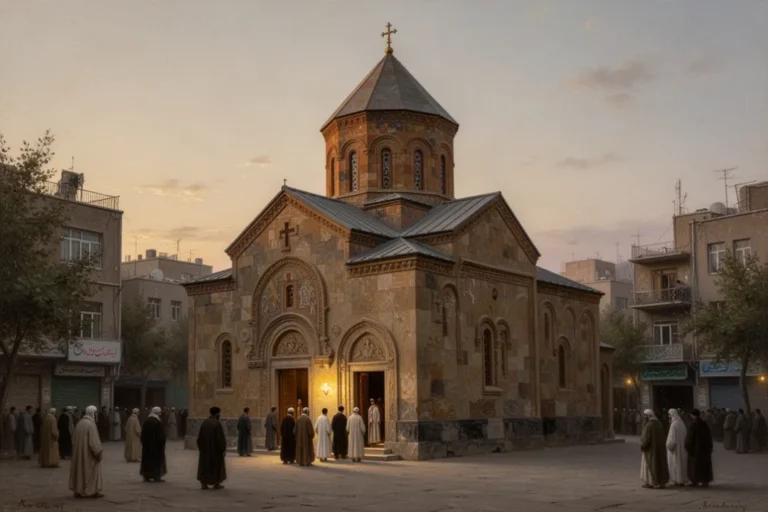
Church buildings may be visible in cities such as Tehran, Isfahan, Tabriz, Urmia, and other places with historic Christian populations. Some churches are also culturally significant landmarks. Their presence does not mean that all Christians can attend freely or that every congregation can operate without official oversight.
For many historic communities, the church is more than a place for Sunday worship. It can support language education, charitable work, family ceremonies, cultural preservation, and community identity. Armenian and Assyrian schools and associations have helped maintain traditions through periods of political upheaval, war, migration, and economic pressure.
Churches generally need permission to function, and their activities may be monitored. Authorities have at times required churches to provide membership information, limit access to services, or avoid Persian-language ministry. Congregations may also be expected to close during Muslim religious holidays or follow regulations that do not apply equally to all faith communities.
Worshippers often make practical choices about visibility. A person from a long-established Christian family may attend a known church, celebrate Christmas at home, and speak openly with relatives while avoiding political discussion. A convert may use a private meeting, encrypted communication, or a small circle of trusted friends instead.
These differences make broad statements misleading. Saying that Christians can worship in Iran is incomplete; saying that all Christians are forbidden to worship is also inaccurate. Public worship exists, but it is regulated, and access depends heavily on the Christian’s identity and congregation.
Christian holidays and public behavior
Christmas is observed by Iranian Christians, although the date and customs may follow Armenian, Assyrian, Catholic, or other church calendars. Families may attend services, prepare special foods, exchange gifts, and visit relatives. In some areas, Christmas decorations and church gatherings are visible, while in others celebrations remain largely private.
Easter and other holy days are also important. Christians may receive permission for religious ceremonies, but public celebrations are expected to remain within accepted boundaries. Large gatherings, public preaching, and outreach to Muslims can attract official attention.
Christian women, like other women in Iran, are subject to national dress regulations in public. Christians are not exempt from rules governing head coverings and modest clothing. Alcohol is prohibited under Iranian law, including for most members of religious minorities, although some recognized communities have limited provisions connected with religious rites.
Why converts and house churches face greater risks
The most vulnerable Iranian Christians are often those who were born Muslim and later became Christian, particularly when they participate in Persian-language house churches. Iranian authorities may regard conversion as a challenge to the Islamic identity of the state. In some cases, officials describe Christian activity as foreign influence, proselytizing, or a threat to national security.
House churches are small, informal gatherings held in private homes or other discreet locations. They may include prayer, Bible discussion, singing, and mutual support. Some meet because no accessible Persian-language congregation is available; others prefer a private setting because attending a public church would expose them to pressure from authorities or relatives.
Security agencies have conducted arrests, interrogations, raids, and prosecutions involving converts and house-church participants. Reported charges can include propaganda against the state, acting against national security, or membership in an illegal organization. The specific charge, evidence, sentence, and treatment vary from case to case.
Even when a person is released, the consequences may continue. Authorities may require a pledge not to attend meetings, confiscate phones, monitor contacts, or impose travel restrictions. Families can face pressure to persuade the convert to return to Islam. Employers, universities, and local officials may also become involved.
Not every convert is arrested, and not every private Christian meeting is discovered. Some people practice quietly for years. That uncertainty is part of the risk: believers may not know whether a meeting is being watched, whether a contact has been detained, or whether a previous warning will lead to a later case.
Women converts can face additional vulnerability within family and social structures, especially in disputes involving marriage, child custody, or domestic authority. Men may face pressure related to employment, military service, or accusations that they are organizing an unauthorized group. The effects depend on gender, age, family support, location, and the authorities involved.
For anyone seeking a current safety assessment: conditions and enforcement can change quickly. People in Iran should rely on qualified local legal advice and reputable human-rights or religious-freedom organizations rather than publicizing sensitive personal details online.
Foreign Christians can also face restrictions, especially if they are suspected of evangelizing or conducting unauthorized religious activity. A visitor who attends a historic church as part of ordinary tourism may have a different experience from a foreign worker leading Persian-language Bible studies. Public political comments can create additional risks regardless of denomination.
How history shaped Christian communities in Iran
Christianity in Iran is not a recent foreign import. Christian communities existed in the Persian world long before the modern Iranian state, and churches in the region developed their own forms of worship, scholarship, and community organization. The historic presence of Armenians and Assyrians is part of the country’s broader cultural and religious history.
Armenian communities expanded and changed through migration, trade, state resettlement, and shifting borders. Isfahan’s New Julfa district became especially associated with Armenian life and architecture. Assyrian communities have longstanding roots in northwestern Iran, including the Urmia region, where Christian institutions once played a significant role in education and publishing.
The twentieth century brought severe disruption. World War I, violence and displacement in the region, political upheaval, economic change, and later emigration reduced the size of many historic Christian communities. The 1979 revolution produced another major transition as some Christians left the country and the new Islamic political system redefined the place of religious minorities.
War and economic hardship have continued to influence Christian life. The Iran-Iraq War affected communities in western Iran, while inflation, unemployment, sanctions, and limited professional opportunities have encouraged younger people to emigrate. As a result, some churches maintain an important heritage even as their local membership declines.
Christian monuments and neighborhoods remain part of Iran’s cultural landscape. Cathedrals, cemeteries, schools, and museums preserve evidence of centuries of Christian life. This heritage can receive official protection as culture, even while contemporary religious activity is subject to strict controls.
The historic communities’ position is therefore mixed. They are recognized and visible, and they contribute to Iran’s cultural diversity. At the same time, they remain a small minority whose institutions depend on official permission and whose members may encounter unequal treatment in public life.
For an Armenian or Assyrian Christian family in a large city, daily life may look familiar in many ways: work, school, shopping, family visits, and participation in a local community. People may speak Persian in public, celebrate both national and Christian occasions, and maintain church traditions at home.
That normality exists alongside careful boundaries. Christians may avoid criticizing religious authorities, discussing sensitive political matters, or inviting outsiders to church events. Young people can feel caught between a historic identity and a society in which Islamic norms shape public institutions and education.
Community size matters. In a city with an established church, a Christian may find relatives, clergy, cultural organizations, and familiar holiday customs. In a smaller town, the person may be more isolated or may need to travel to worship. Rural Christians and converts often have fewer resources than members of established urban communities.
Family attitudes can be decisive. A Christian from a recognized minority may have relatives who share the same faith, while a convert may be the only Christian in the household. Some families respond with acceptance; others fear social consequences, religious condemnation, or official attention.
Education and employment can also shape choices. Christians may attend public universities and work in many private-sector roles, but access to government careers and senior positions is restricted. Religious identity can become especially sensitive when someone seeks a job connected with the state, security services, courts, or public education.
Social media has made it easier for Christians to find teaching, worship music, and fellowship in Persian. It has also increased exposure to surveillance and has created a permanent record of religious activity. Posting a baptism, sharing a sermon, or naming members of a house church can place people at risk.
Support for Iranian Christians should respect these realities. Outsiders can help by distinguishing recognized minorities from converts, avoiding assumptions about a single Christian experience, and using reliable information rather than sensational claims. Privacy, accuracy, and consent matter when discussing people whose religious identity may affect their safety.
Do not assume that every Iranian Christian belongs to a registered church.
Do not publish names, photographs, locations, or meeting details without informed permission.
Do not treat Armenian or Assyrian cultural events as evidence that converts face no restrictions.
Use current country information because laws and enforcement can change.
When offering assistance, work through organizations with experience in Iran and religious-freedom cases.
Christians in Iran are therefore neither a single uniform group nor simply an invisible one. Ancient communities continue to worship and preserve their heritage, while converts and house-church members often practice under far greater pressure. Understanding that distinction gives a more accurate picture of Christian life in the country.
Frequently asked questions
Are Christians allowed to worship openly in Iran?
Some Christians are allowed to worship openly, especially members of recognized Armenian and Assyrian churches. Those congregations operate under official restrictions, including limits on language, membership, and evangelism. Persian-speaking churches, converts from Islam, and house-church groups generally face greater scrutiny and may not be able to worship publicly without risk.
How many Christians live in Iran?
No single figure captures everyone who identifies as Christian. Official records cover recognized minorities, while private converts, house-church participants, expatriates, and people who conceal their faith are difficult to count. Estimates vary, so it is more accurate to describe Iran as having small historic Christian communities plus an uncertain number of newer believers.
What is the difference between Armenian and Assyrian Christians in Iran?
Armenian and Assyrian Christians are distinct historic communities with different languages, church traditions, cultural identities, and regional histories. Both are constitutionally recognized religious minorities, but they are not one denomination or one ethnic group. Their congregations generally have more formal protection than Persian-speaking converts and informal house churches.
Can a Muslim legally convert to Christianity in Iran?
Conversion is not treated as an ordinary, fully protected change of religion in practice. Iranian authorities may investigate or prosecute Muslim-born converts, particularly when they join house churches, evangelize, or organize Persian-language gatherings. The consequences can include interrogation, detention, travel restrictions, employment problems, and family pressure, depending on the circumstances.


Leave a Reply