Christians in China: beliefs, churches, and restrictions
Christians in China: beliefs, churches, and restrictions
Christians in China worship in both officially registered churches and unregistered congregations, but all religious activity takes place under significant government control.
Christianity has a long and varied history in China. It includes Protestant churches, Catholic communities, smaller Orthodox groups, independent congregations, seminaries, charities, and families that practice their faith privately. The experience of a Christian in China can differ greatly depending on location, denomination, age, employment, and whether a congregation has formal registration.
No single figure accurately captures the number of Christians in China. Estimates differ because people define “Christian” in different ways, surveys can be difficult to conduct, and many believers do not belong to a formally registered church. Some attend services regularly, while others pray at home or identify with Christianity without participating in an organized congregation.
Official statistics usually reflect registered religious activity rather than every person who holds Christian beliefs. Independent estimates may include members of house churches, informal Bible study groups, children raised in Christian families, and people who practice privately. These groups are difficult to count, particularly when congregations avoid public membership records.
Christians make up a minority of China’s population, which is overwhelmingly shaped by a mixture of folk traditions, secular worldviews, Buddhism, Taoism, and other religious or philosophical influences. Even so, Christianity has become more visible in some cities and among certain professional and university-educated communities.
Why the numbers vary: A registered church member, a regular worshiper, a baptized believer, and someone who privately identifies as Christian may all be counted differently. Estimates should therefore be treated as ranges rather than precise totals.
Which Christian traditions are present in China?
China’s Christian population is not a single unified community. Protestant and Catholic believers make up the largest groups, while smaller communities include Eastern Orthodox Christians, foreign Christian residents, and independent churches that do not fit neatly within official structures.
Protestant churches and the Three-Self movement
Registered Protestant congregations are generally connected with the Three-Self Patriotic Movement, commonly known as the Three-Self Church. Its name refers to the principles of self-governance, self-support, and self-propagation: churches should be led, funded, and developed within China rather than controlled by foreign missions.
Three-Self churches can hold public services in approved buildings and may employ recognized clergy. Their worship may include preaching, hymns, prayer, Bible reading, and choirs. Some congregations are large, while others serve small local communities.
Registration does not make a church independent of the state. Official churches must follow religious regulations, cooperate with local authorities, and operate within approved boundaries. Rules can affect leadership, building use, children’s participation, religious education, online communication, and relationships with overseas organizations.
Catholic communities and official church structures
Chinese Catholics are divided between communities connected with the state-approved church structure and Catholics who have historically preferred to worship outside that framework. The division is not always simple: some bishops, priests, and laypeople have worked within official structures while maintaining strong ties to global Catholic identity.
The Chinese Catholic Patriotic Association plays a central role in the officially recognized Catholic system. The relationship between Chinese authorities and the Holy See has also involved an agreement concerning the appointment of bishops. The details and practical effects of that arrangement have remained sensitive, and its existence has not removed all tensions surrounding church governance.
Catholic life in China includes Mass, parish associations, charitable work, religious education for adults, and devotion to Mary and the saints. In some areas, older Catholic villages have preserved traditions for generations. In others, Catholic communities have developed around urban professionals, migrant families, or foreign residents.
Orthodox and other Christian communities
Eastern Orthodox Christianity has a smaller presence, linked partly to historical communities near China’s northern borders and to foreign residents in major cities. Other Christian groups may include evangelical fellowships, independent Bible churches, charismatic congregations, and international churches serving expatriates.
International churches often face separate requirements because Chinese citizens and foreign nationals may not be permitted to worship together in every setting. A service open to foreigners may have different rules from a local congregation, and permission to operate can depend on the city and the church’s legal arrangements.
Christianity reached China long before modern missionary movements. The Church of the East established a presence during the Tang dynasty, and the famous Xi’an Stele records the arrival of Christian missionaries in the seventh century. That early community eventually declined, but it remains an important part of Chinese Christian history.
Roman Catholic missions expanded during the late Ming and early Qing periods. Jesuit missionaries such as Matteo Ricci used knowledge of mathematics, astronomy, geography, and classical Chinese culture to build relationships with officials and scholars. Catholic mission work later faced disputes over how Chinese ancestral rites and social customs should be understood.
Protestant missions expanded more substantially during the nineteenth century, often alongside Western commercial and political influence. Missionaries established schools, hospitals, publishing operations, and churches. Some Chinese people embraced Christianity through these institutions, while others associated Christianity with foreign intrusion, unequal treaties, and colonial power.
Chinese Christians were not merely passive recipients of foreign teaching. Local pastors, evangelists, teachers, translators, and lay leaders shaped churches in ways that reflected Chinese language and culture. The growth of indigenous leadership became especially important during periods when foreign missionaries were expelled or restricted.
Christianity after 1949
After the establishment of the People’s Republic of China in 1949, foreign missionaries largely left the country. Religious institutions were reorganized under state supervision, and many churches were closed during political campaigns. The Cultural Revolution brought severe restrictions on religious practice, with church buildings, religious objects, and printed materials often confiscated or destroyed.
Religious activity became more visible again after reforms in the late 1970s. Some churches reopened, seminaries resumed, and registered congregations began serving growing numbers of worshipers. At the same time, Christians who did not want to join official structures formed or maintained house churches, often meeting in homes, offices, rented rooms, or private venues.
The history of this period explains why many Chinese Christians distinguish between faith and institutions. Some believers value the stability and public access provided by registered churches. Others distrust state oversight because of past repression or believe that the church should operate without government direction.
How the Chinese government regulates Christian practice
China’s constitution refers to freedom of religious belief, but religious practice is regulated through laws, administrative rules, local authorities, and the policy of “sinicizing” religion. In practice, this means the government seeks to ensure that religious organizations support national unity, comply with state authority, and express themselves in ways considered compatible with Chinese culture and socialism.
Christian churches generally need approval to register, use buildings for religious services, employ clergy, publish religious materials, and conduct organized activities. A congregation without registration may still meet for worship, but it can face pressure to close, relocate, join an approved body, or limit its activities.
Regulation is not applied identically across China. Local officials may tolerate an informal congregation for years, while another congregation may be questioned or closed quickly. A church’s size, public visibility, building arrangements, leadership, political profile, foreign connections, and willingness to cooperate with authorities can all affect its treatment.
Authorities have also paid closer attention to online religious activity. Livestreamed worship, social media preaching, digital fundraising, religious education, and the distribution of Christian materials may be subject to licensing or content restrictions. Online activity can help believers remain connected, but it also creates a visible record that may attract official scrutiny.
Approved venues: Registered churches can conduct services in recognized locations under the supervision of approved religious bodies.
Clergy and leadership: Pastors, priests, bishops, and other leaders may need recognition or approval through official systems.
Religious education: Teaching children and organizing religious classes can be more restricted than adult worship.
Printed and digital materials: Bibles and other Christian resources are available through approved channels, but distribution outside those channels may create legal risk.
Foreign relationships: Donations, training, conferences, and partnerships involving overseas organizations may receive close attention.
What house churches are and why they matter
A house church is usually an independent Christian congregation or fellowship that does not operate through the official registered church system. The name does not always mean that worship takes place in a private home. Some groups meet in rented offices, apartments, commercial rooms, or rotating locations.
House churches vary widely. One may have a trained pastor, a fixed membership, and a carefully organized weekly service. Another may be a small prayer group led by a layperson. Some are conservative and focused on Bible teaching; others are charismatic, evangelical, or connected to networks of churches in several cities.
Many house churches prefer independence for theological reasons. Leaders may believe that government approval should not determine who can preach, appoint pastors, or manage church finances. Others remain outside the official system because they want stronger links with international Christian organizations or because their local area has no suitable registered church.
Unregistered churches can also provide a sense of close community. Members may share meals, care for elderly people, support families in crisis, and help newcomers find work or housing. These activities can be valuable in a society where migration and urbanization often separate people from their extended families.
Their unofficial status brings risks. Meetings may be disrupted, landlords may be pressured not to rent space to them, leaders may be summoned for questioning, and church members may face employment or educational consequences. The severity of those consequences differs widely, and not every house church experiences the same level of pressure.
What restrictions and pressures do Christians face?
Christians in China are not uniformly persecuted in the same way. Many attend registered services without being arrested or harassed, while some independent congregations experience serious restrictions. The most accurate description is a combination of state control, uneven enforcement, and selective pressure.
One common pressure involves the use of church property. A congregation may lose access to a rented meeting place or be told that its building lacks the necessary permits. Demolition or removal of crosses has occurred in some areas, particularly during local campaigns directed at unauthorized structures or religious visibility.
Leaders of independent churches may be questioned, detained, charged, or placed under travel restrictions. In some cases, authorities have focused on pastors who organize large congregations, communicate with foreign groups, criticize government policy, or refuse repeated demands to register. Members may be warned against attending meetings or providing financial support.
Children’s religious participation is another sensitive area. Rules and enforcement can limit religious instruction for minors, youth camps, church-run schools, and activities involving students. Families may continue to teach their beliefs at home, but public religious education for children can create greater exposure to official scrutiny.
Christian publishing and evangelism also face limits. Churches may legally use approved religious texts in authorized settings, but independent printing, large-scale distribution, street evangelism, and public religious advertising can be restricted. A church that shares sermons through private messaging may still be operating in a legally uncertain space.
These pressures should not obscure the diversity of daily Christian life. Many believers pray, worship, form friendships, raise families, and serve their communities without facing constant confrontation. The difference between ordinary religious practice and official intervention can depend on whether authorities view a group as small and manageable or organized, public, and independent.
Avoid broad labels: “China allows Christianity” and “China bans Christianity” are both misleading. Registered Christian activity is permitted under regulation, while some unregistered or highly visible activity can face significant restrictions.
How Christians in China worship and build community
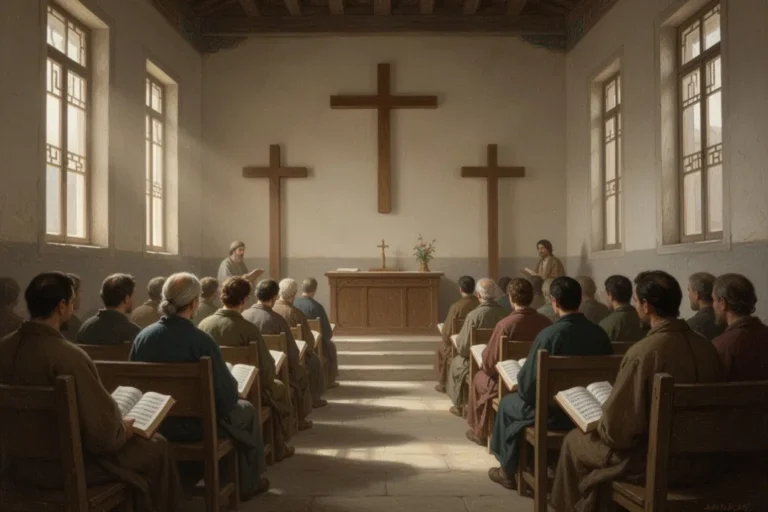
Worship in a registered Protestant church may resemble services found elsewhere: congregational singing, a sermon, prayer, Bible reading, and offerings. Services can be formal or highly participatory, depending on the congregation. Large urban churches may hold several services each Sunday to accommodate attendance.
Catholic parishes typically center worship on Mass, with additional activities such as catechism, choir practice, charitable work, and devotional groups. Parish life can be especially strong in places with a long Catholic history. Some communities maintain local customs that connect Christian practice with family identity and village life.
House church meetings may include extended prayer, small-group discussion, testimony, worship music, and sermons delivered by pastors or lay leaders. Members may gather during the week for Bible study or prayer in addition to a Sunday service. Because meeting places can change, relationships and messaging networks are often central to community life.
Christian service takes many forms. Believers may assist older adults, visit people in hospitals, provide counseling, support people with disabilities, or help migrants adapt to city life. Formal charities must comply with registration and management requirements, while informal aid may be organized through personal networks.
Music, language, and regional culture also shape worship. Congregations may use Mandarin, Cantonese, local dialects, or languages spoken by ethnic minority communities. Younger urban Christians may combine traditional hymns with contemporary worship, while older churches often preserve established forms of singing and prayer.
Practical tips for understanding Christians in China
Visitors, students, journalists, and researchers often make avoidable mistakes when describing Chinese Christianity. The following guidelines help keep explanations accurate and respectful:
Separate belief from registration. A registered church and a house church are different legal and organizational categories, not necessarily different religions.
Ask which region is being discussed. Policies and enforcement can vary between provinces, cities, and even local districts.
Do not treat estimates as exact counts. Explain how a figure was produced and whether it includes unofficial congregations.
Use “Christian” carefully. Specify Protestant, Catholic, Orthodox, house church, registered church, or another group when the distinction matters.
Protect people’s privacy. Do not publish names, meeting locations, photographs, or chat records without informed consent.
Check current rules before organizing activities. Foreign visitors and local believers can face different requirements for worship, teaching, donations, and public events.
Avoid assuming that foreign funding is harmless. Overseas money, training, and partnerships may create legal or personal risks for Chinese church members.
Do not equate visibility with size. A large registered church may be easier to document than a much larger network of small private fellowships.
One of the most serious mistakes is assuming that every Chinese Christian wants to be described as persecuted. Some believers emphasize the ordinary parts of church life, while others have experienced surveillance, closure, detention, or pressure. Both perspectives can exist within the same city or denomination.
How Christianity affects Chinese society and culture
Christianity has influenced education, medicine, publishing, architecture, music, and social welfare in China. Mission hospitals and schools played a significant historical role, even though their legacy is connected to the unequal political relationships of the nineteenth and early twentieth centuries.
Modern Christian communities continue to contribute through professional networks and voluntary service. Churches may help members find employment, support marriage and family life, and provide practical assistance during illness or bereavement. For some urban converts, Christianity offers a structured community in a society where work and migration can produce isolation.
Christian identity can also create tension within families. Parents may worry that conversion means rejecting Chinese culture or traditional family obligations. Converts may need to explain that Christian worship and respect for parents are not necessarily incompatible, although particular practices involving ancestor remembrance can become points of disagreement.
Among ethnic minorities and in border regions, Christianity can carry additional cultural meaning. A church may be connected to a local language, community history, or relationship with neighboring countries. Authorities may therefore view certain religious networks through both a religious and a security lens.
What the future may mean for Christians in China
The future of Christianity in China will likely be shaped by the tension between religious growth and institutional control. Urbanization, education, family networks, and digital communication may continue to create opportunities for Christian communities, while registration requirements and online regulation limit how openly those communities can organize.
Registered churches may gain resources and public stability if they cooperate with official religious structures. Independent churches may continue adapting through smaller groups, rotating meeting places, private communication, and informal leadership. Neither path is uniform, and some congregations may move between formal and informal arrangements as local conditions change.
Relations between Chinese authorities and Christian organizations will also depend on foreign connections. Churches with overseas funding, training, or leadership may face greater scrutiny, while congregations that develop local finances and leadership may be viewed as more compatible with official expectations.
For observers, the clearest picture comes from holding several facts together: Christianity is permitted but regulated; millions of believers worship in different settings; official statistics do not capture everyone; and pressure can be serious but uneven. Understanding those distinctions gives a more accurate view of Christian life in China than either alarmist or overly reassuring descriptions.
Frequently asked questions
Can Christians legally worship in China?
Yes, Christians can legally worship through registered Protestant and Catholic churches that operate under approved religious structures. Unregistered congregations may also meet, but their legal position is less secure. Authorities may restrict their venues, leaders, teaching programs, finances, or online activity. The practical situation varies considerably by city and local government.
Are Bibles available to Christians in China?
Bibles are available through approved religious channels, especially in registered churches. Distribution is more limited outside those channels, and independent printing or large-scale sharing can attract official attention. Access may also differ by region, language, church affiliation, and whether the material is intended for private use or public distribution.
What is the difference between a house church and a registered church?
A registered church operates through an officially recognized religious organization and approved venue. A house church worships outside that framework, although it may meet in a home, office, rented room, or another location. House churches vary widely in theology, size, leadership, and organization, so the term does not describe one single denomination.
Can foreigners attend Christian services in China?
Foreigners can often attend approved international or registered services, but access depends on local rules and the church’s arrangements. Foreign visitors should avoid photographing worshipers, distributing materials, teaching, fundraising, or organizing meetings without permission. Activities involving Chinese citizens and overseas organizations may receive closer scrutiny than ordinary attendance.





Leave a Reply