What the communion of saints means for Christian faith
What the communion of saints means for Christian faith
The communion of saints is the spiritual fellowship uniting all who belong to Christ. It includes Christians living on earth, the faithful departed being purified, and the saints who are with God in heaven. Because they share one life in Christ, they can support one another through prayer, worship, charity, and the grace God gives to the Church.
The phrase does not mean only that Christians gather together or admire holy people from the past. It expresses a deeper belief: the Church is one body, and death does not destroy the relationship between its members. Christians on earth pray for one another, ask the saints to pray with them, and remember that every act of love offered in Christ strengthens the whole community.
What “communion of saints” means in the Apostles’ Creed
The words “communion of saints” appear in the Apostles’ Creed, the ancient statement of Christian belief used especially in Western Christianity. In this context, “communion” means sharing, fellowship, and participation. “Saints” can refer to all holy people belonging to Christ, not only Christians formally recognized as saints by the Church.
The Creed places this belief alongside the Church, the forgiveness of sins, the resurrection of the body, and everlasting life. That setting matters. The communion of saints is connected to Christian hope beyond death, but it also describes the Church’s life now. It means that faith is never merely an isolated relationship between one person and God.
In ordinary conversation, people often use “saint” to mean a canonized Christian such as Saint Augustine, Saint Teresa of Ávila, or Saint Francis of Assisi. In Scripture and Christian theology, however, “saints” often means the entire people of God. Paul addresses several Christian communities as saints, meaning people set apart for God, even though those communities still had serious problems to correct.
These two meanings fit together. Every Christian is called to holiness, while some members of the Church are recognized as exemplary witnesses whose lives can encourage others. The communion of saints therefore includes the whole body of believers and has a special connection to those who have completed their earthly lives in faith.
Core idea: The communion of saints is not a separate spiritual club. It is the shared life of the whole Church in Christ, across earthly life, death, and eternal life.
Who belongs to the communion of saints
Christian traditions explain the members of this communion with slightly different language, but the central picture has three parts. The Church on earth, the faithful departed, and the saints in heaven remain related through Christ rather than separated into unrelated groups.
Christians living on earth
Believers on earth are sometimes called the Church militant, meaning the Church still engaged in the struggle against sin, suffering, temptation, and injustice. This term does not mean Christians should treat other people as enemies. It describes the spiritual work of remaining faithful and growing in love amid the difficulties of ordinary life.
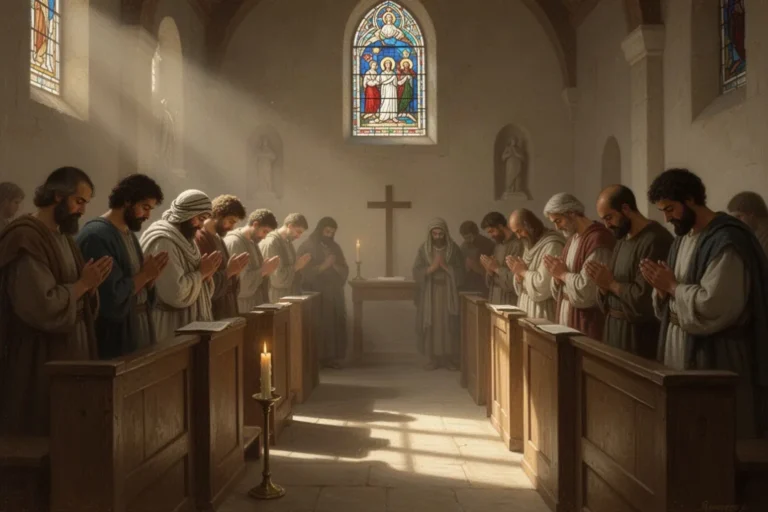
Christians in this earthly community need one another’s prayers and practical help. A congregation that feeds a hungry neighbor, comforts someone who is grieving, teaches children, visits the sick, or forgives an injury participates in the communion of saints. The connection is visible through shared worship and service, not only through private religious feelings.
The faithful departed who are being purified
Many Christians believe that people who die in God’s friendship may still need purification before entering the fullness of heaven. Catholic theology commonly describes this state as purgatory. It is not understood as a second chance after death or as an alternative to salvation, but as the final healing and purification of those already destined for God.
Christians on earth may pray for the dead, asking God to complete that work of mercy. This practice reflects the conviction that love remains meaningful after death. It also encourages humility: people are not reduced to their worst decisions, and the Church continues to entrust the departed to God’s compassion.
The saints who are with God in heaven
The saints in heaven are those who share in the presence of God. Their holiness does not make them rivals to God or independent sources of salvation. Instead, their lives and prayers are understood as participating in Christ’s own work of grace.
Canonized saints hold a particular place in Catholic life because the Church has formally judged that they lived faithfully and now belong to God. Their stories include martyrs, teachers, missionaries, parents, contemplatives, people who served the poor, and Christians whose holiness grew through ordinary responsibilities. Their variety shows that holiness is not limited to one personality type or profession.
The Church on earth: Christians support one another through prayer, worship, teaching, and acts of love.
The faithful departed: Christians commend them to God and, in traditions that teach purification after death, pray for their spiritual completion.
The saints in heaven: Christians honor their witness and may ask them to intercede before God.
How the communion of saints is rooted in the Bible
The exact phrase “communion of saints” is not presented as a single definition in one biblical passage. Its meaning develops from several connected teachings: believers are united in Christ, the Church is described as one body, prayer is shared among God’s people, and death cannot separate believers from God’s love.
One body with many members
In 1 Corinthians 12, Paul compares the Christian community to a body with many parts. Each member has a different role, yet no part can say it does not need the others. The passage presents spiritual gifts as something given for the good of the whole community, not as private achievements.
This image explains why the communion of saints involves both unity and difference. Christians do not all have the same gifts, duties, or life stories. They become one through Christ, while their different forms of service strengthen the entire body.
Sharing in Christ’s life
Jesus uses images of a vine and branches in John 15 to describe the continuing relationship between himself and his disciples. The branches live because they remain connected to the vine. This does not mean Christians become divine by their own power; it means their spiritual life depends on remaining in Christ.
Other New Testament passages describe believers as sharing in one Spirit and being joined together as God’s household. These teachings support the idea that Christian faith is inherently communal. The believer receives life from Christ and is also responsible for loving the other members of Christ’s body.
Praying for one another
The New Testament repeatedly encourages Christians to pray for one another. James 5 connects communal prayer with healing and faithful care. Paul asks different churches to pray for him and tells believers to bring one another’s needs before God. These examples show that asking for prayer is not a sign of weak faith; it is part of Christian fellowship.
The communion of saints extends this logic to the saints in heaven. Christians who ask a saint to pray are not replacing prayer to God. They are asking a member of the heavenly Church to join them in directing prayer toward God through Christ.
Death does not destroy Christian hope
Romans 8 teaches that neither death nor life can separate believers from God’s love in Christ. This passage does not spell out every detail of the relationship between the living and the departed, but it provides an essential foundation: death is not stronger than Christ’s saving love.
Hebrews 12 portrays believers as surrounded by a great cloud of witnesses and approaching the heavenly assembly. Christians interpret this image in different ways, but it clearly connects earthly perseverance with the faithfulness of those who came before. The saints are not forgotten history; their witness continues to encourage the Church.
How the communion of saints differs from worship
A central question concerns the difference between honoring saints and worshiping God. Christian teaching reserves worship for God alone. The saints are honored because God’s grace was active in their lives, and their holiness points beyond themselves to Christ.
When Christians ask a saint to pray, the request has the same basic shape as asking a trusted Christian friend to pray. The difference is that the saint is believed to be alive with God. The request remains dependent on God’s will, God’s power, and Christ’s unique role as Savior and mediator.
Some Christians are uncomfortable with prayers addressed to saints because Scripture strongly emphasizes praying to God. That concern should be taken seriously. A healthy practice of devotion keeps God as the source and destination of prayer, treats Christ as the foundation of salvation, and avoids language that makes a saint appear more powerful or merciful than God.
Devotions become distorted when a person treats a saint as a magic solution, assumes a particular prayer guarantees a desired outcome, or gives a saint the trust and surrender owed only to God. The communion of saints is meant to deepen Christian faith, not compete with it.
Keep the distinction clear: Christians worship God, honor the saints, and ask the saints to pray. The saints do not replace Christ; they witness to his grace and join the Church’s prayer.
Why Christians ask the saints to intercede
Intercession means praying on behalf of another person. Christians already practice it whenever they ask a friend, pastor, family member, or congregation to pray for a need. Asking a saint to intercede applies that shared life of prayer to the Church in heaven.
The practice rests on several beliefs. First, the saints are alive in God. Second, love continues in the presence of God rather than being erased by death. Third, God welcomes the prayers of his people and allows them to participate in his care for the world.
Intercession does not imply that God is reluctant to help until persuaded by a saint. Instead, it reflects the way God often chooses to work through relationships. God can give encouragement through a friend, healing through medical care, wisdom through a teacher, and spiritual support through the prayers of another believer.
Many Christians ask particular saints to pray for certain needs because of the saint’s life or witness. Someone may turn to a martyr when facing persecution, to a saint known for serving the sick during illness, or to a teacher of the faith when seeking clarity. These associations can help people pray with greater attention, but they are not binding formulas or guarantees.
How the communion of saints shapes Christian life today
The doctrine has practical consequences for how Christians treat people, remember the dead, and understand holiness. It teaches that personal faith cannot be separated from responsibility toward the wider body of Christ.
It makes prayer more communal
When you pray for others, you participate in the Church’s shared life. You may pray for a family member, a stranger affected by war, a local congregation, or someone who has died. These prayers train the heart to move beyond immediate personal concerns and to see the needs of others as connected to your own life before God.
It gives suffering a place within Christian fellowship
The communion of saints does not explain away pain. It does, however, say that suffering need not be carried in complete isolation. The prayers of the Church, the examples of faithful people, and the hope of resurrection can provide companionship when circumstances remain unresolved.
This belief also creates a duty to offer concrete help. Saying that believers are spiritually united while ignoring hunger, loneliness, abuse, or injustice contradicts the body-of-Christ image. Prayer and practical love belong together.
It broadens the meaning of holiness
Saints show that holiness can appear in many settings. Some served publicly, while others lived quiet lives of work, family care, prayer, or patient endurance. Their example challenges the assumption that spiritual greatness requires fame or unusual experiences.
The communion of saints also reminds Christians that they inherit a faith shaped by earlier generations. Creeds, prayers, hymns, acts of mercy, and biblical interpretation have been carried forward by people whose names may be known or forgotten. Faith is received as well as personally practiced.
It strengthens hope about death
Christian remembrance of the dead is more than nostalgia. Through funeral prayers, memorial services, anniversaries, and personal remembrance, Christians entrust the departed to God and affirm the hope of resurrection. The communion of saints says that a person’s relationship to the Church is not simply erased at death.
Practical ways to live the communion of saints
You do not need an elaborate devotional routine to practice this belief. Small, deliberate actions can express the Church’s unity across time and death.
Pray for someone else by name. Include a person who is sick, grieving, isolated, or struggling with faith.
Ask trusted Christians to pray with you. Sharing a burden can turn private anxiety into communal care.
Remember the departed. Give thanks for their good qualities and entrust them to God rather than pretending grief does not exist.
Study a saint’s whole life. Look beyond inspirational quotations and consider the person’s failures, decisions, relationships, and service.
Follow a saint’s example through action. If a saint cared for the poor, support a local ministry; if a saint pursued reconciliation, take a concrete step toward peace.
Pray with the Church. Participate in worship, the sacraments where your tradition practices them, or a regular communal prayer gathering.
Give thanks for unseen service. Recognize the ordinary acts of care that keep families, congregations, and neighborhoods healthy.
Common mistakes about the communion of saints
The phrase can be misunderstood when one part of the teaching is isolated from the rest. These are common errors to avoid:
Reducing saints to perfect people: The saints were not people without weakness. Their lives show repentance, perseverance, and cooperation with grace, not flawless personalities.
Thinking only canonized people are saints: Formal recognition identifies particular witnesses, but Christian language can refer to all believers as people called to holiness.
Treating prayer as a transaction: A devotion is not a contract that forces God to grant a request or guarantees a particular result.
Ignoring Christians on earth: Admiring saints from history does not excuse neglecting neighbors, congregations, or people who need practical help now.
Confusing honor with worship: Respect for saints should direct attention to God’s grace rather than giving a creature the place that belongs to the Creator.
Using the doctrine to avoid grief: Hope in the communion of saints does not require you to hide sadness. Christian hope and honest mourning can exist together.
Assuming every tradition explains it identically: Catholic, Eastern Orthodox, Anglican, and Protestant communities differ in their use of the phrase and in their practices concerning saints and the departed.
How different Christian traditions understand the communion of saints
The phrase is shared across much of historic Christianity, but its practical expression varies. In Catholic and Eastern Orthodox Christianity, asking saints to intercede, honoring feast days, and remembering the departed are established parts of devotional life. These traditions also emphasize the Church’s unity across heaven and earth.
Many Anglican and Episcopal communities honor saints, commemorate them in the church calendar, and use prayers that remember the faithful departed. Practices differ among congregations, and individual Christians may have different levels of comfort with asking saints for intercession.
Many Protestant churches strongly affirm the unity of all believers and the importance of mutual prayer, while directing prayer to God rather than asking saints in heaven to intercede. Some Protestant communities honor historical saints as examples of faith, but they may not use devotional practices associated with Catholic or Orthodox Christianity.
These differences should be described accurately rather than treated as a minor disagreement. Christians may share belief in the Church’s spiritual unity while disagreeing about how the saints participate in prayer. A respectful conversation begins by asking what a tradition means by saint, prayer, intercession, and worship.
What the communion of saints asks you to believe about the Church
At its heart, the communion of saints presents the Church as a living relationship rather than a weekly event or private identity. Christians belong to one another because they belong to Christ. Their prayers, sacrifices, encouragement, and acts of mercy can bless people they may never meet.
The belief also places ordinary faithfulness within a larger story. A prayer whispered in a hospital room, a meal prepared for a grieving neighbor, a child taught to forgive, and a life remembered with gratitude can all become expressions of the Church’s shared life. None of these acts needs public recognition to matter before God.
For Christians, the communion of saints therefore joins doctrine, prayer, memory, and service. It points upward to the saints in heaven, outward toward fellow believers, backward toward those who carried the faith before us, and forward toward the resurrection. Its practical invitation is clear: receive support from the body of Christ, offer support to others, and let every act of love point to God.
Frequently asked questions
Does the communion of saints include all Christians?
In the broad Christian sense, yes. The phrase can refer to all people who belong to Christ, including believers on earth and the faithful departed. Some traditions also use “saints” more narrowly for holy Christians recognized by the Church. The wider meaning emphasizes that holiness is a calling shared by the whole Christian community, not an achievement reserved for a few famous figures.
Can Christians pray directly to God and still ask saints to intercede?
In traditions that practice asking saints for intercession, these actions are considered compatible. The Christian prays to God as the source of grace and salvation, while asking a saint to join that prayer. The saint is not treated as a replacement for God or Christ. Christians who do not practice this devotion generally affirm mutual prayer among living believers instead.
Why do Christians pray for people who have died?
Christians pray for the dead as an expression of love, hope, and trust in God’s mercy. Catholic teaching connects this practice with purification after death, while other traditions may remember the departed without using that explanation. In either case, prayer can help the living grieve faithfully, give thanks for a person’s life, and entrust that person to God.
How can someone honor a saint without copying every detail of that person’s life?
Focus on the saint’s underlying faithfulness rather than reproducing a different historical setting. You might imitate courage, mercy, prayerfulness, hospitality, or care for the vulnerable through actions appropriate to your own responsibilities. Learning about a saint’s weaknesses and cultural context can also prevent unrealistic imitation and help you apply the person’s example thoughtfully.



Leave a Reply