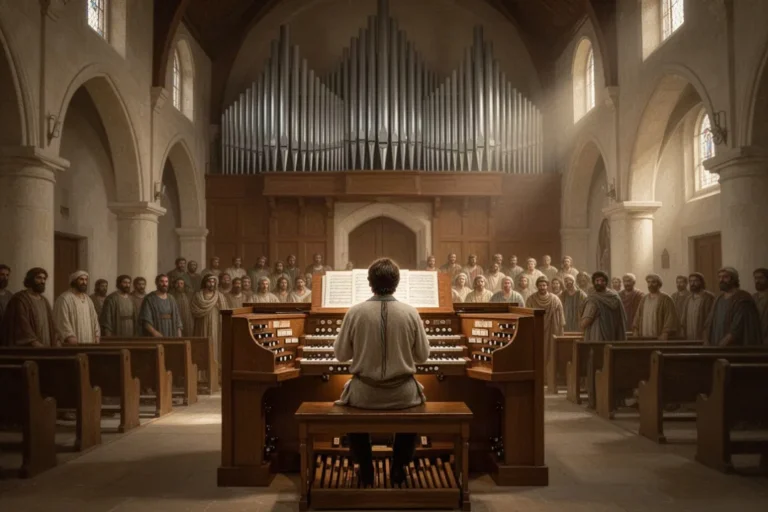
A church organ is a keyboard instrument that produces sound by sending air through tuned pipes, although some modern instruments create or reproduce the sound electronically. Most traditional organs have several keyboards, called manuals, plus a pedalboard, allowing one player to control multiple families of sounds at once.
The instrument’s size, sound, and cost vary greatly. A small chapel organ may have only a few stops and one manual, while a large cathedral organ can contain several thousand pipes, multiple consoles, and a broad range of orchestral colors. Understanding the pipes, stops, manuals, pedals, and wind system makes the instrument much easier to appreciate or evaluate.
A church organ supports worship by providing pitch, harmony, rhythm, and musical leadership. It can accompany congregational singing, provide music for a procession or recessional, support a choir, and perform solo repertoire before or after a service. Its sustained sound helps singers stay together in a large room where voices may otherwise lose focus.
The instrument is also built for a particular building. An organ’s tone depends on the room’s size, shape, materials, and reverberation. A powerful instrument voiced for a stone cathedral may sound overwhelming in a small sanctuary, while a compact organ may lack the presence needed to support a large congregation.
Unlike a piano, an organ does not become louder simply because the player strikes a key harder. The key usually opens a valve or activates an electronic signal, and the selected stop determines which pipes or sampled voices will sound. Volume and character are controlled through stop selection, expression pedals, swell boxes, and the number of notes being played.
Core idea: An organ is both a musical instrument and a room-specific sound system. Its design must match the building, the worship tradition, the repertoire, and the person who will play it.
How a traditional church organ produces sound
A pipe organ begins with a supply of air. An electric blower usually fills a reservoir, which stores air at a steady pressure. When the organist presses a key and a stop is engaged, the instrument opens the appropriate path so air can reach a pipe.
Each pipe is tuned to a particular pitch, but its construction determines much of its sound. Flue pipes produce sound when air passes across an opening and sets a column of air vibrating. Reed pipes use a vibrating tongue, or reed, to create more distinctive colors such as trumpet, oboe, clarinet, or bassoon-like tones.
The organ’s internal mechanism connects the player’s controls with the pipes. In a mechanical-action instrument, the key movement is transferred through a system of trackers, levers, and other parts. In a pneumatic or electric-action organ, pressure or electrical signals operate the valves. Modern organs may use digital control systems, but the basic task remains the same: send the right signal to the right pipe or speaker at the right time.
The blower supplies air to one or more reservoirs.
The organist selects stops to choose the desired ranks of pipes or electronic voices.
A key or pedal is pressed, sending a mechanical, pneumatic, or electrical command.
A valve opens beneath the selected pipe or pipes.
Air enters the pipe, creating a pitch with a particular tone color.
The room carries the sound, adding resonance and reverberation.
What the organ’s manuals, pedals, and stops control
Organ consoles can look complicated because each group of controls serves a different purpose. The manuals are the keyboards played by the hands. The pedalboard is played by the feet, and the stop controls determine which voices are available on each division.
Manuals and divisions
Many church organs have two or three manuals, although smaller instruments may have only one. Each manual generally controls a separate division, which is a group of pipes with its own musical purpose. Names vary by instrument and tradition, but divisions commonly include a main or great division, a softer enclosed division, and a solo or secondary division.
The manuals can be coupled so that pressing one key activates sounds from more than one division. This lets the organist combine a principal chorus with a softer color, add a solo line above accompaniment, or increase the instrument’s weight for a large hymn or ceremonial moment.
Stops and ranks
A stop is a control that brings a particular rank of pipes or voice into use. A rank is a set of pipes designed to produce one pitch for each note on its division. Stops may represent different families, such as principals, flutes, strings, and reeds.
Principal stops provide the clear, direct tone often associated with the traditional organ sound.
Flute stops offer round, hollow, or gentle colors for accompaniment and quieter music.
String stops imitate the narrow, bright character of bowed strings, often with a related undulating stop.
Reed stops add strong, speech-like, buzzing, or orchestral colors.
Mixtures contain several high-pitched ranks that reinforce the upper harmonics of a chord.
Mutation stops sound at pitches other than the unison pitch, adding color and harmonic emphasis.
Stop labels may include numbers such as 8′, 4′, or 16′. These refer to the approximate speaking length of the lowest pipe in the rank and indicate pitch relationships rather than the physical height of every pipe. An 8′ stop usually sounds at the written pitch, a 4′ stop sounds an octave higher, and a 16′ stop sounds an octave lower.
The pedalboard allows the feet to play bass lines and reinforce harmony. It may contain a modest number of pedals in a small organ or a broader compass in a larger instrument. Pedal stops often include deep 16′ voices, though the exact arrangement depends on the organ’s design.
Organists do not use the pedals only for long bass notes. Pedal technique can include walking bass lines, repeated patterns, fast scales, and independent musical phrases. In hymn playing, a well-controlled pedal line gives the congregation a firm foundation without overpowering the voices.
Expression and crescendo controls
An expression pedal changes the volume of pipes enclosed inside a wooden swell box. The organist can open or close shutters to make the sound grow or diminish. A crescendo pedal gradually adds predetermined stops, increasing the instrument’s volume and density.
These controls are different from a piano’s touch. Expression depends on the organ’s mechanical or electronic design and on the player’s preparation. The most effective changes are usually planned around the music’s phrases rather than applied continuously.
How church organs differ from one another
There is no single standard church organ. Instruments differ according to their historical period, builder, location, worship needs, available budget, and musical tradition. Two organs with similar numbers of stops may sound completely different because of their voicing, pipe scales, wind pressures, action, and room acoustics.
Pipe organs
A pipe organ creates its sound through physical pipes. The pipes may be made from wood, tin, lead alloys, zinc, or other materials selected for the intended tone. Their diameter, length, shape, metal thickness, mouth design, and voicing all influence the result.
Pipe organs can be highly expressive and mechanically complex. They also require a suitable room and regular care. A pipe organ’s identity is not determined only by its stop list; the craftsmanship of the pipes and the way they are voiced for the building matter just as much.
Digital and electronic organs
A digital organ produces sound through electronic technology rather than through a complete set of speaking pipes. It may use recordings, modeled sounds, or a combination of approaches. Speakers are arranged to project the sound into the room, and the console can often reproduce the layout of a pipe-organ console.
Digital instruments are often chosen when a congregation needs predictable maintenance, flexible placement, or a lower initial cost than a new pipe organ. They can also provide useful practice facilities. Their success depends on the quality of the sound system, the samples or modeling, the room, and the way the instrument is voiced and installed.
Hybrid organs
A hybrid organ combines pipes with electronic voices. The pipework may provide the core sound while digital stops expand the instrument’s range, or the electronic system may supplement an older organ whose pipework is incomplete. This approach can provide flexibility, but it requires careful integration so that the different sound sources blend naturally.
Portable and positive organs
A small positive organ may have one manual and no pedalboard, or only a limited pedal arrangement. These instruments are useful in chapels, schools, rehearsal spaces, and churches with modest musical programs. Some are portable enough to move, although even a compact organ can be heavy and should be transported by people familiar with the equipment.
How to choose a church organ for a congregation
Choosing an organ should begin with the congregation’s actual musical needs rather than with appearance or the largest possible stop count. A qualified organ consultant or experienced organbuilder can assess the building, existing instrument, electrical service, heating and humidity conditions, and intended repertoire.
Start by documenting the practical setting. The following questions help define the project:
How large is the worship space, and how reverberant is it?
How many people regularly sing, and does the organ need to lead a large congregation?
Will the instrument accompany a choir, instrumentalists, or soloists?
What music will be played most often: hymns, liturgical settings, choral works, or organ repertoire?
Where can the console, pipes, speakers, and blower be installed?
What budget is available for purchase, installation, tuning, repairs, and long-term care?
Who will play the instrument, and what level of pedal and registration control is needed?
Listen to comparable organs in rooms of a similar size. A demonstration in a showroom may not reveal how an instrument will support singing in your sanctuary. Ask the player to perform hymns, quiet accompaniment, full-organ passages, and music that resembles the congregation’s regular program.
Evaluate the instrument’s clarity at soft volume as well as its power. A loud organ can be impressive during a demonstration, but an organ that cannot accompany without covering voices may be poorly matched to worship needs.
Practical warning: The purchase price is only one part of the cost. Include installation, electrical work, climate control, tuning, routine service, repairs, console maintenance, and possible replacement of aging components.
What church organ maintenance involves
Regular maintenance protects the organ’s reliability and musical character. Pipe organs are sensitive to temperature, humidity, dust, insects, building movement, and changes in electrical systems. Digital organs have different needs, including speaker performance, software or control hardware, ventilation, and electronic component replacement.
Pipe organs commonly receive periodic tuning and inspection. Tuning needs depend on the instrument’s design, the stability of the building, the climate, and how often the organ is used. A specialist may also check for ciphering pipes, sluggish keys, leaking reservoirs, damaged leather, loose wiring, noisy action, and problems with stop controls.
A cipher occurs when a pipe continues to sound after the key is released or sounds without being played. Possible causes include debris, a valve problem, a fault in the action, or changes in the pipe or mechanism. The organ should not be disassembled by untrained volunteers, since small adjustments can affect many related parts.
Church staff can help by keeping the organ area clean and dry, preventing storage near the console, reporting unusual noises promptly, and avoiding candles, flowers, liquids, and construction dust near exposed components. Stable indoor conditions are generally better than repeated dramatic swings in heat or humidity.
How organists register music for worship
Registration is the process of choosing stops for a piece or service. Good registration balances the musical line, the room, and the people being accompanied. The same stop combination may work beautifully in one building and sound muddy or weak in another.
For congregational singing, the organist often chooses a clear foundation that supports the melody without making every inner part too prominent. A principal-based combination may provide definition, while selected flutes can soften the sound. Reeds and mixtures are usually added with care, especially when the room has long reverberation.
Solo lines may be assigned to a contrasting voice on a separate manual, with accompaniment played more softly on another. Couplers allow the organist to bring divisions together, while manual changes and preset combinations help manage a complex service without interrupting the music.
Consider the room first. Reduce density in a highly reverberant space and add color carefully.
Identify the musical function. Decide whether the organ is leading, accompanying, supporting a solo, or creating a transition.
Choose a clear foundation. Begin with stops that establish pitch and provide a stable blend.
Add color gradually. Introduce flutes, strings, reeds, mixtures, or mutations only when the music needs them.
Test with singers present. An empty sanctuary can give a misleading impression of volume and balance.
Prepare changes in advance. Use combination pistons or written stop plans when the service requires rapid transitions.
How to learn to play a church organ
Piano experience provides useful skills, including reading notation, coordinating the hands, understanding harmony, and practicing musical phrasing. It does not automatically prepare a pianist for organ technique. The organist must learn to manage sustained notes, articulate without piano-style force, coordinate the feet, and choose suitable registrations.
A teacher who regularly plays the organ can help you develop a safe and efficient technique. Lessons should include posture, bench position, finger substitution, legato playing, pedal technique, hymn accompaniment, registration, and the operation of the specific instrument you will use.
Organ practice should be arranged with the church because the instrument may be needed for rehearsals, services, weddings, funerals, or maintenance. Before playing, learn which controls are safe to use and which parts should be handled only by an organ technician.
A practical learning sequence is:
Become comfortable with one manual and a simple foundation registration.
Practice legato and detached articulation without relying on piano dynamics.
Learn basic scales and independent pedal patterns slowly.
Play hymns with steady rhythm and a singing melody.
Add simple manual changes and pedal stops.
Study registration by comparing contrasting stop families.
Build toward repertoire that matches your technique and the organ’s capabilities.
Never force a key, stop, coupler, piston, or pedal. Organ mechanisms can be durable but are not indestructible, and unfamiliar controls may operate with less resistance than expected. If something feels stuck or behaves unusually, stop playing and ask a qualified technician or the instrument’s regular caretaker.
Sound travels differently through wood, stone, plaster, carpeting, and upholstered seating. Hard surfaces reflect sound, while soft materials absorb some frequencies. A high ceiling and long reverberation can make the organ seem larger, but they can also blur fast passages and reduce the clarity of spoken or sung text.
Pipe placement affects projection. Pipes located behind a case, above a choir, or in separate chambers may blend differently from pipes arranged openly near the front of the room. Digital speakers require similar attention: their height, direction, spacing, and relationship to the room strongly influence the perceived sound.
Temperature and humidity also affect tuning and reliability. Pipe organs may change pitch as the surrounding air changes, and wooden components can respond to moisture variation. A building’s heating and cooling schedule should be considered when planning tuning, concerts, and long-term conservation.
What makes a church organ historically significant
An organ may be valued for its age, builder, design, surviving pipework, connection to a congregation, or role in local musical life. Historical importance does not mean that every old component should remain untouched, but it does mean that repairs should respect the instrument’s construction and documented character.
Before major restoration, a church should gather records, photographs, previous service reports, stop lists, and information about alterations. A specialist can distinguish original material from later additions and recommend work that preserves the instrument’s musical identity while addressing safety and reliability.
Historic instruments often require patience. Replacing parts with modern equivalents may solve an immediate problem but change the action, tone, or appearance. Conservation decisions should balance regular worship needs with the responsibility to protect features that cannot easily be recreated.
How to care for a church organ as a shared resource
An organ lasts longer when the congregation treats it as a carefully managed resource rather than ordinary furniture. Establish one point of contact for scheduling, maintenance reports, access, and communication with technicians. Keep a simple log of tuning visits, repairs, unusual sounds, and environmental concerns.
Provide clear instructions for substitute organists, visiting musicians, wedding coordinators, and cleaning staff. Those instructions should explain how to turn the instrument on and off, which stops or accessories require special care, and whom to contact when a problem appears.
Good care also includes planning for the future. Set aside funds for routine service instead of waiting for a major failure, review insurance coverage, and maintain the building systems that affect the organ. A modest instrument that receives consistent care can serve a congregation well for many years.
Frequently asked questions
How loud is a church organ?
Its volume depends on the number and scale of its pipes, the selected stops, the room’s acoustics, and how it is voiced. A small organ may be gentle enough for intimate accompaniment, while a large instrument can fill a cathedral. Perceived loudness is not the same as musical effectiveness; clarity and balance matter just as much as power.
Can a piano player learn church organ?
Yes. Piano skills provide a strong foundation, but organ playing requires additional training in legato technique, articulation, registration, manual changes, and pedal work. Lessons with an organist are especially helpful because each instrument has different controls and responses. Regular practice on the actual church organ will make the transition more practical.
How often does a church organ need tuning?
The schedule varies with the organ’s design, climate, building stability, use, and desired pitch accuracy. Some instruments receive regular annual service, while others may need attention more often or less often. A technician can recommend a schedule after inspecting the organ and considering whether it supports frequent worship, rehearsals, and performances.
Is a digital organ better than a pipe organ for a church?
Neither is automatically better. A digital organ may offer predictable maintenance, flexible placement, and a broad range of sounds, while a pipe organ provides physical pipe tone and a distinctive relationship with the building. The better choice depends on the sanctuary, musical program, budget, available technical support, and long-term care plan.








Leave a Reply