What is Pentecost? Meaning, history, and traditions
What is Pentecost? Meaning, history, and traditions
If you have seen Pentecost marked on a church calendar or heard someone mention the “birthday of the church,” you may wonder what the word means. Pentecost is a major Christian feast that celebrates the coming of the Holy Spirit upon Jesus’ disciples in Jerusalem.
The event is described in Acts 2. Jesus’ followers were gathered together when they experienced a powerful sign involving wind, fire, and speech in languages they had not learned. They then began proclaiming the message about Jesus to people from many regions, and the disciples’ public mission began in a new and visible way.
Pentecost also has roots in a Jewish festival called Shavuot, or the Feast of Weeks. That connection matters because the events in Acts took place during a Jewish pilgrimage festival, when Jerusalem was filled with visitors. The Christian celebration is therefore connected to both Israel’s biblical worship and the beginning of the church’s worldwide witness.
Pentecost means “fiftieth.” The name comes from a Greek word referring to the fiftieth day. In Christian practice, Pentecost is observed fifty days after Easter Sunday, counting Easter as the first day in the traditional liturgical calendar.
The feast focuses on three connected ideas: the Holy Spirit’s presence, the disciples receiving power to witness, and the gathering of people from different nations into one community of faith. Christians understand Pentecost as the fulfillment of Jesus’ promise that the Spirit would come to guide and strengthen his followers.
Many churches call Pentecost the birthday of the Christian church. That phrase does not mean no one believed in God or followed Jesus before Acts 2. It means that Pentecost marks the point when Jesus’ followers were publicly empowered and began carrying the gospel beyond their original circle in a new, organized way.
The short answer: Pentecost is the Christian celebration of the Holy Spirit coming upon Jesus’ disciples in Jerusalem, giving them courage and ability to proclaim the gospel to people from many nations.
How Pentecost connects to the Jewish Feast of Weeks
Before Pentecost became a Christian feast, the Jewish calendar already included a festival known as the Feast of Weeks. In Hebrew, it is called Shavuot. The festival was associated with the grain harvest and was observed after a period of counting from Passover.
The instructions for this feast appear in passages such as Leviticus 23 and Deuteronomy 16. The timing explains why Acts describes Jerusalem as crowded with Jewish visitors from many places. They had come to the city for a major religious celebration, not merely for an ordinary day of worship.
Jewish tradition also connects Shavuot with the giving of the Law at Mount Sinai. Christian interpretations often see a meaningful contrast and connection between Sinai and Pentecost: at Sinai, Israel was formed as a covenant people; in Acts, the Holy Spirit gathers believers into a people shaped by faith in Christ.
These connections should be handled with care because Jewish and Christian communities understand their festivals in their own traditions. Still, the shared biblical setting helps explain why wind, fire, gathered people, and spoken languages carry such significance in the story of Pentecost.
What happened at Pentecost in Acts 2
Acts 1 describes Jesus telling his disciples to remain in Jerusalem and wait for the promised Holy Spirit. They did not yet know exactly how the promise would appear. Acts 2 then describes the disciples gathered together when a sudden sound like a strong wind filled the place where they were staying.
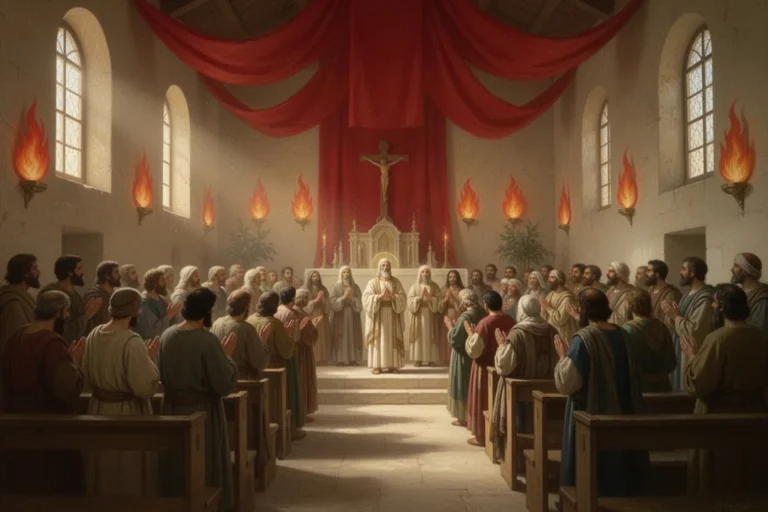
The account says that something resembling flames of fire appeared and rested on the disciples. They were filled with the Holy Spirit and began speaking in other languages. The description emphasizes that the languages were recognizable to the Jewish visitors who had come from different parts of the Mediterranean world and beyond.
The crowd was confused because Galileans were speaking in languages associated with the listeners’ home regions. The visitors heard the disciples declaring God’s mighty works. Pentecost therefore involved more than a private spiritual experience; it created a public message that could be heard across cultural and linguistic boundaries.
Some people were amazed, while others mocked the disciples and suggested they were drunk. Peter responded by addressing the crowd. He explained the event through the Hebrew Scriptures, announced Jesus’ death and resurrection, and called the listeners to turn toward God and be baptized.
Acts reports that many people accepted Peter’s message and joined the community of believers. The passage presents Pentecost as a decisive turning point: the disciples who had been waiting and praying now began speaking openly, and the message about Jesus moved rapidly into a multinational setting.
The main events in order
The disciples wait in Jerusalem. Jesus’ followers gather as instructed and pray while awaiting the promised Spirit.
A sound like a powerful wind fills the gathering place. The event is presented as an act of God rather than something the disciples create.
Fire-like appearances rest on the disciples. This visible sign accompanies their being filled with the Holy Spirit.
They speak in other languages. Visitors from different regions hear the message in languages they understand.
Peter explains what is happening. He connects the event with Scripture and proclaims Jesus as risen Lord.
People respond and join the believers. The Christian community becomes publicly visible and begins to grow.
Why wind, fire, and languages matter
The signs in Acts 2 are not decorative details. They help communicate what Christians believe the Holy Spirit does. The sound like wind suggests movement, power, and God’s active presence. The text does not say that the disciples became filled with ordinary air; it describes a dramatic sign pointing to something spiritual and divine.
Fire often represents God’s holiness, presence, purification, or judgment in the Bible. At Pentecost, the fire-like appearances rest on each disciple, suggesting that the Spirit is not given only to one leader. The sign presents the gathered believers as people who have received God’s empowering presence.
The languages highlight communication and inclusion. Pentecost is not described as forcing everyone into one human culture before they can hear the message. Instead, people from different places hear the disciples in languages connected with their own communities.
Some Christians interpret the languages in Acts 2 as known human languages. Other Christian traditions connect this event with the broader New Testament discussion of speaking in tongues, including passages in 1 Corinthians 12–14. Churches differ in how they understand and practice such spiritual gifts, but Acts 2 clearly centers on the Spirit enabling public witness.
How Pentecost fulfills Jesus’ promise
Before his ascension, Jesus told his disciples that they would receive power when the Holy Spirit came upon them and that they would become witnesses in Jerusalem and far beyond it. Acts 1:8 describes this expanding mission from the local community outward to the wider world.
Pentecost is the beginning of that movement. The disciples are not simply given information; they are given boldness, guidance, and power for witness. Peter’s speech shows the change. Earlier in the Gospels, the disciples often misunderstand Jesus or fear opposition. In Acts, Peter publicly addresses a large crowd and explains the significance of Jesus’ death and resurrection.
Christian theology generally distinguishes the Holy Spirit’s work from human confidence or emotional excitement. The Spirit’s presence is associated with faithfulness to Jesus, courage in witness, unity among believers, spiritual gifts, and changed character. The signs at Pentecost are extraordinary, but the purpose is practical: the disciples are equipped to serve and proclaim.
A useful distinction: Pentecost is not mainly a celebration of unusual physical signs. Its central message is that God empowers ordinary followers of Jesus to bear witness, serve others, and participate in the church’s mission.
Why Pentecost is called the church’s birthday
The expression “birthday of the church” is a teaching phrase rather than a quotation from Acts. It points to the way the believers become a recognizable, Spirit-empowered community after Pentecost. They devote themselves to teaching, fellowship, shared meals, prayer, and practical care for one another.
Acts 2 describes the community as continuing in the apostles’ teaching and sharing life together. The believers are not presented as a crowd that gathers once and disappears. They become a community with worship, instruction, generosity, baptism, and a common identity centered on Jesus.
Pentecost also shows that the church is not intended to remain limited to one ethnic group or one geographic location. The visitors in Jerusalem represent many lands and languages. As the story of Acts continues, the message moves into Judea, Samaria, and other regions, matching the outward pattern Jesus gave the disciples.
The church’s universality does not mean that cultural differences vanish. The early Christian community had to work through real disagreements about food, leadership, religious customs, and the inclusion of Gentiles. Pentecost provides the foundation for unity in the Spirit, while the rest of the New Testament shows that living out that unity requires patience, discernment, and generosity.
How different Christian traditions observe Pentecost
Pentecost is observed by Roman Catholic, Eastern Orthodox, Anglican, Lutheran, Methodist, Presbyterian, Pentecostal, and many other Christian communities. The date changes each year because it is linked to Easter, but it always falls on a Sunday in churches that follow the Western Christian calendar.
Church services may use the color red to represent fire and the Holy Spirit. Some congregations decorate with red fabric, banners, flowers, or symbolic flames. Others use white or gold during the season surrounding Pentecost, particularly where local customs or denominational calendars differ.
Readings commonly include Acts 2, accounts of Jesus promising the Spirit, and passages about spiritual gifts or life in the Spirit. Sermons may focus on courage, mission, unity, baptism, the church’s worldwide calling, or the ways Christians should recognize and use spiritual gifts responsibly.
In some churches, Pentecost includes baptisms, confirmations, public professions of faith, or special prayers for renewal. Some congregations emphasize outreach and mission because the first Pentecost sent the disciples into public witness. Others focus on the Spirit’s role in worship, holiness, service, and the formation of Christian character.
Red clothing or decorations: A visual reminder of fire and the Spirit’s power.
Readings from Acts 2: A retelling of the event at the center of the feast.
Prayers for the Holy Spirit: Requests for guidance, courage, wisdom, and faithful service.
Confirmation or baptism: Practices that connect people with Christian identity and discipleship.
Mission and community service: Ways to express Pentecost’s outward focus.
Multilingual worship: A reminder that the Christian message is intended for people from every nation.
What Pentecost means for Christians today
For Christians, Pentecost is a reminder that faith is not meant to be lived entirely through private effort. The Holy Spirit is understood as God’s presence with believers, helping them understand truth, resist sin, grow in love, pray, serve, and speak about their faith with wisdom and courage.
The feast also challenges churches to consider whether their witness is understandable to the people they hope to serve. At Pentecost, the message reaches listeners in languages they recognize. That can encourage churches to communicate clearly, welcome people from different backgrounds, and remove unnecessary barriers to participation.
Pentecost does not promise that every believer will have the same experience or spiritual gift. The New Testament describes a variety of gifts and forms of service. Some people teach, some encourage, some give, some lead, some show mercy, and some serve in less visible ways. The common purpose is the good of the community and faithful witness to Christ.
The feast can also shape how Christians think about unity. Unity at Pentecost does not depend on everyone having the same personality, culture, language, or role. It is grounded in the one Spirit while making room for many kinds of people and service.
Questions Pentecost can raise for personal faith
Where do you need courage? The disciples receive strength to speak and act faithfully despite public opposition.
How do you communicate with people unlike you? Pentecost places understandable communication across cultural and linguistic boundaries at the center of the story.
How can you serve the community? The Spirit’s gifts are directed toward building up others, not simply gaining personal recognition.
What does unity require? Pentecost invites believers to value differences while sharing a common commitment to Christ.
Are you relying only on your own ability? The disciples’ mission begins with waiting, prayer, and dependence on God’s power.
How Pentecost differs from Pentecostalism
Pentecost is a Christian feast and a biblical event. Pentecostalism is a family of Christian movements and churches that place particular emphasis on the Holy Spirit, spiritual gifts, healing, prophecy, and speaking in tongues. The two terms are related, but they do not mean the same thing.
Many Pentecostal churches teach that Christians should actively seek a deeper experience of the Holy Spirit. Some identify speaking in tongues as evidence of baptism in the Holy Spirit, while others do not require that interpretation. Pentecostal and charismatic churches vary considerably in their teaching and worship practices.
Christians in many non-Pentecostal traditions also celebrate Pentecost and believe in the Holy Spirit. They may emphasize different signs of the Spirit’s work, such as love, holiness, service, wisdom, justice, or the church’s unity. Understanding these differences helps prevent the common mistake of treating the feast as belonging only to Pentecostal denominations.
When Pentecost happens each year
Pentecost is celebrated fifty days after Easter in the Western Christian calendar. Because Easter is a movable feast, Pentecost also falls on a different calendar date each year. It occurs after the period Christians call Eastertide, which celebrates Jesus’ resurrection.
In many Western churches, Pentecost marks the end of the Easter season. In Eastern Orthodox churches, the date may differ because some communities calculate Easter using a different calendar method. The underlying celebration remains connected to the coming of the Holy Spirit.
The name can cause confusion because the modern English spelling is Pentecost, not “Pentacost.” If you searched for “what is pentacost,” you are most likely asking about Pentecost, the Christian feast described above.
How to explain Pentecost to a child
A simple explanation is that Pentecost is the day Jesus’ friends received the Holy Spirit and were helped to tell people everywhere about Jesus. They were together when they experienced signs like a strong wind and fire, and they began speaking so visitors from many countries could understand them.
You can explain the “birthday of the church” phrase by saying that this was when Jesus’ followers began working together publicly as a growing community. It was not the first time people trusted God, and it was not the end of the story. It was the beginning of the church’s mission to share the message of Jesus with the world.
For a family or children’s group, useful activities include identifying the countries mentioned in Acts 2, learning greetings in several languages, creating red paper flames, or discussing ways to welcome someone who speaks differently. The goal is to connect the biblical story with courage, inclusion, and service.
Common misunderstandings about Pentecost
One misunderstanding is that Pentecost is simply another name for Easter. Easter celebrates Jesus’ resurrection, while Pentecost celebrates the coming of the Holy Spirit to the disciples. The feasts are closely related in the Christian calendar, but they focus on different events.
Another misunderstanding is that Pentecost only concerns the disciples’ personal spiritual experience. Acts presents the event as public and missional. The disciples receive the Spirit so they can bear witness, and the crowd’s response becomes part of the story.
It is also inaccurate to assume that every Christian church interprets speaking in tongues in exactly the same way. Churches disagree about the nature, purpose, and present-day role of this gift. Pentecost itself should be understood within the wider biblical emphasis on faithful witness, love, unity, and service.
Finally, Pentecost does not mean that Christians must copy every external detail of Acts 2 to prove their faith. The passage describes a unique foundational event while also presenting principles that many Christians continue to apply: dependence on the Spirit, clear communication, courage, community, and a mission that crosses boundaries.
Frequently asked questions
Is Pentecost the same as the Jewish holiday Shavuot?
They are distinct religious observances, but they share a calendar setting and biblical background. Shavuot is a Jewish festival connected with the grain harvest and, in Jewish tradition, the giving of the Torah. Christian Pentecost is tied to the events in Acts 2 and celebrates the Holy Spirit coming upon Jesus’ disciples during the time of that Jewish festival.
Why is Pentecost celebrated on a Sunday?
Christian Pentecost is observed fifty days after Easter, and Easter is celebrated on Sunday. Since Easter commemorates Jesus’ resurrection on the first day of the week, the Christian calendar continues counting through the Easter season until the Sunday associated with the Spirit’s coming in Acts 2.
Do all Christians believe speaking in tongues is required at Pentecost?
No. Christian denominations interpret the language miracle in Acts 2 differently. Some see it as the ability to speak known human languages, while others connect it with spiritual gifts discussed elsewhere in the New Testament. Many churches celebrate Pentecost without teaching that every believer must speak in tongues.
What color represents Pentecost?
Red is the most common color because it symbolizes the fire associated with the Holy Spirit in Acts 2. Churches may use red vestments, banners, flowers, or other decorations. Some traditions also use white or gold during the Easter season, so local practice can vary.


Leave a Reply