If you have opened a Bible and wondered why some editions include a Maccabees book while others do not, the short answer is that “Maccabees” refers to several ancient Jewish writings, not one universally included volume. The most widely recognized are 1 Maccabees and 2 Maccabees, which describe Jewish resistance to foreign rule and the rededication of the Jerusalem Temple in the second century B.C.
In Catholic Bibles, 1 and 2 Maccabees are part of the Deuterocanonical books. Many Orthodox traditions also receive 3 Maccabees and, in some cases, 4 Maccabees. Most Protestant Bibles place these writings in the Apocrypha or omit them from the main biblical collection. Their status differs by tradition, but their historical and religious importance is widely recognized.
The Maccabees books focus on a crisis in Jewish life under the Seleucid Empire, a Hellenistic kingdom that controlled Judea. The central conflict developed during the reign of Antiochus IV Epiphanes, who ruled from 175 to 164 B.C. His policies and actions affected Jewish worship, law, and public life, producing resistance that eventually led to the restoration of the Temple.
The name “Maccabee” is commonly associated with Judas Maccabeus, one of the leading figures in the revolt. The term may have begun as a nickname, although its exact meaning is uncertain. Over time, it came to describe not only Judas but also his family and the wider movement that fought for Jewish independence and religious practice.
The books are set during a period when Greek language and culture had spread across the eastern Mediterranean. Hellenistic influence was not automatically rejected by every Jew, and the conflict was not simply a struggle between all Jews and all foreigners. Some Jewish leaders supported cultural accommodation, while others believed that particular policies threatened the covenant, the Law of Moses, and worship at the Temple.
Quick distinction: 1 Maccabees gives a broad political and military history of the revolt, while 2 Maccabees offers a more theological account of selected events, especially the persecution under Antiochus and the Temple’s purification.
The books are connected, but they are not two consecutive volumes telling exactly the same story. 1 Maccabees begins with Alexander the Great’s conquests and traces the rise of the Hasmonean family through several decades. 2 Maccabees covers a shorter period and presents overlapping events with different emphasis, style, and purpose.
1 Maccabees: a detailed account of political leadership, battles, alliances, and the growth of Hasmonean power.
2 Maccabees: a selective, theological narrative about martyrdom, faithfulness, divine justice, and the Temple.
3 Maccabees: a separate story about persecution of Jews in Egypt, not a continuation of the main revolt.
4 Maccabees: a philosophical reflection on reason, religious conviction, and martyrdom, built around examples associated with 2 Maccabees.
What happens in 1 Maccabees
First Maccabees opens by placing the crisis within the larger history of Alexander the Great and the kingdoms that followed his death. It then turns to the reign of Antiochus IV and the pressure placed on Jewish communities to adopt practices associated with Greek religion and culture. The narrative describes decrees that restricted Jewish observance and treats the desecration of the Temple as a decisive outrage.
The first major act of resistance comes from Mattathias, an elderly priest from Modein. When he refuses to participate in an apostate sacrifice and kills a Jewish man who appears willing to comply, he calls others to join him in defending the covenant. His sons, including Judas, Jonathan, and Simon, become the principal leaders of the movement.
Judas receives the name Maccabeus and emerges as the movement’s most prominent military commander. First Maccabees presents him as a disciplined leader who combines courage, tactical judgment, and commitment to Jewish law. His forces win several important victories despite being smaller and less heavily equipped than the armies sent against them.
The narrative describes battles against Seleucid commanders, including campaigns near Emmaus and Beth-zur. It emphasizes the rebels’ use of surprise, knowledge of the terrain, and confidence in God. At the same time, the book does not portray the struggle as effortless. The rebels face defeat, internal disagreements, political pressure, and the constant danger that a military victory may not produce lasting freedom.
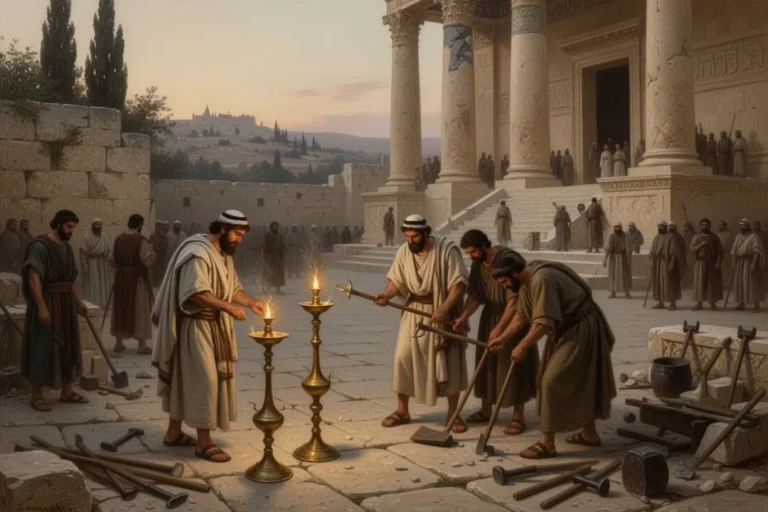
One of the book’s central episodes is the recovery and rededication of the Jerusalem Temple. After the Jewish forces regain control of the sanctuary, they remove defiling objects, repair damaged areas, and establish a renewed cycle of worship. The celebration lasts eight days and becomes the foundation for the festival later known as Hanukkah, or the Feast of Dedication.
First Maccabees then continues beyond the Temple’s rededication. Judas seeks alliances, including a relationship with Rome, and later dies in battle. His brother Jonathan succeeds him and operates through a mixture of military action and diplomacy. Jonathan eventually gains political and religious authority, but he is captured and killed through political treachery.
The final major leader in the book is Simon, another son of Mattathias. Simon secures greater independence, strengthens the country, and becomes both a political ruler and a high priest. First Maccabees ends by celebrating the achievements of Simon and his family, establishing the Hasmonean dynasty as the new ruling house.
Why 1 Maccabees matters for historical reading
First Maccabees is especially valuable because it supplies a sustained narrative of the Hasmonean revolt and its aftermath. It names rulers, military commanders, political agreements, and places, giving readers a framework for understanding the transition from Seleucid control to Jewish self-rule. Its author appears deeply sympathetic to the Hasmonean cause, so the account should be read as both history and advocacy.
The book’s purpose is not detached modern historiography. It praises leaders who defend the Law and portrays the family’s success as connected with faithfulness. Even so, its political details and chronological structure make it an important source for the period. Reading it alongside 2 Maccabees reveals how different authors can describe related events while highlighting different meanings.
What happens in 2 Maccabees
Second Maccabees begins with letters from Jews in Jerusalem to Jews in Egypt. These letters encourage them to observe the festival of the Temple’s purification. The narrative that follows is not a complete continuation of 1 Maccabees. Instead, it retells selected events from the years leading up to the Temple’s restoration, with special attention to persecution, martyrdom, and divine judgment.
The book identifies Jason and Menelaus as high priests whose actions contribute to political and religious turmoil. Their rivalry shows that conflict existed within the Jewish community as well as between Judeans and the Seleucid authorities. The story presents corruption in the Temple leadership as part of the wider crisis surrounding Antiochus’s policies.
Second Maccabees includes several dramatic accounts of suffering. Eleazar, an elderly scribe, refuses to save his life by pretending to eat forbidden meat. The book also tells of a mother and her seven sons who endure torture and death rather than abandon their religious commitments. These scenes are among the best-known examples of Jewish martyr literature from the ancient world.
The mother and her sons express confidence that God can restore life to those who remain faithful. This makes 2 Maccabees especially significant for the development of Jewish teaching about resurrection. The book does not treat death as the final measure of justice; it argues that God will ultimately vindicate those who suffer for righteousness.
The narrative also describes Judas Maccabeus praying for fallen soldiers and arranging an offering connected with their sins. This passage is important in Catholic theology because it supports prayer for the dead and appears in discussions of purification after death. Different Christian traditions interpret the passage differently, but its presence demonstrates the book’s distinctive religious outlook.
Second Maccabees presents battles as well, yet it gives them a more visibly theological shape than 1 Maccabees. Heavenly help, angelic protection, prophetic visions, and divine intervention appear throughout the account. The book’s aim is to strengthen readers facing persecution by showing that apparent defeat does not mean God has abandoned the faithful.
Length of coverage: 1 Maccabees spans a longer period, while 2 Maccabees concentrates on a shorter section of the crisis.
Literary approach: 1 Maccabees resembles a political and military history; 2 Maccabees uses speeches, visions, martyr stories, and theological interpretation.
Main emphasis: 1 Maccabees highlights leadership, independence, and the Hasmonean dynasty; 2 Maccabees highlights Temple worship, suffering, resurrection, and divine justice.
Relationship to other sources: 2 Maccabees identifies itself as an abridgment of a larger work by Jason of Cyrene, while 1 Maccabees stands as an independent historical narrative.
Neither book should be treated as a simple duplicate of the other. Their differences can help you read them more carefully. 1 Maccabees asks how a people organizes resistance and builds political stability; 2 Maccabees asks how faithfulness is sustained when resistance brings suffering.
Where the Maccabees books appear in the Bible
The answer depends on the biblical tradition being used. Roman Catholic Bibles include 1 and 2 Maccabees among the Deuterocanonical books. These writings are read as Scripture in Catholic worship and theology, although their canonical status was disputed in some periods of Christian history.
Many Eastern Orthodox churches also include 1 and 2 Maccabees and may include 3 Maccabees and 4 Maccabees in different ways. The exact arrangement varies by church and edition. Some Orthodox Bibles place 4 Maccabees in an appendix rather than among the main books.
Most Protestant Bibles do not place 1 and 2 Maccabees in the same section as the Old Testament books. Some editions print them under the heading Apocrypha, usually between the Old and New Testaments. Other Protestant editions leave them out entirely, while still recognizing their value for historical and literary study.
Jewish Bibles do not include the Maccabees books in the Hebrew Bible’s canon. However, the events they describe remain closely connected to Jewish history, and the Temple’s rededication is commemorated through Hanukkah. The books therefore matter across religious boundaries even though communities assign them different scriptural authority.
Before you start reading: Check which edition you own and whether it includes the Apocrypha or Deuterocanonical books. If 1 Maccabees is absent, a Catholic, Orthodox, or study Bible edition may provide it.
The books also influence Christian interpretation of later themes. Readers often consult 2 Maccabees when studying martyrdom, resurrection, prayer for the dead, angels, and the meaning of Temple worship. First Maccabees is frequently used to understand the political background of the Hasmonean period and the world that preceded the New Testament.
How to read the Maccabees books carefully
A useful starting point is to read 1 Maccabees before 2 Maccabees. This gives you a broad chronological frame and introduces the principal leaders. You can then read 2 Maccabees as a focused, interpretive retelling rather than expecting it to pick up exactly where 1 Maccabees ends.
Begin with the historical setting: Learn the basic roles of Alexander’s successors, the Seleucid rulers, Judea, Jerusalem, and the Temple.
Read 1 Maccabees for the sequence of events: Follow Mattathias, Judas, Jonathan, and Simon as the revolt develops.
Read 2 Maccabees for its theological emphasis: Pay attention to the martyr accounts, resurrection hope, prayer, and divine justice.
Compare overlapping episodes: Notice what each author includes, leaves out, or interprets differently.
Use a reliable study Bible or historical introduction: Notes can explain unfamiliar rulers, place names, political titles, and differences in chronology.
Keep the surrounding history in view. The Maccabean revolt took place during the Second Temple period, several centuries after the Babylonian exile and before the birth of Jesus. The Hasmonean state later faced its own internal conflicts, and Roman power eventually became decisive in the region. The books explain part of the political and religious background behind the New Testament, but they are not direct predictions or narratives about Jesus.
It also helps to distinguish religious conviction from simplistic cultural categories. The books portray some forms of Hellenistic influence as threatening, yet the ancient world involved extensive exchange of language, art, administration, and ideas. The central issue was not every aspect of Greek culture; it was the imposition or acceptance of practices that the authors believed violated Jewish covenantal faithfulness.
Readers should also recognize the books’ strong point of view. First Maccabees praises Hasmonean leadership, while 2 Maccabees interprets suffering through faith and divine action. That perspective does not make the works useless as history, but it means that literary purpose and historical evidence belong together when evaluating their claims.
The Maccabees books speak to questions that remain recognizable: How should a community respond when authorities restrict its worship? What does loyalty require when compromise seems safer? How should people remember those who suffer or die for their convictions? The books do not offer one simple political formula, but they show how historical memory, religious identity, and public leadership can become inseparable.
For many readers, the strongest passages are the martyr narratives in 2 Maccabees. They present courage not as the absence of fear but as a decision to place ultimate loyalty in God rather than in a ruler. The stories have shaped Jewish and Christian reflections on conscience, endurance, resurrection, and the cost of faithful witness.
First Maccabees contributes a different kind of insight. It shows that a successful revolt requires more than battlefield bravery. Leaders must form alliances, negotiate with competing powers, rebuild institutions, protect worship, and decide how authority should be transferred. The book therefore combines religious conviction with the practical demands of governing a vulnerable state.
The Temple’s rededication gives the collection its most enduring cultural connection. Hanukkah developed as a celebration of restored worship and renewed dedication. Although the books do not provide every later detail associated with the holiday, they preserve the historical setting for its origin and show why the purification of the Temple became such a powerful symbol.
Reading the Maccabees books can also sharpen your understanding of the Bible’s diversity. Some biblical writings read like law, poetry, prophecy, wisdom instruction, biography, or apocalypse. These books add revolt history, political narrative, martyr testimony, and theological interpretation to that range. Their different canonical status across communities makes them especially useful for learning how traditions formed and how readers have argued about Scripture.
If you want the clearest path, read 1 Maccabees for the main historical storyline, then read 2 Maccabees for its deeper treatment of persecution and hope. After that, explore 3 and 4 Maccabees if your Bible includes them. The result is a fuller picture of how Jewish communities remembered oppression, defended worship, and reflected on faithfulness under pressure.
Frequently asked questions
Is the Maccabees book part of the Bible?
It depends on the Christian tradition and Bible edition. Roman Catholic Bibles include 1 and 2 Maccabees as Deuterocanonical Scripture. Many Orthodox traditions also include them and may include 3 and 4 Maccabees in different locations. Protestant Bibles may place 1 and 2 Maccabees in the Apocrypha or omit them from the edition entirely.
Which Maccabees book should I read first?
Start with 1 Maccabees if you want the broadest chronological account of the revolt and the rise of the Hasmonean leaders. Read 2 Maccabees afterward to explore martyrdom, resurrection, prayer for the dead, and divine justice. The two books overlap but serve different purposes, so reading both gives a more balanced understanding.
Are 1 and 2 Maccabees the same story?
They cover some of the same events, but they are not identical accounts. First Maccabees follows several decades and emphasizes military campaigns, political alliances, and Hasmonean leadership. Second Maccabees focuses on a shorter period and interprets persecution, martyrdom, the Temple, and resurrection with a stronger theological emphasis.
What does Maccabees have to do with Hanukkah?
The Maccabees books describe the Jewish recovery and rededication of the Jerusalem Temple after it had been defiled during the persecution under Antiochus IV. The eight-day celebration that followed became the historical foundation for Hanukkah, also called the Feast of Dedication. The books preserve the setting for the festival’s origin.



Leave a Reply