Tongues and glossolalia: meaning, history, and practice
Tongues and glossolalia: meaning, history, and practice
Tongues, or glossolalia, is usually understood as speech produced in a religious or altered state that the speaker experiences as spiritually meaningful.
The term glossolalia comes from Greek words associated with “tongue” and “speech.” In ordinary conversation, “speaking in tongues” often refers to a Christian practice in which a person prays or speaks using sounds and syllables that do not form a familiar language. Different churches interpret the practice in different ways, and those interpretations affect how the experience is taught, evaluated, and used in worship.
For some Christians, tongues are a spiritual gift described in the New Testament. For others, the biblical passages refer mainly to recognizable human languages, or to a practice that was specific to the early church. Linguists and psychologists generally study glossolalia as a form of patterned vocal behavior rather than deciding whether it has a supernatural source. These perspectives can describe different features of the same experience without answering every religious question about it.
In modern religious discussion, speaking in tongues can describe several related but distinct practices. A person may use unfamiliar syllables during private prayer, speak aloud during a congregation’s worship service, or report that an utterance has been interpreted as a message for others. The same phrase may therefore mean personal devotion in one setting and a public spiritual ministry in another.
Glossolalia is the more neutral descriptive term. It does not, by itself, claim that the speech is divine, meaningless, fraudulent, or an actual foreign language. It simply identifies vocal behavior that resembles language in rhythm and sound but is not readily understood by the speaker or listeners as a known language.
Glossolalia should be distinguished from xenoglossy, a term sometimes used for an alleged ability to speak a real language that the person has not learned. These claims are difficult to verify and are not the same as the common Pentecostal or charismatic practice of prayer speech. A recording that sounds foreign is not automatically evidence that it is a particular language; human speech can resemble unfamiliar languages without matching their grammar or vocabulary.
Religious communities also use “tongues” in more than one theological sense:
Private prayer: an individual speaks or prays in tongues as an act of worship, devotion, or perceived communion with God.
Public utterance: a person speaks during a service, often with the expectation that the congregation will receive an interpretation.
Missionary language: some Christians understand certain biblical accounts as describing miraculous speech in recognizable human languages.
Spiritual confirmation: some traditions connect tongues with baptism in the Holy Spirit or another significant religious experience.
These categories overlap in practice, but they should not be treated as identical. A church may encourage private prayer in tongues while requiring a different procedure for public speech. Another church may reject modern tongues altogether while affirming that miraculous languages occurred in the biblical period.
Essential distinction: “Speaking in tongues” is a religious phrase, while “glossolalia” is a descriptive term. Neither word alone settles whether an utterance is a miracle, a learned behavior, a psychological experience, or some combination of personal and communal influences.
What the Bible says about speaking in tongues
The main New Testament discussions of tongues appear in Acts 2, Acts 10, Acts 19, and 1 Corinthians 12–14. These passages are interpreted differently because they describe several situations rather than providing one simple definition. Readers must consider the setting, the audience, and the relationship between tongues, prophecy, interpretation, and the church community.
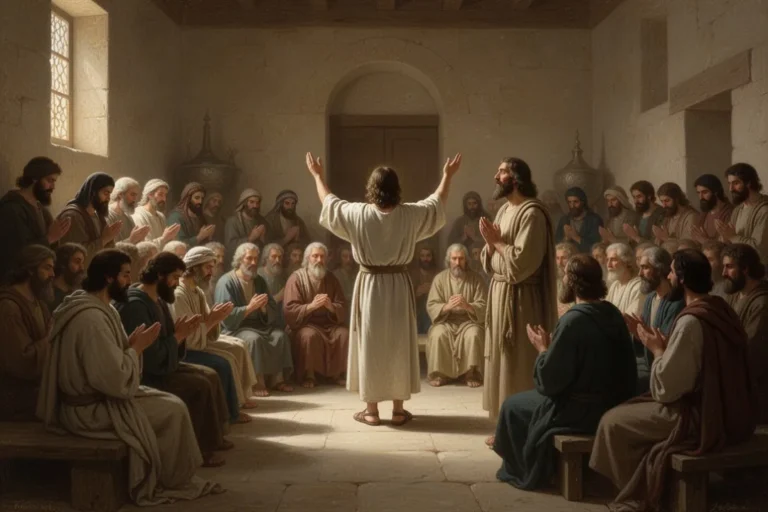
Acts 2 describes Jesus’ followers receiving the Holy Spirit during the Jewish festival of Pentecost. The account presents visitors from many regions hearing the disciples speak in languages associated with those regions. Some Christian interpreters see this as a miracle involving recognizable human languages, while others understand it as a foundational event related to the broader gift of tongues. The passage emphasizes that people from different backgrounds heard the message about God in ways they could understand.
Acts 10 and Acts 19 connect tongues with the reception of the Holy Spirit in different groups of believers. In Acts 10, the event involving Cornelius and his household is presented as evidence that Gentiles were welcomed into the Christian community. Acts 19 describes a group in Ephesus receiving the Spirit after learning more fully about Jesus. These accounts are often used in debates about whether tongues should be expected as a sign of spiritual transformation.
Paul’s discussion in 1 Corinthians 12–14 focuses on how spiritual gifts should function within a congregation. He lists tongues and interpretation among gifts associated with the Holy Spirit, but he also stresses that gifts should benefit the community. His argument places love, intelligibility, order, and mutual strengthening above personal display or status.
In 1 Corinthians 14, Paul distinguishes between speech that listeners can understand and speech that requires interpretation. He presents interpretation as necessary when tongues are used publicly, because worshipers need to be able to receive and evaluate what is being communicated. He also gives instructions intended to prevent multiple people from speaking at once or turning worship into confusion.
Christians commonly develop several theological positions from these texts:
Cessationist position: tongues and some other miraculous gifts belonged especially to the apostolic or foundational period of Christianity and are not expected as ordinary church practice today.
Continuationist position: the gifts described in the New Testament remain available to Christians, although their use should follow biblical principles and careful pastoral guidance.
Sign-gift position: tongues may serve as a sign associated with receiving the Holy Spirit, particularly in some Pentecostal traditions.
Broad charismatic position: tongues may be one gift among many, but Christians do not necessarily need to speak in tongues to demonstrate genuine faith or spiritual maturity.
These labels simplify a wide range of beliefs. Two congregations may both call themselves charismatic yet differ about whether tongues are expected, how interpretation works, and how much authority should be given to a public utterance. A responsible reading of the biblical material should account for both the reality of spiritual gifts in the text and the repeated concern for understandable, orderly, community-centered worship.
How glossolalia sounds and develops in practice
From a linguistic perspective, glossolalia often has the sound patterns of language without functioning as a conventional language. Speakers may use repeated consonants and vowels, syllable sequences, pauses, stress, and changes in volume. Their speech can sound fluent because it follows familiar habits of timing and pronunciation, even when listeners cannot identify a stable vocabulary or grammar.
The sounds are not necessarily random. A speaker’s first language can influence the consonants, vowels, rhythm, and syllable shapes that appear in glossolalia. Someone who speaks English may produce patterns that reflect English pronunciation, while a speaker raised with another language may use a different range of sounds. This helps explain why listeners can perceive glossolalia as meaningful or language-like even when it does not correspond to a known language.
People often learn the practice through social participation. A worshiper may hear trusted members of a congregation praying in tongues, receive encouragement to try, and gradually become comfortable producing unfamiliar syllables. In some settings, leaders teach that the speaker should begin vocalizing without planning each word. In other settings, people report that the experience arose unexpectedly during prayer or intense emotion.
Learning does not automatically make the practice insincere. Religious rituals frequently use forms that are learned from a community, including posture, song, prayer language, and patterns of response. A person can adopt a shared form sincerely while experiencing it as spontaneous, intimate, and personally significant.
Researchers examining recordings may ask whether the speech has the regular features of a natural language. They may consider:
Whether the sound inventory resembles the speaker’s known language.
Whether syllables and pauses follow recurring patterns.
Whether words or grammatical forms remain consistent across different occasions.
Whether the speaker changes the utterance when responding to a particular prompt.
Whether listeners interpret the speech through prior expectations or through a recognized language system.
These observations can describe the structure of an utterance, but they cannot measure the speaker’s spiritual meaning. A recording may show that speech is not an identifiable foreign language while leaving open the question of whether the speaker experienced prayer, transcendence, surrender, or divine presence.
Interpretation of tongues is also a separate practice. In many churches, an interpreter does not translate each syllable word for word. Instead, the interpreter offers what the community understands as the message or meaning of the utterance. Because this process is not usually equivalent to ordinary translation, churches differ in how they test it and how much authority they assign to it.
Why people speak in tongues and what the experience may feel like
People who practice glossolalia often describe it as a form of prayer beyond ordinary words. They may say that it helps them express emotion, focus attention on God, release tension, or feel closer to a religious community. Some describe a sense of freedom because they are not selecting carefully worded sentences. Others experience the practice as physically intense, emotionally moving, or connected with singing and worship.
Psychological explanations focus on processes such as attention, expectation, imitation, emotion, and altered patterns of self-monitoring. During highly absorbing prayer or worship, a person may pay less conscious attention to how each syllable is selected. The speech can then feel as though it is arriving without deliberate construction, even though the person remains involved in producing it.
That account does not require the assumption that practitioners are pretending. Sincerity and psychological process can coexist. A person may sincerely believe that God is enabling the speech, while a researcher describes the same event in terms of attention, learned behavior, and emotional arousal. The two descriptions answer different kinds of questions.
Some people report benefits such as comfort, concentration, emotional release, or a stronger sense of belonging. Those effects may come from several sources at once: the act of prayer, the rhythm of vocalization, supportive relationships, expectations about worship, and the meaning attached to the experience. Reports of benefit should be taken seriously without treating every claimed effect as proof of a supernatural cause.
The experience is not positive for everyone. A person may feel pressured to produce tongues because leaders or peers suggest that mature believers should do so. Others may feel embarrassed, frightened, confused, or spiritually rejected when they do not have the experience. A healthy congregation should avoid turning one practice into a universal test of faith.
Pastoral caution: No one should be coerced, mocked, publicly exposed, or told that a lack of tongues proves a lack of faith. Religious practice should involve informed consent, room for questions, and respect for people whose beliefs or experiences differ.
Glossolalia can also appear alongside strong emotional or bodily responses, including crying, trembling, singing, laughter, stillness, or a feeling of detachment. Such responses can occur in religious settings without automatically indicating illness. At the same time, distressing experiences should not be dismissed as spiritual simply because they occur during worship.
Seek qualified medical or mental-health support if unusual speech is accompanied by severe confusion, inability to care for yourself, dangerous behavior, persistent fear, hallucinations outside the religious setting, or major disruption to sleep and daily life. A clinician can assess the person’s overall condition without needing to settle a theological debate about tongues.
How churches can practice tongues responsibly
Churches that welcome tongues usually benefit from clear expectations. Leaders can explain whether the congregation views tongues as private prayer, public ministry, evidence of a particular spiritual experience, or one gift among several. Clear teaching reduces pressure and helps visitors understand what they are seeing.
Public use requires particular care because a congregation contains people with different levels of trust, knowledge, and vulnerability. A dramatic utterance can be mistaken for an unquestionable command from God. Leaders should therefore distinguish between personal conviction, community discernment, and formal doctrine.
Practical guidelines may include the following:
Protect voluntary participation. Do not require every attendee to speak in tongues or suggest that imitation is proof of spiritual acceptance.
Explain the purpose. Tell the congregation how tongues fit into worship and why interpretation may be requested.
Preserve intelligibility. When speech is offered publicly, provide a clear way for the congregation to receive and evaluate its meaning.
Limit disruption. Leaders can prevent many people from speaking over one another and can redirect an event that becomes chaotic or intimidating.
Respect privacy. Do not pressure individuals to explain a personal prayer experience in front of others.
Test claims carefully. No utterance should be used to justify abuse, financial exploitation, medical neglect, political control, or violations of personal boundaries.
These principles reflect the concerns found in Paul’s teaching about public worship: spiritual activity should serve others, communicate clearly, and contribute to peace rather than competition. They also support basic ethical standards that apply regardless of denomination. A practice can be deeply sacred to participants while still requiring safeguards against manipulation.
Visitors who encounter tongues for the first time may find the experience unfamiliar. Listening respectfully does not require immediate agreement. You can ask whether the practice is understood as prayer or a message, whether interpretation is expected, and what the congregation believes about people who do not speak in tongues.
People who practice privately may choose a quiet setting where they feel safe and unpressured. People who are uncertain should not force an experience or treat a particular emotional state as a spiritual requirement. A thoughtful approach allows faith, conscience, and personal boundaries to remain connected.
How to evaluate claims about tongues
Claims about tongues should be evaluated according to the kind of claim being made. A theological claim, such as “this prayer brings me closer to God,” belongs to the person’s religious interpretation. A linguistic claim, such as “this is ancient Aramaic,” can be examined through language analysis. A medical claim, such as “this practice cures a disorder,” requires appropriate clinical evidence.
Confusion often arises when evidence from one category is used to prove a claim in another. A moving worship experience does not establish that an utterance is a foreign language. A linguistic analysis showing familiar sound patterns does not prove that the speaker’s spiritual experience was false. Keeping these questions separate allows for more honest discussion.
When someone says that an utterance is a known language, ask what supports that identification. Reliable evaluation would require more than a listener recognizing a few similar sounds. It would involve a qualified speaker or linguist examining sustained vocabulary, grammar, pronunciation, and context while accounting for the possibility of coincidence.
When a public interpretation is presented as a message from God, consider its content and consequences. It should not override scripture as understood by that community, basic moral responsibilities, or a person’s right to make informed decisions. Statements that demand secrecy, obedience to a leader, large payments, or harmful action deserve serious skepticism.
For an individual trying to understand a personal experience, useful questions include:
Did I feel free to participate, or did I feel pressured?
Does the practice bring steady peace and meaning, or persistent fear and impairment?
Can I discuss doubts with trusted people without punishment or shame?
Does my congregation allow room for different spiritual gifts and honest disagreement?
Are leaders accountable when they make claims about tongues or interpretation?
Tongues remain a subject where religious conviction, human behavior, language, and community life meet. A careful understanding neither reduces every experience to deception nor accepts every supernatural claim without examination. It recognizes the variety of biblical interpretations, the observable features of glossolalia, the genuine meaning people may find in prayer, and the need for consent, discernment, and care.
Frequently asked questions
Are speaking in tongues and glossolalia exactly the same thing?
They overlap, but they are not identical in every context. “Speaking in tongues” is primarily a religious expression, especially in Christianity. “Glossolalia” is a descriptive term used in linguistics and psychology for speech-like vocalization that is not readily identified as a known language. Some religious believers use the terms interchangeably, while others distinguish different forms of tongues.
Does speaking in tongues mean someone is speaking a foreign language?
Not necessarily. Some Christians interpret Acts 2 as describing recognizable human languages, while many modern examples of glossolalia do not match an identifiable language. Similar sounds alone are not enough to establish a language. Verification would require sustained vocabulary, grammar, and pronunciation examined by someone qualified in that language.
Do all Christians believe people should speak in tongues?
No. Pentecostal and charismatic churches may encourage or affirm the practice, but they differ over whether it is expected of every believer. Other Christians believe tongues were limited to the early church or interpret the biblical passages differently. Many churches teach that spiritual maturity is shown through character and love rather than one particular gift.
Is speaking in tongues harmful?
The practice is not automatically harmful, especially when it is voluntary, supportive, and integrated into a person’s faith. Problems can arise when people are pressured, shamed, financially exploited, or told to ignore serious medical or psychological symptoms. Distressing experiences that interfere with daily life should be discussed with an appropriately qualified professional.





Leave a Reply