What is Vespers? A guide to Christian evening prayer
What is Vespers? A guide to Christian evening prayer
As the day winds down, you may be looking for a way to pray that feels more grounded than a quick private prayer before bed. You may have heard a church announce Vespers, Evening Prayer, or Evensong and wondered what those names mean. Vespers is a Christian service of evening prayer, traditionally prayed near sunset or later in the day.
The service usually combines psalms, Scripture, hymns or canticles, silence, thanksgiving, and prayers for the needs of the church and the world. It can be prayed by clergy and congregations, by religious communities, or by one person alone. Its purpose is to help you recognize God’s presence at the close of the day and place the day’s work, worries, and unfinished business into prayer.
At a glance: Vespers is the evening office in several Christian traditions. It is not a single worldwide script; the order, music, gestures, and prayers depend on the church using it.
The word Vespers comes from a Latin word associated with the evening and the setting sun. In Christian practice, it became the name for an established period of prayer held toward the end of the day. The term is especially common in Catholic, Anglican, Lutheran, and Orthodox settings, although each tradition gives the service its own shape.
Vespers belongs to a larger pattern called the Liturgy of the Hours, also known as the Divine Office or Daily Office. This pattern divides prayer across the day so that worship is not limited to Sunday or to one morning service. Other daily offices may include Morning Prayer, prayer during the day, Night Prayer, and additional times of worship.
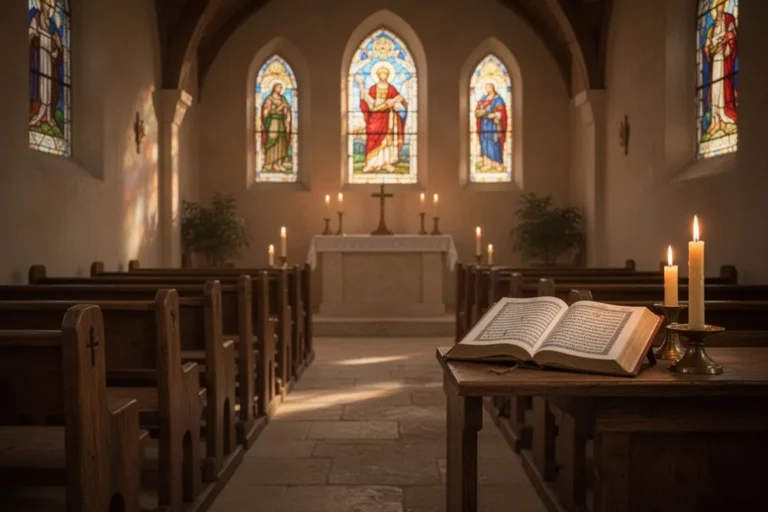
The name points to the time of prayer, but it does not require a particular building or a particular number of people. A cathedral may hold a solemn service with organ music, incense, and a choir. A small group may gather around a table with a Bible and a candle. An individual may pray a shorter form at home using a printed or digital prayer book.
Why Christians pray Vespers in the evening
Evening offers a natural pause between the demands of the day and the rest that follows. Vespers gives that pause a liturgical structure, which can make prayer easier when you are tired or distracted. Rather than deciding from scratch what to say, you follow a pattern of praise, Scripture, reflection, and intercession.
The service also helps you look back over the day without treating it as either a complete success or a complete failure. You can give thanks for particular people and moments, acknowledge harm or neglect, and ask for help with matters that remain unresolved. The emphasis is not on producing a perfect emotional experience. It is on bringing the whole day honestly before God.
Many forms of Vespers include prayers for protection through the night. These prayers express dependence on God while recognizing human limits. Work has ended, control has narrowed, and tomorrow cannot yet be managed. The evening office therefore often carries a tone of trust, repentance, gratitude, and hope.
Vespers can also connect personal prayer with the wider church. The psalms and readings are often shared by Christians in many places, even when they pray at different times. A person praying alone participates in a practice that has shaped Christian worship for centuries.
When Vespers is traditionally prayed
Historically, Vespers was connected with sunset, one of the natural markers used to organize Christian prayer. In practice, the exact time varies. A parish may schedule it at 5:00 or 6:00 p.m., while a monastery may pray at a time suited to its daily rhythm. Some churches use the name for a service later in the evening.
Vespers is commonly offered on Sundays, major feast days, and other occasions when a church wants to gather for prayer beyond its principal service. In Orthodox churches, a Saturday evening Vespers service often prepares worshipers for Sunday, since the liturgical celebration begins with the evening before the feast. In other traditions, Sunday Vespers may be a distinct service held after the day’s main worship.
There is no universal requirement that Vespers begin precisely at sunset. Modern work schedules, public transportation, family responsibilities, and local customs affect the time. What makes the service Vespers is its place within the church’s pattern of prayer and its evening character, not a specific minute on the clock.
What happens during a typical Vespers service
The exact order differs, but many services follow a recognizable movement. The congregation is called to prayer, praises God, hears Scripture, responds with song or spoken prayer, and offers intercessions. The service may be brief and simple or richly ceremonial and sung.
Opening prayer: The leader invites the congregation to turn toward God and begins the office.
Psalms: One or more psalms are sung, spoken, or chanted. They may express praise, lament, confidence, repentance, or longing.
Scripture reading: A passage from the Bible is read aloud, sometimes followed by a short homily or period of silence.
Canticle: A biblical song, often associated with Mary or another figure in the New Testament, may provide the central response.
Intercessions: The church prays for the world, public authorities, people who are suffering, the local community, and personal needs.
The Lord’s Prayer: Many traditions include the prayer Jesus taught his disciples, using the wording customary in that church.
Closing blessing or dismissal: The service ends with a blessing, a prayer for the night, or a short dismissal.
In a solemn Vespers service, you may see incense, candles, processions, robes, chanted texts, and a choir. In a less formal service, the same basic purpose may be expressed through spoken prayers, a few hymns, and a reading. External ceremony can deepen attention, but ceremony is not what makes Vespers valid or meaningful.
The role of psalms and canticles
Psalms are central because they give worshipers words for many states of mind. You do not have to feel joyful to pray a psalm of praise, nor must you be in despair to pray a lament. The service lets the language of Scripture carry your prayer when your own words feel limited.
A canticle is a song or hymn drawn from the Bible. In many Western forms of Vespers, the Magnificat—the song associated with Mary in Luke 1—is a central evening canticle. Rather than reproducing its wording, its theme can be described as praise for God’s holiness, mercy, faithfulness, and concern for the humble.
Some traditions appoint psalms and readings according to a calendar, so the material changes from day to day. This cycle prevents the service from depending only on personal preference and exposes worshipers to a broad range of biblical prayer. Other communities choose texts for the season, feast, or particular pastoral need.
How Vespers differs among Christian traditions
Vespers is not identical in every denomination. The shared idea is evening prayer shaped by the church’s worship tradition, but the language, theology, music, and physical gestures may differ considerably.
Vespers in the Catholic tradition
In the Roman Catholic Church, Vespers is one of the two principal hours of the Liturgy of the Hours, along with Morning Prayer. A standard form includes an opening, a hymn, psalmody, a short Scripture reading, a responsory, the Magnificat, intercessions, the Lord’s Prayer, and a concluding prayer.
Priests, deacons, religious communities, and laypeople may pray the office. It may be prayed privately from an approved prayer book or celebrated publicly in a parish, cathedral, or monastery. The texts generally follow the church calendar, so the prayers reflect seasons such as Advent, Christmas, Lent, Easter, and ordinary time.
Some Catholic communities use the term Solemn Vespers for a more elaborate public celebration. Music, incense, candles, and a procession may be included. A parish service does not need all those features to be genuine Vespers.
Vespers in Eastern Orthodox and Eastern Catholic churches
In Eastern Orthodox and Eastern Catholic traditions, Vespers is often called Esperinos, a Greek term for evening prayer. It is frequently celebrated with chanting, incense, candles, psalms, hymns, and prayers connected with the feast or season. The service may be especially full on Saturday evenings, before Sunday Divine Liturgy, and on major feast days.
A notable feature of Byzantine Vespers is its strong sense of entering sacred time. The evening service may begin the celebration of the next liturgical day. Hymns explain the meaning of the feast, while the movement of the service joins biblical prayer with the church’s theological tradition.
Eastern services can feel unfamiliar to someone used to a short spoken office. Standing, bowing, making the sign of the cross, using incense, and responding with repeated chants may all be part of the congregation’s participation. Visitors can usually follow along by observing others, and no special knowledge is required before attending.
Anglican Evening Prayer and Evensong
Anglican churches commonly use the name Evening Prayer for the Daily Office. When that service is sung by a choir, it is often called Evensong. Evensong may include psalms, readings, canticles, prayers, an anthem, and music written for the Anglican choral tradition.
Evensong and Vespers serve similar purposes, but the names are not always interchangeable. An Anglican church may describe a service as Vespers when it draws more directly on historic Western forms or a monastic pattern. Checking the service description is the best way to learn what a particular congregation means.
Vespers in Lutheran and other Protestant communities
Lutheran churches and other Protestant communities may use Vespers as part of a daily prayer tradition. The service often centers on Scripture, psalmody, preaching or meditation, hymn singing, and intercession. Some congregations use a formal order from their denomination’s hymnal, while others adapt the office for local use.
Protestant Vespers may place greater emphasis on congregational singing or a sermon, depending on the community. It may also be offered as a seasonal service, a contemplative gathering, or a midweek alternative to a more typical worship service. The title alone does not tell you how formal or musical the gathering will be.
Vespers, Evening Prayer, and Compline: what is the difference?
These terms overlap, which can make church schedules confusing. Vespers and Evening Prayer generally refer to the main evening office. Compline, also called Night Prayer, is usually prayed later, close to bedtime. Its themes often include quiet, examination of conscience, forgiveness, and rest.
The timing is a helpful guide, although local practice may vary:
Vespers: Usually prayed near sunset or in the early evening as the day’s work comes to an end.
Evening Prayer: A broad name for an evening office, especially in Anglican and Protestant traditions; it may be similar to Vespers.
Evensong: A sung form of Anglican Evening Prayer, often associated with choral worship.
Compline: A later service before sleep, generally quieter and shorter than Vespers.
These distinctions are useful, but they are not absolute. A church may call a service Evening Prayer even when its order resembles Catholic Vespers, or use Vespers for a service held later than sunset. If you want to attend a particular kind of service, read the church’s description or contact the office beforehand.
Helpful distinction: Vespers is usually the evening office that marks the close of the day, while Compline is the prayer of the night. Both can be peaceful, but they occupy different places in the daily rhythm.
How to attend Vespers for the first time
You do not need to be an expert in liturgy to attend. Many public services provide a printed booklet, a hymnal, or projected texts. If the service is in a cathedral or monastery, the website may explain whether it is spoken, sung, or especially ceremonial.
Before you go, consider taking these simple steps:
Check the time and format. Confirm whether the service is public, whether it is sung, and how long it usually lasts.
Arrive a few minutes early. This gives you time to find a seat and locate the service materials without rushing.
Watch before joining unfamiliar gestures. Standing, sitting, kneeling, bowing, and making the sign of the cross vary by tradition.
Participate in ways that feel appropriate. You can pray silently, speak responses, sing, or listen respectfully.
Ask for help if needed. A greeter, usher, priest, pastor, or member of the community can explain the basic order.
Communion is usually not part of Vespers itself, although a church may schedule it alongside another service. If you are unsure about receiving communion, ask a clergy member about that congregation’s practice. You can attend and pray without receiving.
Common mistakes when praying Vespers
Because Vespers follows a set form, beginners sometimes assume they must perform every response perfectly. That concern can make the service feel more complicated than it is. The office is meant to support prayer, not test your memory.
Trying to understand every word immediately: Let repeated phrases and unfamiliar hymns become familiar over time.
Assuming every church uses the same order: Catholic, Orthodox, Anglican, Lutheran, and other forms may look quite different.
Feeling pressure to match every gesture: Observe the congregation and participate when you are comfortable.
Skipping the service because you missed the exact starting time: Enter quietly if the setting permits, or use the service materials at home.
Treating the office as a performance: The purpose is prayerful attention, not flawless pronunciation or musical ability.
Expecting instant calm: Evening prayer may reveal tiredness, grief, or distraction before it brings peace.
When praying alone, another common mistake is trying to create an elaborate service every night. A shorter office prayed consistently may serve you better than a long order that becomes difficult to maintain. You can use the church’s official form, a simpler prayer book, or a few selected elements.
How to pray Vespers at home
A home version can be as simple as setting aside ten or fifteen minutes in the evening. Choose a regular place, silence notifications, and keep a Bible or prayer book nearby. A candle may help mark the transition into prayer, but it is optional and should be used safely.
Begin with a brief prayer or invitation to worship.
Read or sing one psalm slowly.
Read a short passage from the Bible.
Sit in silence and consider one phrase or theme from the reading.
Offer thanks for the day and confess where you need mercy or change.
Pray for family, friends, the church, the suffering, and the wider world.
End with the Lord’s Prayer or another familiar closing prayer.
You can adapt the pattern to your circumstances. If you are caring for children, the service may include a single psalm and a spoken prayer. If you share a home with others, invite them to name one thing they are thankful for and one person who needs prayer. If you are exhausted, read one psalm and rest quietly before God.
Using a daily lectionary or established prayer book can help you avoid choosing texts only when they match your mood. At the same time, personal needs matter. A season of grief may call for lament, while a season of gratitude may lead you toward psalms of praise. The structure creates space for both.
What Vespers can mean for your daily life
Vespers does not erase unfinished tasks or guarantee that every evening will feel peaceful. Its value lies in creating a dependable practice of attention and release. You stop treating the day as something that must be controlled completely and acknowledge that your life is held within a larger story of worship.
The practice can also give shape to gratitude. Instead of remembering the day only through its mistakes, you name specific gifts: a conversation, a meal, a moment of patience, a chance to serve, or strength that arrived when you needed it. Gratitude becomes concrete rather than abstract.
Intercession broadens the focus beyond your own concerns. You remember people who are ill, lonely, displaced, grieving, or facing difficult decisions. You may also pray for communities and public leaders. This outward movement keeps evening prayer from becoming only a private method for relaxation.
For Christians who already attend Sunday worship, Vespers can connect weekly church life with ordinary weekdays. For those who cannot attend a regular congregation, praying the office at home can provide a modest but meaningful rhythm. The essential act is not completing a checklist; it is turning toward God at the close of the day.
Where to find a Vespers service
Search local church websites for Vespers, Evening Prayer, Evensong, or Daily Office. Cathedrals, monasteries, seminaries, university chapels, and larger parishes are particularly likely to offer a scheduled service. Some communities stream or record evening prayer, although attending in person provides a different experience of shared worship.
Read the description before attending. Look for information about the tradition, music, length, accessibility, childcare, and whether the service is open to visitors. If no local church uses the word Vespers, an Evening Prayer service may offer a very similar pattern.
Vespers can be formal or simple, sung or spoken, communal or private. Across these differences, it remains an evening practice that gathers the day’s praise, questions, failures, hopes, and needs into prayer.
Frequently asked questions
Is Vespers only for Catholics?
No. Catholics use Vespers as part of the Liturgy of the Hours, but Anglican, Orthodox, Eastern Catholic, Lutheran, and other Christian communities also have forms of evening prayer. The service may be called Vespers, Evening Prayer, Evensong, or another local name. Its order and style depend on the church’s tradition.
How long does a Vespers service usually last?
There is no single standard length. A simple spoken office may take 10 to 20 minutes, while a sung or ceremonial service with music, incense, and a homily may last 30 minutes or longer. The church’s website or office can usually tell you the expected duration.
Can I pray Vespers without attending church?
Yes. Vespers can be prayed privately at home using a prayer book, Bible, or daily office resource. A short pattern of psalm, Scripture, silence, thanksgiving, and intercession is enough to begin. You can also join a livestream if you want the structure of a shared service from home.
Do I need to be baptized or a church member to attend Vespers?
Public Vespers services are generally open to visitors, including people who are exploring Christianity or visiting a different tradition. You can observe and participate at your own comfort level. Communion, when offered separately, may have specific guidelines, so ask a clergy member if you are uncertain.


Leave a Reply