The best-known pilgrim routes in the UK include the historic Pilgrims’ Way from Winchester to Canterbury, St Cuthbert’s Way from Melrose to Lindisfarne, St Michael’s Way in Cornwall, and the North Wales Pilgrim’s Way to Bardsey Island. They range from short, manageable walks to multi-day journeys of more than 100 miles.
Some routes follow medieval roads associated with saints and shrines, while others are modern long-distance trails based on older pilgrimage traditions. You can walk for religious reasons, cultural interest, personal reflection, or simply to experience landscapes connected with Britain’s churches, abbeys and holy sites.
There is no single national pilgrim trail in the United Kingdom. Instead, you will find a network of routes with different levels of official waymarking, historical evidence and practical support. The most suitable choice depends on how far you want to walk, how much navigation you prefer to do, and whether reaching a particular shrine matters to you.
Pilgrims’ Way: a historic route linking Winchester and Canterbury, generally around 140 miles depending on the chosen alignment.
North Downs Way: an official 153-mile national trail from Farnham to Dover, overlapping with parts of the traditional Pilgrims’ Way.
St Cuthbert’s Way: a well-established cross-border route of about 62 miles from Melrose in Scotland to Lindisfarne in Northumberland.
St Michael’s Way: a short Cornish crossing of roughly 12.5 miles between Lelant and Marazion.
Saints’ Way: an approximately 27-mile route across Cornwall between Padstow and Fowey.
North Wales Pilgrim’s Way: a long route of about 135 miles from Basingwerk Abbey to Bardsey Island.
St Patrick’s Way: an approximately 82-mile pilgrimage route across Northern Ireland from Armagh to Downpatrick.
Distances can vary because historic routes often have several lines, diversions and alternative stages. A guidebook may describe a different route from a modern mapping service, so check the route authority’s current information before booking accommodation or transport.
Choose by purpose: for a clearly marked multi-day walk, start with St Cuthbert’s Way or the North Downs Way. For a short pilgrimage with a strong destination, St Michael’s Way is easier to complete in a weekend.
Routes also differ in character. The Pilgrims’ Way is a historical concept rather than one consistently waymarked trail. The North Downs Way is easier to follow because it is a national trail, although it should not be treated as identical to the medieval route. St Cuthbert’s Way combines a clear route with an important destination: the island of Lindisfarne, also called Holy Island.
The best-known pilgrim routes in England
The Pilgrims’ Way from Winchester to Canterbury
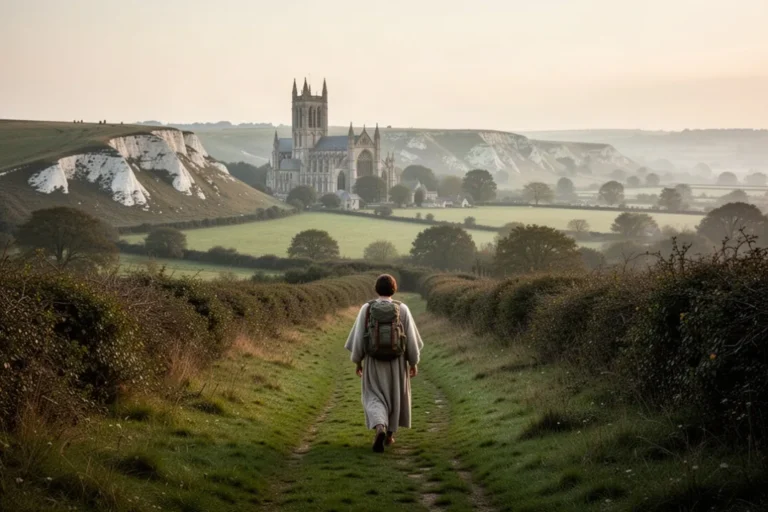
The traditional Pilgrims’ Way connects Winchester Cathedral with Canterbury Cathedral, two major medieval religious centers. Pilgrims historically traveled toward the shrine of Thomas Becket in Canterbury, while Winchester was itself an important ecclesiastical city and a practical starting point from the west.
Today, the route is best understood as a family of historic paths rather than a single perfectly preserved trail. It crosses the Hampshire and Surrey countryside, reaches the North Downs, and continues through Kent toward Canterbury. Sections may use public footpaths, bridleways, lanes and quiet roads.
The scenery includes chalk downs, woodland, farmland, villages and historic churches. The route can feel surprisingly rural, but accommodation is not evenly distributed. Some stages require careful planning around villages with limited evening services, especially if you want to stay in small guesthouses rather than larger towns.
Many walkers use the North Downs Way for the eastern part of the journey because it is an official national trail with clearer waymarking. This is a sensible practical option, but historical and modern route descriptions may differ. If the pilgrimage’s traditional line matters to you, compare a specialist Pilgrims’ Way guide with current footpath maps.
The North Downs Way
The North Downs Way runs between Farnham and Dover, following the chalk ridge across Surrey and Kent. It is one of the easiest UK pilgrim routes to plan as a long-distance walk because the national trail has established signage, published information and frequent connections with towns and transport.
The route passes near places associated with pilgrimage, including Canterbury, and shares sections or general corridors with the historic road used by medieval travelers. Its main appeal is the combination of practical accessibility and varied scenery: open downland, woodland, vineyards, villages and views toward the English Channel.
It is not a pilgrimage in the same direct sense as a route ending at a shrine, so you can approach it as a secular long-distance trail. However, its relationship with the Pilgrims’ Way makes it a strong choice for anyone who wants to walk toward Canterbury without relying entirely on uncertain historical alignments.
Allow roughly one to two weeks, depending on your daily distance and rest days. A fit walker carrying a light pack may complete it more quickly, while a pilgrim who wants time for churches, museums and local history may prefer shorter stages.
St Michael’s Way in Cornwall
St Michael’s Way crosses Cornwall between Lelant, near St Ives, and Marazion, near St Michael’s Mount. At about 12.5 miles, it is one of the most accessible pilgrim routes in Britain and can usually be walked in a day by people accustomed to a moderate full-day hike.
The route follows an ancient east-west crossing of the Cornish peninsula. Its destination is St Michael’s Mount, a tidal island with a long religious and cultural history. The causeway is exposed when covered by water, so check tide information before planning the final approach.
Expect a mixture of lanes, tracks, fields and undulating countryside rather than a continuous wilderness path. Weather can change quickly, and wet ground may make some sections slower than the mileage suggests. Public transport at either end makes the route particularly convenient for walkers who do not want to arrange a multi-day itinerary.
The Saints’ Way across Cornwall
The Saints’ Way links Padstow on the north coast with Fowey on the south coast. The route is roughly 27 miles long and is traditionally connected with the movement of early Christian travelers across Cornwall, who avoided a hazardous sea journey around Land’s End.
It passes through wooded valleys, farmland, quiet lanes and small settlements. The route is generally suitable for a two-day walk, although some people complete it in one long day and others take three days to include time in Padstow, Fowey or nearby historic sites.
Navigation is usually manageable, but you should not assume that every section is flat or easy. Cornwall’s terrain can be muddy, and coastal weather can make exposed paths uncomfortable. Accommodation and evening meals need advance checking outside the busiest summer months.
St Cuthbert’s Way and northern pilgrimage trails
St Cuthbert’s Way is one of the strongest choices for a first multi-day pilgrimage in the UK. It runs for about 62 miles between Melrose in the Scottish Borders and Lindisfarne, or Holy Island, on the Northumberland coast.
The route begins near Melrose Abbey, associated with St Cuthbert, and finishes at the island where his relics were eventually enshrined. Along the way it crosses the Eildon Hills, follows country tracks and riverside paths, passes through the Cheviot Hills, and reaches the coast near Lindisfarne.
The route is well known and has established waymarking, but it still includes remote sections. The crossing of Holy Island’s tidal causeway requires careful planning. Never rely on being able to cross simply because the weather looks calm; use the official tide timetable and allow a generous safety margin.
A typical itinerary takes four to six walking days. Stages through the Cheviots can be more demanding than the distance suggests, with climbs, exposed ground and limited services. Carry enough food and water for the day, and book accommodation early during spring, summer and major holiday periods.
The route can be walked in either direction. Starting in Melrose gives the journey a natural progression toward Lindisfarne, but beginning on Holy Island may suit travelers who want to finish in the Scottish Borders. Check border and transport arrangements if you are arriving from outside the United Kingdom.
Plan the Lindisfarne finish first: the tidal causeway has fixed safe crossing times. Build your final walking stage around the tide rather than treating the causeway as an ordinary road or footpath.
St Oswald’s Way is another northern route with a strong Christian and historical connection. It runs for about 97 miles across Northumberland between Holy Island and Heavenfield, near Hexham. The route is linked with St Oswald, the seventh-century king and saint, and includes castles, coast, farmland and sections near Hadrian’s Wall.
Although it does not have the same single-shrine identity as St Cuthbert’s Way, St Oswald’s Way works well for walkers who want a longer Northumberland itinerary. You can combine religious history with visits to Bamburgh, Lindisfarne and other major sites, though transport between stages may be limited in rural areas.
Pilgrimage routes in Wales and Northern Ireland
The North Wales Pilgrim’s Way
The North Wales Pilgrim’s Way extends from Basingwerk Abbey near Holywell to Bardsey Island, or Ynys Enlli, off the Llŷn Peninsula. It is around 135 miles long and connects churches, chapels, wells, abbeys and landscapes associated with Welsh pilgrimage.
The route offers a very different experience from the better-known English trails. It crosses varied terrain, including country lanes, upland paths, coastal sections and mountain landscapes. Welsh place names and local traditions are central to the experience, so allow time to learn the pronunciation and history of the communities you pass through.
Sections can be walked independently, making the route suitable for people who cannot commit to a full two-week journey. Bardsey Island has particular logistical considerations, including boat access and weather-dependent travel. Confirm sailings and accommodation before setting out toward the western end.
Waymarking and services may vary between sections. A current route guide, detailed map and offline navigation are especially useful. Some paths can become wet or difficult in poor weather, and mountain conditions may be substantially different from those in nearby towns.
St Patrick’s Way in Northern Ireland
St Patrick’s Way forms a cross-country pilgrimage between Armagh and Downpatrick, covering roughly 82 miles. It links sites associated with St Patrick and passes through landscapes including the Ring of Gullion, the Mourne region and the Lecale area.
The route combines footpaths, roads, forest tracks and rural lanes. It is usually approached as a multi-day walk, with stages selected around available accommodation and transport rather than a single fixed schedule. Some sections may be more road-based than walkers expect, so reflective clothing and care around traffic are essential.
Downpatrick is traditionally associated with St Patrick’s burial place, giving the route a clear destination. Churches, heritage centers and local communities add context, but opening hours can be seasonal. Contact accommodation providers directly if you need luggage transfer, packed meals or a pickup from an isolated stage.
How to plan a UK pilgrimage walk
Start by deciding what kind of journey you want. A short route such as St Michael’s Way allows you to focus on one landscape and destination. A longer trail such as St Cuthbert’s Way or the North Wales Pilgrim’s Way creates more space for solitude, but it demands greater attention to weather, supplies and overnight stops.
Choose the route and direction. Check the official route description rather than relying only on a general walking app.
Divide the distance into realistic stages. Include climbs, rough ground, sightseeing and the weight of your pack.
Reserve accommodation. Rural bed-and-breakfasts and small inns may have limited rooms, particularly on weekends and during school holidays.
Arrange transport. Confirm trains, buses, taxis, parking and any boat or tidal crossing before you commit to a start date.
Download maps for offline use. Mobile coverage can be unreliable on moors, hills, coasts and remote country lanes.
Check weather and local restrictions. Temporary path closures, flooding, forestry work and animal-grazing arrangements can change the safest route.
Daily distances of 10 to 15 miles suit many walkers, but there is no virtue in making every stage as long as possible. A pilgrimage often includes time in cathedrals, abbeys, village churches and museums. A shorter day may give you the chance to attend a service, speak with local custodians or simply arrive before dark.
Accommodation ranges from hotels and inns to bed-and-breakfasts, hostels, campsites and occasional religious hospitality. Do not assume that every church offers a place to sleep. When a route has a formal pilgrim passport or stamping system, details are usually provided by the route organizer, cathedral or local tourism body.
For luggage, a lightweight backpack is enough for an inn-to-inn journey if you can wash clothes regularly. A waterproof layer, warm mid-layer, hat, gloves, blister supplies, headlamp, power bank and water bottle are useful on nearly every route. On exposed upland sections, add a paper map and compass even if you normally rely on your phone.
Footwear depends on the season and terrain. Waterproof walking shoes may suit lowland paths in dry weather, while boots can offer more support on muddy or rocky routes. Break them in beforehand, and carry blister treatment from the first day rather than waiting for a problem to develop.
Late spring and early autumn often offer a good balance of daylight, manageable temperatures and open accommodation. Summer brings longer days but also more visitors, higher prices and heat on exposed chalk or coastal paths. Winter walking can be rewarding, but short daylight, wet ground, strong winds and reduced public transport make planning more demanding.
Always check whether churches, cathedrals, abbeys and visitor sites are open on the day you arrive. Religious buildings may close for services, funerals, repairs or private events. If your purpose is prayer or worship, behave as you would in any active place of faith: dress appropriately, follow local instructions and avoid treating a service as a tourist performance.
Many pilgrimage routes pass through working farmland. Keep gates closed, control dogs, stay on the marked path and give livestock plenty of space. On roads without sidewalks, walk facing traffic where appropriate, wear visible clothing and take extra care at bends and narrow bridges.
Leave no trace: take litter home and avoid disturbing plants, wildlife or historic structures.
Protect quiet places: keep voices low near cemeteries, churches, monasteries and homes.
Respect access rules: follow signs about dogs, seasonal diversions and private land.
Use local businesses: cafés, shops, inns and transport providers help sustain rural communities along the route.
Prepare for limited services: carry food when the next village may have no shop or pub.
A pilgrim route does not have to be walked in one continuous trip. You can complete sections over several weekends, use public transport to reach each stage, or walk only the part with the greatest personal or historical meaning. The most rewarding route is usually the one that fits your available time, walking experience and reason for going.
Which UK pilgrim route should you choose?
Choose the Pilgrims’ Way if medieval history and Canterbury are your main interests, but be prepared to research the precise line. Choose the North Downs Way if you want clearer national-trail signage and a more straightforward long-distance plan connected with that history.
Choose St Cuthbert’s Way for a compact, scenic pilgrimage with a memorable island destination. It offers enough challenge to feel like a genuine journey without requiring the commitment of a 100-mile trail.
Choose St Michael’s Way or the Saints’ Way for a shorter Cornish experience, especially if you want to combine walking with coastal towns and heritage sites. Choose the North Wales Pilgrim’s Way for a longer, more varied route rooted in Welsh religious history, and St Patrick’s Way for a cross-country journey through Northern Ireland.
Whichever route you select, treat the published distance as a planning guide rather than a promise. Confirm the current path, tide times, accommodation and transport shortly before departure. That preparation leaves you free to focus on the landscape, the people and the places that give a pilgrimage its meaning.
Frequently asked questions
What is the most popular pilgrim route in the UK?
The Pilgrims’ Way to Canterbury is probably the best-known historic pilgrimage route, while the North Downs Way is the more clearly waymarked modern trail in the same general region. St Cuthbert’s Way is also highly popular because it combines established signage, varied scenery and a dramatic finish at Lindisfarne.
Are UK pilgrim routes suitable for beginners?
Short routes such as St Michael’s Way can suit beginners with reasonable fitness and proper footwear. Multi-day trails require more preparation, especially where accommodation, hills, tides or remote sections are involved. Start with shorter stages, carry navigation backups, and test your shoes and backpack on local walks before leaving.
Do you need a pilgrim passport in the UK?
Not generally. Some routes, cathedrals and pilgrimage organizations offer a passport or credential that can be stamped along the way, but participation is usually optional. Check the specific route’s official information for current arrangements, collection points and any requirements for receiving a completion certificate.
Can you camp on UK pilgrim routes?
Camping is possible on some routes, but it depends on land access rules, designated campsites and the laws of the country you are walking through. England and Wales generally require permission for wild camping, while Scotland has broader access rights subject to responsible behavior. Use official campsites unless you have confirmed permission elsewhere.









Leave a Reply