The paschal candle is a large candle used by many Christian churches to represent Jesus Christ as the risen light of the world. It is usually blessed and lit during the Easter Vigil, then burns during worship throughout the Easter season and at significant celebrations such as baptisms and funerals.
Its design often includes a cross, the Greek letters Alpha and Omega, and the current year. Some candles also contain five wax studs or grains of incense that recall Christ’s wounds. The candle’s size, decoration, and exact use vary by denomination and congregation, but its central message is consistent: Christ’s resurrection brings light, life, and hope.
The paschal candle points to the resurrection of Jesus. Darkness at the beginning of the Easter Vigil symbolizes the darkness of sin, death, and separation from God. When the candle is lit from the new fire and carried into the darkened church, its flame becomes a visible sign of Christ’s presence overcoming that darkness.
The candle is more than a seasonal decoration. It functions as a liturgical symbol, meaning that the church uses a physical object to communicate a spiritual reality during worship. The flame suggests life, illumination, and divine presence, while the candle’s gradual burning also evokes Christ’s self-giving love.
Many churches connect the candle with Jesus’ teaching that he is the light of the world, a theme found in John 8. The candle does not replace Scripture or worship; instead, it gives the congregation a tangible image that supports the biblical proclamation of Easter.
Central meaning: The paschal candle represents the risen Christ, whose light shines through death and remains present with the church.
Why it is called paschal
The word paschal comes through Latin from the Greek word associated with Pascha, the Christian observance of Easter and the Jewish Passover. The name connects Jesus’ death and resurrection with the biblical story of Passover, in which God delivers Israel from slavery.
Christian theology understands Jesus as the Paschal Lamb, whose death and resurrection bring deliverance from sin and death. The paschal candle therefore carries Easter’s central themes: sacrifice, liberation, victory over death, and new life in Christ.
You may also see the phrase Easter candle used informally. In many English-speaking churches, that term refers to the same object. “Paschal candle” is the more traditional liturgical name and emphasizes the connection between Easter and Passover.
When churches light the paschal candle
The candle is most closely associated with the Easter Vigil, held after nightfall on Holy Saturday or before sunrise on Easter Sunday, depending on local practice. The service begins outside or near the entrance of the church, where a fire may be kindled and blessed.
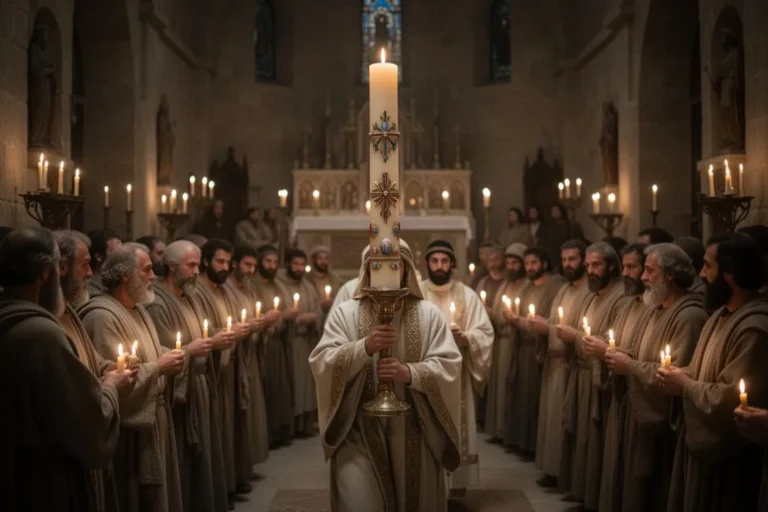
The minister lights the paschal candle from that fire. A procession then carries the candle into the dark church, often stopping several times while the congregation responds to a proclamation such as “The light of Christ.” The people may light their smaller candles from the paschal candle, allowing one flame to spread through the assembly.
This movement from darkness to light makes the service’s theology visible. The church is not merely switching on its lights; it is enacting the proclamation that Christ has risen and that his life gives light to the community.
After the procession, the candle is placed in a prominent position, often near the ambo, altar, or baptismal font. The placement differs by church tradition, but it should be visible without competing with the central actions of the service.
In churches that use the traditional Easter Vigil liturgy, the lighting of the candle is followed by the Exsultet, also called the Easter Proclamation. This extended hymn or proclamation praises God for the resurrection and describes the candle as a light offered for the glory of God.
The Exsultet may mention the candle’s work, beeswax, or flame in poetic language. The exact wording depends on the approved worship text used by the denomination. The important point is that the candle is interpreted within the church’s proclamation of Easter rather than treated as an isolated object.
What the symbols on a paschal candle mean
Paschal candles usually have several symbols placed on their surface. Some are required by a particular tradition, while others reflect the maker’s design or a congregation’s custom. Their meanings are related, but no single decoration carries the whole significance of the candle.
The cross: The cross identifies the candle with Jesus’ crucifixion and shows that resurrection cannot be separated from his death.
Alpha and Omega: These are the first and last letters of the Greek alphabet. They refer to Christ as the beginning and the end, based on imagery from Revelation.
The current year: The year places the Easter celebration in the congregation’s present life. It can also suggest that Christ is Lord of time and history.
Five wax studs or incense grains: In the Roman Catholic tradition, these may be inserted into the candle in the shape of a cross to recall the five wounds of Christ.
Decorative imagery: Symbols such as water, wheat, vines, lambs, or the risen Christ may reflect baptism, Eucharist, resurrection, or local artistic tradition.
The symbols should be understandable without turning the candle into a puzzle. A well-designed candle combines clear Christian meaning with practical visibility. If the markings are too small, ornate, or hidden by wax drips, worshipers may not be able to recognize them during the service.
How the candle is prepared for Easter
Preparation begins before the Easter Vigil. The church selects a candle large enough to burn safely during the season and appropriate for the worship space. It may be made of beeswax, paraffin, or a blend of waxes, although the materials and standards differ among manufacturers and traditions.
A minister or other authorized person may mark the candle with the cross, the Greek letters, and the year. In churches that use wax studs or incense grains, these are added according to the customary rite. The candle is then placed where it can be reached easily for lighting but will not create a hazard during the procession.
The candle does not need to be elaborate to be meaningful. A plain white candle with a carefully drawn cross can serve its purpose. What matters most is reverent preparation, safe use, and a clear connection to the church’s Easter worship.
Some congregations order a new candle each year, while others use a candle designed to burn for several seasons. A new date is normally added when a candle is reused, and old markings may remain beneath later decoration. Churches should follow their denomination’s guidance when deciding how to update or replace the candle.
How the paschal candle is used after Easter
The paschal candle normally remains in a visible place throughout the Easter season. In many Western churches, that season lasts from Easter Sunday through Pentecost. The candle may be lit during Sunday worship, especially when the congregation is emphasizing the resurrection or the meaning of baptism.
At the Easter Vigil, the candle’s meaning is linked to the resurrection itself. After Easter, it continues to remind the congregation that the risen Christ remains at the center of Christian life. Its repeated lighting turns a single Easter proclamation into a continuing pattern of worship.
In some traditions, the candle is moved or its regular seasonal use changes around the Ascension. It may then be placed near the baptismal font, where it remains available for rites of baptism. Other churches keep it in the sanctuary or use it according to local custom. Practices vary, so the congregation’s authorized liturgical books provide the best guidance.
Use at baptisms
The paschal candle is commonly lit during baptism because baptism represents sharing in Christ’s death and resurrection. After the baptized person receives the sacrament or rite, a smaller baptismal candle may be lit from the paschal candle.
The smaller candle symbolizes the newly baptized person’s calling to live in the light of Christ. Parents or sponsors may receive it in the case of an infant, while an older child or adult may hold it personally. The candle is not a magical object and does not make baptism effective by itself; it is a visible sign accompanying the church’s words and actions.
Many families keep the baptismal candle and light it on anniversaries or other occasions. If you have one at home, store it upright in a cool place away from sunlight. A candle that has softened, cracked, or developed a loose wick should be handled carefully before it is burned again.
Use at funerals
The paschal candle may also be lit during a Christian funeral or memorial service. It is often placed near the coffin or urn as a sign of the deceased person’s baptism and hope in the resurrection.
This use connects the beginning and end of Christian life. The candle that welcomed a person into the church at baptism may stand near that person at death, proclaiming that Christian hope rests on Christ’s victory rather than on human strength or denial of grief.
The candle does not mean that Christians are expected to ignore sorrow. Its light stands alongside mourning, reminding the congregation that grief and hope can exist together. The funeral service may also include readings, prayers, music, and commendation that explain this hope more fully.
How the paschal candle differs from other church candles
Churches use several kinds of candles, and their meanings are not interchangeable. The paschal candle is specifically associated with Easter, resurrection, baptism, and Christian funerals. Its large size and distinctive symbols set it apart from candles used for ordinary worship.
Altar candles: These are placed on or near the altar and may be lit during regular services. They can signify reverence, prayer, or the light of Christ, but they do not usually carry the specialized Easter symbolism of the paschal candle.
Advent candles: These are used in the Advent wreath and mark the Sundays leading to Christmas. Their colors and arrangement belong to Advent rather than Easter.
Prayer candles: These may be lit by worshipers as an expression of prayer. They are often smaller and are not normally used in the Easter Vigil procession.
Christ candles: In some Protestant churches, a central candle in an Advent wreath or worship display is called the Christ candle. It may share themes of Christ’s light with the paschal candle, but the two are not always the same object.
Baptismal candles: These are smaller candles lit from the paschal candle or another church flame for an individual baptism.
Names and customs vary across denominations. A congregation may call its central Easter candle a Christ candle, Easter candle, or paschal candle. To understand the local practice, look at the service book, ask the pastor or priest, and observe when the candle is lit and where it is placed.
Common mistakes when choosing or using one
A paschal candle should be selected for both symbolic clarity and safe practical use. A beautiful candle can still be unsuitable if it is too narrow for the holder, too short for the season, or made from wax that burns unpredictably.
Choosing the wrong diameter: Measure the candle stand before ordering. A candle that is too small can wobble, while one that is too large may not fit at all.
Ignoring burn time: Estimate how often the candle will be lit and choose a size that can serve the season without being reduced to a stub too early.
Using an unstable stand: Place the candle in a holder designed for its weight and diameter. Test the stand before the procession rather than discovering a problem during worship.
Adding decorations that shed or flare: Ribbons, loose flowers, glitter, and flammable ornaments can create hazards near an open flame.
Leaving the candle unattended: A trained adult should supervise it whenever it is burning, especially during processions and crowded baptismal services.
Failing to protect nearby surfaces: Wax can damage wood, stone, fabric, and flooring. Use a suitable drip tray or protective plate where needed.
Overheating the candle: Burning it for long periods without checking the wick and wax can cause excessive dripping, tunneling, or an unstable flame.
Treating local custom as universal: Instructions about symbols, placement, and when to extinguish the candle differ. Follow the denomination’s approved rite.
Safety tip: Never carry a lit paschal candle near loose clothing, hanging fabric, dry floral arrangements, or an overcrowded doorway. Assign a responsible person to manage the flame and candle stand.
How to care for a paschal candle
Good care helps the candle burn evenly and remain dignified throughout the season. Store an unlit candle upright and cool, away from direct sunlight, heaters, and hot vehicles. Heat can soften the wax, bend the candle, or loosen decorative elements.
Before lighting it, trim the wick according to the manufacturer’s guidance. A wick that is too long may create a large, smoky flame, while one that is too short may struggle to stay lit. Do not cut into the wax more than necessary, because the wick must remain firmly anchored.
Keep the candle vertical while it burns. If it leans, the flame may heat one side more than the other, causing uneven melting and a greater risk of wax running down the candle stand. A candle that has become unstable should be extinguished and secured before it is used again.
Extinguish the flame with a snuffer rather than blowing on it, particularly in a sanctuary with delicate furnishings or nearby candles. Blowing can spread hot wax or glowing particles. Allow the candle to cool before moving it.
If the candle is used in a procession, practice the route beforehand. Check doorways, steps, wind, and the distance between the flame and people’s clothing. Outdoor flames can behave unpredictably, so a candle lighter or protective taper may be needed to transfer the flame safely.
What the paschal candle teaches about Christian worship
The candle demonstrates how Christian worship engages more than words. Its flame, movement, scent, color, and placement help the congregation experience a theological claim through the senses. These physical elements do not replace faith, but they can make the structure of the liturgy easier to see and remember.
The candle also gives Easter a continuing presence in the church’s calendar. The resurrection is proclaimed in Scripture and preaching, but the candle’s repeated lighting shows that Easter is not treated as a single date that disappears once the service ends. The church carries its meaning into baptism, funerals, Sunday worship, and daily Christian life.
Its symbolism also holds together realities that are sometimes separated: death and life, grief and hope, memory and expectation. The cross marked on the candle remains visible as the flame burns, reminding worshipers that the resurrection does not erase the wounds of Good Friday. Instead, Christian hope understands those wounds in light of God’s redemptive work.
Questions to ask when a church needs a paschal candle
Before purchasing a candle, church leaders can consult the person responsible for worship, the sacristy, or the building. Practical details matter because the candle will be handled during public services and may burn for many weeks.
What size fits the existing stand?
How many services will use the candle during the Easter season?
Does the denomination specify particular symbols or materials?
Will the candle be carried outdoors or only used inside?
Where will it be stored between services?
Will it be used at baptisms and funerals after Easter?
Who will trim, light, extinguish, and inspect it?
Choosing the candle as part of a wider worship plan prevents common problems. The right candle should be visible from the congregation, stable in its holder, compatible with the church’s rites, and manageable for the people who care for it.
The paschal candle is ultimately a simple object carrying a large message. Its flame directs attention to Christ’s resurrection, its markings connect Easter with the Christian story, and its presence at baptism and funerals links the beginning, middle, and end of a believer’s life in the church.
Frequently asked questions
Is a paschal candle the same as an Easter candle?
Usually, yes. “Easter candle” is a common English description of the large candle used during the Easter season, while “paschal candle” is the traditional liturgical term. Some churches use “Christ candle” for a related candle, but local terminology can differ. The candle’s placement, symbols, and use in the Easter Vigil help identify which tradition a congregation follows.
Why does a paschal candle have the year on it?
The year identifies the candle with the congregation’s current Easter celebration. It places the resurrection proclamation in the present rather than treating it as only a past event. The date may also symbolize Christ’s authority over time and history. When a church reuses a candle, it should follow its customary practice for adding or replacing the year.
Can a paschal candle be used at home?
It can be displayed or lit at home only with careful attention to fire safety and the customs of your church. These candles are often large and designed for a stable church stand, so they may not be suitable for ordinary household surfaces. Never leave one burning unattended, and ask your pastor or priest about appropriate devotional use.
What happens to the paschal candle after the Easter season?
Practices vary. In many churches, it is moved near the baptismal font and used for baptisms and funerals. Some traditions change its regular placement around the Ascension, while others continue using it according to local custom. It may remain in service until it is consumed or replaced, rather than being discarded immediately after Easter.





Leave a Reply