Advent: Meaning, traditions, and ways to observe it
Advent: Meaning, traditions, and ways to observe it
Advent is the Christian season of preparation for Christmas and remembrance of Christ’s promised return. It gives the weeks before Christmas a spiritual rhythm centered on hope, expectation, repentance, and joy, rather than treating the entire season as a countdown to one day.
The word Advent comes from a Latin term meaning “coming” or “arrival.” In Christian worship, it points both to Jesus’ birth at Bethlehem and to the future hope of Christ’s return. Those two themes shape the prayers, Scripture readings, music, and visual symbols used during the season.
In Western Christian churches, Advent begins on the fourth Sunday before Christmas Day. Because Christmas falls on a fixed date but Sundays shift from year to year, Advent can begin as early as November 27 or as late as December 3. The season continues through December 24, ending before Christmas Day begins.
Advent is not identical in every denomination. Roman Catholic, Anglican, Lutheran, Methodist, Presbyterian, and other traditions may use different readings, colors, calendars, and customs. Some churches emphasize the second coming of Christ at the start of the season, while others focus more quickly on the Nativity. Eastern Christian churches generally follow different calendars and fasting practices, so their preparation for Christmas does not always match the Western Advent dates.
Core idea: Advent holds two kinds of waiting together: Christians remember that Jesus came into the world, and they look forward to the fulfillment of God’s promises.
How the four weeks of Advent are commonly observed
Each Sunday of Advent traditionally highlights a particular theme, although the names vary among churches. A common pattern moves from expectation toward celebration:
First Sunday: Hope and watchfulness, often connected with Christ’s promised return.
Second Sunday: Peace, preparation, and the work of making a faithful path.
Third Sunday: Joy, frequently marked by a rose-colored candle or vestment.
Fourth Sunday: Love, Mary’s role in receiving God’s promise, and the nearness of Christmas.
These themes are not four separate ideas that must be mastered in order. They are invitations to notice different dimensions of Christian hope. A person may need peace more than joy in a particular year, or may find that grief makes the language of celebration difficult. Advent observance can make room for both honest sorrow and confident hope.
Churches may also use an annual lectionary, a planned cycle of Bible readings. Common Advent readings include prophetic promises, John the Baptist’s call to prepare, Mary’s response to the angel, Joseph’s faithfulness, and the expectation of God’s kingdom. The exact passages depend on the church calendar and denomination.
How to observe Advent at home step by step
You do not need elaborate decorations or a formal religious background to create a meaningful Advent practice. A simple routine can connect the season with prayer, Scripture, generosity, and attention to other people.
Choose a regular time. Set aside five to fifteen minutes in the morning, at dinner, or before bed. A consistent time is usually more helpful than an ambitious plan that becomes difficult to maintain.
Mark the week. Use an Advent wreath, a calendar, a candle, or a simple note on the refrigerator. The physical marker reminds you that the season is progressing gradually.
Read a short passage. Choose a church reading plan or passages related to prophecy, preparation, the Nativity, and hope. Read the reference in your preferred Bible translation rather than treating the exercise as a race through many chapters.
Reflect on one question. Ask what hope looks like in your circumstances, what needs preparing, where peace is missing, or how love can become practical.
Pray honestly. Prayer can include gratitude, confession, requests for help, concern for the vulnerable, and longing for renewal. It does not need to sound formal.
Practice one outward action. Give food, write to someone who is lonely, repair a strained relationship where appropriate, volunteer, or support a local organization responsibly.
Keep the final days gentle. Make room for rest and worship instead of allowing shopping, travel, and social obligations to fill every available hour.
A household with children might light one candle each Sunday, read a short story, sing a hymn, or place one figure near a Nativity scene each week. Families do not have to turn every evening into a lesson. A brief practice that children can understand and repeat often has more value than a complicated schedule.
What the Advent wreath and candles represent
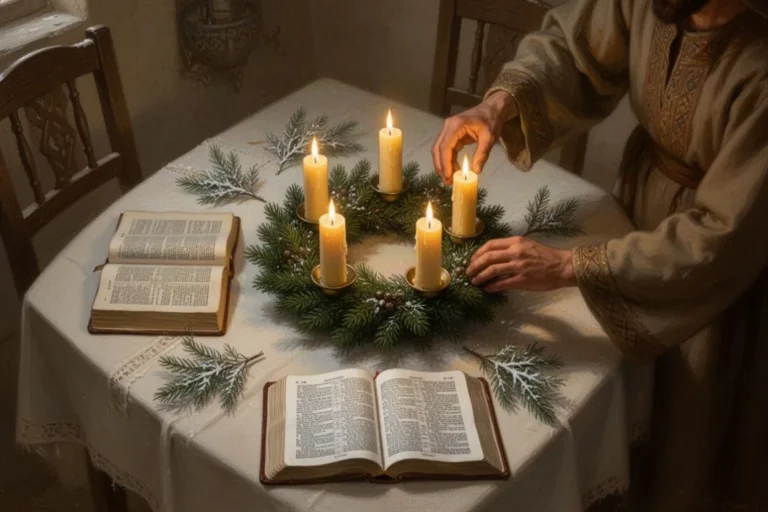
An Advent wreath is usually a circle of evergreen branches with four candles arranged around the edge. One candle is lit on the first Sunday, two on the second, three on the third, and all four on the fourth. Some wreaths include a fifth candle in the center, called the Christ candle, which is lit on Christmas Eve or Christmas Day.
The wreath’s circle commonly suggests eternity and God’s unending faithfulness, while evergreen branches represent life and endurance during winter. These meanings are devotional symbols rather than requirements found in the Bible. Their purpose is to help worshipers remember the season’s themes.
Candle colors differ. Purple candles are common in many Western traditions and can suggest repentance, royalty, or solemn expectation. Some churches use blue candles to emphasize hope and expectation. The third candle is often rose-colored, signaling a change from the season’s more reflective character toward joy. Other churches use four white candles or a mixture of colors.
There is no single universally required set of words for lighting the candles. A household might say the weekly theme, read a short passage, and pray. If a flame is used around children, keep candles on a stable, heat-resistant surface and never leave them unattended.
Why Advent includes both celebration and restraint
Advent can feel unusual because it is festive and restrained at the same time. Christmas music, decorations, gatherings, and gift-giving may begin early, while worship retains a quieter tone and directs attention toward waiting. This tension is deliberate. Christian hope is not presented as the denial of suffering but as confidence that suffering and death do not have the final word.
Many churches use Advent as a period of self-examination. That does not mean trying to manufacture guilt or treating ordinary enjoyment as wrong. It means asking whether your habits, spending, words, and priorities reflect the hope you claim to celebrate. A reflective season can make generosity more concrete and expose the ways consumer pressure has shaped your expectations.
The restraint of Advent also protects Christmas from becoming emotionally overwhelming. When every day is treated as the peak of celebration, the season can feel exhausting before Christmas arrives. A slower rhythm allows anticipation to grow rather than demanding constant excitement.
Practical reminder: Advent observance is not measured by how many customs you complete. A few minutes of attentive prayer, a thoughtful act of care, or a quiet reading can faithfully express the season.
How Advent connects with the Bible
The Bible does not prescribe a four-week Advent season or command Christians to use wreaths and calendars. Advent developed as a church tradition that gathers biblical themes into a period of preparation. Its practices are valuable when they direct attention toward Scripture rather than replacing it.
Several biblical strands appear repeatedly in Advent worship:
Promises of a coming king: Passages such as Isaiah 9 and Isaiah 11 describe hope, justice, peace, and a ruler connected with David’s line. Advent readings interpret these promises in light of Jesus.
A prepared way: Isaiah 40 and the preaching of John the Baptist, described in the Gospels, call people to prepare for God’s work through repentance and renewed faithfulness.
God with humanity: The opening of John’s Gospel presents Jesus as the Word who enters human life. It gives the Nativity a wider meaning than the memory of a child’s birth.
Mary’s trust: Luke 1 describes Mary receiving an unexpected announcement and responding with humility and faith. Her story highlights courage, vulnerability, and participation in God’s purposes.
Watchfulness: Several Gospel passages tell Jesus’ followers to stay alert for his return. Advent uses these texts to connect Christmas hope with the future restoration Christians await.
When reading these passages, consider their original setting as well as their place in Christian worship. Prophetic texts addressed particular people and historical circumstances. Christians interpret them through the life, death, and resurrection of Jesus, but responsible reading still avoids treating every image as a simple prediction with no context.
It is also helpful to distinguish between biblical quotation and personal reflection. A reading may inspire you, but its meaning should not depend entirely on how it makes you feel that day. Pay attention to who is speaking, whom the passage addresses, and how the surrounding verses develop its message.
What Advent traditions mean beyond church services
Advent calendars are among the most familiar customs. Traditional calendars open one door or compartment for each day leading to Christmas, often revealing a picture, Scripture reference, small gift, or piece of chocolate. A calendar can serve as a daily reminder, but its contents do not determine whether someone is observing Advent meaningfully.
Some people create a reverse Advent calendar by setting aside one useful item each day for a food pantry or shelter. Others use the season to collect winter clothing, make meals for neighbors, or donate to organizations that serve families under financial strain. These practices connect waiting with action: hope becomes visible through attention to real needs.
Nativity scenes also develop across the season. In some homes, the figures of Mary and Joseph are placed away from the stable and moved closer each day, while the baby Jesus figure remains absent until Christmas. This is a local custom, not a universal rule. Its usefulness comes from giving children and adults a physical way to think about approaching the Nativity.
Music plays a major role as well. Advent hymns often sound different from Christmas carols because they emphasize longing, prophecy, and expectation. A church may limit the singing of Christmas carols until Christmas Eve, while another may sing them throughout December. Both approaches reflect legitimate differences in worship practice.
How Advent differs from Christmas
Advent and Christmas are closely connected but not interchangeable. Advent is a season of waiting and preparation; Christmas begins the celebration of Jesus’ birth. In the Western church calendar, Christmas Day starts the Christmas season, which traditionally continues beyond December 25 rather than ending immediately after the presents are opened.
The distinction can help you respond to common seasonal pressure. You are not required to feel cheerful every day of December, and Advent does not ask you to pretend that family conflict, illness, financial stress, or grief has disappeared. Its language of hope can be honest precisely because it acknowledges that the world still needs healing.
For Christians who have lost someone, the season may bring both warm memories and sharp absence. Churches often provide Blue Christmas services or other gatherings for people who find standard celebrations difficult, although names and formats vary. A person who is grieving may choose quiet prayer, a memorial gift, or time with a trusted friend instead of participating in every festive event.
How different Christians practice Advent
Roman Catholic parishes commonly use an Advent wreath, seasonal Scripture readings, and a liturgical color associated with preparation. Some Catholics also emphasize confession, charitable giving, and special devotional practices. The exact schedule of services and customs differs by parish and country.
Anglican and Episcopal churches often use a lectionary, Advent hymns, wreaths, and services that place strong emphasis on both Christ’s coming in history and his expected return. A service of lessons and carols may be held during Advent, although Christmas music practices vary.
Lutheran, Methodist, Presbyterian, and other Protestant churches may observe Advent through Sunday preaching, candles, congregational music, family resources, and community outreach. Some congregations follow a formal liturgical pattern, while others use a less structured series focused on hope, peace, joy, and love.
Many evangelical churches observe Advent even when their services are not highly liturgical. A pastor may preach through the Nativity narratives, provide devotional guides, or invite the congregation to light candles. Other churches do not emphasize the church calendar and instead focus on Christmas programs or Bible teaching. The absence of an Advent program does not by itself indicate a church’s view of Christmas.
If you attend a church, ask how it understands the season rather than assuming every congregation uses the same symbols. If you worship at home, you can draw from historic customs while adapting them to your convictions, schedule, and family situation.
How to make an Advent practice meaningful
Choose a practice that answers a real spiritual need. If your December is crowded, use a short morning prayer. If you feel distracted, put the phone in another room while reading. If you are isolated, invite another person to share a weekly meal or video call. The best practice is one that creates attention rather than adding another source of pressure.
Keep the four themes connected to specific actions:
Hope: Pray for a situation that appears stuck, and identify one faithful step you can take without pretending to control the outcome.
Peace: Reduce one avoidable source of conflict, make a needed apology, or spend time in silence before responding to difficult news.
Joy: Receive a good moment without guilt, share music or food with others, and remember that joy can coexist with sadness.
Love: Offer practical help, make room for someone who is often overlooked, or give in a way that respects the recipient’s actual needs.
Do not use these themes as a checklist for judging yourself. A week marked by fatigue may require sleep and support rather than extra activity. Advent’s emphasis on grace means that a missed reading or forgotten candle does not cancel the purpose of the season.
Common questions about Advent symbols and timing
Why does Advent sometimes start in November?
Advent begins on the fourth Sunday before Christmas, not on a fixed numbered date. Since Christmas is always December 25 but the weekday changes each year, the first Sunday of Advent may fall in late November or early December. Churches may also begin Advent-related music or programs at different times for practical reasons.
Does Advent always last exactly four weeks?
It includes four Sundays, but the number of calendar days varies. The season ends on December 24, so the first Sunday’s date determines its length. Christmas Eve is the final day of Advent in the Western calendar, even though some services held that evening already begin celebrating Christmas.
What should you do if your church does not observe Advent?
You can observe it privately through Scripture, prayer, generosity, or a candle-lighting practice, provided those actions fit your beliefs. You can also ask church leaders how they understand the season. Advent is a helpful tradition, not a test of Christian commitment, and churches differ in how they organize worship.
Can people observe Advent without being Christian?
Anyone can learn about Advent or use its themes as a cultural or reflective practice, but its original meaning is explicitly Christian. The season centers on Jesus’ birth, Christian hope, repentance, and expectation of his return. A non-Christian household might appreciate the calendar, candles, or charitable customs while understanding that these symbols come from Christian worship.
How Advent can shape the days after Christmas
The habits formed during Advent do not have to disappear on December 25. Attention to prayer, generosity, hospitality, and hope can continue into the Christmas season and the new year. The point is not to preserve a mood but to carry forward a way of living that recognizes other people’s needs and trusts that renewal is possible.
For Christians, Advent ultimately points beyond decorations, schedules, and seasonal feelings. It recalls a historical claim about Jesus’ birth, invites a present response of faith and love, and directs attention toward a future in which God’s promises are fully realized. That combination gives the season its distinctive depth: it remembers, waits, acts, and hopes at the same time.
Frequently asked questions
Is Advent the same as the 12 days of Christmas?
No. Advent comes before Christmas and ends on December 24 in the Western church calendar. The traditional 12 days of Christmas begin on Christmas Day and continue through the period leading to Epiphany. Modern commercial customs often shorten or blur both seasons, but church calendars treat them as distinct periods with different themes.
Are Advent candles required for Christians?
No. Advent candles are a useful tradition, but they are not a biblical requirement or a condition of faith. Churches and families can observe Advent through prayer, Scripture, worship, generosity, music, or quiet reflection without using a wreath. If you do use candles, choose a safe location and supervise children closely.
Why is the third Advent candle sometimes pink?
The rose-colored candle traditionally marks the third Sunday, often associated with joy. Its lighter color provides a visual change within a season that otherwise uses purple or blue in many churches. The custom is not universal, and churches may use white, blue, or another color instead.
Can Advent be a difficult season for people who are grieving?
Yes. Advent’s emphasis on hope does not remove grief, loneliness, illness, or family strain. Some people find comfort in quiet worship, a memorial practice, or a supportive service rather than large celebrations. Churches may offer services for those experiencing loss, and trusted friends can help make the season less isolating.





Leave a Reply