A lectionary is an organized schedule of Scripture readings for public worship. Instead of choosing passages at random, a church follows a planned pattern that brings different parts of the Bible before the congregation over time.
The Church of England commonly uses the Common Worship Lectionary. It provides readings for the Eucharist, other principal services, festivals, and many weekdays. Some churches also use the Book of Common Prayer lectionary, particularly when they hold services according to the 1662 Prayer Book.
The lectionary supports both clergy and congregations. It helps ministers plan services, gives readers clear passages to prepare, and allows people at home to follow the same biblical rhythm as their local church.
Most useful starting point: Find the date and the service you are attending, then check the lectionary’s appointed readings for that specific occasion. The readings can differ between a Sunday Eucharist, Morning Prayer, Evening Prayer, and a festival.
How the liturgical year determines the readings
The lectionary follows the Christian year rather than the January-to-December calendar alone. The year begins with Advent, the season of preparation for Christmas, and continues through Christmas, Epiphany, Lent, Holy Week, Easter, Pentecost, and the long period usually called Ordinary Time or the season after Trinity.
Each season gives the readings a particular emphasis. Advent often turns attention toward Christ’s coming, judgment, hope, and preparation. Lent emphasizes repentance, discipleship, testing, and baptismal themes, while Easter focuses on the resurrection and the life of the risen Church.
The dates of some seasons change each year. Easter is a movable feast, so the dates of Lent, Holy Week, Ascension Day, and Pentecost also move. Advent begins on the Sunday nearest to November 30, so the first Sunday of Advent can fall on different dates from one year to the next.
The three-year Sunday cycle
Sunday and principal feast readings generally follow a three-year cycle. The cycles are called Year A, Year B, and Year C, and the cycle changes at the beginning of Advent rather than on January 1.
Year A gives particular prominence to the Gospel according to Matthew.
Year B gives particular prominence to the Gospel according to Mark, with passages from John used at important points.
Year C gives particular prominence to the Gospel according to Luke, with John also appearing during major seasons.
This arrangement does not mean that one Gospel is read exclusively in its assigned year. The lectionary uses passages from all four Gospels, especially during Christmas, Lent, Holy Week, Easter, and other significant occasions.
The three-year pattern helps congregations hear a substantial range of the New Testament and selected Old Testament readings. It also creates continuity: a person who attends regularly encounters recurring seasons while hearing different passages as the cycle progresses.
What readings are normally appointed for a Sunday Eucharist
A principal Sunday Eucharist usually has several appointed readings. Their exact presentation can vary according to the service and local practice, but the main pattern normally includes an Old Testament reading, a psalm, a New Testament reading, and a Gospel reading.
Old Testament reading: This may come from the historical books, prophets, wisdom literature, or another part of the Hebrew Scriptures. It often connects thematically with the Gospel or offers a wider biblical setting.
Psalm: The psalm provides a sung, spoken, or responsorial response to the first reading. It gives the congregation language for praise, lament, trust, confession, or thanksgiving.
New Testament reading: Usually drawn from an epistle, Acts, or Revelation, this reading may follow a semi-continuous sequence through a biblical book rather than directly matching the Gospel.
Gospel: The Gospel is the central reading in the Eucharist and is often introduced and concluded with particular ceremony. It presents a passage from Matthew, Mark, Luke, or John.
“Thematic” connections between readings are often present, but they are not always exact. One reading may relate closely to the Gospel while another traces an independent sequence through a New Testament letter. This prevents the congregation’s exposure to Scripture from being limited only to passages that support one weekly theme.
Some services use a shorter form of a reading, shown as an alternative in the lectionary. A minister may choose the longer or shorter form based on the service’s length, the pastoral setting, the season, and the needs of the congregation.
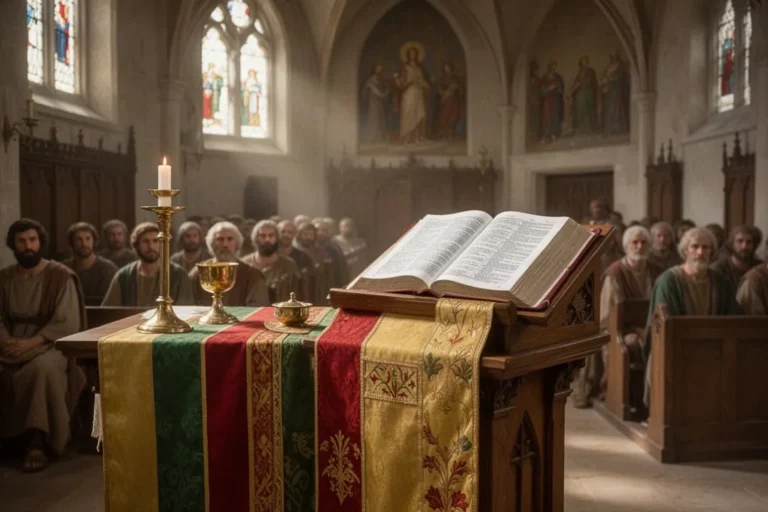
In many Anglican churches, the Gospel is read from a different place in the church, and the congregation may stand. These customs are not merely logistical; they show the Gospel’s special place within the Eucharistic reading pattern.
The service may include a Gospel acclamation before the reading and a response afterward. Local custom determines the wording and music, but the purpose is consistent: the congregation is invited to receive the Gospel as the good news of Jesus Christ.
How to find the correct Church of England lectionary reading
Finding the correct passage requires more than searching for a date. You need to identify the liturgical occasion, the service, and sometimes the particular observance chosen by the church.
Write down the date. Remember that the lectionary year may have begun at Advent, even though the civil year has not changed.
Identify the occasion. Check whether it is an ordinary Sunday, a principal feast, a saint’s day, a weekday, or a special observance.
Choose the service. Sunday Eucharist, Morning Prayer, Evening Prayer, and a baptism or funeral may use different readings.
Check the cycle. Confirm whether the date falls in Year A, Year B, or Year C.
Read every appointed option carefully. Some entries provide alternatives, shorter forms, or readings for different service traditions.
Confirm the local order of service. A parish may use authorized seasonal material or a local decision that affects which readings are proclaimed.
Printed editions are arranged by liturgical season and date, while online versions are often arranged as a calendar. An online calendar can be faster for checking one day, but a printed lectionary makes it easier to see the relationship between neighboring Sundays and the wider season.
When preparing to read in church, check the wording in the Bible edition used by the parish. The lectionary may give a reference, while the church’s service booklet or lectern Bible supplies the actual text. Pronunciation notes, paragraphing, and headings can vary between editions.
Check the parish notice carefully: A church may announce a special service for a patronal festival, baptism, confirmation, harvest, remembrance, or another occasion. The readings printed in the pew sheet usually reflect what will actually be used.
How Sunday readings differ from weekday readings
Sunday worship normally has the widest congregational attendance and a fuller set of readings. Weekday services are often shorter and may follow a different Daily Prayer lectionary, especially for Morning Prayer and Evening Prayer.
Weekday patterns allow people who pray the Daily Office to move steadily through substantial portions of Scripture. The readings may be arranged over more than one year and are not simply a repeat of the previous Sunday’s passages.
Morning Prayer and Evening Prayer can also have different appointed readings on the same date. A person using the Church of England’s online Daily Prayer resources should select the particular office being prayed rather than assuming that one daily list applies to every service.
Weekday entries may include a first reading and a second reading, with a psalm or psalms appointed separately. The precise structure depends on the office and the day. A weekday Eucharist may use readings associated with the saint or holy day rather than the readings appointed for Daily Prayer.
Why weekday lectionary entries can appear complicated
The calendar includes optional memorials, lesser festivals, greater festivals, principal feasts, and days with special priority. When more than one observance falls on the same date, the higher-ranking occasion normally determines the readings.
Some observances can be transferred to another day when pastoral or practical reasons require it. A parish may also observe a particular saint’s day on a different date, so the service sheet remains the best confirmation of what the congregation will hear.
Principal feasts usually take priority over ordinary weekdays.
Major festivals may have their own readings and a distinctive liturgical color or service pattern.
Saints’ days can include readings connected with the saint, although local practice may vary.
Optional commemorations may be observed or omitted according to the calendar and the church’s custom.
Transferred celebrations should be checked against the parish’s published schedule.
How seasons shape the selection of Scripture
Advent and Christmas
Advent readings often combine promises of God’s future reign with calls to watchfulness and repentance. The later Sundays of Advent turn more directly toward the people and events associated with Christ’s birth, while the Christmas readings proclaim the incarnation through different Gospel perspectives.
The Christmas season continues beyond December 25. Readings for the Nativity, Saint Stephen, Saint John, the Holy Innocents, and other days can each have their own focus. The first Sunday of Christmas and the feast of the Epiphany may also use readings that differ from the nearest ordinary Sunday.
Epiphany and the season after Epiphany
The Epiphany season explores the revelation of Jesus Christ to the nations. Readings may include the visit of the wise men, the baptism of Jesus, the calling of disciples, miracles, and teaching that reveals his identity and mission.
The length of the season after Epiphany changes because it leads toward Lent. Some years include a Sunday devoted to the Transfiguration shortly before Lent; in other years, the calendar’s sequence and dates affect how that material is placed.
Lent and Holy Week
Lent’s readings often invite reflection on sin, faith, covenant, prayer, and the cost of discipleship. The Gospel sequence may include stories traditionally associated with preparation for baptism, such as the Samaritan woman, the man born blind, or the raising of Lazarus, depending on the year and the lectionary provision being used.
Holy Week has a concentrated pattern of readings. Palm Sunday includes the entry into Jerusalem and a Passion narrative, while Maundy Thursday, Good Friday, and Easter Day each have readings shaped by the final supper, the crucifixion, and the resurrection.
Easter, Ascension, and Pentecost
Easter readings proclaim the resurrection and then follow the risen Christ’s appearances, the growth of the early Church, and the work of the Holy Spirit. During the Easter season, the first reading is often taken from Acts rather than the Old Testament, highlighting the life and witness of the apostolic community.
Ascension Day marks Christ’s exaltation and the transition toward the Church’s mission. Pentecost focuses on the Holy Spirit and the formation of the Church, after which readings continue into the season after Pentecost or Trinity.
The season after Pentecost or Trinity
This long season gives space for sustained reading from the Gospels and other books of the Bible. Depending on the year, the Gospel may move through a substantial portion of Matthew, Mark, or Luke, while the Old Testament and epistle readings follow their own patterns.
The season can include Trinity Sunday, Corpus Christi, the feast of the Transfiguration, All Saints’ Day, and the feast of Christ the King. These occasions interrupt the ordinary sequence with readings chosen for their particular theological emphasis.
How ministers and readers prepare with the lectionary
The lectionary supplies references, not a substitute for preparation. A reader should first understand the passage’s setting, then practice delivering it clearly to people who may be hearing it for the first time.
Read the whole chapter or surrounding section. The appointed verses may begin or end in the middle of an argument or story.
Check names and places. Use a reliable pronunciation guide or ask the minister if an unfamiliar biblical name is uncertain.
Identify the main movement. Notice who is speaking, what changes, and where the passage reaches its emphasis.
Practice aloud. Spoken Scripture needs a pace and volume that work in the actual building.
Mark difficult transitions. Long lists, changes of speaker, and poetic lines often need careful phrasing.
Follow the service book. Know when the congregation sits, stands, responds, or joins a refrain.
Preparation should preserve the character of the text. A lament should not be rushed into cheerful delivery, and a narrative should not be read as a flat collection of sentences. Clarity matters more than performance.
Readers should avoid adding explanations to the biblical text unless the service specifically calls for it. Context belongs in preaching, teaching, or a study group; the reading itself should be heard as Scripture.
How to use the lectionary for personal Bible reading
The lectionary can provide a manageable framework for private prayer. You can begin with the readings appointed for the coming Sunday, then read each passage slowly during the week and notice repeated words, images, questions, or promises.
A simple pattern is to read the Gospel first, then the other passages. Ask what the Gospel reveals about Jesus, how the other readings illuminate it, and what response the texts invite from the Church. This approach avoids treating the readings as isolated quotations.
You can also pray with the Daily Prayer readings. The Daily Office gives a regular pattern that includes Scripture, psalms, confession, praise, and intercession. If the full office feels too long, use one reading and a short period of silence rather than abandoning the practice altogether.
A practical weekly reading pattern
Early in the week: Read the appointed Gospel slowly and note the central action or teaching.
Later in the week: Read the Old Testament and New Testament passages, looking for connections and differences.
Before Sunday: Read the Gospel aloud and consider how it will sound when proclaimed in worship.
After worship: Return to one phrase or idea that stayed with you and use it in prayer.
A study Bible, biblical commentary, or parish discussion group can help with historical and literary context. These resources should serve attentive reading rather than replace it with a large amount of background information.
How the Church of England lectionary relates to other Anglican calendars
The Church of England lectionary belongs to a wider Anglican and ecumenical family, but calendars are not identical in every province. The Revised Common Lectionary has influenced many churches, yet each denomination or national church may make adjustments to feasts, readings, seasonal observances, or local saints.
That is why a search result from another Anglican church may not match the Church of England entry for the same date. A Roman Catholic, Scottish Episcopal, Episcopal, or other denominational calendar can also assign different readings even when the liturgical season is the same.
If you are preparing for a Church of England service, use a Church of England source or the readings supplied by the parish. Similar names do not guarantee identical entries.
Common mistakes when checking a lectionary
Several simple errors can lead to the wrong reading. The most common is checking the civil date without checking the liturgical year or the observance attached to that date.
Using the wrong year: The cycle changes at Advent, not at the start of January.
Confusing services: Morning Prayer, Evening Prayer, and the Eucharist may have separate readings.
Missing a feast: A saint’s day or principal feast can replace the ordinary weekday entry.
Ignoring alternatives: A listing may provide a longer and shorter form or options for different service traditions.
Relying on an outdated page: Confirm that an online calendar corresponds to the current liturgical year.
Assuming every church follows one pattern: Local authorized provision and parish custom can affect the final service.
Another mistake is assuming that a reading must explain the entire theme of the service by itself. The lectionary brings passages together in a pattern, but the sermon, prayers, music, sacramental action, and season also shape how the readings are heard.
Where to verify the readings
The most dependable place to confirm a Sunday or festival reading is the parish’s service sheet, website, or notice from the minister. The Church of England’s official resources can help with the wider calendar and Daily Prayer, while published Common Worship materials provide the authorized framework.
For regular use, keep a record of the source and version you are using. A printed lectionary, an official online calendar, and a church bulletin may display the same reading with different abbreviations or formatting, but the actual reference should correspond.
When a source appears unclear, compare it with the parish’s announced readings rather than guessing. The local service may be celebrating a transferred feast, a baptism, confirmation, or another occasion with its own appointed provision.
The lectionary is most useful when it is treated as a shared pattern rather than a rigid reading list. It connects the worship of a local congregation with the seasons of the Church, gives Scripture a regular place in common prayer, and offers a reliable path for personal reading throughout the year.
Frequently asked questions
Does every Church of England church use the same lectionary?
Many Church of England churches use the Common Worship Lectionary, but worship traditions differ. A parish using the Book of Common Prayer may follow its lectionary instead, and local services can use authorized seasonal or pastoral provisions. Check the parish notice or service sheet for the readings that will actually be used on a particular day.
What lectionary year is used in the Church of England?
Sunday readings follow a three-year cycle named Years A, B, and C. The cycle changes at Advent. Year A is mainly associated with Matthew, Year B with Mark, and Year C with Luke, although John is used throughout the cycle, especially at major festivals and during particular seasons.
Can I use the lectionary for daily prayer at home?
Yes. The Church of England’s Daily Prayer resources provide readings for offices such as Morning Prayer and Evening Prayer. You can pray the complete office or read one appointed passage quietly. Choose the office and date carefully, since weekday readings are not necessarily the same as those appointed for a weekday Eucharist.
Why are my online readings different from the ones in church?
You may be looking at a different service, calendar, or denomination. A parish could also be celebrating a feast, transferred observance, baptism, or another special occasion. Compare the date, liturgical year, service name, and church tradition, then use the parish’s published service sheet as the final local reference.







Leave a Reply