What Is Ascension Day? Meaning, Date, and Traditions
What Is Ascension Day? Meaning, Date, and Traditions
If you have seen Ascension Day marked on a church calendar and wondered what it means, the short answer is this: it is the Christian observance of Jesus Christ’s ascension into heaven after his resurrection. The day recalls the end of Jesus’ earthly appearances to his disciples and the beginning of their mission as witnesses.
Ascension Day is traditionally observed 40 days after Easter Sunday, which makes it a Thursday in many church calendars. Some denominations and congregations transfer the observance to the following Sunday so more people can attend worship. The date changes each year because Easter follows a calendar based on the moon.
Ascension Day remembers the event described in the opening chapter of Acts, when the risen Jesus meets with his disciples and is taken up from their sight. The disciples are then directed to wait in Jerusalem for the Holy Spirit. The event marks a change in the way Jesus is present with his followers: his visible earthly ministry has ended, while the church’s public mission is beginning.
For Christians, the ascension is not understood simply as Jesus traveling upward through the sky. It expresses his return to the Father, his exaltation, and his participation in divine glory. The language of being “taken up” communicates a theological truth about Jesus’ authority and status rather than providing a scientific description of heaven’s location.
The story also connects Jesus’ resurrection with the continuing life of the church. His disciples are not told to remain focused on the past. Instead, they are sent to proclaim the gospel, make disciples, and serve as witnesses. That connection gives Ascension Day both a reflective and an active character.
The central idea: Ascension Day celebrates Christ’s exaltation and presence with God while also marking the disciples’ responsibility to continue his work in the world.
Where the Bible describes the ascension
The clearest account appears in Acts 1:1–11. This passage explains that Jesus appeared to his apostles after his suffering and gave them instructions before being taken up. It also describes the disciples watching as he went from their sight and receiving a message that directs their attention toward his future return.
The Gospel of Luke also ends with a brief account of the ascension in Luke 24:50–53. In that scene, Jesus blesses his disciples, is parted from them, and they return to Jerusalem with joy. Luke’s two-volume work therefore begins and ends with the risen Christ commissioning his followers and pointing them toward the next stage of God’s work.
Other New Testament passages explain the meaning of the ascension without narrating the event in the same way. Ephesians 1:20–23 connects Christ’s exaltation with authority over all things. Hebrews 4:14 presents Jesus as the great high priest who has passed through the heavens, while 1 Peter 3:22 associates his ascension with authority and the submission of spiritual powers.
Several passages also use language about Jesus being at the right hand of God. These references, including Mark 16:19 and Acts 2:33–35, communicate honor, authority, and participation in God’s reign. They help explain why the ascension is treated as a major Christian belief rather than a minor detail at the end of the resurrection stories.
Why Jesus’ ascension matters to Christian faith
The ascension is closely tied to several central Christian teachings. It is often included in statements of faith, including the Apostles’ Creed and the Nicene Creed, because it identifies Jesus as the risen and reigning Lord. The event links what Christians believe about the resurrection, the Holy Spirit, the church, and Christ’s future return.
It signifies Jesus’ exaltation
Christian theology understands the ascension as Jesus being lifted into glory and given the position of supreme authority. His earthly ministry involved teaching, healing, suffering, death, and resurrection. His ascension signals that this work has been accepted and that he now reigns with the Father.
This does not mean that Jesus has abandoned humanity. Instead, many Christian traditions teach that he continues to care for his people, intercede for them, and exercise authority over the church. The ascension therefore combines absence from ordinary sight with a deeper form of divine presence.
It prepares for the coming of the Holy Spirit
In Acts 1, Jesus tells the disciples to wait for the promised Holy Spirit. That promise is fulfilled at Pentecost, traditionally celebrated 10 days after Ascension Day. The two feasts are therefore connected: Ascension Day focuses on Christ’s exaltation, while Pentecost celebrates the Spirit’s empowering presence and the public beginning of the church’s witness.
The relationship between the two days also shapes the Christian understanding of mission. The disciples are not expected to carry out their work through personal strength alone. They are to receive power from the Holy Spirit and then proclaim what they have seen and learned about Jesus.
It gives the church a continuing mission
Before the ascension, Jesus commissions his followers to be witnesses. In practical terms, this means the church is called to teach, serve, worship, care for people in need, and announce the Christian message. Ascension Day can therefore prompt questions about how a congregation represents Christ in its community.
The mission is not limited to clergy or professional church workers. In many Christian traditions, all baptized believers share responsibility for prayer, service, hospitality, justice, and public witness. The ascension directs attention outward, from remembering Jesus’ past ministry to participating in his continuing work.
It points toward Christ’s return
Acts 1 connects the ascension with the hope that Jesus will return. Christians differ in how they interpret the details of that promise, but the basic belief is widely shared: Christ’s reign is real now, and it will be fully revealed in the future. Ascension Day therefore includes both present confidence and future hope.
The ascension joins Christ’s finished earthly ministry with the church’s continuing witness and the hope of his return.
When Ascension Day takes place
Ascension Day is observed 40 days after Easter Sunday, counting Easter as the first day in the traditional way used for this feast. It falls on a Thursday and is sometimes called the Feast of the Ascension, Ascension Thursday, or simply the Ascension.
The date is not fixed on the civil calendar. Easter is celebrated on a Sunday determined through the church’s traditional calculation involving the spring equinox and the full moon. Since Ascension Day follows Easter, it also moves from year to year. It usually occurs in May, although the exact date varies.
Many churches regard Ascension Day as one of the most important celebrations in the Easter season. In some places, it remains a public holiday or a major day of worship. Elsewhere, work and school schedules have made Thursday attendance difficult, so churches commonly celebrate the ascension on the following Sunday.
Traditional date: Thursday, 40 days after Easter Sunday.
Liturgical setting: The Easter season, before Pentecost.
Common adjustment: Transfer to the following Sunday where local practice allows.
Related celebration: Pentecost, traditionally observed 10 days later.
How different Christian traditions observe the feast
Ascension Day is observed in Roman Catholic, Eastern Orthodox, Anglican, Lutheran, Methodist, and many other Christian traditions. The details vary, but worship often includes readings from Acts 1 and Luke 24, prayers of praise, hymns about Christ’s reign, and attention to the church’s mission.
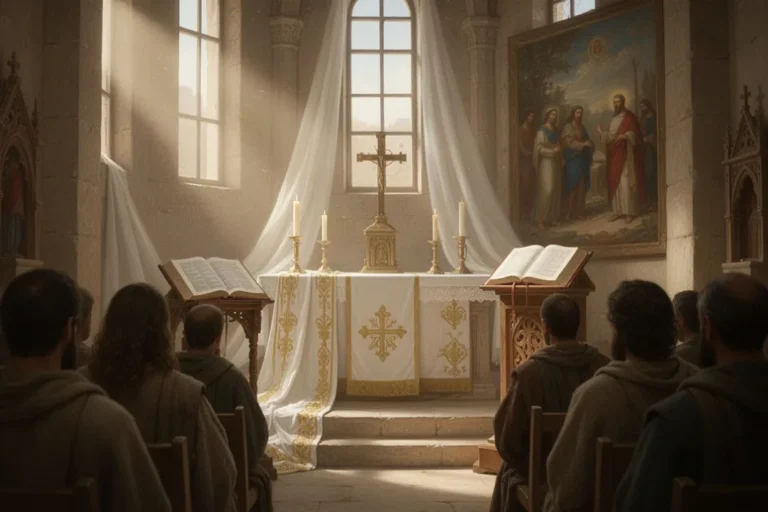
In Roman Catholic and Anglican settings, Ascension Day has traditionally been a significant feast within the liturgical year. Some congregations hold a Eucharistic service, use white or gold vestments, and include special music. White and gold commonly represent joy, glory, and celebration during major feasts of Christ.
Eastern Orthodox churches celebrate the Ascension as one of the Great Feasts. Orthodox observance follows the date of Pascha, the Eastern Christian celebration of Easter, which may differ from the Western date. Services often emphasize Christ’s glorification, his blessing of the disciples, and the promise of the Holy Spirit.
Many Protestant churches recognize the ascension through preaching, Scripture readings, prayer, and congregational singing. Some hold a dedicated service on Thursday, while others include the theme in worship on the Sunday after Easter. Churches that do not follow a formal liturgical calendar may still teach the ascension as an essential part of Christian belief.
Local customs can include processions, bell ringing, outdoor worship, prayer walks, or community service. In some European countries, Ascension Day has been associated with family gatherings and public holidays. Customs differ widely, so a local congregation’s practice may be more informal than the descriptions found in a traditional church calendar.
Common symbols associated with Ascension Day
Churches use several visual and musical symbols to express the meaning of the feast. A cross, an image of Christ in glory, or a depiction of the disciples looking upward may appear in worship materials. These images are meant to point to Christ’s authority and the disciples’ changed situation.
Some congregations remove or move an Easter candle after the Ascension service. The candle represents the risen Christ, and its change in location can symbolize the end of Jesus’ visible appearances. Other churches keep the candle in place through Pentecost or use it throughout the Easter season, so this practice is not universal.
White and gold are common liturgical colors because they express celebration and glory. Music may focus on themes such as Christ’s kingship, heaven, mission, hope, and the coming of the Holy Spirit. Prayers often ask for courage and wisdom to live as faithful witnesses in the world.
What Ascension Day is not
Ascension Day is sometimes confused with other Christian observances. Understanding the differences helps keep the calendar clear and prevents common misunderstandings about what each feast celebrates.
It is not Easter Sunday. Easter celebrates Jesus’ resurrection. Ascension Day comes later and recalls his departure from visible earthly ministry.
It is not Pentecost. Pentecost celebrates the coming of the Holy Spirit upon the disciples. It follows Ascension Day by about 10 days in the traditional calendar.
It is not the Assumption of Mary. The Assumption is a separate Marian feast, especially important in Roman Catholic and Eastern Orthodox traditions, concerning Mary’s being taken into heavenly glory.
It is not simply a farewell ceremony. Christians understand the ascension as Christ’s exaltation and continuing reign, not as a permanent loss of his presence or care.
It does not mean heaven is merely a place above the clouds. The biblical imagery communicates divine glory and authority rather than offering a physical map of the universe.
Practical ways to observe Ascension Day
You can observe Ascension Day through church worship, personal prayer, Bible reading, or service to other people. The most meaningful practice usually connects the event’s theological meaning with a concrete response: praise Christ, seek the Spirit’s guidance, and participate in the church’s witness.
Attend a service. Look for a Thursday service or a Sunday observance focused on the ascension, resurrection, and mission.
Read the relevant passages. Read Acts 1:1–11 and Luke 24:44–53, then compare how each passage presents Jesus’ final appearance and commission.
Pray for faithful witness. Ask for wisdom, courage, humility, and compassion in the places where you live and work.
Serve someone in need. Offer practical help, visit someone who is isolated, support a local ministry, or take part in a church service project.
Prepare for Pentecost. Use the days between Ascension Day and Pentecost for prayer and reflection on the Holy Spirit’s role in Christian life.
Talk with children clearly. Explain that Christians believe Jesus returned to the Father and that his followers were given a mission, rather than presenting the story as a simple flight into the clouds.
Families can mark the day with a short reading and prayer before a meal. Churches may invite members to write down one way they can serve their neighbors or share one prayer for the congregation’s mission. These practices keep the observance connected to ordinary life instead of limiting it to a date on the calendar.
Common mistakes people make about Ascension Day
Several misunderstandings arise because the feast is less familiar than Christmas or Easter. Most can be corrected by paying attention to the biblical sequence and to the purpose of the celebration.
Assuming it always falls on the same date: Ascension Day moves because it is tied to Easter.
Counting it as 40 calendar days after Easter without checking church counting: Traditional observance places it on the Thursday of the sixth week of Easter.
Treating the event as Jesus disappearing forever: Christian teaching emphasizes his reign, intercession, and continuing presence through the Holy Spirit.
Ignoring the disciples’ commission: The ascension story is not only about where Jesus goes; it is also about what his followers are called to do.
Confusing the ascension with the resurrection: They are related but distinct events in the Christian calendar.
Assuming every church uses the same ceremony: Some worship on Thursday, some transfer the feast to Sunday, and others observe it less formally.
Helpful check: If you want the local date and service time, consult your church’s calendar rather than relying on a fixed annual date. Western and Eastern churches may celebrate Easter and Ascension Day on different dates.
How Ascension Day shapes Christian prayer and worship
Ascension Day gives worship a particular balance. Christians praise Jesus as the risen Lord, acknowledge his authority, and remember that his visible ministry has ended. At the same time, they ask for strength to carry out their responsibilities as his people.
Prayers for the feast often include thanksgiving for Christ’s victory, requests for the Holy Spirit’s guidance, and intercession for the church’s mission. They may also pray for leaders, communities, people who are suffering, and those who have not heard or understood the Christian message.
The day can change how a congregation views its work. Worship is not treated as an isolated activity that ends when the service is over. The ascension sends believers into homes, workplaces, schools, neighborhoods, and public life with a calling to reflect Christ’s character.
For an individual Christian, that may mean reconsidering the relationship between faith and daily responsibility. The feast can raise practical questions: Do your choices reflect the values you profess? Do you make room for prayer and service? How do you treat people who have little power or social influence? These questions turn a doctrine into a pattern of life.
Why Ascension Day still matters
Ascension Day matters because it completes the sequence that begins with Jesus’ death and resurrection and leads into the life of the church. Without the ascension, the Christian story would lack a clear account of Christ’s exaltation and of the disciples’ transition from learners into witnesses.
The feast also offers a distinctive understanding of hope. Christians do not look only backward to what Jesus did in the past. They believe he reigns in the present, works through the Holy Spirit, and will bring his purposes to completion. That hope can shape endurance, worship, ethical choices, and service.
At the same time, Ascension Day acknowledges a tension at the center of Christian faith: Jesus is not physically visible to his followers in the way he was to the first disciples, yet Christians believe he is active and present. The church lives between the ascension and the promised return, carrying out its mission in that interval.
So, when you ask, “What is Ascension Day?” the fullest answer includes more than a date. It is the Christian celebration of Jesus’ return to the Father, his exaltation as Lord, the preparation for the Holy Spirit, and the sending of his followers to bear witness through word and action.
Frequently asked questions
Is Ascension Day a Christian holiday?
Yes. Ascension Day is a major Christian feast commemorating Jesus Christ’s ascension into heaven after his resurrection. It is observed by many Catholic, Orthodox, Anglican, Lutheran, Methodist, and other Christian communities. Some churches treat it as a holy day of obligation or a particularly important service, while others recognize it through Sunday worship, Scripture readings, and sermons.
Why is Ascension Day always on a Thursday?
Traditionally, Ascension Day is celebrated 40 days after Easter Sunday, placing it on a Thursday. This follows the account in Acts 1, which describes Jesus appearing to his disciples for 40 days after the resurrection before his ascension. Some churches move the observance to the following Sunday because Thursday is less convenient for congregational worship.
What should I read in the Bible on Ascension Day?
Acts 1:1–11 provides the most detailed account of the ascension and connects it with the disciples’ mission and the coming Holy Spirit. Luke 24:44–53 gives another account of Jesus’ final appearance and blessing. Ephesians 1:20–23 and Hebrews 4:14 help explain the Christian belief that the ascended Christ reigns and intercedes for his people.
How is Ascension Day different from Pentecost?
Ascension Day remembers Jesus returning to the Father and being exalted after his resurrection. Pentecost, celebrated about 10 days later, remembers the Holy Spirit coming upon the disciples and empowering them to witness publicly. The two feasts are closely related: the ascension marks the end of Jesus’ visible earthly ministry, while Pentecost marks a new stage in the church’s life.





Leave a Reply