Antiochus Epiphanes IV was a Seleucid king who ruled from 175 to 164 BCE. He is best known for imposing policies that disrupted Jewish religious life in Judea, desecrating the Jerusalem Temple, and provoking the Maccabean Revolt.
His reign mattered far beyond one failed attempt to control a province. Antiochus’s actions became central to the history of Hanukkah, the Hasmonean dynasty, Jewish resistance to foreign rule, and later interpretations of the Book of Daniel.
Antiochus IV belonged to the Seleucid dynasty, a Hellenistic royal house that controlled much of the Near East after the division of Alexander the Great’s empire. The Seleucid kingdom included, at different times, territories in Syria, Mesopotamia, Asia Minor, and parts of the eastern Iranian world.
He was probably born around the early third century BCE as a younger son of Antiochus III the Great. His father had expanded Seleucid power but later suffered defeat by Rome. After the Treaty of Apamea in 188 BCE, Antiochus IV was sent to Rome as a political hostage or guarantee of the agreement.
Antiochus later returned to the eastern Mediterranean and lived under the rule of his brother, Seleucus IV Philopator. When Seleucus was murdered in 175 BCE, Antiochus took the throne. The succession was complicated because Seleucus’s son, Demetrius, was still being held in Rome. Antiochus used that situation to establish his own authority.
His formal title was Epiphanes, usually understood as “manifest” or “appearing,” with the implication that the king represented a divine presence or blessing. Enemies and later critics sometimes turned the title into Epimanes, meaning “madman.” That hostile nickname reflects the way his opponents remembered his behavior, not a neutral medical judgment.
Name in context: “Antiochus IV” identifies his place in the Seleucid royal line, while “Epiphanes” is a royal title. Ancient writers often used both personal names and political titles to shape a ruler’s reputation.
How the Seleucid Empire shaped his rule
Antiochus inherited an empire under pressure. The Seleucids faced Roman influence in the west, competing powers in the east, local dynasties, and recurring disputes over succession. A king had to raise revenue, maintain armies, reward supporters, and keep distant provinces loyal.
The empire was also culturally diverse. Greek-speaking settlers and institutions existed alongside older local traditions in Syria, Mesopotamia, Judea, Babylonia, and other regions. Hellenistic rulers commonly promoted Greek civic customs, public institutions, coinage, royal festivals, and the worship of Greek and local deities. This did not always mean that local populations were forced to abandon their traditional religions.
That distinction matters when assessing Antiochus. His government did not simply impose one uniform religious policy on every community in the empire. The crisis in Judea developed from a mixture of imperial control, local political rivalry, competition within Jerusalem’s priesthood, military intervention, and a particularly aggressive attempt to regulate Jewish practice.
Antiochus also needed money. His kingdom was expensive to administer, and military campaigns required substantial resources. Royal treasuries, temples, taxes, tribute, and local officials all became part of the struggle over power. Ancient sources portray him as energetic and ambitious, but they also show a ruler whose policies repeatedly created new resistance.
Why Jerusalem became a center of conflict
Judea was a small but strategically important region between Egypt and Syria. Jerusalem’s Temple was not only a religious center; it also held financial resources and stood at the heart of local political authority. Control over the city and its high priesthood therefore had both religious and administrative consequences.
Before Antiochus’s most severe measures, Jerusalem was already divided. Some members of the elite supported stronger engagement with Greek civic culture, while others defended inherited Jewish law and customs. The high priesthood became entangled in this rivalry.
Jason, a member of the high-priestly family, obtained the high-priesthood by offering the king a large payment and promising changes favorable to Hellenistic institutions. He promoted the development of a Greek-style gymnasium in Jerusalem and sought recognition for the city as a Greek polis, or city-state. These changes appealed to some elites but angered those who viewed them as an attack on Jewish identity.
Jason was later displaced by Menelaus, who offered Antiochus an even larger payment. Menelaus was not from the traditional high-priestly line in the same way Jason was, and his appointment deepened the controversy. When Menelaus failed to meet his financial obligations, the dispute became more dangerous.
Ancient accounts differ in their details, but they agree that Jerusalem’s leadership was divided and that the high-priesthood had become closely tied to royal intervention. Antiochus’s later actions cannot be separated from this internal struggle. The king was not confronting a united population from the beginning; he was exploiting and intensifying an existing conflict.
What Antiochus did to Jerusalem and Jewish practice
In 169 BCE, Antiochus entered Jerusalem and took wealth from the Temple according to the accounts of 1 and 2 Maccabees. In 167 BCE, after further conflict, his government imposed much harsher measures. The policies described in 1 Maccabees included restrictions on circumcision, Sabbath observance, dietary practices, and the study or public observance of Jewish law.
The Temple was converted into a center of worship associated with Zeus Olympios. An altar connected with foreign worship was established, and sacrifices that violated Jewish law were performed. The precise wording and details vary among ancient sources, but the central event is clear: the Jerusalem Temple was deliberately transformed in a way that many Jews regarded as a profound desecration.
These measures appear to have been enforced through local officials, military presence, and punishment. 1 Maccabees describes the destruction of sacred books and the execution of people who refused to abandon Jewish practices. The accounts emphasize families, elders, and mothers who accepted death rather than violate their religious commitments.
Modern historians debate the exact policy behind the decrees. Some interpret them as a broad attempt to suppress Judaism. Others see them as an effort to unify the population under a royal civic cult after rebellion, with the most severe enforcement emerging from the specific conditions in Judea. Either way, the result was a direct assault on practices that defined Jewish communal life.
Historical caution: Ancient Jewish sources present Antiochus as a persecutor, while royal inscriptions and later historical accounts may emphasize kingship and imperial order. A careful account recognizes both the political setting and the real religious suffering described by the sources.
How the Maccabean Revolt began
The revolt began in the town of Modein, where Mattathias, a Jewish priest, was ordered to participate in a sacrifice associated with the royal policy. According to 1 Maccabees, Mattathias killed a Jew who stepped forward to comply and also killed the king’s representative. He and his sons then fled into the hill country.
Mattathias’s family became the nucleus of the resistance. His sons included Judas, Jonathan, Simon, John, and Eleazar. Judas received the surname Maccabeus, commonly connected with the meaning “hammer” or “hammerer,” though the exact origin remains debated.
The rebels used knowledge of the local terrain, rapid attacks, and religious commitment to challenge forces loyal to the Seleucid government. Their goal was not simply to replace one governor. They sought to restore Jewish worship, remove foreign cult practices from the Temple, and end the decrees that prohibited core elements of Jewish law.
Judas became the leading military commander after Mattathias’s death. His forces won several important battles against Seleucid troops and local supporters of the royal policy. The rebellion was not a quick village uprising; it developed into a sustained war involving military campaigns, internal Jewish divisions, and negotiations with the Seleucid court.
How Hanukkah is connected to Antiochus
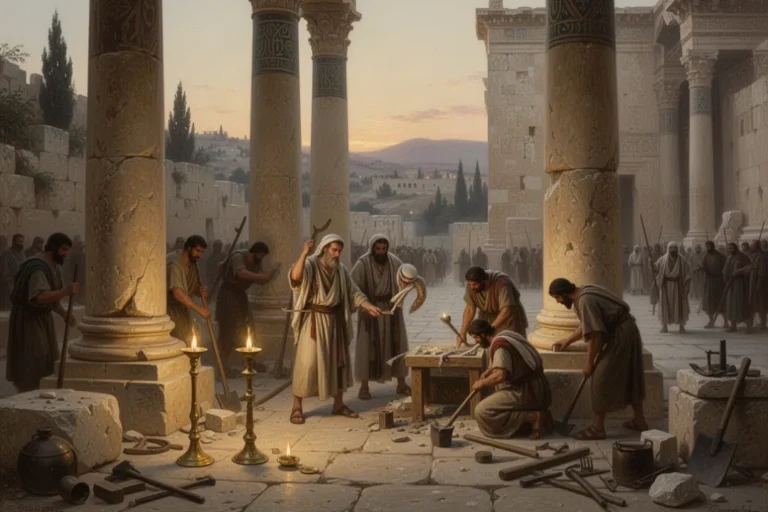
In 164 BCE, Judas and his supporters recaptured Jerusalem and purified the Temple. They removed the foreign altar, repaired parts of the sanctuary, and restored Jewish sacrifices. The rededication lasted eight days and became the foundation of the festival now known as Hanukkah, or the Feast of Dedication.
The festival commemorates the restoration of Jewish worship after the Temple’s desecration. It is associated with the lighting of the menorah, although the familiar explanation about a small supply of oil lasting eight days comes from later rabbinic tradition rather than the earliest Maccabean accounts.
Antiochus did not live to see the full outcome of the revolt. The Temple’s rededication took place near the end of his reign, while the larger political struggle continued for years. The Hasmonean state eventually emerged from the Maccabean movement, but that development followed additional warfare and complex negotiations.
Antiochus was not solely focused on Jerusalem. He pursued an active foreign policy, especially against Egypt, where the Seleucids and the Ptolemies competed for control. He invaded Egypt more than once and achieved significant military success before Rome intervened.
In 168 BCE, Antiochus was near Alexandria when the Roman envoy Gaius Popillius Laenas confronted him. The envoy reportedly required him to decide whether he would withdraw before stepping outside a circle drawn around him in the sand. Antiochus chose to withdraw, demonstrating the growing power of Rome over Hellenistic kings.
The episode became a lasting example of Roman diplomatic authority. It also exposed the limits of Antiochus’s ambitions. He could command armies and influence local governments, but he could not ignore Roman demands without risking a direct conflict with the expanding republic.
After withdrawing from Egypt, Antiochus faced the challenge of maintaining control elsewhere. The policies in Judea may have reflected a desire to secure a strategically important region while restoring royal finances and authority. His attempt produced the opposite result: resistance became more organized, and the Temple crisis gave the rebels a powerful religious and political cause.
How Antiochus died
Antiochus died in 164 BCE during a campaign in the eastern part of his empire. Ancient sources disagree about the exact place and circumstances. Some traditions connect his death with an attempt to plunder or control a temple in Elymais, while others describe a physical illness or divine punishment following his treatment of Jerusalem.
First Maccabees and Second Maccabees present different versions of his final illness and death. Both works interpret his fate in moral and theological terms, linking it to his hostility toward the Jewish people and the Temple. These accounts are valuable evidence for how Antiochus was remembered, but they should not be treated as identical medical reports.
It is safest to say that Antiochus died during an eastern expedition after the Temple had been rededicated. His death did not immediately end the Seleucid presence in Judea, and it did not settle the succession crisis. His successor, Antiochus V Eupator, was still a child, leaving powerful officials to compete for control.
What the Book of Daniel says about Antiochus
Many scholars identify Antiochus IV as the historical figure behind the “little horn” and the hostile king described in parts of Daniel 7–12. Daniel 11 contains a sequence of political conflicts that closely resembles the struggles between the Seleucid and Ptolemaic kingdoms, followed by criticism of a ruler who attacks the holy covenant and interrupts regular sacrifice.
The book presents these events through symbolic visions and a prophetic framework. Its descriptions do not read like a modern biography. The purpose is to encourage people facing persecution by assuring them that arrogant earthly power will be judged and that faithfulness will ultimately prevail.
Daniel’s final chapters are commonly understood by historians as reflecting the crisis under Antiochus, especially the Temple’s desecration and the resistance that followed. Religious readers may also apply the passages to later events or future expectations. Those interpretations differ, but the historical connection to Antiochus is one of the most widely discussed features of the book.
Daniel 11:31, for example, describes the removal of regular sacrifice and the installation of a desolating offense. Rather than reproducing the verse, its central meaning can be stated plainly: a foreign ruler interrupts Temple worship and places an unacceptable cultic object or practice in the sanctuary.
Which sources describe Antiochus
Our knowledge of Antiochus comes from sources with different purposes and perspectives. The most important include 1 Maccabees, 2 Maccabees, parts of Daniel, writings by the Greek historian Polybius, and later authors who preserved accounts of the Seleucid kings.
1 Maccabees offers a political and military narrative of the revolt, the Temple’s desecration, and the rise of the Hasmonean leaders.
2 Maccabees focuses more heavily on martyrdom, divine justice, the Temple, and the religious meaning of resistance.
Daniel uses visions and symbolic prophecy to interpret the persecution and Temple crisis.
Polybius provides an important Greek historical perspective on Hellenistic politics and Antiochus’s reputation.
Inscriptions and coins reveal how Antiochus presented his kingship, religious titles, and authority to the wider empire.
Each source preserves useful evidence, but none gives a completely detached account. The Maccabean books support the rebels, Daniel speaks from a persecuted community’s perspective, and royal materials naturally present the king in favorable terms. Comparing them helps distinguish documented events from interpretation and literary emphasis.
Common mistakes when studying Antiochus Epiphanes IV
The story is often simplified into a conflict between one evil king and one united Jewish population. That version captures the intensity of the persecution but leaves out the political divisions and imperial pressures that shaped the crisis.
Do not confuse Antiochus with Antiochus III. Antiochus III was his father and an earlier Seleucid ruler. Their reigns and military achievements were different.
Do not call him a Roman emperor. Antiochus was a Hellenistic king of the Seleucid Empire, not a ruler of Rome.
Do not assume all Hellenization was forced. Greek language, education, civic institutions, and artistic customs had supporters among some Jewish elites.
Do not treat the revolt as a purely religious dispute. High-priestly appointments, money, royal authority, local factions, and strategic concerns were also involved.
Do not say Antiochus personally carried out every action. Policies were implemented through officials, soldiers, allied local leaders, and competing Jerusalem authorities.
Do not equate the Temple rededication with the end of the war. Fighting and political negotiations continued after Hanukkah’s founding events.
Do not assume every detail of his death is certain. The ancient accounts disagree, especially over the illness, location, and alleged temple attack.
Do not read Daniel as a straightforward modern biography. Its historical references appear through visions, symbols, and theological interpretation.
Why Antiochus still matters in Jewish and Christian history
For Jewish history, Antiochus represents the danger of imperial power invading religious life. His reign also shows that cultural change could produce internal conflict, especially when local elites used a foreign king to compete for office and influence.
The Maccabean victory created a new political order. The Hasmonean family eventually ruled an independent or semi-independent Jewish state for roughly a century, although its leaders later adopted some of the same forms of kingship and expansion associated with Hellenistic monarchies.
For Christian readers, Antiochus matters because he appears in the historical background of Daniel and in the books of the Maccabees, which are part of the Catholic and Orthodox biblical canons and are included in the Apocrypha or Deuterocanonical books in different traditions. The stories of Jewish martyrs also influenced Christian discussions of faithful suffering and resurrection.
He is sometimes described as a prototype of a future persecuting ruler. That association comes from later interpretation of Daniel, not from a simple statement that every later figure is identical to Antiochus. The historical Antiochus was a second-century BCE king whose policies became a model for interpreting later religious persecution.
What his reign reveals about power and resistance
Antiochus’s career illustrates the fragile nature of Hellenistic kingship. A ruler could win battles, control appointments, and collect tribute while still lacking deep loyalty among local communities. Royal authority depended on cooperation from priests, governors, soldiers, urban elites, and subject populations.
His policy in Judea also shows why religious symbols can become political rallying points. The Temple was not merely a building that changed hands. It represented covenant, law, communal identity, and the legitimacy of leadership. Once Antiochus’s government altered its worship, resistance gained a meaning that military taxation alone might not have produced.
The Maccabean movement succeeded partly because it joined several concerns together: defense of Jewish law, opposition to foreign domination, rejection of corrupt appointments, and control of Jerusalem. That combination turned a local crisis into a long-lasting transformation of the region.
Antiochus Epiphanes IV is therefore remembered both as an imperial king and as a warning about the limits of coercion. His attempt to impose order in Judea helped create one of the most durable resistance movements in ancient Jewish history.
Important dates in Antiochus’s reign
175 BCE: Antiochus IV takes the Seleucid throne after the death of Seleucus IV.
169 BCE: Antiochus enters Jerusalem and is associated with the removal of Temple wealth.
168 BCE: Roman intervention forces him to withdraw from Egypt.
167 BCE: Severe decrees against Jewish religious practice and the Temple’s desecration intensify the crisis.
167 BCE: Mattathias and his sons begin the revolt from Modein.
164 BCE: Judas Maccabeus rededicates the Jerusalem Temple, and Antiochus dies during an eastern campaign.
Frequently asked questions
Was Antiochus Epiphanes IV a Greek?
Antiochus was a Hellenistic ruler of the Seleucid dynasty, a royal house founded by Seleucus I after Alexander the Great’s conquests. His dynasty used Greek language and political culture, but the Seleucid Empire ruled many peoples and regions. Calling him simply “Greek” can obscure his identity as a monarch of a multicultural Near Eastern empire.
Did Antiochus destroy the Jerusalem Temple?
Ancient Jewish sources describe Antiochus’s forces as plundering the Temple and later profaning it by introducing worship associated with Zeus Olympios. The building itself was not permanently destroyed during his reign. Judas Maccabeus and the rebels later cleansed and rededicated the sanctuary, an event commemorated by Hanukkah.
Why was Antiochus called Epiphanes?
“Epiphanes” was a royal title meaning something like “manifest” or “appearing,” suggesting divine favor or a ruler’s visible presence. His opponents mocked him with “Epimanes,” meaning “madman.” The contrast shows how royal titles and hostile political labels shaped competing memories of the same king.
Did Antiochus cause the Maccabean revolt by himself?
His decrees and Temple policy were the immediate triggers, but the revolt also grew from local disputes over the high-priesthood, competing views of Hellenistic culture, financial pressure, and resentment of Seleucid interference. The conflict was therefore both a religious crisis and a struggle over political authority in Judea.






Leave a Reply