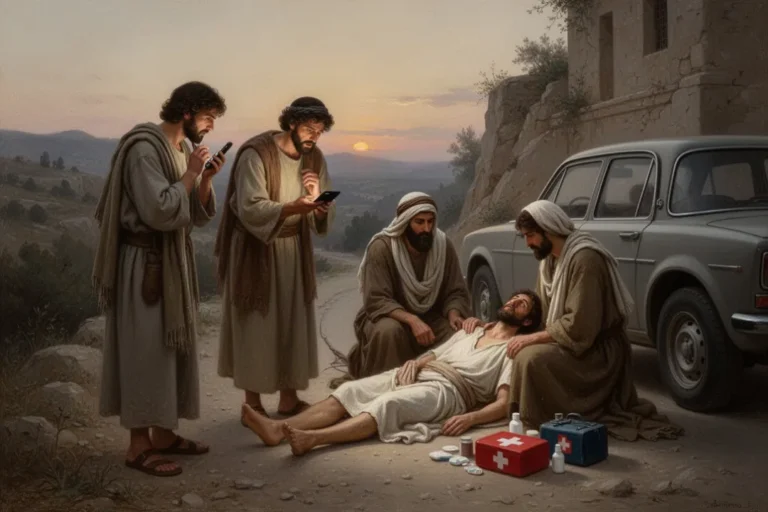
The phrase comes from Jesus’ parable in Luke 10:25–37. A man traveling from Jerusalem to Jericho is attacked, robbed, and left injured beside the road. Several people see him, but a Samaritan—the person least expected to receive praise in the story—stops to provide care.
The Samaritan treats the injured man’s wounds, places him on an animal, takes him to an inn, and pays for his continued care. Jesus uses the story to answer a question about who counts as a neighbor. The answer is not limited to a friend, relative, member of your community, or person who shares your beliefs.
The central point is active compassion. A neighbor is someone whose need you recognize and respond to. The story also challenges prejudice: the person who acts rightly may be someone a listener has been taught to distrust or dismiss.
Core meaning: Being a Good Samaritan means seeing another person’s need, taking reasonable action to help, and treating that person with dignity.
Why the Samaritan’s identity matters
Jews and Samaritans had longstanding religious, cultural, and political tensions. That background makes the parable more challenging than a simple story about one kind stranger helping another. Jesus deliberately makes the outsider the example of moral behavior.
The story does not say that compassion belongs to one group. Instead, it asks you to examine the boundaries you place around responsibility. It is easier to help people you already understand or like. The Good Samaritan shows that human need can create a duty of care even across serious differences.
The priest and Levite who pass by are not described in detail, so readers should be cautious about assigning motives to them. The practical contrast is clear, however: seeing suffering is not the same as responding to it. Compassion becomes meaningful through action.
What the Good Samaritan parable teaches step by step
Notice the person in distress. The Samaritan sees the injured traveler rather than ignoring the scene or treating it as someone else’s problem.
Allow compassion to influence your choices. The story presents concern as something that moves a person to act, not merely an emotion felt from a safe distance.
Provide practical help. The Samaritan offers immediate care and transportation instead of giving only sympathetic words.
Use available resources wisely. He brings the injured man to a place where additional care can be provided.
Accept reasonable cost and inconvenience. He pays for treatment and makes arrangements for the man’s continued recovery.
Protect the person’s dignity. The injured traveler is treated as a human being deserving attention, not as a burden or interruption.
Continue responsibility appropriately. The Samaritan does not pretend to solve every problem alone; he connects the injured man with ongoing care.
This sequence offers a useful pattern for modern situations. You may not be able to fix another person’s entire problem, but you can often take the next safe and constructive step.
How to act like a Good Samaritan in an emergency
Helping someone does not require recklessness. A responsible helper first considers whether the scene is safe enough to approach. Fire, traffic, weapons, exposed electrical wires, violence, hazardous materials, or an unstable structure can turn one emergency into two.
If there is immediate danger, call emergency services and give clear information about the location and hazards. You can help from a safe distance by directing responders, warning approaching people, or asking a specific bystander to call for assistance.
When the scene is reasonably safe, use a simple process:
Assess the situation. Look for immediate threats, the number of people involved, and signs of serious injury.
Call for professional help. In the United States, call 911 when someone is unconscious, having trouble breathing, bleeding severely, experiencing chest pain, or facing another serious emergency.
Identify yourself and ask permission when possible. Say that you want to help. An unconscious person or someone unable to respond may require emergency assistance without express permission.
Follow dispatcher instructions. Put the phone on speaker if practical and answer questions accurately.
Give only the care you know how to provide. Basic first aid or CPR training can help, but guessing or attempting unfamiliar procedures may cause harm.
Stay until help arrives if it is safe. Tell responders what you saw, what happened, and what care was given.
Specific emergencies require different responses. For severe bleeding, apply firm direct pressure with clean cloth or gauze if you can do so safely. For a person who may have a spinal injury, avoid moving them unless leaving them in place creates greater danger. For suspected opioid overdose, call 911 and use naloxone if it is available and you are trained or instructed to do so.
Do not give food, drink, or medication to an injured person unless a medical professional directs you. Do not remove an embedded object, force someone to stand, or move a vehicle-crash victim without a compelling safety reason. These cautions are general; recognized first-aid training is the best way to prepare.
How to help when the need is not an emergency
Good Samaritan behavior is not limited to dramatic rescues. Many opportunities involve quieter forms of care: helping an older neighbor obtain groceries, accompanying someone to an appointment, reporting unsafe conditions, or connecting a person experiencing homelessness with local services.
The most useful help is often specific, respectful, and sustainable. Instead of saying, “Let me know if you need anything,” offer a concrete choice such as, “Would you like me to call a shelter, bring you food, or sit with you while you contact a family member?” This gives the other person control while making support easier to accept.
Offer transportation only if you can do so safely and within your boundaries.
Help someone contact a trusted friend, family member, social worker, or professional service.
Donate useful supplies to an established local organization.
Report suspected abuse, neglect, or immediate danger through the appropriate official channel.
Ask before sharing someone’s situation, photograph, name, or location with others.
Follow through on promises, or clearly explain if your circumstances change.
Respect matters as much as the practical assistance. Do not assume that poverty, disability, addiction, mental illness, or cultural difference tells you what a person wants. Ask what would help, listen to the answer, and avoid turning assistance into a public performance.
What Good Samaritan laws generally do in the United States
Good Samaritan laws are state laws intended to encourage people to provide emergency assistance without automatically facing civil liability for ordinary mistakes. The details differ significantly by state, and some laws apply only to particular situations, such as medical emergencies, opioid overdoses, or use of an automated external defibrillator.
These laws generally do not create a universal license to practice medicine, guarantee immunity, or excuse reckless behavior. Protection may depend on acting in good faith, providing aid without expecting payment, staying within the scope of your training, and avoiding gross negligence or intentional misconduct.
Some states protect certain professionals or trained responders under specific conditions. Other laws address people who call for emergency help during a drug overdose, reducing the risk of prosecution for selected offenses. These provisions vary, so you should check the law in the state where the incident occurs.
Legal caution: Good Samaritan protection is not identical across the United States. For advice about a real incident, consult a qualified attorney and the relevant state statute rather than relying on a general explanation.
When a Good Samaritan law may not protect you
Protection can be limited when a helper acts with recklessness, gross negligence, intentional harm, or misconduct. A person who creates an unreasonable danger or performs a procedure far beyond their training may not receive the same protection as someone who provides ordinary emergency assistance carefully.
Some laws also distinguish between a person who happens upon an emergency and a professional who already has a duty to provide care. A doctor, nurse, lifeguard, teacher, employer, or caregiver may face different responsibilities depending on the circumstances and applicable law.
Payment can matter as well. A statute may protect unpaid emergency help but not services provided in exchange for compensation. Asking for emergency medical assistance or following dispatcher directions is different from advertising a service and charging for treatment at the scene.
Another limitation is that many Good Samaritan laws protect against certain civil claims, not every possible legal consequence. They may not eliminate reporting duties, workplace rules, licensing requirements, or criminal liability for separate misconduct. The exact wording of the law controls.
Does the law require you to help?
In many parts of the United States, an ordinary bystander has no general legal duty to rescue a stranger. That does not mean there can never be a duty. A special relationship, a contract, a professional role, a prior action that worsened the danger, or a state-specific statute may create responsibilities.
Even when the law does not require intervention, the ethical question remains. You can often help without putting yourself in danger by calling 911, finding trained assistance, keeping other people away from hazards, or offering calm support.
Do not confuse choosing not to enter a dangerous scene with indifference. A person who stays on the phone with emergency dispatch and guides responders may be helping more effectively than an untrained person who rushes into traffic or a burning building.
How to balance compassion with personal boundaries
Compassion does not require you to become the only source of support. You can care about someone and still decline unsafe transportation, protect your finances, avoid entering a private residence, or ask professionals to take over. Healthy boundaries make assistance more reliable rather than less compassionate.
Use clear language when a request exceeds what you can do: “I cannot provide a ride, but I can help you contact a transportation service.” If someone is threatening you, step away and call for help. If the person is in immediate danger, contact emergency services even if they refuse other forms of assistance, while recognizing that adults with decision-making capacity generally retain control over their choices.
Be especially careful when helping children, vulnerable adults, or people who may be unable to consent. In those situations, follow emergency procedures and involve appropriate guardians, medical professionals, protective services, or law enforcement as needed.
How communities put the Good Samaritan principle into practice
Individual kindness matters, but communities can make helpful action safer and more effective. Training programs in CPR, first aid, mental-health crisis response, and overdose response give people practical tools before an emergency occurs.
Community groups can also build systems that address recurring needs rather than relying on one person’s generosity. Food banks, shelters, transportation programs, domestic-violence services, mutual-aid networks, disability organizations, and crisis lines can connect people with specialized support.
Useful community preparation includes:
Keeping emergency contacts and local service numbers easy to find.
Learning the location of automated external defibrillators and first-aid kits.
Creating clear procedures for severe weather, workplace injuries, and building emergencies.
Supporting organizations led by or closely connected to the people they serve.
Making assistance accessible to people with mobility, hearing, vision, language, or cognitive needs.
Reviewing privacy practices before collecting or sharing personal information.
This approach reflects the deeper meaning of the parable. The goal is not to appear heroic. It is to reduce suffering in a way that respects the person receiving help and makes responsible action easier for everyone nearby.
The Samaritan provides immediate care and arranges additional help. That is different from claiming unlimited personal responsibility. Calling trained professionals, paying for a necessary service when you can afford it, or making a referral may be the most effective response.
It does not mean ignoring safety
Compassion should be guided by judgment. You are not expected to confront an armed person, enter a collapsing building, or provide medical treatment beyond your ability. Safe assistance can begin with an emergency call and accurate information.
It does not mean helping only people you consider deserving
The parable challenges selective compassion. A person’s choices, status, background, or mistakes do not erase their humanity. At the same time, helping someone does not require approving every choice they have made.
It does not mean public recognition
Recording a rescue, posting private details, or seeking praise can compromise someone’s dignity. If documentation is necessary for safety or evidence, share it with the appropriate authority rather than broadcasting it.
How to remember the Good Samaritan in daily life
Start by paying attention. Notice the person who is struggling to carry a package, seems disoriented in a public place, has fallen, or is being excluded. A simple question—“Are you safe?” or “Would you like help?”—can open the door without taking control away from them.
Then match your response to the need. A minor problem may call for patience or a practical favor. A medical emergency calls for emergency services. A long-term problem may require a trusted organization, professional care, or repeated support rather than one dramatic gesture.
Finally, act with humility. You may not know the entire story, and the person may decline your offer. The Good Samaritan’s example is not a demand to control other people’s lives. It is a reminder to recognize shared human worth and respond responsibly when you can.
Frequently asked questions
What does “Good Samaritan” mean today?
Today, “Good Samaritan” usually describes someone who helps another person in need without expecting a reward. The phrase may refer to emergency aid, everyday kindness, volunteer work, or assistance given across social and cultural differences. It can also describe a person protected under a state’s Good Samaritan law after providing certain kinds of emergency help.
What is the main lesson of the Good Samaritan parable?
The parable teaches that being a neighbor is demonstrated through compassionate action, not defined only by geography, friendship, religion, or social identity. It asks people to respond to suffering with practical care and to challenge prejudice about who is capable of moral behavior.
Can you be sued for helping someone during an emergency?
You may have protection under a state Good Samaritan law, but protection is not automatic or uniform. Laws often address good-faith, unpaid emergency assistance and may exclude reckless or intentionally harmful conduct. The rules vary by state, so legal advice should come from a qualified attorney familiar with the location and circumstances.
What should you do first when you see someone injured?
Check whether the scene is safe, then call 911 or ask a specific person to call. Follow the dispatcher’s instructions, provide only care you know how to give, and avoid moving the injured person unless remaining there is more dangerous. Stay nearby when safe and tell responders exactly what you observed.










Leave a Reply