Ezra was a Jewish priest and scribe who returned from Babylonian exile to Jerusalem and helped rebuild the community around worship and the law of Moses. He appears mainly in the Book of Ezra and is also connected with the public reading of Scripture in Nehemiah 8.
His story takes place after the Babylonian conquest of Jerusalem, when many Jews had lived for decades under foreign rule. Some exiles returned in stages, rebuilt the temple, and re-established life in Jerusalem. Ezra arrived later with a specific mission: to teach God’s law, correct serious violations of the covenant, and strengthen the people’s identity as a worshiping community.
Unlike Zerubbabel, who led an earlier return and supervised the temple’s rebuilding, Ezra was not primarily a construction leader or military governor. His influence came through Scripture, teaching, confession, and reform. The Bible presents him as someone who prepared his heart to study the law, practice it, and teach it to others (Ezra 7:10).
Ezra’s identity as a priest, scribe, and descendant of Aaron
Ezra 7 introduces him as “Ezra son of Seraiah,” followed by a genealogy that traces his priestly line back to Aaron, the brother of Moses. Because Aaron was Israel’s first high priest, this ancestry establishes Ezra’s standing within the priesthood. He was not simply a government official who happened to know religious traditions; he belonged to the family responsible for Israel’s worship.
The title scribe also tells you something important about Ezra’s work. In the biblical setting, a scribe was more than a person who copied documents. A skilled scribe could study, preserve, interpret, and teach written law. Ezra was described as a scribe “skilled in the law of Moses,” meaning that he had a strong command of the covenant instructions given to Israel.
His priestly role and scribal role worked together. As a priest, Ezra represented the community’s worship and covenant responsibilities. As a scribe, he explained how those responsibilities applied to ordinary life. His authority therefore rested on both his lineage and his understanding of God’s law.
The central description of Ezra: Ezra 7:10 presents a three-part pattern for his life: he studied the law, practiced it, and taught it. His teaching carried weight because it was joined to personal obedience.
The Bible does not give a detailed account of Ezra’s childhood, education, or years in Babylon. It also does not identify his mother, wife, or children. What it does emphasize is his preparation and calling. He had developed the knowledge needed to guide a community that had returned from exile but still needed a clear understanding of its religious obligations.
Ezra’s identity should also be distinguished from several other biblical figures with similar names. The name Ezra appears in genealogical and historical lists, but the priestly scribe who led the later reform is the principal Ezra associated with the postexilic period. The Book of Ezra focuses on his mission rather than providing a full biography.
Why Ezra went to Jerusalem after the exile
Ezra traveled from Babylon to Jerusalem during the reign of the Persian king Artaxerxes. The Persian Empire had replaced Babylon as the dominant power in the region, and Persian rulers allowed displaced peoples to return to their ancestral lands and restore local religious institutions. Earlier, King Cyrus had authorized Jewish exiles to return and rebuild the temple, as described in Ezra 1.
Ezra’s mission came after that earlier return. The temple had been rebuilt, but the community still faced spiritual and social problems. Jerusalem needed more than a completed building. The people needed instruction in the law, responsible leadership, and renewed commitment to the covenant that shaped Israel’s identity.
The royal letter in Ezra 7 gives Ezra broad authority. The king permitted him to go to Jerusalem with other Israelites who wanted to return. Ezra was also authorized to investigate conditions in Judah and Jerusalem according to the law of God, and he could appoint judges and teachers to help administer that law.
Although the Persian king’s decree supported Ezra’s work, the biblical account gives credit to God for making the mission possible. Ezra repeatedly describes God’s “good hand” as being over him and the returning group. This language shows how Ezra understood political permission and divine providence together: the Persian government opened the way, but Ezra believed God guided the outcome.
Ezra did not treat the journey as a routine government assignment. Before leaving, he gathered the people near a river and proclaimed a fast. The group asked God for protection because Ezra had told the king that God cared for those who sought him. Ezra was reluctant to request a military escort after speaking so confidently about God’s protection, so the travelers fasted and prayed instead (Ezra 8:21-23).
The returning group carried valuable gifts for the temple, including silver, gold, and other dedicated items. Ezra carefully entrusted these materials to priests and weighed them before the journey and after arriving in Jerusalem. This detail shows his concern for accountability and faithful stewardship, especially when handling resources dedicated to worship.
He gathered the returning community before departure and assessed who was traveling.
He called for fasting and prayer rather than treating the journey as merely political or logistical.
He organized the temple gifts carefully and assigned priests to protect them.
He arrived in Jerusalem and delivered the Persian king’s instructions to the local officials.
Ezra’s journey shows that restoration required both physical return and spiritual reorientation. People could live again in Jerusalem and still fail to understand the obligations of their covenant. Ezra came to address that deeper need.
What Ezra did to restore the community’s spiritual life
Ezra’s most important work was teaching. The biblical narrative portrays him as a person who knew that a restored temple alone could not secure the community’s future. Worship, justice, family life, and public decisions all had to be measured against the law of Moses.
His mission included explaining the law to the people and helping appoint leaders who could teach it. The royal letter specifically authorized Ezra to ensure that those who did not know the law learned it. This was not limited to private study. Ezra’s work affected the entire community, including officials, priests, families, and local leaders.
The crisis over marriages with surrounding peoples became the most dramatic test of his leadership. Ezra learned that some of the people, including priests and leaders, had entered marriages with neighboring groups. The issue was not presented as a general rule against every foreign person. The concern was that these relationships had drawn the community into religious practices and loyalties that threatened Israel’s covenant faithfulness.
When Ezra heard the report, he tore his clothing, pulled hair from his head and beard, and sat in grief. These actions expressed public mourning and distress. He recognized that the community’s behavior was connected to the same kind of disobedience that had contributed to earlier judgment and exile.
Ezra’s prayer in Ezra 9 is a confession on behalf of the people. He acknowledged that God had shown mercy by allowing a remnant to survive and return, yet the community had again violated the law. Rather than blaming only a few individuals, Ezra identified himself with the people and confessed their guilt as part of the nation.
Ezra’s prayer presents restoration as an undeserved mercy that calls for renewed obedience.
The confession moved the community to action. Shecaniah proposed a covenant response, and the leaders investigated the marriages. Ezra then required the returned exiles to separate themselves from practices and relationships considered incompatible with the covenant. The passage in Ezra 10 lists names and describes the process, but it does not provide every personal circumstance behind each marriage.
This episode can be difficult for modern readers. It should not be reduced to a simple ethnic policy or treated as permission for religious hostility. In the setting of Ezra, the concern centered on the survival of Israel’s covenant worship after exile. At the same time, the account describes a painful and disruptive decision with serious effects on families. Reading it responsibly requires attention to the historical setting, the surrounding laws, and the Bible’s broader concern with loyalty to God rather than assumptions about ethnicity.
Ezra’s reform demonstrates several features of his leadership:
He took communal wrongdoing seriously instead of ignoring it because influential people were involved.
He began with grief and confession, not self-congratulation or political triumph.
He involved the community in examining the problem and determining a response.
He treated restoration as ethical change, not merely a return to Jerusalem or a rebuilt temple.
The account does not portray Ezra as a detached scholar. He studied the law, but he also acted when the community’s conduct contradicted it. His example combines careful interpretation with moral responsibility.
How Ezra is connected with Nehemiah 8
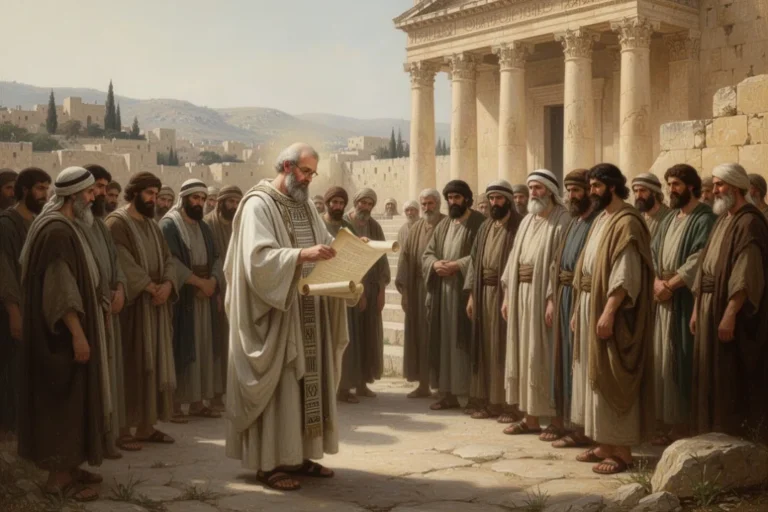
Ezra is prominently associated with the public reading of the law in Nehemiah 8. In that scene, the people gather together at the Water Gate and ask for the Book of the Law of Moses. Ezra brings the book before the assembly and reads from it publicly, while other Levites help the people understand what is being read.
The passage describes a community listening attentively for an extended period. The Levites explain the meaning so the people can understand the reading. This detail is essential: Ezra’s ministry was not simply recitation. It involved making the law comprehensible and showing the people how its words applied to their life together.
The people begin to weep when they hear the law. Nehemiah, Ezra, and the Levites tell them not to remain in mourning because the day is holy. They direct the people to celebrate, share food, and include those who have nothing prepared. The response to Scripture therefore includes both conviction and joyful communal action.
Nehemiah 8 then records the observance of the Festival of Booths. The people discover that the law requires this festival and begin celebrating it according to the instructions. The episode shows how public teaching can lead to specific changes in worship and community practice.
The exact chronology and literary relationship between Ezra and Nehemiah are discussed by biblical scholars. The books overlap in subject matter and include accounts that may not be arranged as a modern continuous biography. Even with those questions, the biblical text clearly presents Ezra as a major teacher of the law during the restoration of Jerusalem.
Ezra’s appearance in Nehemiah 8 adds an important dimension to his character. He was not only a reformer confronting wrongdoing. He was also a teacher who helped people hear difficult words, understand them, and respond in a way that included celebration, generosity, and renewed worship.
What the Book of Ezra teaches about restoration
The Book of Ezra is not a complete biography of Ezra from birth to death. Much of the book concerns the return from exile, the rebuilding of the temple, opposition from local enemies, and the later arrival of Ezra. The first part focuses especially on the leadership of Zerubbabel and the priest Jeshua. Ezra becomes the central human figure in the latter portion.
The book’s structure highlights two related kinds of restoration. The first is the restoration of the temple. The second is the restoration of the people’s obedience to God’s law. A functioning temple mattered deeply, but the narrative does not suggest that a building could replace covenant faithfulness.
Ezra also illustrates how God can work through ordinary institutions and foreign rulers. Persian kings issue decrees, officials enforce or challenge them, priests transport sacred gifts, and local leaders respond to the law. Yet the writer repeatedly directs attention to God’s providence behind these events.
Several themes stand out in Ezra’s story:
God preserves a remnant. The returned community exists because God allows survivors to come back and rebuild.
Restoration requires truth. The people must face their disobedience rather than assume that returning home has solved everything.
Teaching shapes community life. The law must be studied, explained, and practiced rather than merely honored in theory.
Leadership includes humility. Ezra confesses the people’s sin and identifies himself with them instead of presenting himself as morally separate.
Worship and conduct belong together. The temple, festivals, family decisions, and public justice all fall within the community’s covenant responsibilities.
Ezra’s legacy is therefore larger than the question of his job title. He represents the kind of leader who helps a damaged community recover its identity through faithful teaching and disciplined obedience. His authority is not based on charisma or force. It comes from his knowledge of Scripture, his willingness to practice what he teaches, and his readiness to address uncomfortable problems.
For readers studying Ezra today: Read Ezra 7–10 alongside Nehemiah 8. Together, these passages show Ezra preparing to teach, responding to communal sin, and explaining Scripture so that people can put it into practice.
In the Bible’s account, Ezra is a priestly scholar who helped a postexilic Jewish community become more than a group of returned exiles. He helped shape them into a people committed to worship, Scripture, repentance, and covenant life. His story emphasizes that rebuilding a community’s spiritual foundations can be as demanding as rebuilding its city.
Frequently asked questions
Was Ezra a prophet in the Bible?
Ezra is identified primarily as a priest and scribe, not as a prophet. His authority came from his priestly ancestry and his expertise in the law of Moses. He taught and applied Scripture during the restoration period after the exile. The Bible does not give him the formal prophetic designation used for figures such as Isaiah, Jeremiah, or Haggai.
Did Ezra write the Book of Ezra?
The Book of Ezra does not explicitly name its final author. It includes first-person sections in which Ezra describes his actions, especially from Ezra 7 onward, suggesting that material came from Ezra’s own account or memoir. The book also contains lists, official letters, and narrative material about events before Ezra’s arrival.
What was Ezra’s main message?
Ezra’s central message was that returning from exile and rebuilding the temple were not enough by themselves. The people also needed to understand and obey God’s law. His ministry emphasized study, repentance, faithful worship, responsible community life, and separation from practices that threatened Israel’s covenant identity.
How is Ezra different from Nehemiah?
Ezra was primarily a priest, scribe, and teacher of the law, while Nehemiah served as a Persian-appointed governor and led the rebuilding of Jerusalem’s walls. Their work overlapped: Ezra focused more on spiritual instruction and reform, and Nehemiah focused more on civic organization, security, and administration.




Leave a Reply