An evangelical Christian is someone who emphasizes the authority of the Bible, personal faith in Jesus Christ, and the responsibility to share the gospel with others. Evangelical Christianity is not one denomination; it is a broad movement found in many Protestant churches and Christian communities.
The word evangelical comes from a Greek term connected with “good news.” In Christian use, that good news is the message that God offers reconciliation and new life through Jesus Christ. Evangelicals generally believe that people respond to this message through repentance, trust in Christ, and a personal commitment to follow him.
Evangelical Christians share a recognizable set of convictions, although individual churches may differ in worship style, church government, baptism practices, and views on secondary theological questions. The movement is best understood through its central priorities rather than through one universal statement of faith.
Most evangelicals place the following beliefs near the center of Christian faith:
The Bible is authoritative for teaching, spiritual formation, and understanding God’s will.
Jesus Christ is the Son of God, fully involved in God’s saving work and central to Christian faith.
Human beings need salvation because sin separates people from God.
Jesus’ death and resurrection make forgiveness and reconciliation with God possible.
Personal conversion matters; Christian faith is more than cultural identity or church membership.
The Holy Spirit changes believers and gives them strength to live as followers of Christ.
Christians are called to mission, which includes proclaiming the gospel and serving their neighbors.
These convictions are often described using four broad themes: conversionism, the belief that people need a personal turning to Christ; activism, the call to express faith through action; Biblicism, a strong focus on Scripture; and crucicentrism, an emphasis on Christ’s death on the cross. Not every evangelical uses these labels, but they help describe the movement’s common shape.
Central idea: Evangelical Christianity is defined more by shared beliefs and priorities than by one denomination, worship format, or political position.
An evangelical Christian may attend a Baptist, non-denominational, Pentecostal, Methodist, Presbyterian, Anglican, or other Protestant church. Some evangelical churches are highly traditional, while others use contemporary music, informal preaching, small groups, or online services. The variety can make the label seem unclear, but the shared focus remains faith in Christ, the Bible, conversion, and Christian mission.
How evangelical Christians understand salvation
For evangelicals, salvation means being rescued from sin and restored to a right relationship with God. It is understood as God’s gift rather than something a person earns through good deeds, religious ceremonies, moral effort, or charitable work. Good works are considered a response to salvation, not its price.
Evangelical teaching commonly describes salvation through several connected ideas. People are created for relationship with God, yet sin affects human motives, choices, relationships, and the wider world. Because of this separation, people need more than self-improvement. They need forgiveness and spiritual renewal that they cannot provide for themselves.
Jesus’ death on the cross is central to this understanding. Evangelicals generally believe that Christ willingly gave his life to deal with the problem of sin and make reconciliation with God possible. The exact language used to explain the cross varies among churches, but the cross is consistently treated as the decisive act of God’s saving work.
The resurrection of Jesus is equally essential. Evangelical Christians believe that Jesus was raised from the dead and that his resurrection confirms his identity, demonstrates God’s power over death, and provides the foundation for Christian hope. Paul’s discussion in 1 Corinthians 15 is often used to explain why the resurrection is not an optional detail but a foundation of Christian belief.
Evangelicals commonly describe a person’s response to the gospel as repentance and faith. Repentance involves turning away from sin and a life directed without God. Faith involves trusting Jesus Christ rather than relying on personal goodness or religious status. This response is personal, but it is not meant to remain private; it leads to a changed relationship with God and a new way of living.
Many evangelical churches speak of being “born again,” drawing on Jesus’ conversation with Nicodemus in John 3. The phrase refers to spiritual renewal through God’s work, not to physical rebirth. It is often used to describe the moment or process in which someone consciously places faith in Christ and begins a new life as a Christian.
Evangelicals do not all agree on the precise order of salvation or on how God’s sovereignty and human choice relate to each other. Some traditions emphasize God’s initiative in choosing and calling people; others emphasize the human decision to respond to the gospel. Despite these differences, they generally agree that salvation is centered on God’s grace through Jesus Christ.
What changes after conversion?
Conversion is not usually presented as a claim that a Christian becomes instantly perfect. Evangelicals often describe Christian growth as a continuing process called sanctification. Through prayer, Scripture, worship, fellowship, confession, service, and the work of the Holy Spirit, believers are expected to grow in holiness and become more like Christ.
That growth can involve visible changes in behavior, but it also includes changes in motives, priorities, relationships, and responses to suffering. A person may still struggle with sin, doubt, grief, or temptation. Evangelical churches generally teach that ongoing failure should lead to repentance and dependence on God, not to the belief that a Christian must appear flawless.
Common expressions of Christian growth include:
Reading and applying the Bible with humility and care.
Praying regularly and seeking God’s guidance.
Participating in worship and church fellowship.
Practicing forgiveness, generosity, truthfulness, and compassion.
Serving people in need and working for the good of the community.
Sharing Christian beliefs respectfully with people who do not share them.
Why the Bible has such a central role
An evangelical Christian usually regards the Bible as the primary written authority for Christian belief and practice. Evangelicals may differ in how they interpret difficult passages, but they generally expect Scripture to shape preaching, personal discipleship, ethics, worship, and decisions about church life.
This does not mean every evangelical believes that every passage should be read in exactly the same way. Evangelical Bible study often considers the literary genre, historical setting, original audience, surrounding context, and the relationship between individual passages and the Bible’s wider message. Poetry, wisdom literature, prophecy, narrative, letters, and apocalyptic writing require different reading approaches.
Most evangelicals believe the Bible is inspired by God and trustworthy in what it teaches. Different churches explain inspiration in different ways. Some emphasize that the original writings were fully without error; others use broader language about Scripture’s reliability and authority. These distinctions can matter within evangelical discussions, but all mainstream evangelical approaches give Scripture a uniquely important place.
The Bible is not treated merely as a reference book for finding isolated rules. Evangelicals often read it as the story of God’s relationship with humanity, reaching its central point in Jesus Christ. The Old Testament is understood as laying foundations for that story, while the New Testament presents Jesus’ life, teachings, death, resurrection, and the growth of the early church.
Evangelical preaching often aims to connect biblical teaching with everyday life. A sermon may explain a passage, show how it relates to the gospel, and apply it to decisions involving family, work, money, sexuality, justice, forgiveness, suffering, or service. Healthy interpretation seeks to apply Scripture without ignoring its original meaning.
A practical safeguard: A Bible verse should be read in its paragraph, book, and historical context rather than used as a stand-alone slogan to justify a preferred opinion.
Because evangelicals place such weight on Scripture, they often encourage personal Bible reading. Common practices include reading through one book at a time, studying a Gospel such as Mark or John, using a guided devotional, joining a small group, and comparing interpretations with trusted teachers. Personal study is usually encouraged alongside the gathered church rather than as a replacement for it.
How evangelical churches worship and serve
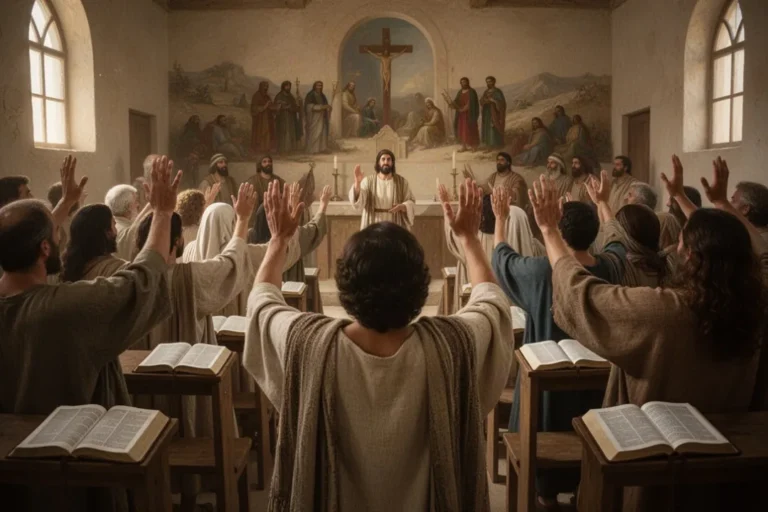
There is no single evangelical worship service. A congregation may meet in a historic sanctuary with hymns, formal prayers, and a lectionary, or in a simple room with contemporary songs, projected lyrics, and an extended sermon. The style can vary greatly while the service still centers on Scripture, prayer, worship, preaching, and Christian community.
A typical evangelical service may include several of these elements:
Congregational singing focused on God and the work of Christ.
Prayer for worshipers, families, churches, leaders, and people facing hardship.
A reading from the Bible and a sermon or teaching message.
Opportunities for confession, reflection, testimony, or response.
Communion, also called the Lord’s Supper, in churches that observe it regularly.
Baptism as a public expression of Christian faith.
Announcements about small groups, service projects, missions, and pastoral care.
Evangelical churches differ over baptism. Many Baptist and non-denominational churches practice believer’s baptism, in which a person is baptized after personally professing faith, often by immersion. Other evangelical denominations baptize infants and also recognize later personal faith. Churches also differ on whether baptism is primarily a public testimony, a means of grace, or both.
Communion also takes different forms. Some churches celebrate it weekly, while others observe it monthly or on another schedule. Evangelical Christians generally see it as a significant practice that remembers Jesus’ death and strengthens the church’s shared identity, though they do not all explain Christ’s presence in the meal in the same way.
Small groups are common because evangelicals usually see Christianity as a shared life rather than an isolated belief system. A group may meet in a home, church building, or online setting to study the Bible, pray, discuss personal challenges, and provide practical support. Accountability and friendship are often important parts of this ministry.
Service is another major expression of evangelical faith. Churches may support food pantries, disaster relief, foster care, refugee assistance, pregnancy support, prison ministry, addiction recovery, housing projects, or international mission work. The methods and priorities vary, but the underlying conviction is that love for God should produce love for neighbors.
Evangelical mission includes both evangelism and practical care. Evangelism means communicating the Christian message and inviting people to consider faith in Jesus. Practical service addresses physical, emotional, and social needs. Many evangelicals believe these should not be separated: Christian words should be accompanied by credible love, and service should not be used as a hidden condition for receiving help.
How evangelical Christianity differs from other Christian traditions
Evangelical Christianity overlaps with many other Christian traditions, so the boundaries are not always simple. A person can be evangelical while belonging to a denomination with a long historical tradition. Conversely, a church may use evangelical language without agreeing with every belief commonly associated with the broader movement.
Compared with some mainline Protestant churches, evangelical churches often place stronger emphasis on personal conversion, biblical authority, evangelism, and the saving significance of Jesus’ death and resurrection. This is a broad comparison, not a rule about every congregation. Many mainline churches also emphasize these themes, while some evangelical churches have adopted historic liturgical practices.
Compared with the Roman Catholic and Eastern Orthodox traditions, evangelical Protestants generally give the Bible a more primary role in relation to church tradition and do not recognize the authority of a pope or Orthodox patriarch. They also commonly understand justification, sacraments, and the church’s structure differently. Yet evangelicals share with Catholics and Orthodox Christians belief in the Trinity, Jesus’ resurrection, and the importance of the historic Christian faith.
Evangelicals also differ among themselves. Baptists may differ from Presbyterians on baptism and church governance. Pentecostal and charismatic evangelicals often place greater emphasis on spiritual gifts, healing, and expressive worship. Reformed evangelicals may stress God’s sovereignty and covenant theology, while Arminian evangelicals may place stronger emphasis on human response and free will.
Some differences are theological, while others concern church practice. Before deciding whether an evangelical church is a good fit, you may want to ask:
What does the church teach about Jesus, salvation, Scripture, baptism, and communion?
How are sermons prepared, and is the Bible handled in context?
How does the church respond to questions, disagreement, and doubt?
What safeguards protect children and vulnerable adults?
How are pastors and other leaders held accountable?
How does the congregation serve people outside its own membership?
Are money, authority, and expectations explained clearly?
These questions help distinguish a healthy church from one that merely uses familiar Christian language. A strong evangelical community should point people toward Christ, teach responsibly, welcome honest questions, and treat people with dignity. It should not demand unquestioning loyalty to a leader or suggest that financial giving guarantees health, success, or spiritual favor.
Evangelical Christians do not form one political bloc. They may share theological beliefs while reaching different conclusions about government, public policy, economics, immigration, war, education, poverty, abortion, race, environmental responsibility, and other issues. The label evangelical describes a religious identity, not a complete political platform.
Some evangelicals are politically conservative, some are politically progressive, and others avoid party identification. Churches may encourage civic participation while warning members not to confuse any political movement with the kingdom of God. Individual evangelical leaders and organizations can make strong political statements, but those statements should not automatically be treated as the belief of every evangelical Christian.
Evangelical approaches to public life often begin with biblical concerns about human dignity, justice, mercy, truth, family, care for the vulnerable, and responsibility toward neighbors. Christians may agree on these broad principles and still disagree about how they should shape laws and institutions. Faithful disagreement is possible, although it requires humility and respect.
A church’s political involvement can be assessed by asking whether it keeps the gospel central, treats people outside the congregation fairly, protects freedom of conscience, and avoids placing partisan loyalty above Christian commitments. Political engagement may be part of Christian responsibility for some believers, but it is not the definition of evangelical faith.
The same principle applies to culture. Evangelicals live in many countries and communities, speak different languages, and have different customs. In the United States, the term often carries political associations that do not apply universally. A person may be deeply evangelical without fitting common media stereotypes about evangelical churches or voters.
At its best, evangelical Christianity calls believers to hold convictions clearly while treating other people as neighbors rather than projects or enemies. That includes people of other religions, people with no religious faith, and Christians from different traditions. Sharing the gospel is meant to involve honesty, compassion, and respect for a person’s freedom to respond.
For someone exploring evangelical Christianity, the most useful starting point is to examine its central claim: that God has acted decisively through Jesus Christ and calls people to respond with faith, repentance, worship, and a life of love. Attend a church, read one of the Gospels carefully, speak with more than one Christian, and ask direct questions about beliefs and practices. A thoughtful exploration should make room for both conviction and careful investigation.
Frequently asked questions
Is evangelical Christianity a denomination?
No. Evangelical Christianity is a broad movement that includes people from many Protestant denominations and independent churches. Baptist, non-denominational, Pentecostal, Presbyterian, Methodist, and Anglican congregations may all be evangelical, although they can differ substantially in worship, baptism, church leadership, and theology. The shared emphasis is usually personal faith in Jesus, biblical authority, conversion, and communicating the gospel.
Do all evangelical Christians agree on politics?
No. Evangelicals hold a wide range of political views. Some identify with conservative parties, some with progressive causes, and some avoid partisan politics. Their shared religious beliefs do not produce one required position on every public issue. Political differences can exist within the same congregation, although churches vary in how openly they discuss politics and how much they participate in public debates.
What is the difference between an evangelical and a born-again Christian?
“Born again” usually describes a person’s experience of spiritual renewal or personal conversion through faith in Jesus. “Evangelical” usually identifies a broader set of beliefs and a Christian movement that emphasizes conversion, Scripture, Christ’s saving work, and evangelism. Many evangelical Christians describe themselves as born again, but the two expressions focus on different aspects of Christian identity.
How can you tell whether an evangelical church is trustworthy?
Look for clear teaching about Jesus and salvation, responsible interpretation of the Bible, transparent finances, accountable leadership, and appropriate safeguards for children and vulnerable people. Notice how the church handles questions, criticism, disagreement, and personal boundaries. Be cautious when leaders demand unquestioning loyalty, promise guaranteed prosperity, isolate members from family, or use fear and shame to control participation.












Leave a Reply