Bible and the Apocrypha: books, history, and meaning
Bible and the Apocrypha: books, history, and meaning
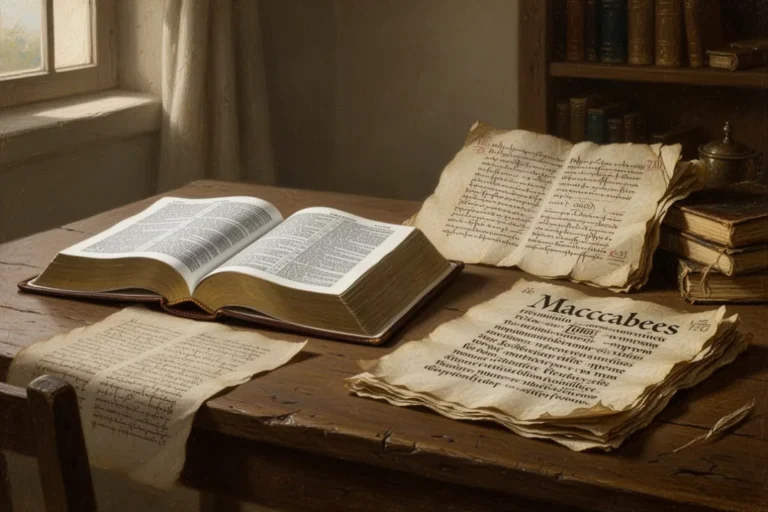
The Apocrypha refers to a group of ancient Jewish and Christian religious writings associated with the Bible but not accepted as Scripture by every tradition. In Catholic and Eastern Orthodox Bibles, many of these books are included as part of the Old Testament; most Protestant Bibles place them in a separate section or omit them.
The term can mean different collections depending on who is using it. In Protestant discussion, “the Apocrypha” usually means books such as Tobit, Judith, Wisdom, Sirach, Baruch, and 1 and 2 Maccabees. Catholic Christians often call these books the deuterocanonical books, while Orthodox churches may accept additional writings beyond the Catholic collection.
The word apocrypha comes from a Greek term associated with things that are hidden or concealed. Over time, English-speaking Christians used it for religious books that were respected by some communities but did not have a universally agreed place in the biblical canon.
That definition is useful, but it can be too broad. The word may describe books included in the Catholic Old Testament, books printed separately in Protestant Bibles, or a much larger group of ancient writings that were never accepted as Scripture by most churches. Context matters whenever someone refers to “the Apocrypha.”
Some related writings are better classified as pseudepigrapha. These are works attributed to biblical figures or other respected ancient people, even though they were generally written later. Examples include 1 Enoch, the Book of Jubilees, and the Testament of the Twelve Patriarchs. They are important for studying ancient Jewish thought, but they are not normally what a Protestant or Catholic reader means by the Apocrypha.
The simplest definition: the Apocrypha is a label for ancient religious books connected with the biblical tradition whose status differs among Jewish and Christian communities.
Which books are usually included in the Apocrypha
The collection most familiar to English-speaking readers contains books that appear in Catholic Bibles but are not included in the Jewish or Protestant Old Testament. Catholic Christians call them deuterocanonical, meaning “second canon,” not “less important.” Their accepted books are commonly listed as follows:
Tobit, a story about faithfulness, family, healing, and divine guidance.
Judith, the account of a courageous Jewish woman who helps save her people.
Greek additions to Esther, which make the story more explicitly religious by adding prayers and references to God.
Wisdom of Solomon, a reflection on wisdom, righteousness, mortality, and the fate of the wicked.
Sirach, also called Ecclesiasticus, a broad collection of practical teaching about character, speech, work, worship, and relationships.
Baruch, which includes confession, encouragement, reflections on wisdom, and a letter attributed to Jeremiah.
Letter of Jeremiah, often treated as part of Baruch, criticizing the worship of idols.
Greek additions to Daniel, including the Prayer of Azariah and the Song of the Three Young Men, Susanna, and Bel and the Dragon.
1 Maccabees, a historical account of the Jewish revolt against Seleucid rule.
2 Maccabees, a theological history of the same general period, emphasizing martyrdom, resurrection, prayer for the dead, and faithfulness under persecution.
Orthodox Bibles generally include these books and may also contain 1 Esdras, the Prayer of Manasseh, Psalm 151, 3 Maccabees, and sometimes 4 Maccabees in an appendix or as a separate accepted work. The exact contents vary among Greek, Russian, Ethiopian, and other Orthodox traditions, so “the Orthodox Apocrypha” does not identify one identical list everywhere.
Some editions also include 2 Esdras, known in some traditions as 4 Ezra. Its final form includes Christian material and is distinct from the books called 1 and 2 Esdras in some English Bibles. Similar names can make the contents of different editions confusing, so check the table of contents and the publisher’s tradition.
Why Catholic Bibles call these books deuterocanonical
The Catholic Church does not generally describe Tobit, Judith, Wisdom, Sirach, Baruch, and Maccabees as nonbiblical. It calls them deuterocanonical because their canonical status was disputed or clarified later than that of books accepted across the Christian tradition. “Deutero” does not mean false, optional, or spiritually inferior.
These books are read in Catholic worship and influence Catholic theology, prayer, and devotional practice. For example, passages from 2 Maccabees are associated with prayer for the dead, while Wisdom is frequently connected with reflection on righteousness, death, and hope. Sirach is valued for its practical moral instruction.
The Catholic Old Testament therefore contains more books than the Protestant Old Testament. The difference is not that Catholics possess a completely different New Testament. The disagreement centers mainly on the boundaries of the Old Testament and on how certain ancient books should be received.
Catholic terminology also helps prevent a common misunderstanding. The “second” in deuterocanonical refers to the history of recognition, not to a lower level of authority. Catholic teaching treats these writings as part of Scripture.
How Jewish and Christian communities received the books
The books of the Apocrypha were written during the centuries between the Old Testament period and the time of Jesus, although their dates and places of composition differ. Most were composed in the later Second Temple period, when Jewish communities lived under Persian, Greek, and Roman influence.
They reflect a world shaped by foreign empires, religious pressure, debates about wisdom and resurrection, and the challenge of preserving Jewish identity. 1 and 2 Maccabees, for example, provide different perspectives on the conflict involving Antiochus IV and the rededication of the Jerusalem temple. These writings help explain the historical and religious setting behind parts of the New Testament era.
Many of the books circulated in Greek, although some appear to have been composed in Hebrew or Aramaic and later translated. Fragments of several works were discovered among the Dead Sea Scrolls, showing that some of this literature was known in Jewish communities before the destruction of the Second Temple.
Ancient Judaism did not operate with one universally defined, bound volume called “the Old Testament” in the same way modern readers often imagine. Different Jewish communities valued different writings, and the process by which biblical collections became fixed took place over time. The later rabbinic Jewish Bible contains the books that Protestants generally call the Old Testament, arranged and counted differently.
Early Christians inherited the Jewish Scriptures through several languages and textual traditions. The Greek translation known as the Septuagint was especially influential among Greek-speaking Jews and Christians. Manuscripts and early Christian lists did not always contain exactly the same collection, so the boundaries of the Old Testament remained a subject of discussion.
How the Apocrypha entered Christian Bibles
The Apocrypha was included in many Greek and Latin biblical manuscripts, although its exact contents varied. Early Christian writers quoted some of these books, referred to them as useful for instruction, or treated them as authoritative. Other writers distinguished them from the books accepted as Scripture.
Jerome, the influential translator associated with the Latin Vulgate, recognized a difference between the Hebrew books and additional Greek writings. Even so, the Latin biblical tradition continued to transmit these additional books. Their presence in manuscripts and church reading practices helped preserve them within Western Christianity.
In the medieval period, Latin Christian Bibles commonly included the books now called deuterocanonical. The boundaries of the biblical canon became a sharper point of disagreement during the Protestant Reformation. Many Protestant leaders gave priority to the books preserved in the Hebrew Jewish canon for the Old Testament and placed the other writings in a separate section.
The 1611 King James Bible, for example, originally included an Apocrypha section between the Old and New Testaments. Later Protestant editions often left it out, partly because of changing publishing practices and partly because many Protestant communities did not regard these books as canonical Scripture.
The Catholic Church formally affirmed its list of biblical books at the Council of Trent in the sixteenth century, responding in part to Reformation-era disputes. The council’s decision confirmed the Catholic reception of the deuterocanonical books as Scripture.
These developments should not be reduced to the claim that one side “added” books and the other “removed” them at a single moment. The history was longer and more complicated. Ancient collections differed, early writers disagreed, and communities gradually clarified which writings they treated as authoritative.
What the Apocryphal books are about
The books are not one kind of literature. They include historical narratives, wisdom teaching, prayers, expansions of earlier biblical stories, and accounts of persecution. Reading them by genre makes their purpose easier to understand.
Tobit and Judith emphasize faithfulness under pressure
Tobit follows an exiled Israelite family dealing with suffering, illness, marriage, and the need to remain faithful away from Jerusalem. The story includes the angel Raphael, a journey, and healing. Its moral teaching highlights almsgiving, burial of the dead, prayer, marital faithfulness, and trust in God’s care.
Judith presents a fictionalized or highly stylized national deliverance story. Judith uses courage, intelligence, prayer, and decisive action to resist an invading army. The book portrays faithfulness not as passive endurance alone but as loyalty expressed through brave action when a community faces destruction.
Wisdom and Sirach teach practical and moral formation
Wisdom of Solomon explores the contrast between righteous and wicked living. It speaks about wisdom as a gift from God, the apparent prosperity of the wicked, and the hope that righteousness is not defeated by death. Its language and ideas influenced later Jewish and Christian reflection.
Sirach resembles the wisdom books of Proverbs and Ecclesiastes. It addresses friendship, speech, money, family life, humility, discipline, worship, and the use of knowledge. The work combines short sayings with longer reflections and often asks the reader to connect reverence for God with everyday conduct.
Maccabees records persecution and Jewish resistance
1 Maccabees offers a relatively detailed historical account of the Hasmonean revolt. It describes the attempt to suppress Jewish religious practice, the resistance led by Mattathias and his sons, and the restoration of worship in the Jerusalem temple. It is especially useful for understanding the political history of the period.
2 Maccabees covers some of the same events but has a different focus. It emphasizes martyrdom, divine judgment, resurrection, angelic help, and the importance of prayer for the dead. The two books should not be treated as duplicate versions of one story; they interpret related events with different aims.
Baruch and the additions to Daniel and Esther expand familiar stories
Baruch speaks in the setting of exile and repentance. Its sections move from confession to encouragement and reflection on wisdom. The Greek additions to Esther add explicit prayer and references to divine deliverance, making religious themes that are less directly stated in the Hebrew form of Esther more visible.
The additions to Daniel include Susanna, a story about false accusation and the exposure of corrupt witnesses, and Bel and the Dragon, which challenges idol worship. The Prayer of Azariah and the Song of the Three Young Men develop the worship and suffering associated with Daniel 3.
How the Apocrypha relates to the New Testament
The New Testament does not introduce the Apocrypha with a simple statement that settles the later debate. New Testament writers clearly knew the broader Jewish world reflected in these books, and there are similarities in language, themes, and ideas. Similarity, however, is not the same as a direct quotation or a formal declaration of canonical status.
Jesus and the New Testament writers lived in a setting where Greek Scriptures, Hebrew traditions, oral teaching, and other Jewish writings circulated together. Themes found in the Apocrypha include resurrection, angels, wisdom, martyrdom, judgment, almsgiving, and hope under persecution. These themes also appear in books accepted by all major Christian traditions.
Some passages in the New Testament resemble wording or ideas in Wisdom of Solomon and 2 Maccabees. Scholars compare these texts to understand the intellectual and religious environment of the first century. The comparison can show that an idea was known in the period without proving that an author regarded the earlier work as inspired Scripture.
There are also important differences. The New Testament does not cite every respected Jewish work as Scripture, and early Christian writers used the terms “quote,” “Scripture,” and “useful reading” in various ways. A careful reader should distinguish among historical influence, thematic parallel, literary allusion, and formal quotation.
Practical tips for reading the Apocrypha responsibly
You do not need to settle every canon question before reading these books. Begin by identifying the edition, its religious tradition, and the notes that explain its textual history. Then read each work according to its genre rather than assuming every passage is intended to function like a legal code or a modern historical report.
Check the collection. See which books your Bible includes and whether it uses names such as deuterocanonical books, Apocrypha, or additional books.
Read the introduction and notes. Pay attention to proposed date, language, audience, authorship, and whether the work is a translation or an addition to an earlier book.
Compare related passages. Read the additions to Esther with Esther and the additions to Daniel alongside Daniel so you can see what has been expanded.
Notice the genre. Treat wisdom sayings, historical narrative, prayer, and heroic storytelling according to their literary purpose.
Separate history from doctrine. A book may preserve valuable historical evidence without resolving every theological question for every tradition.
Use a tradition-appropriate guide. Catholic, Orthodox, Jewish, and Protestant study Bibles may explain the canon differently.
Several common mistakes make the subject harder than it needs to be:
Calling every extra-biblical work “the Apocrypha.” Pseudepigrapha, Gnostic writings, and later Christian legends belong to different categories.
Assuming all churches have the same list. Catholic and Orthodox collections overlap but are not identical, and Protestant editions vary in whether they print the books.
Claiming the books were simply hidden. Their status was debated and transmitted openly through different Jewish and Christian communities.
Using one book to represent the entire collection. Sirach’s wisdom sayings, 1 Maccabees’ history, and Judith’s dramatic narrative have different purposes.
Treating a similar New Testament phrase as proof of canon. Literary influence and canonical authority are related questions, not identical ones.
Reading modern assumptions into ancient stories. Ancient authors used symbolism, stylized speeches, and theological interpretation in ways that may not match modern historical writing.
Helpful reading order: Start with Sirach for practical wisdom, Tobit for narrative, 1 Maccabees for history, Wisdom of Solomon for theology, and the additions to Esther or Daniel alongside the familiar biblical books.
Why the Apocrypha still matters for Bible study
The Apocrypha matters because it fills in part of the historical and religious landscape between the Old and New Testaments. Without 1 and 2 Maccabees, readers may know less about the conflicts that shaped Jewish identity before the time of Jesus. Without Wisdom and Sirach, they may miss important examples of later Jewish wisdom writing.
These books also explain why New Testament themes could feel familiar to first-century Jewish and Christian audiences. Ideas about resurrection, angels, martyrdom, divine wisdom, and faithful endurance were not formed in isolation. The Apocrypha provides evidence of how these subjects were discussed before and around the emergence of Christianity.
For Catholics and Orthodox Christians, these writings are also part of the church’s scriptural life. For many Protestants, they remain valuable for history, theology, and devotional study even without canonical status. A reader can acknowledge those different convictions while still approaching the books with care and respect.
The most useful question is not only whether a particular community places a book inside its canon. Ask what kind of writing it is, when and why it was produced, how ancient communities received it, and what it contributes to understanding Jewish and Christian thought. Those questions make the Apocrypha more than a disputed appendix: they make it an important window into the world from which the Bible emerged.
Frequently asked questions
Is the Apocrypha part of the Bible?
The answer depends on the Christian tradition. Catholic Bibles include the deuterocanonical books as part of the Old Testament. Eastern Orthodox Bibles generally include those books and may include others. Most Protestant Bibles do not treat them as canonical, although some editions print them in a separate section. Jewish Bibles do not include them in the Hebrew Scriptures.
How many books are in the Apocrypha?
There is no single universal number because the collection varies. The most familiar Protestant Apocrypha contains fourteen writings, including additions to Esther and Daniel, while Catholic Bibles contain the corresponding deuterocanonical material as part of the Old Testament. Orthodox traditions may include additional books such as 3 Maccabees, Psalm 151, or 1 Esdras.
Did Jesus quote from the Apocrypha?
The New Testament reflects themes and language also found in books such as Wisdom of Solomon and 2 Maccabees, but it does not provide a simple, universally accepted statement that Jesus formally endorsed the whole collection as Scripture. Similar ideas may reflect a shared Jewish religious environment rather than direct quotation or agreement about the canon.
What is the best Apocrypha book to read first?
Sirach is a good starting point if you want practical wisdom about speech, friendship, family, work, and character. Tobit offers an accessible narrative involving family, travel, prayer, and healing. If you want historical background, begin with 1 Maccabees; if you want reflections on suffering and resurrection, read 2 Maccabees.



Leave a Reply