Athenian Areopagus: history, meaning, and Paul’s speech
Athenian Areopagus: history, meaning, and Paul’s speech
The Athenian Areopagus was both a rocky hill beside the Acropolis and one of Athens’ most influential ancient councils. In the New Testament, it is the place associated with Paul’s speech to the Athenians in Acts 17, although scholars debate whether “the Areopagus” means the hill itself, the council, or both.
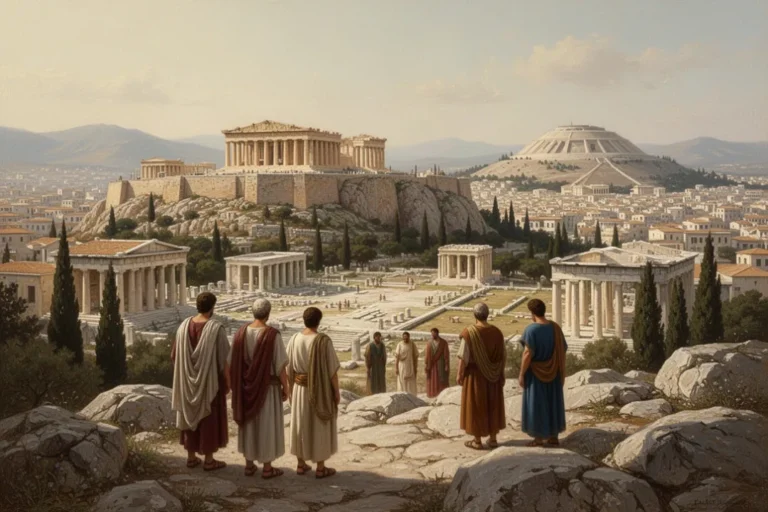
The hill is also called Mars Hill, an English name derived from the Roman identification of the Greek war god Ares with Mars. Today, visitors can stand on the exposed rock northwest of the Acropolis and look across the ancient Agora, the Pnyx, and much of central Athens.
The name Areopagus comes from the Greek expression meaning “Hill of Ares.” The word could refer to the physical height in Athens or to the governing body that met there. This double meaning explains why ancient and biblical references can sound ambiguous to modern readers.
The hill rises near the Acropolis, between the sacred rock and the ancient Agora. It is not a large mountain but a compact, exposed outcrop of gray stone. Its position made it a natural meeting place: it stood close to the religious and political center of the city while remaining distinct from the main civic spaces below.
The Council of the Areopagus was made up of former archons, the senior magistrates of Athens. Membership was generally connected with having completed service as an archon, so the council represented an older political elite. Its members were known as Areopagites.
In earlier periods, the council had broad authority over public affairs. It could supervise conduct, investigate serious matters, and exercise influence over magistrates and civic order. Its power reflected the conservative structure of early Athenian government, before later democratic reforms transferred many responsibilities to broader citizen institutions.
The Areopagus was not identical to the Assembly of Athens. The Assembly included eligible male citizens who gathered to debate and vote on major matters. The Areopagus was a smaller council with a more restricted membership and a different historical role. Confusing these bodies can make descriptions of Athenian government misleading.
The hill also carried a strong religious and mythological association. In Greek mythology, Ares was said to have been tried there by the gods after killing Poseidon’s son. The story helped explain the hill’s name and connected the site with questions of justice, violence, and divine judgment.
Two meanings to remember: “Areopagus” can mean the rocky hill in Athens, the council connected with that hill, or the setting associated with both. The surrounding context determines which meaning is intended.
How the Areopagus council changed under Athenian democracy
The history of the Areopagus reflects the larger development of Athenian democracy. In the early city-state, the council had substantial power because its members were drawn from former archons and represented established authority. Over time, reformers challenged that concentration of influence.
A major turning point came in the fifth century BCE, when Ephialtes led reforms that reduced the council’s political authority. These changes transferred important responsibilities to the Assembly, the Council of Five Hundred, and popular courts. The exact process was shaped by political conflict, but the broad result was clear: the Areopagus no longer controlled as much of Athens’ government as it once had.
The council did not disappear. It retained respected responsibilities, especially those related to homicide cases, certain religious matters, and offenses involving sacred places or practices. Its continued role gave it legal and moral importance even after its wider political authority had been curtailed.
Ancient Athens used several kinds of courts, and jurisdiction depended on the nature of the alleged offense. The Areopagus was particularly associated with deliberate homicide and related forms of bloodshed. Other courts dealt with different categories of cases, including disputes involving foreigners, property, or less serious offenses.
The council’s association with homicide had a symbolic dimension as well as a legal one. The mythic story of Ares and the site’s connection with divine judgment made the hill an appropriate setting for the city’s most serious cases. It represented the idea that violence could not be treated as merely private retaliation.
Its authority also carried an element of moral oversight. Ancient sources portray the Areopagus as a body concerned with public behavior and civic stability, although its precise powers changed across periods. It should not be imagined as a modern supreme court with a fixed constitution and completely stable jurisdiction.
The council’s prestige lasted beyond the period when Athens was at the height of its democratic experiment. Roman-era Athens still valued the Areopagus as an ancient institution. This later reputation helps explain why the name remained meaningful when Luke described Paul’s visit to the city in Acts.
Early period: the Areopagus had broad political influence and represented the authority of former archons.
After democratic reforms: much of its political power moved to popular institutions.
Continuing role: the council remained connected with homicide, religion, and civic morality.
Roman period: its name still carried institutional prestige in Athens.
What happened at the Areopagus in Acts 17
Acts 17 describes Paul arriving in Athens during his missionary travels. The city’s many shrines and images troubled him, and he reasoned with people in the synagogue, in the marketplace, and with those he encountered in public life. Some philosophers became interested in his message and brought him to the Areopagus.
The passage presents Paul speaking before Athenians who wanted to understand his teaching about Jesus and the resurrection. Luke describes the audience as including Epicurean and Stoic philosophers, two major schools of thought in the Hellenistic and Roman world. They did not share one unified religious position, so the gathering should not be treated as a single-minded jury.
Paul began by referring to Athens’ religious practice and to an altar dedicated “to an unknown god,” as described in Acts 17. Rather than repeating the biblical wording, the central idea is that Paul used this altar as a starting point for presenting the God whom the Athenians worshiped without fully knowing.
He then argued that the creator of heaven and earth does not live in temples built by human hands and does not depend on human service. According to the speech, God gives life and breath to all people, governs human history, and is not confined to crafted images made from precious metals or stone.
Paul also connected his message with ideas familiar to his listeners. Acts 17 includes a reference to Greek poetic language about humanity’s relationship to God. Paul’s approach was therefore both distinctly Christian and responsive to the intellectual world of Athens.
The speech reaches its sharpest point when Paul speaks of resurrection. Some listeners mocked the idea, while others wanted to hear more. Acts names Dionysius, a member of the Areopagus, and a woman named Damaris among those who responded positively, along with other people.
The biblical account does not say that the entire council converted, nor does it describe a formal trial. It shows a public exchange in which Paul explained his beliefs to a mixed audience. The response was divided, which fits the broader pattern of public preaching in Acts.
Acts 17 presents Paul addressing an audience shaped by Athenian religion and philosophy, then directing the discussion toward the God who created humanity and raised Jesus from the dead.
Was Paul speaking on the hill or before the council?
The Greek wording in Acts 17 has led to more than one interpretation. “Areopagus” could identify the place where Paul spoke, the governing council itself, or an official group associated with the council. The text does not provide enough detail to settle the question with complete certainty.
Some readers understand the scene as a formal appearance before the Council of the Areopagus. Dionysius is called an Areopagite, which may indicate that he belonged to the council. Others think Paul was taken to the hill or to a public meeting place connected with it, where interested Athenians could question him.
These interpretations are not necessarily mutually exclusive. A gathering could have occurred in a setting associated with the Areopagus and included at least some members or representatives of the council. The important point is that Paul was brought into a serious public conversation rather than simply passing through the city unnoticed.
Why Paul’s speech mattered to its Athenian audience
Paul’s speech is significant because it shows him presenting Christian belief in a setting shaped by Greek philosophy, civic religion, and artistic culture. He did not begin by assuming that his listeners already accepted the Hebrew Scriptures. Instead, he started with observations about their religious practices and moved toward claims about creation, human dependence, and judgment.
His criticism of idols addressed a central feature of ancient Athens. Temples, statues, shrines, and public sacrifices were woven into civic life. Religion was not merely a private set of opinions; it helped define the city’s identity and its relationship with the gods.
At the same time, Paul’s words were not a simple endorsement of Stoicism or Epicureanism. The Stoics emphasized reason and the ordering of the universe, while Epicureans generally sought freedom from fear and disturbance through a particular understanding of the gods and nature. Paul’s message overlapped with some concerns of both schools but rejected important parts of each worldview.
The speech emphasizes that God is not an impersonal principle contained within the cosmos. God is presented as the creator who gives life, establishes human history, calls people to repentance, and will judge the world through a chosen man whom he raised from the dead.
This combination of common ground and disagreement helps explain the mixed response. Paul used language his listeners could recognize, but he led them toward claims that challenged their religious assumptions. The resurrection in particular demanded more than philosophical reflection; it called for a decision about a historical and theological claim.
Acts 17 also offers a window into how Christianity entered cities with sophisticated intellectual traditions. Athens was not portrayed as an ignorant place waiting for information. It was a city with established schools, religious customs, cultural prestige, and strong habits of debate. Paul’s speech addressed that setting directly.
For readers studying the New Testament, the passage raises several useful questions:
How can a speaker explain unfamiliar beliefs using concepts an audience already understands?
Where should shared ideas give way to clear disagreement?
How do public religion, philosophy, and civic identity shape a conversation about faith?
What does a mixed response reveal about the audience rather than only the speaker?
What visitors can see at the Areopagus today
The modern Areopagus is an exposed limestone outcrop near the Acropolis in central Athens. A short climb by metal stairs leads onto the rock, although the surface itself can be uneven and slippery. The site has no large surviving council chamber that allows visitors to reconstruct the ancient meeting place in detail.
From the top, you can look toward the Acropolis and Parthenon, the ancient Agora, the hill of the Pnyx, and the densely built neighborhoods of modern Athens. The view helps explain the Areopagus’ location within the city: it stood close to the major religious and political landmarks rather than in an isolated area.
The hill is near several important archaeological sites. The Agora below was the center of commercial, civic, and social activity. The Pnyx was associated with meetings of the Athenian Assembly. Seeing these places in relation to one another makes it easier to understand the difference between the Areopagus council and the institutions of popular democracy.
The physical setting also explains why “Mars Hill” became a familiar Christian name. The biblical association has made the rock a destination for visitors interested in Paul’s speech, early Christian history, and the relationship between Christianity and the classical world.
Modern visitors should treat the rock as a genuine safety concern rather than a conventional paved viewpoint. Smooth stone can become especially hazardous after rain, and the metal steps may be steep. Practical precautions include:
Wear shoes with secure soles rather than smooth dress shoes.
Use the railings on the stairs and avoid climbing over barriers.
Allow more time if you want to connect the hill with the Agora and Pnyx.
Check current access conditions, since archaeological sites and paths can change.
Visit with care in strong heat, when the exposed rock offers little shade.
For a meaningful visit: read Acts 17 before arriving, then identify the Agora, Acropolis, and Pnyx from the hill. The surrounding landscape makes the political and religious context clearer than the rock alone can do.
How to understand the Areopagus without mixing history and tradition
The Athenian Areopagus carries several layers of meaning: a mythological hill, an ancient legal council, a symbol of civic authority, and the setting of a famous Christian speech. Each layer is genuine, but they belong to different periods and types of evidence.
The myth of Ares belongs to Greek religious tradition. The council’s legal and political history comes from ancient accounts of Athenian government. The details of Paul’s visit come from Acts 17. Modern Christian references to “Mars Hill” often combine these biblical and geographic associations with later preaching and educational traditions.
It is also useful to avoid assuming that Paul delivered a courtroom defense in the modern sense. Acts does not present a full legal indictment or a detailed verdict. The scene is better understood as a public intellectual and religious encounter, possibly involving the council or people associated with it.
Nor should the hill be confused with every important event in classical Athens. Socrates was tried by an Athenian jury in a separate legal setting, not simply “at Mars Hill” because both stories involve Athens and questions of belief. The Areopagus had its own institutional history and jurisdiction.
The most reliable way to read the site is to keep the physical and institutional meanings together while still distinguishing them. The rock gave the council its name and symbolic setting, but the council was a body of people whose powers changed over time.
That distinction makes the site more, not less, interesting. The hill lets you see how place, law, religion, philosophy, and memory can accumulate around one location. Whether you approach it as a traveler, a student of ancient Athens, or a reader of Acts, the Areopagus is best understood as both a real place and a changing institution.
Frequently asked questions
Is the Areopagus the same as Mars Hill?
Yes. “Mars Hill” is the common English name for the rocky hill called the Areopagus in Athens. The name reflects the Roman identification of the Greek god Ares with Mars. In biblical discussions, “Mars Hill” can also refer more broadly to the setting where Paul addressed people connected with the Areopagus.
Did Paul speak to the entire Areopagus council?
Acts 17 does not clearly identify every person in the audience or describe a formal session of the full council. “Areopagus” may refer to the hill, the council, or a gathering associated with it. Dionysius is identified as an Areopagite, but the passage does not claim that the whole council accepted Paul’s message.
Can you visit the Athenian Areopagus today?
Yes. The rock is located near the Acropolis and ancient Agora in central Athens. Visitors reach it by stairs and can view major landmarks across the city. The surface is uneven and can be slick, so sturdy footwear and caution are advisable, particularly in wet weather or intense heat.
What is the main message of Paul’s Areopagus speech?
Paul argues that the creator God is not confined to temples or images and that all people depend on God for life. He connects this claim with human responsibility, future judgment, and Jesus’ resurrection. His audience responds in different ways: some reject the message, while others want to hear more or believe.





Leave a Reply