Antioch in the Bible: Two Cities and Their Stories
Antioch in the Bible: Two Cities and Their Stories
Antioch in the Bible refers to two different cities: Syrian Antioch, a major center of the early Christian movement, and Pisidian Antioch, a city visited by Paul and Barnabas during their missionary travels. They were separate places in different regions, and confusing them can make several passages in Acts difficult to understand.
Syrian Antioch was where Jesus’ followers were first called Christians, where a diverse church sent Paul and Barnabas into missionary work, and where an important dispute about Gentile believers was addressed. Pisidian Antioch was known especially for Paul’s preaching in the synagogue and the opposition that followed it.
The name Antioch appears in several New Testament settings. The surrounding details usually identify which city is meant. Syrian Antioch was north of Jerusalem in the Roman province of Syria, near the Orontes River. Pisidian Antioch was farther west in Asia Minor, in the region associated with Pisidia.
Acts 6:5: Nicolaus, one of the seven appointed in Jerusalem, is described as a proselyte from Antioch. This most likely means the prominent Syrian city.
Acts 11:19-30: Believers from Jerusalem and other places preached in Antioch, a large mixed congregation formed, and Barnabas brought Saul there. This is Syrian Antioch.
Acts 13:1-3: Teachers and prophets in the Antioch church prayed, fasted, and sent Barnabas and Saul on a mission. This is Syrian Antioch.
Acts 13:14-52: Paul and Barnabas entered a synagogue in Antioch of Pisidia and preached about Jesus. This is Pisidian Antioch.
Acts 14:19-28: After persecution in the region, Paul and Barnabas returned to Pisidian Antioch before traveling back through other churches.
Acts 15:22-35: Paul, Barnabas, and other leaders returned to Syrian Antioch after the Jerusalem Council.
Galatians 2:11-14: Paul describes confronting Peter at Antioch over conduct that separated Jewish and Gentile believers. The setting is Syrian Antioch.
Quick distinction: When Antioch is connected with the church that sent missionaries, the debate over Gentile believers, or the name “Christian,” it means Syrian Antioch. When it appears in Paul’s first missionary journey in Acts 13, it generally means Pisidian Antioch.
How to identify Antioch in the Bible step by step
A simple reading process can help you determine which Antioch a passage describes. The city’s location is often implied by the people traveling, the route being followed, or the events taking place nearby.
Check the immediate chapter. Acts 11 and Acts 13 describe different stages of Christian expansion, so the Antioch in one chapter may not be the Antioch in another.
Look for nearby places. A passage mentioning Syria, Jerusalem, or the church that sent Paul points toward Syrian Antioch. A passage describing travel through Asia Minor points toward Pisidian Antioch.
Notice the church’s role. Syrian Antioch acts as a sending and teaching center. Pisidian Antioch is mainly a destination where Paul and Barnabas preach.
Track the travelers. Paul and Barnabas leave Syrian Antioch in Acts 13, visit Pisidian Antioch, and later return to the Syrian church.
Separate biblical events from later tradition. The New Testament gives direct information about both cities, while later Christian history may add details that are not stated in Scripture.
This distinction matters because the two cities represent different kinds of scenes. Syrian Antioch shows a local church developing an outward mission, while Pisidian Antioch shows the reception and rejection of the gospel during Paul’s travels.
Why Syrian Antioch became important to the early church
Syrian Antioch became one of the most influential Christian communities outside Jerusalem. Acts presents the city as a place where believers from different Jewish and non-Jewish backgrounds came together to hear the message about Jesus. The church’s growth was connected to believers who had been scattered after persecution following Stephen’s death.
At first, some scattered disciples spoke mainly to Jews. Others, however, began announcing the good news to Greek-speaking people in Antioch. Acts says that the Lord’s hand was with them and that many believed. The report reached the Jerusalem church, which sent Barnabas to investigate and encourage the new community.
Barnabas was a fitting choice for this work. Acts portrays him as an encouraging and generous leader, and he recognized that the Antioch church needed substantial teaching. He then went to Tarsus to find Saul, later known as Paul, and brought him to Antioch.
For a significant period, Barnabas and Saul taught the church there. This detail shows that Antioch was not merely a stopping point for travelers. It was a place where a growing congregation received sustained instruction, developed leadership, and became prepared for wider service.
Acts describes the disciples being called Christians first at Antioch.
The name “Christian” appears in the New Testament only a few times, including Acts 11:26, Acts 26:28, and 1 Peter 4:16. Acts does not explain exactly who first applied the label or how it was intended. The passage does make Antioch the first location explicitly associated with the name.
What the church at Syrian Antioch reveals about Christian community
The Antioch church was notable for its cultural and ethnic diversity. Acts 13 names several leaders connected with the congregation, including Barnabas, Simeon called Niger, Lucius of Cyrene, Manaen, and Saul. The list reflects people with different backgrounds, experiences, and relationships to the wider Roman world.
The city itself was a major urban center, which helps explain why the church could become a meeting point for people from many places. A congregation in such a setting would encounter different languages, customs, social positions, and religious histories. Acts presents the church’s diversity as part of its life rather than as an obstacle that prevented ministry.
The leaders are described as worshiping the Lord and fasting when the Holy Spirit directed them to set apart Barnabas and Saul. The church responded with prayer, fasting, laying on of hands, and sending. These actions show that missionary work came from the gathered church rather than from two men acting independently.
Teaching: Barnabas and Saul helped establish believers in the faith.
Worship: The leaders ministered to the Lord and sought God’s direction.
Discernment: The church recognized a specific calling for Barnabas and Saul.
Commissioning: The congregation publicly supported the missionaries before they left.
Partnership: The church remained connected to the mission after the travelers departed.
Syrian Antioch therefore illustrates a church that was both rooted and outward-looking. It invested in formation within the congregation while also accepting responsibility for ministry beyond its own city.
How Syrian Antioch supported relief for believers in Judea
Acts 11 also describes a prophet named Agabus announcing that a severe famine would spread across the Roman world. The disciples in Antioch responded by deciding to send relief to believers living in Judea. They contributed according to their ability and sent the gift through Barnabas and Saul to the elders.
This account connects Antioch with practical generosity across geographic and cultural boundaries. The church did not treat teaching and evangelism as separate from care for people facing hardship. Its response was organized, proportional, and directed through trusted representatives.
The passage also shows the relationship between Syrian Antioch and Jerusalem. Antioch was not presented as replacing the Jerusalem church. Instead, the two communities remained connected through shared faith, leaders, financial support, and communication.
Practical lesson: The Antioch church responded to a distant need by combining compassion with responsible action. It gathered support, entrusted it to recognized leaders, and delivered it to the people who needed help.
Why Antioch became a base for Paul’s missionary work
After the Holy Spirit directed the church to set apart Barnabas and Saul, the two men traveled from Syrian Antioch to Cyprus and then into parts of Asia Minor. This journey is commonly called Paul’s first missionary journey, although Barnabas was a central leader during much of it.
The mission moved through synagogues, public spaces, and local communities. Paul and Barnabas announced the message about Jesus, reasoned from the Jewish Scriptures, and spoke to Gentiles who were interested in the God of Israel. Their work led to belief, opposition, debate, and the formation of new groups of disciples.
Syrian Antioch continued to function as a home church. When the missionaries completed their first journey, they returned there and reported what God had done through them. Acts emphasizes that God had opened a door of faith to the Gentiles. The report was received by the congregation, not kept as a private account between the missionaries and a few leaders.
Later, a dispute arose when some visitors taught that Gentile believers needed to follow circumcision and the Law of Moses in order to be saved. Paul and Barnabas strongly opposed this teaching, and the church in Antioch sent them to Jerusalem to discuss the matter with the apostles and elders.
What the Antioch controversy teaches about Gentile believers
The dispute connected with Antioch was not a minor disagreement about personal preference. It concerned the basis of salvation and membership in the people of God. If Gentile believers had to become Jewish proselytes in a full ritual and legal sense, the gospel’s reach and the unity of the churches would be affected.
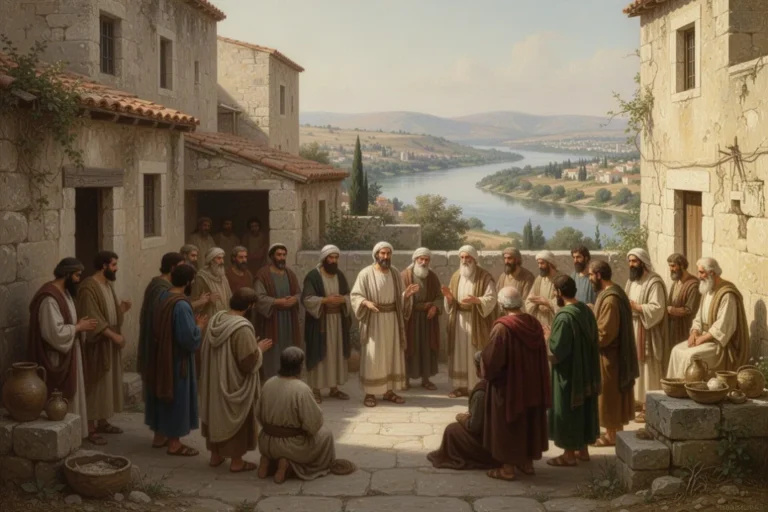
Acts 15 records the meeting commonly called the Jerusalem Council. The leaders considered testimony from Peter, Paul, Barnabas, and James. The resulting letter told Gentile believers that they were not required to receive circumcision as a condition of salvation. It also gave several instructions concerning practices closely connected with idolatry, sexual immorality, and the handling of blood.
Judas Barsabbas and Silas accompanied Paul and Barnabas back to Antioch. They read the letter to the congregation and encouraged the believers. The church received the decision with joy, showing that a difficult doctrinal conflict could be addressed through testimony, Scripture, spiritual discernment, and a formal message to the churches.
Antioch’s role in this conflict is significant because the issue arose in a mixed congregation where Jewish and Gentile believers worshiped together. The city became a real-life setting in which the church had to work out what unity in Christ meant.
What happened when Paul confronted Peter at Antioch?
Paul’s letter to the Galatians describes another event in Syrian Antioch. Peter had been eating with Gentile believers, but when certain people associated with James arrived, he withdrew and separated himself. Other Jewish believers, including Barnabas, followed his example.
Paul opposed Peter publicly because the behavior communicated that Gentile believers were not fully accepted unless they adopted Jewish practices. The problem was not simply that one meal had been missed. Paul saw the separation as a denial of the truth that people are made right with God through faith in Christ rather than through works of the law.
This passage gives a more tense picture of Antioch than Acts 11 or Acts 13. The church could be a center of mission and still experience serious conflict over identity, table fellowship, and religious practice. Its leaders were not beyond correction, and its unity required more than a shared confession in theory.
The confrontation also shows how food and fellowship carried social meaning in the first-century world. Eating together communicated acceptance. Refusing to share a table could create a visible boundary between groups. Paul’s concern was that the church’s behavior should match its confession about the equal standing of Jewish and Gentile believers in Christ.
What happened at Pisidian Antioch?
Pisidian Antioch appears primarily in Acts 13 and Acts 14. Paul and Barnabas arrived there after traveling through Cyprus and parts of southern Asia Minor. On the Sabbath, they entered the synagogue and were invited to speak a word of exhortation to the people.
Paul’s sermon reviewed important moments in Israel’s history, including God’s choice of Israel, the exodus, the period of the judges, the kingdom of David, and the promise connected with David’s line. He then announced that God had fulfilled the promise through Jesus, whose death and resurrection formed the center of the message.
Paul’s speech connected Jesus with the Scriptures his listeners already knew. He argued that the resurrection confirmed Jesus’ identity and that forgiveness and justification were proclaimed through him. The sermon was addressed first to the Jewish community and to Gentiles who worshiped the God of Israel.
Many people wanted to hear more. On the next Sabbath, a large crowd gathered, including many Gentiles. Some Jewish leaders became jealous when they saw the size of the crowd and opposed Paul’s message. Paul and Barnabas then declared that the message had been spoken first to the Jews, but that opposition led them to turn more openly toward the Gentiles.
The passage presents both positive response and determined resistance. Some believed and continued with Paul and Barnabas. Others stirred up influential people and drove the missionaries from the region. The disciples, however, are described as continuing with joy and the Holy Spirit.
How Pisidian Antioch fits into Paul’s missionary route
Pisidian Antioch was not the same city as Syrian Antioch, even though both carried the name Antioch. The name came from the Seleucid ruler Antiochus, and several ancient cities were named Antioch. Biblical readers should therefore pay attention to the regional setting rather than assume every reference points to the same place.
From Pisidian Antioch, Paul and Barnabas went to Iconium. Later, after opposition in that region, Paul was stoned at Lystra and left for dead. The missionaries then returned through the area, strengthening the disciples and appointing elders in the churches before traveling back toward the coast.
Acts 14 says they passed through Pisidian Antioch on the return portion of the journey. They then traveled to Perga and down to Attalia before sailing back to Syrian Antioch, where they had originally been commended to God’s grace for the work they had completed.
This travel pattern makes the distinction clear: Syrian Antioch was the sending church, and Pisidian Antioch was one of the mission field locations. The two cities were connected by Paul and Barnabas’ work, but they served different roles in the narrative.
What Antioch means for reading Acts and Galatians
Antioch helps readers see how the early Christian movement expanded beyond its original center in Jerusalem. The gospel moved through networks of synagogues, households, cities, trade routes, and local congregations. The growth was not presented as effortless. It involved persecution, internal disagreements, doctrinal debates, leadership decisions, and repeated travel.
The two Antiochs also show that Christian mission had both local and transregional dimensions. In Syrian Antioch, believers built a diverse congregation and sent workers outward. In Pisidian Antioch, those workers entered an established city, explained the message in a Jewish setting, and faced a range of responses.
Several themes become clearer when the Antioch passages are read together:
The gospel crossed cultural boundaries. Gentiles were welcomed into the community of believers without becoming Jewish proselytes.
Teaching was central to church growth. New believers needed sustained instruction, not only an initial public response.
Mission involved the whole church. Antioch prayed, fasted, commissioned workers, received reports, and supported wider ministry.
Opposition was expected. Both the message and the messengers faced resistance in different forms.
Unity required honesty. The confrontation between Paul and Peter shows that behavior could contradict the gospel and needed correction.
Churches remained connected. Antioch communicated with Jerusalem and participated in financial, doctrinal, and missionary relationships.
What happened to the Antiochs after the New Testament period?
The New Testament focuses on what God was doing through these cities rather than providing a complete history of either one. Syrian Antioch continued to be an important city in early Christian history for centuries, and later tradition associates it with major teachers and church leaders. Pisidian Antioch also continued as an ancient settlement, though its location and remains belong to the history of Asia Minor.
Later historical developments should be kept separate from the biblical accounts. Scripture gives direct information about the churches, travelers, sermons, conflicts, and decisions connected with Antioch. Archaeology and later Christian writings may help explain the broader setting, but they should not be treated as if every later tradition were stated in Acts or Galatians.
For Bible study, the most useful point is the role each city plays in the New Testament story. Syrian Antioch represents a mature, diverse congregation that became a center of teaching, relief, missionary sending, and debate about Gentile inclusion. Pisidian Antioch represents a strategic city where the message about Jesus was preached and where the response included both faith and opposition.
How to study Antioch passages more carefully
Read the Antioch passages with a map of the eastern Mediterranean or a Bible atlas, but begin with the biblical text itself. Mark every place name in Acts 11–15 and trace the movement of Paul and Barnabas from Syrian Antioch into Asia Minor and back again.
It also helps to compare the perspectives of Acts and Galatians. Acts emphasizes the public development of the church, the Jerusalem Council, and the missionary journeys. Galatians gives Paul’s personal account of the confrontation with Peter and explains why table fellowship mattered for the gospel.
As you study, ask these questions:
Which city is named in the passage, and what surrounding locations identify it?
Is Antioch acting as a sending church, a destination, or a setting for internal conflict?
Who is present: apostles, missionaries, local believers, Gentiles, synagogue leaders, or civic authorities?
What response follows the preaching or decision?
How does the passage connect faith in Christ with fellowship among different peoples?
These questions prevent the two cities from blending together and bring out the main theological themes. Antioch was not significant merely because it was a large ancient city. It mattered because the early church had to practice its convictions there: welcoming outsiders, teaching new believers, supporting the needy, resolving disputes, and sending the gospel across cultural boundaries.
Frequently asked questions
Was Antioch where Christianity began?
Christianity began with Jesus, his disciples, and the earliest believers in the setting of first-century Judaism, especially Jerusalem. Antioch became the first place where Jesus’ followers were explicitly called Christians, according to Acts 11:26. It was therefore an important early center of Christianity, but it was not the original birthplace of the Christian movement.
Is Antioch in Syria the same place as Antioch of Pisidia?
No. Syrian Antioch was a major city near the Orontes River and became a missionary center for the early church. Pisidian Antioch was a separate city in Asia Minor, visited by Paul and Barnabas during their first missionary journey. Their similar names reflect ancient naming practices, not the same location.
Why did Paul and Barnabas return to Antioch after missionary travel?
Syrian Antioch was their sending church and ministry base. After visiting several cities, they returned to report what God had done, especially among the Gentiles. The return strengthened the relationship between the missionaries and the congregation that had prayed for them, commissioned them, and supported their work.
What was the main issue in Paul’s conflict with Peter at Antioch?
The issue was fellowship between Jewish and Gentile believers. Peter had eaten with Gentiles but withdrew when certain visitors arrived, and others followed his example. Paul argued that this separation contradicted the gospel because Gentiles were accepted by faith in Christ, not required to adopt Jewish identity markers before belonging fully to the church.





Leave a Reply