Imagine joining a community whose members come from very different religious backgrounds. Some believe new members should adopt the community’s long-established customs, while others believe faith in Jesus is enough for full membership. That was the question facing the first Christians: Did Gentile believers need circumcision and obedience to the Mosaic law before they could belong to the people of God?
The Council of Jerusalem, described in Acts 15, addressed that dispute. The apostles and elders concluded that Gentile Christians did not need to be circumcised or become Jewish in order to be saved. They asked Gentile believers to avoid several practices closely connected with idolatry, sexual immorality, and the use of blood, so Jewish and Gentile Christians could live together in faith and fellowship.
The Christian movement began within Judaism. Jesus, the apostles, and many of the earliest believers were Jewish, and they understood the Scriptures through Israel’s covenant history. As missionaries preached to non-Jews, however, Gentiles began trusting in Christ and receiving the Holy Spirit without first becoming Jews.
That development raised a difficult question about circumcision. Circumcision was the covenant sign given to Abraham and was central to Jewish identity. Some believers from a Pharisaic background argued that Gentile converts had to be circumcised and required to keep the law of Moses. In their view, faith in Jesus did not remove the need to enter Israel’s covenant community through its established practices.
Paul and Barnabas strongly opposed that requirement. Acts 15 presents the dispute as serious enough that the church in Antioch sent them, along with other representatives, to consult the apostles and elders in Jerusalem. The trip was not merely an administrative visit. It concerned the basis of salvation and whether the church would become one community or divide into separate Jewish and Gentile groups.
The central question: Gentiles were not being asked whether Jewish customs were valuable. They were being asked whether those customs were required as a condition of salvation and full membership among Christ’s people.
What happened before the council in Jerusalem
As Paul and Barnabas traveled toward Jerusalem, they described the conversion of Gentiles in Phoenicia and Samaria. Those reports brought joy to many believers because they showed that God was welcoming people from outside Israel. The conflict therefore existed alongside clear evidence of Gentile faith and participation in the church.
When the delegation arrived in Jerusalem, they were welcomed by the church, the apostles, and the elders. They reported what God had done among the Gentiles. Yet some believers who belonged to the Pharisees insisted that Gentile converts should be circumcised and instructed to keep the law of Moses.
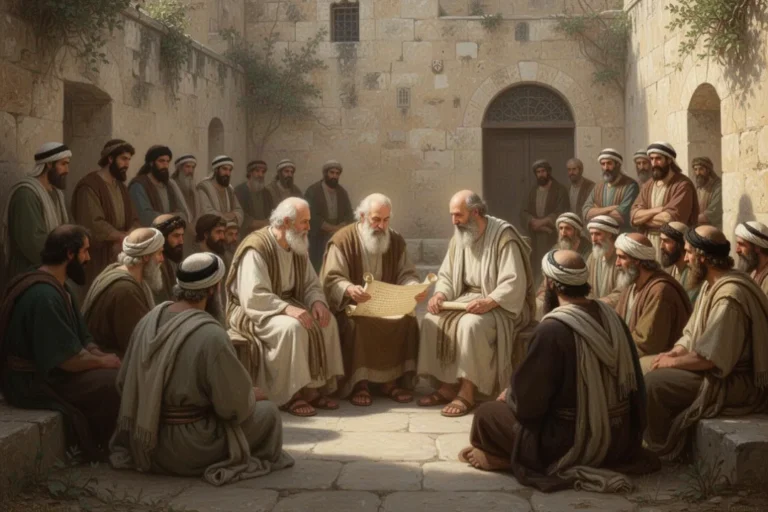
Acts 15 distinguishes between two settings. First, the apostles and elders met privately or in a formal gathering to consider the matter. Then the wider assembly listened to the main arguments. This pattern shows that the decision involved both careful leadership and the participation of the broader church community.
Peter’s argument about Gentile faith and salvation
Peter played a decisive role in the discussion. He reminded the church that God had chosen him to preach to Gentiles, especially in the events surrounding Cornelius and his household in Acts 10–11. God knew the hearts of those Gentiles and gave them the Holy Spirit just as he had given the Spirit to Jewish believers.
Peter’s argument did not rest on Gentiles successfully adopting Jewish customs. Instead, it rested on God’s direct acceptance of them through faith. Acts 15 says that God made no distinction between Jewish and Gentile believers in this respect, cleansing their hearts by faith.
Peter then challenged the idea that the Jewish community should place a “yoke” on Gentile disciples that Israel’s ancestors had not been able to bear fully. The point was not that God’s law was evil or meaningless. The point was that requiring Gentiles to take on the complete covenant identity of Judaism would turn human obligation into a condition that God himself had not imposed on them.
His conclusion was central to the council’s decision: Jewish believers and Gentile believers are saved through the grace of the Lord Jesus. Acts 15 does not present two different standards of salvation. It presents one gracious basis for both groups.
Paul and Barnabas report signs among the Gentiles
After Peter spoke, the assembly listened to Paul and Barnabas. They described the signs and wonders God had performed among the Gentiles through their ministry. Their testimony reinforced Peter’s point: God was not waiting for Gentiles to become culturally Jewish before blessing their response to the gospel.
Their report also gave the council evidence from lived experience. Gentile conversions were not an abstract possibility. Congregations had already formed, and people from different nations were worshiping Christ. Any decision had to address the real pastoral situation created by those communities.
The presence of signs and wonders was not treated as a separate gospel or as a replacement for discernment. The council weighed missionary experience together with Scripture, the work of the Spirit, and the testimony of trusted leaders. That combination offers a picture of how the early church handled a disagreement with theological and practical consequences.
James explains the decision from Scripture
James, the leader who spoke after Peter, Paul, and Barnabas, proposed the formal judgment. He agreed that God was taking a people from among the Gentiles for his name. He then connected that development with the words of the prophets, especially the restoration promises associated with David’s fallen house.
Acts 15 refers to Amos 9:11–12. James uses the prophetic passage to show that the inclusion of the nations fits God’s larger purpose revealed in Scripture. Gentile inclusion was not an accidental emergency or a departure from the biblical story. It was consistent with God’s intention to restore his people and bring the nations into relationship with him.
James therefore judged that the church should not make it difficult for Gentiles who were turning to God. This sentence expresses the council’s theological and pastoral center: do not add unnecessary barriers to genuine faith.
At the same time, James recommended that Gentile believers abstain from four practices. Acts 15 lists food polluted by idols, sexual immorality, meat from strangled animals, and blood. The council’s letter later repeats these requirements in slightly related language.
What the four requirements meant
The four requirements have generated discussion because Christians interpret their continuing application in different ways. The text itself places them in the setting of Jewish-Gentile fellowship, idolatrous practices, and the need for communities with different backgrounds to live together.
Food sacrificed to idols: Gentile converts were to separate themselves from meals and practices that identified them with idol worship. The concern was not simply where food had been sold, but participation in religious life centered on false gods.
Sexual immorality: The term refers broadly to prohibited sexual behavior. In a world where some pagan religious settings involved sexual practices, this command also marked a clear break with the moral life associated with idolatry.
Meat from strangled animals: Animals killed without the blood being drained were especially problematic in a Jewish setting. Avoiding such meat helped Gentile believers respect Jewish sensitivities and the biblical association between blood and life.
Blood: Abstaining from blood reflected longstanding Jewish convictions found in the law of Moses. It also reduced a major source of offense at shared meals between Jewish and Gentile Christians.
These requirements should not be treated as a second route to salvation. The council had already rejected the claim that Gentiles must accept circumcision and the entire Mosaic law to be saved. The four practices functioned as boundaries for faithful communal life, particularly in churches where Jewish and Gentile believers worshiped and ate together.
Christians differ on how directly each requirement applies to churches today. Some understand all four as enduring moral or religious principles. Others see the decree primarily as a first-century pastoral decision designed to protect unity in mixed congregations. Either way, the passage clearly rejects idolatry and sexual immorality and emphasizes the importance of considering how personal practices affect fellow believers.
How the council communicated its decision
The apostles and elders chose representatives to accompany Paul and Barnabas back to Antioch. Judas Barsabbas and Silas were selected to carry the decision and strengthen the local church. Their presence mattered because a written message could be misunderstood or challenged as a private interpretation.
The letter addressed the Gentile believers as “brothers,” signaling that they were recognized as full members of the Christian family. It also stated that certain people had troubled them by claiming the authority of the apostles and elders without authorization. The council did not want its decision confused with the teaching of those who had demanded circumcision.
The letter explained that the Holy Spirit and the council had agreed on the requirements being given. This language presents the decision as both spiritually guided and responsibly deliberated. The leaders did not claim to have invented a new religion; they sought to discern how God’s work among the Gentiles should shape the church’s common life.
When the letter was read in Antioch, the believers rejoiced because of its encouragement. Judas and Silas, who were prophets, continued strengthening the church before returning to Jerusalem. The result was not only a doctrinal ruling but also pastoral reassurance for a congregation that had been under pressure.
What the Council of Jerusalem decided about circumcision
The council’s clearest decision was that Gentile converts did not need circumcision to become Christians. This did not mean circumcision was forbidden to Jewish believers, nor did it erase Jewish identity. The issue was whether Gentiles had to adopt circumcision as a religious requirement for salvation and acceptance.
Paul’s later ministry shows how carefully this issue could be handled. In some situations, he opposed circumcision because it was being demanded as a condition of belonging. In another setting, Acts 16 describes Timothy, whose family background included both Jewish and Gentile connections, being circumcised for ministry among Jews. These accounts suggest that the practice itself was not the sole issue; the decisive question was what circumcision was being made to mean.
If circumcision meant cultural accommodation or a voluntary expression of Jewish identity, it could be treated differently. If it meant that Christ was insufficient without law observance, Paul regarded that claim as a denial of the gospel’s freedom. The council’s decision protected Gentiles from being required to cross a cultural boundary that God had not made a condition of salvation.
How Acts 15 relates to Paul’s account in Galatians
Readers often compare the Jerusalem meeting in Acts 15 with Paul’s visit to Jerusalem described in Galatians 2:1–10. Both passages concern Gentile inclusion, circumcision, and the relationship between Paul’s mission and the Jerusalem leaders. Many interpreters identify them as the same event, while others think they describe different visits.
There are reasons for both views. The subject matter is closely related, and Galatians names Paul’s companions Titus and Barnabas, while Acts names representatives connected with the Antioch dispute. Yet the accounts differ in emphasis, sequence, and the details they highlight. Acts narrates a public council and its letter, while Galatians emphasizes the recognition of Paul’s Gentile mission and a confrontation over conduct at Antioch.
The two passages agree on the main theological point: Gentiles were not required to be circumcised in order to belong to Christ. Galatians says Titus was not compelled to be circumcised, while Acts records the council’s rejection of circumcision as a requirement. Even if the precise chronology remains debated, the accounts point in the same direction on the central issue.
Why the council mattered for the early church
The Council of Jerusalem prevented the Christian movement from making ethnic identity a requirement for salvation. Gentiles could belong to Christ without first becoming Jews. That decision allowed the church to remain rooted in Israel’s Scriptures while becoming genuinely international.
It also established a pattern for handling disputes. The council did not settle the matter through force, majority pressure, or a single person’s authority. The participants listened to competing claims, heard testimony about God’s work, considered Scripture, and issued guidance for actual congregations.
The decision preserved two truths at the same time. First, salvation is by God’s grace through faith, not by adopting a particular ethnic or ceremonial identity. Second, Christian freedom does not remove responsibility toward other believers. Gentile Christians were asked to abandon practices that would directly tie them to idolatry or make shared fellowship impossible.
This balance became important as Christianity moved through cities where Jewish and Gentile believers lived side by side. A church could not treat cultural differences as a reason to create separate classes of Christians. It also could not use freedom as an excuse to disregard the consciences, histories, or spiritual dangers faced by fellow believers.
The lasting principle: The council rejected religious barriers that God had not required, while asking believers to limit practices that threatened faithfulness or damaged the unity of the church.
Common mistakes when interpreting Acts 15
Several misunderstandings arise when the council is read without attention to its historical setting and theological argument. Keeping the following distinctions clear helps explain what the decision actually says.
Do not reduce the issue to food rules. The debate began with salvation, circumcision, and the law. The four prohibitions were part of the council’s response, not the original center of the controversy.
Do not say the council rejected the Old Testament. James used the prophets to support the inclusion of Gentiles. The decision interpreted God’s earlier promises in light of Christ and the Spirit’s work.
Do not treat the decree as permission for idolatry. The council specifically required Gentile believers to separate from practices associated with idols.
Do not confuse cultural flexibility with gospel compromise. Paul could adapt his conduct for ministry, but he resisted any demand that Gentiles trust in circumcision or law observance as necessary for acceptance by God.
Do not assume Jewish believers had to abandon their heritage. The council removed the requirement for Gentiles; it did not declare Jewish customs sinful for Jewish Christians who practiced them.
Do not overlook the unity problem. The decision addressed how believers from different backgrounds could share meals, worship, and fellowship without forcing one group to erase its identity.
Do not treat the apostles’ process as effortless agreement. Acts 15 records sharp disagreement and substantial discussion before the church reached a common judgment.
Practical lessons for handling church disagreements
Acts 15 offers more than a historical answer about circumcision. It shows how communities can address disputes that involve doctrine, tradition, identity, and daily behavior. The pattern is especially useful when people agree on the center of faith but disagree about practices connected to it.
Identify the real question. Ask whether the disagreement concerns the gospel itself, a cultural tradition, a moral command, or a practice affecting fellowship. The council separated the requirement for salvation from the requirements for communal peace.
Listen to evidence from lived ministry. Peter, Paul, and Barnabas described what God was doing among Gentiles. Reports from actual communities helped the leaders evaluate whether a proposed rule matched the work of the Spirit.
Read Scripture in context. James did not quote the prophets as isolated proof texts. He connected them to God’s promises, the Gentile mission, and the testimony already heard.
Protect people from unnecessary burdens. Religious communities can create barriers that God has not imposed. Leaders should ask whether a demand truly follows from Scripture or simply reflects habit and group identity.
Consider the effect of freedom on others. A practice may be permissible in one setting yet harmful in another. Christian maturity includes restraint when personal choices threaten another believer’s faith or the unity of the congregation.
Communicate decisions clearly. The Jerusalem leaders sent a letter and trusted representatives. Clear explanations reduce confusion and help people receive a difficult decision with confidence.
The council’s method does not promise that every disagreement will end quickly. It does show that faithfulness may require both conviction and patience. The leaders defended the gospel firmly while seeking a practical arrangement that allowed Jewish and Gentile believers to remain one body.
Why the Council of Jerusalem still matters
The Jerusalem council remains significant because it answered a question that appears whenever a faith community crosses cultural boundaries: What must everyone share, and what may remain different? Acts 15 places salvation, rather than ethnicity or ritual status, at the center of Christian identity.
Its decision also warns against two opposite errors. One error adds human traditions to the requirements of salvation. The other treats freedom as independence from love, holiness, or responsibility. The council’s ruling avoids both by affirming grace and requiring conduct that protects worship and fellowship.
For readers studying Acts, the event marks a turning point in the church’s public recognition of Gentile believers. For churches today, it remains a model of theological seriousness, communal listening, scriptural reasoning, and practical concern for unity. Its main answer is direct: Gentiles do not need to become Jews to become Christians, but every believer is called to live in a way that honors God and serves the whole community.
Frequently asked questions
Where did the Council of Jerusalem take place?
The meeting took place in Jerusalem, where the apostles and elders gathered to address the dispute affecting Gentile believers. The church in Antioch sent Paul, Barnabas, and others to consult the Jerusalem leaders. The decision was then communicated back to Antioch through a written letter and trusted representatives.
Who attended the Council of Jerusalem?
Acts 15 identifies the apostles, elders, Paul, Barnabas, and other believers as participants. Peter spoke about God’s acceptance of Gentiles, Paul and Barnabas reported on their mission, and James presented the proposed judgment. Judas Barsabbas and Silas later helped deliver and explain the decision to Antioch.
Did the council abolish the law of Moses?
The council did not declare the law of Moses worthless or forbid Jewish Christians from maintaining their heritage. It decided that Gentiles did not have to adopt the Mosaic law, including circumcision, as a condition of salvation. Its ruling focused on Gentile inclusion and on practices needed for faithful fellowship.
Why did the council include rules about food and blood?
These rules helped Gentile and Jewish Christians share life in congregations without endorsing idolatrous worship or seriously offending Jewish convictions. They addressed practices associated with pagan religion, blood, and communal meals. The requirements were not presented as a separate way for Gentiles to earn salvation.




Leave a Reply