When you feel unqualified for a difficult responsibility, Gideon’s story may sound familiar. He was not introduced as a confident warrior or obvious leader. In the biblical account, he was hiding while threshing wheat when an angel called him to rescue Israel from oppression. Gideon was a judge of Israel, a military leader, and a man whose life showed both genuine faith and serious weakness.
Gideon appears in Judges 6–8. God used him to defeat the Midianites with a remarkably small army, but Gideon’s later choices created spiritual trouble for Israel. His story is therefore more than a victory narrative. It shows how God can work through a fearful person while also warning that a successful beginning does not guarantee a faithful ending.
Gideon lived during the period described in the Book of Judges, after Israel had entered the land but before the nation had a permanent king. The recurring pattern in Judges was clear: Israel turned away from God, suffered under an enemy, cried out for help, and received deliverance through a judge. A judge was not primarily a courtroom official; in this setting, the term usually describes a leader raised up to rescue and guide Israel.
During Gideon’s time, the Midianites oppressed Israel. Midian and allied groups entered the land when crops were ready to harvest, destroying or taking food and livestock. The pressure was so severe that many Israelites abandoned their normal homes and hid in caves and mountain strongholds. Israel’s poverty was not simply the result of one lost battle; it came from repeated raids that made farming and settled life dangerous.
The biblical explanation connects this suffering with Israel’s disobedience. The people had worshiped the Baals and other local deities rather than remaining loyal to the God of Israel. A prophet was sent to remind them that God had rescued their ancestors from Egypt and given them the land, but they had not listened to him.
The setting matters: Gideon was called when Israel was weak, frightened, and economically devastated. His assignment was not a routine leadership promotion; it was a response to national oppression and spiritual failure.
Gideon belonged to the tribe of Manasseh and came from the Abiezrite family. His father was Joash, who lived at Ophrah. Gideon’s family was not presented as the strongest or most influential in Israel. Gideon himself described his clan as the weakest in Manasseh and called himself the least important member of his father’s household.
God called Gideon while he was hiding
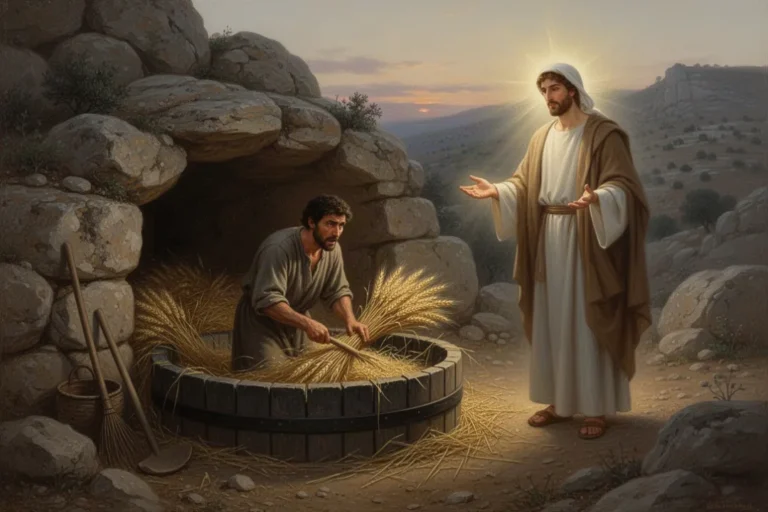
Gideon first appears threshing wheat in a winepress. Threshing normally took place in an open, exposed area where wind could separate grain from chaff. Gideon was working in a winepress instead, apparently to keep the grain hidden from Midianite raiders. The scene communicates fear and vulnerability before Gideon says anything about being a leader.
The angel of the Lord came to him and addressed him as a mighty warrior, even though Gideon was behaving cautiously and privately. Gideon’s first response was not confidence. He questioned why Israel was suffering if God was truly with them and asked where the wonders of the past had gone. His questions reflected the gap between Israel’s inherited stories of deliverance and its present experience of oppression.
God’s answer focused on Gideon’s assignment: he was to go in the strength he had and rescue Israel from Midian. Gideon replied that his family was too weak and that he was too insignificant. The response he received was not a detailed promise that Gideon had enough natural ability. Instead, God promised to be with him. God’s presence, rather than Gideon’s status, became the basis of his mission.
Gideon asked for confirmation that he was truly speaking with a divine messenger. He prepared an offering, and the angel touched it with a staff. Fire consumed the offering, confirming the seriousness of the encounter. Gideon became afraid because he believed he had seen the angel of the Lord, but he was reassured that he would not die.
Gideon then built an altar and gave it a name meaning that the Lord is peace. The name reflects a major tension in the story: Gideon was living in a time of danger, yet he received assurance that God had not abandoned Israel. His first public act was not leading an army but responding to the divine encounter with worship.
Gideon tore down his father’s altar to Baal
Before Gideon could confront Midian, he had to confront idolatry within his own community. God instructed him to tear down his father’s altar to Baal and cut down the associated Asherah pole. He was then to build an altar to the Lord and offer a sacrifice using the wood from the destroyed pole.
Gideon obeyed, but he did so at night because he was afraid of his family and the townspeople. That detail does not erase the significance of his obedience, but it shows that faithful action can coexist with fear. Gideon did not wait until he felt fearless. He acted while still afraid, using caution because he understood the danger of challenging a community’s religious practices.
When the townspeople discovered what had happened, they wanted Gideon punished. His father Joash defended him by arguing that Baal should be able to defend himself if he were truly a god. Joash’s response turned the confrontation back on Baal’s supposed power. Gideon received the name Jerubbaal, associated with the challenge that Baal should contend with him.
This episode marks a crucial stage in Gideon’s calling. The deliverance from Midian began with the removal of false worship. The story does not portray military victory as Israel’s only problem. The nation needed rescue from its oppressors, but it also needed to return to loyalty toward God.
Gideon asked for signs before facing the Midianites
After Gideon was clothed with the Spirit of the Lord, he summoned men from several Israelite tribes. Yet he remained uncertain and asked for another sign. He placed a wool fleece on the ground and asked that dew appear on the fleece while the surrounding ground remained dry. After receiving that sign, he asked for the reverse: dry fleece with dew on the ground. The text says both requests were granted.
The fleece episode is often treated as a simple model for decision-making, but the biblical narrative presents something more specific. Gideon already had a command and a promise from God; he was not merely trying to choose between two ordinary options. His repeated requests reveal deep uncertainty as he prepared to face a larger and stronger enemy.
The story neither portrays Gideon as a faithless unbeliever nor presents fleece-testing as a universal formula. Gideon had already acted on God’s command by destroying the altar. At the same time, he needed repeated reassurance. His faith was real, but it was not bold or effortless.
A careful lesson from the fleece: Gideon’s signs belonged to a unique calling recorded in Scripture. They should not be treated as a guaranteed method for discovering God’s will, especially when they replace prayer, wisdom, Scripture, and responsible counsel.
God continued to accommodate Gideon’s fear. Before the final battle, he told Gideon to go down near the Midianite camp and listen to what the soldiers were saying. Gideon heard a Midianite describe a dream involving a loaf of barley bread overturning the camp. Another soldier interpreted the dream as a sign that Gideon’s army would prevail.
Hearing this strengthened Gideon. He worshiped and returned to Israel’s camp with renewed confidence. The scene shows that encouragement came to Gideon through a surprising source: the fear of an enemy soldier. It also emphasizes that the victory would come from God’s action, not from Israel’s military superiority.
Gideon defeated Midian with only 300 men
Gideon gathered a large force, but God said the army was too big. If Israel won with a large army, the people might claim that their own strength had saved them. The first reduction sent home those who were afraid. A second test involved how the remaining men drank water. Only 300 men were chosen, while the rest were dismissed.
The biblical account does not describe the 300 as Israel’s most skilled or naturally superior soldiers. Their small number was the point. The reduced force made it difficult to explain the outcome as a conventional military achievement. Gideon was promised victory despite having an army vastly smaller than the Midianite coalition.
Gideon divided the 300 into three groups. Each man received a trumpet, an empty jar, and a torch hidden inside the jar. At Gideon’s signal, the men blew the trumpets, broke the jars, exposed the lights, and shouted. The sudden noise, light, and coordinated movement created confusion in the enemy camp.
The Midianites panicked and turned on one another before fleeing. Israelite forces from other tribes were called to pursue them, and additional leaders joined the effort. Gideon also dealt with resistance from nearby Israelite towns that had refused to provide supplies earlier. The victory was not limited to one dramatic nighttime maneuver; it involved pursuit, endurance, and conflict among Israel’s own communities.
Some Ephraimites complained that Gideon had not called them earlier to fight. Gideon responded diplomatically, praising their later contribution and saying that what they had accomplished was greater than his initial action. His answer prevented the dispute from becoming a larger internal conflict. Gideon showed political wisdom by acknowledging another tribe’s role rather than insisting on personal credit.
He also faced criticism from the towns of Succoth and Peniel, whose leaders refused to give food to his exhausted troops while the Midianite kings were still at large. Gideon later returned after capturing the kings and punished the towns. These episodes reveal that his campaign involved more than external enemies. He had to manage tribal rivalries, local resistance, hunger, and the practical demands of a long pursuit.
Gideon’s leadership included both courage and harshness
Gideon’s military leadership was effective, but the later part of his story is morally complicated. He captured and killed the Midianite kings Zebah and Zalmunna, who had apparently killed Gideon’s brothers at Tabor. The account presents this as personal as well as national justice. Gideon’s actions were connected to revenge for his family, not only to the defense of Israel.
He then dealt severely with Succoth and Peniel. The biblical text reports punishment against the leaders and people who had refused support. Readers should not assume that every action recorded in a biblical narrative is automatically presented as an ideal for imitation. Scripture often reports a leader’s conduct without approving every detail, and Gideon’s later severity deserves careful reading.
After the victory, the Israelites asked Gideon to rule over them, along with his son and grandson. Gideon refused in words that affirmed God’s kingship: he said that neither he nor his son would rule over Israel because the Lord was Israel’s ruler. This response sounded faithful and placed an important limit on human authority.
However, Gideon then asked the Israelites to give him gold from the spoils of war. He used the gold to make an ephod and placed it in his hometown, Ophrah. An ephod could refer to a priestly garment or a religious object, and the account does not explain its precise form. What it does say is that the object became a snare to Gideon and his household, and Israel turned toward it in improper worship.
This is one of the story’s sharpest warnings. Gideon rejected formal kingship, but he accepted wealth and created a religious object that drew misplaced devotion. Refusing one form of power does not guarantee freedom from other forms of ambition. A leader can reject a title while still accumulating influence, possessions, or symbolic authority.
Gideon had many wives and a son named Abimelech in Shechem. The biblical text records that Gideon had 70 sons, reflecting the size and status of his household, and that Abimelech was born to a concubine. After Gideon died at an advanced age, Israel again turned away from God and failed to show lasting loyalty to Gideon’s family despite the deliverance he had provided.
What Gideon teaches about faith, success, and compromise
Gideon’s story holds several truths together. He was fearful but obedient, doubtful but responsive, and hesitant yet capable of leading others. His faith did not look like constant certainty. He asked questions, requested signs, and needed encouragement, but he still took concrete steps when God called him to act.
His calling also shows that a person’s background does not determine the usefulness of his or her service. Gideon believed his clan was weak and his household insignificant. The narrative does not deny his limitations; instead, it makes them part of the explanation for the victory. The reduced army ensured that Israel could not reasonably claim that military numbers had produced the rescue.
God can work through reluctant people: Gideon’s fear did not prevent him from being called or used.
Obedience may begin privately: Gideon first confronted idolatry at home before confronting Midian publicly.
Victory can expose the heart: success brought Gideon opportunities for humility, but also wealth and religious compromise.
Human leaders remain limited: Gideon delivered Israel for a time, but he could not produce permanent faithfulness in the nation.
The fleece account also encourages a balanced view of uncertainty. Gideon’s questions were not hidden from God, and God patiently strengthened him. Yet the story does not encourage endless hesitation. Once Gideon received direction, he had to move forward. Faith was expressed through action, not merely through the ability to ask for more reassurance.
His story further distinguishes between a good beginning and a faithful legacy. Gideon tore down an idol, led a remarkable deliverance, and refused the title of king. But his ephod became a snare, and his household later became part of a troubled succession. Spiritual discernment must continue after success; the danger of pride and compromise can increase when people begin to admire a leader.
For Christians and other readers of the Bible, Gideon is best understood neither as a flawless hero nor as a person whose doubts disqualify him. He is a complex judge in Israel’s history. His life points beyond human courage to God’s ability to save, while also showing why authority, wealth, revenge, and religious symbols must be handled with care.
So, who was Gideon in the Bible? He was a fearful Israelite from Manasseh whom God raised up to deliver Israel from Midian. He became a courageous commander through God’s help, but his later choices showed that winning a battle is not the same as remaining faithful. Gideon’s story is remembered for both the 300-man victory and the warning that followed it.
Frequently asked questions
Was Gideon a prophet, judge, or king?
Gideon was primarily one of the judges of Israel. The Bible also describes him receiving messages from God and being empowered by God’s Spirit, but it does not present him as a king. When Israel asked him to establish a ruling dynasty, Gideon declined and said that the Lord should rule over the nation.
Why did Gideon use a fleece?
Gideon used a fleece to seek confirmation of his calling before confronting Midian. He asked for dew on the fleece with dry ground, then for dry fleece with dew on the ground. The episode shows his uncertainty and God’s patience, but it is not presented as a universal test for making everyday decisions.
Did Gideon really defeat Midian with 300 soldiers?
Judges 7 describes Gideon leading 300 selected men against a much larger Midianite force. The reduced army emphasized that Israel’s victory did not depend on numerical strength. Trumpets, jars, torches, surprise, and confusion caused the Midianite camp to collapse, after which other Israelites joined the pursuit.
What happened to Gideon after his victory?
Gideon declined Israel’s offer to make him king, but he accepted gold from the battle spoils and made an ephod at Ophrah. The object became a source of unfaithfulness for Israel. Gideon later died at an advanced age, and after his death Israel turned away from God again.










Leave a Reply