If you have ever wondered who wrote the Bible, the answer is more complicated than naming one author. The Bible did not appear all at once as a single finished volume. It developed over many centuries from oral traditions, written documents, edited histories, letters, poetry, prophecy, and teaching.
Its books were produced in different places and periods by many human authors and communities. Jewish communities preserved the writings that became the Hebrew Bible, while early Christians gradually recognized additional writings about Jesus and the first Christian communities. The result is a library of texts brought together into collections that different religious traditions arrange and count somewhat differently.
The word Bible comes through Latin and Greek terms related to “books.” That meaning fits its structure: the Bible is not a single continuous work but a collection of writings with different genres, purposes, and historical settings.
Christians usually divide it into the Old Testament and New Testament. Jewish tradition generally refers to the Hebrew Scriptures as the Tanakh, a name based on its three major divisions: Torah, Nevi’im, and Ketuvim. The Old Testament overlaps substantially with the Tanakh, although the books can be arranged and counted differently.
The New Testament contains writings about Jesus of Nazareth, his teachings, his death and resurrection as understood by Christians, and the growth of early Christian communities. It includes four Gospels, Acts, letters, and Revelation. These texts were written in the first century, several decades after Jesus’ public ministry began.
Central idea: The Bible originated through a long process of composition and preservation. “The Bible” describes the completed collection, not one manuscript written by one person at one time.
How the Bible developed step by step
The Bible’s origin can be understood as a sequence of overlapping stages. These stages were not perfectly separate, and different books followed different paths, but they provide a useful framework for understanding how the collection formed.
Communities preserved stories and teachings orally. Before many biblical passages were written, families, priests, teachers, and worshiping communities passed on accounts of ancestors, laws, prayers, songs, wisdom, and acts of God.
Some traditions were recorded in writing. Scribes produced documents using materials such as parchment, leather, and papyrus. Earlier sources could be copied, combined, expanded, or edited.
Religious communities preserved and used particular writings. Texts read in worship, used for instruction, or associated with respected prophets and apostles gained lasting authority.
Collections began to take shape. Groups of law, prophecy, poetry, Gospel accounts, and letters circulated together or were treated as related bodies of writing.
Communities debated and recognized a canon. A canon is an accepted list of authoritative books. Jewish and Christian communities reached their collections through extended historical processes rather than one universal meeting.
Scribes copied and translated the texts. Hebrew, Aramaic, and Greek manuscripts were transmitted across regions. Later translations made the Scriptures available in Latin and many other languages.
Printed editions standardized access. Printing did not create the Bible, but it made widely distributed editions possible and helped establish familiar formats for readers.
This process explains why the Bible contains both unity and variety. Its books share major themes, including creation, covenant, justice, worship, human failure, redemption, and hope. At the same time, they reflect different authors, communities, literary styles, historical situations, and theological emphases.
Where the earliest biblical traditions began
Many of the Bible’s earliest traditions arose in the ancient Near East, especially among the people of ancient Israel and Judah. The Hebrew Bible describes the history, worship, laws, struggles, and hopes of these communities, while also engaging with neighboring cultures such as Egypt, Assyria, Babylon, and Persia.
These traditions were shaped by major historical experiences. Stories about ancestors, the exodus, settlement, kingship, exile, and return helped communities understand their relationship with God and their identity as a people. Some accounts may have circulated for generations before reaching their written forms.
The Hebrew Bible itself presents a history that stretches from creation narratives through the history of Israel, prophetic activity, wisdom writing, and later Jewish life. Modern scholars study its language, literary structure, manuscript evidence, historical references, and relationships among parallel passages to understand how individual books developed.
Oral tradition and written sources
Oral tradition was not simply an informal version of a written text. In ancient societies, memorized stories, songs, genealogies, legal decisions, and sayings could be carefully preserved and performed in recognizable forms. Repetition in family, religious, and public settings helped maintain continuity.
Writing eventually recorded some of these materials. A biblical book may contain older poems or laws alongside later framing material. It may also bring together more than one tradition. The presence of different perspectives does not by itself tell us exactly when every passage was written, but it shows that the Bible’s formation was layered.
For example, the books of Kings and Chronicles describe much of the same broad history but have different emphases and arrangements. The four Gospels also tell the story of Jesus in distinct ways. Their similarities and differences reflect the work of separate authors and communities rather than a single dictated account.
How the Hebrew Bible formed
The Hebrew Bible’s books were written primarily in Hebrew, with some passages in Aramaic. They were composed, collected, revised, and transmitted over a long period. The exact date of every passage is not known, and scholars sometimes disagree about the order in which layers of a book developed.
The traditional Jewish division gives the collection three sections:
Torah: the five books traditionally associated with Moses, including Genesis, Exodus, Leviticus, Numbers, and Deuteronomy.
Nevi’im: the Prophets, including historical narratives and books associated with figures such as Isaiah, Jeremiah, and Ezekiel.
Ketuvim: the Writings, including Psalms, Proverbs, Job, Ruth, Daniel, Ezra-Nehemiah, Chronicles, and other books.
The Torah holds a central place in Jewish life and includes creation and ancestral narratives, laws, worship instructions, and the story of Israel’s formation. The Prophets interpret national events through religious and ethical themes, often criticizing injustice and unfaithfulness. The Writings include poetry, wisdom, festival stories, historical works, and reflections on suffering and faith.
The phrase Old Testament is a Christian designation connected with the Christian understanding of a “new covenant.” Jewish readers generally do not use that term for their Scriptures because it reflects a specifically Christian relationship between the Hebrew Scriptures and the New Testament.
What the Dead Sea Scrolls reveal
The Dead Sea Scrolls, discovered in the mid-20th century near the Dead Sea, provide some of the earliest surviving manuscripts of many Jewish biblical writings. They include copies or fragments of books later found in the Hebrew Bible, along with other Jewish religious and community texts.
These manuscripts are valuable because they come from a period before the medieval Hebrew manuscripts traditionally used by scholars and translators. They show both substantial continuity and textual variation. Some passages resemble the later Masoretic Hebrew text closely, while others reflect readings known from ancient Greek translations or other textual traditions.
The scrolls do not provide a single missing original Bible. Instead, they show that ancient Jewish Scripture existed in more than one textual form during the centuries before and around the time of Jesus. They help researchers compare wording, spelling, arrangement, and transmission across different manuscript traditions.
Important distinction: A manuscript copy is not the same as an original author’s document. The Bible survives through a history of copying, and textual scholars compare manuscripts to identify early readings and understand how texts were transmitted.
How the Greek Old Testament influenced the Bible
Many Jews in the ancient Mediterranean world spoke Greek rather than Hebrew. As a result, Jewish Scriptures were translated into Koine Greek, the widely used form of Greek in the eastern Mediterranean. This collection is commonly called the Septuagint, although the name can refer to the translation tradition as a whole rather than one single edition produced at one moment.
The Greek Scriptures were important for early Christians. The New Testament authors and other early Christian writers often used Greek forms of Jewish Scripture when referring to the biblical story. The wording of a quotation may therefore differ from a modern English translation based primarily on Hebrew manuscripts.
Greek-speaking Jewish communities also preserved some books that later became part of the Christian Old Testament in certain traditions. Roman Catholic and Eastern Orthodox Bibles include books often called deuterocanonical or related terms, while most Protestant Bibles place these writings in a separate section called the Apocrypha or do not include them in the main collection. Jewish and Protestant, Catholic, and Orthodox traditions therefore do not all have identical Old Testament canons.
How the New Testament writings originated
The New Testament grew out of the movement that formed around Jesus and his earliest followers. Jesus taught in an Aramaic-speaking Jewish environment, but the New Testament books were written in Greek, with the possible exception of some debated linguistic influences. Greek allowed these writings to circulate widely across the eastern Roman Empire.
The earliest Christian preaching focused on Jesus’ life, teachings, crucifixion, and resurrection. Before the Gospels were written, communities shared these traditions through worship, instruction, preaching, and personal testimony. The letters of Paul and other early Christian leaders provide some of the earliest surviving New Testament writings.
Paul’s letters addressed specific communities and practical problems, including disagreements about worship, ethics, leadership, and the relationship between Jewish and non-Jewish believers. They were not written as a general biography of Jesus. Even so, they preserve early Christian beliefs and references to Jesus’ death, resurrection, teachings, and followers.
Why there are four Gospels
The four canonical Gospels—Matthew, Mark, Luke, and John—were written for different audiences and present Jesus with distinct emphases. Mark is commonly regarded by scholars as the earliest of the four, although the precise dates and development of each Gospel remain subjects of study. Matthew and Luke share material with Mark and with other traditions, while John has a notably different style and structure.
Each Gospel is a theological narrative, not a modern transcript or neutral chronology. The authors selected, arranged, and shaped traditions to communicate what they believed about Jesus. Similar events may appear in different sequences or with different details because the writers had different purposes.
The Gospels were probably written several decades after Jesus’ death. That interval allowed oral traditions and written sources to circulate among communities. It does not by itself settle questions of historical reliability; it simply describes the period and the way ancient biography and religious teaching were transmitted.
Other New Testament books and early Christian writings
Acts continues the narrative begun in Luke and describes the expansion of the early Christian movement. The letters associated with Paul, Peter, John, James, and Jude address churches and individuals. Revelation uses symbolic visions and prophetic imagery to encourage communities facing pressure and uncertainty.
Many other Christian writings existed in the first and second centuries, including texts later called the Gospel of Thomas, the Didache, and letters associated with early Christian leaders. Some were valued by particular groups or communities. Their existence shows that the early Christian literary world was broader than the eventual New Testament.
The fact that a writing was early or popular did not automatically make it part of the New Testament. Communities considered factors such as connection to apostles, consistency with received teaching, widespread use in worship, and long-term acceptance among churches.
How the biblical canon was recognized
A canon is a recognized collection of authoritative writings. The books of the Bible were not all accepted in the same way or at the same time. Some were widely recognized early, while others were debated for generations.
For the Hebrew Bible, the final shape of the collection developed through Jewish transmission and use. The process was not necessarily a single event. Different Jewish communities had variations in which writings they emphasized or included, especially during the Second Temple period and afterward.
For the New Testament, early Christians gradually treated certain writings as authoritative across a broad range of churches. The four Gospels, Acts, Paul’s letters, and several other books gained strong acceptance. Books such as Hebrews, James, 2 Peter, 2 John, 3 John, Jude, and Revelation had varying levels of acceptance in some regions before the collection became more stable.
Lists of New Testament books appear in early Christian sources, and later church councils and leaders confirmed collections already used in many communities. These gatherings did not write the books or create their contents. They helped formalize boundaries that had emerged through reading, teaching, worship, and debate.
Why different Bibles contain different books
There is no single table of contents shared by every Christian Bible. The differences result from distinct traditions concerning the Hebrew Scriptures, the Greek Septuagint, church authority, and the status of particular books.
Jewish Bibles contain the Tanakh, arranged in the traditional Jewish order and without the New Testament.
Most Protestant Bibles contain 39 Old Testament books and 27 New Testament books, for 66 books in all.
Roman Catholic Bibles contain additional Old Testament books commonly called deuterocanonical, along with the 27 New Testament books.
Eastern Orthodox Bibles generally include a somewhat broader Old Testament collection, although the exact contents can vary among Orthodox traditions.
The Protestant count of 39 Old Testament books corresponds largely to the same material counted as 24 books in the Jewish Tanakh, because some books are combined differently. The difference in numbering does not mean that every individual text is entirely different.
How scribes preserved and copied the biblical texts
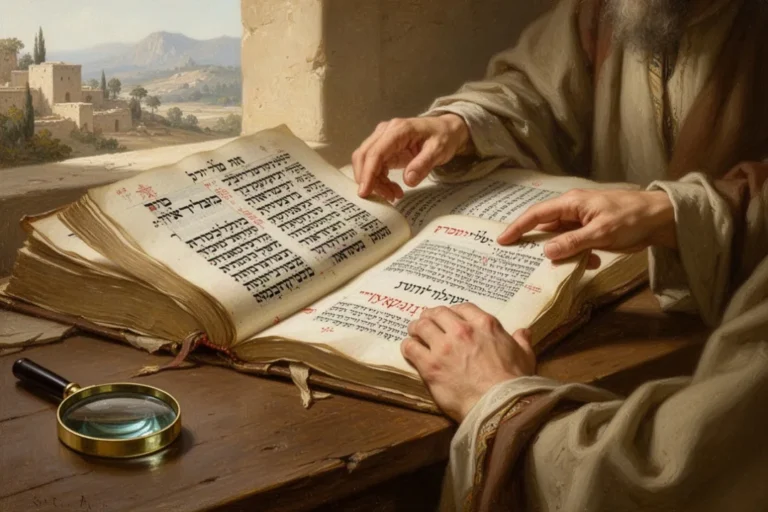
Before printing, biblical books were copied by hand. Scribes worked in Jewish, Christian, monastic, and scholarly settings, depending on the period and community. Copying was a disciplined activity, but handwritten transmission naturally produced differences in spelling, word order, omissions, additions, and marginal notes that sometimes entered later copies.
Some variations are minor, such as alternate spellings or grammatical adjustments. Others affect a sentence or passage. Textual critics compare a wide range of manuscripts, ancient translations, and quotations by early writers to determine which readings are likely to be earlier and how the text changed during transmission.
Important manuscript witnesses include the Masoretic Text for the Hebrew Bible, the Greek Septuagint tradition, the Dead Sea Scrolls, and ancient Greek New Testament manuscripts. No single witness answers every question. Researchers examine the evidence together, taking into account a manuscript’s age, location, textual family, and patterns of copying.
How translations shaped access to the Bible
The Bible was translated because its readers spoke many languages. Ancient translations included Greek versions of Jewish Scriptures and later translations into Syriac, Latin, Coptic, Armenian, Georgian, and other languages. Translation was not merely a technical exercise; translators made choices about vocabulary, grammar, poetry, and cultural meaning.
The Latin Vulgate, associated especially with Jerome’s work in the late fourth and early fifth centuries, became highly influential in Western Christianity. It served as a major biblical text for churches, scholars, worship, and manuscripts for many centuries.
During the Reformation and afterward, translators increasingly produced Bibles in languages spoken by ordinary readers. English translations developed from Hebrew, Aramaic, Greek, and earlier Latin traditions. Modern translations differ because of their manuscript bases, translation philosophies, vocabulary choices, and intended audiences.
Reading a modern English Bible therefore involves several layers: an ancient composition, a manuscript tradition, a scholarly reconstruction or selected base text, and a translation into contemporary language. Comparing multiple translations can help you see where translators have made different reasonable choices.
What “inspired” means in relation to human authors
Many Jewish and Christian communities describe the Bible as inspired by God, but beliefs about inspiration differ. Some understand inspiration as God’s guidance of the biblical authors. Others emphasize the authority of the final form, the work of the Holy Spirit in the community, or the Bible’s role in revealing God through human language.
Belief in inspiration does not necessarily require the view that every book was dictated word for word. The Bible displays individual voices, literary techniques, historical perspectives, and cultural settings. A reader can recognize human authorship and still understand the text as sacred Scripture within a religious tradition.
Different denominations also interpret apparent tensions in different ways. Some harmonize details, some focus on theological meaning rather than exact chronology, and others accept that biblical authors may present events with different emphases. The origin of the Bible is therefore both a historical question and, for believers, a question of faith and authority.
How to study the Bible’s origin responsibly
If you want to investigate the Bible’s origins, begin by identifying which collection you are reading. A Jewish Tanakh, Protestant Bible, Catholic Bible, and Orthodox Bible may not have the same contents or order. Then consider the language, genre, historical setting, and manuscript evidence for each book.
Separate the original setting from later interpretation. Ask what a passage may have meant to its first audience before considering later theological readings.
Check the genre. Poetry, law, wisdom literature, prophecy, Gospel narrative, and personal letters communicate in different ways.
Compare translations carefully. A difference in English wording may reflect a difference in the underlying manuscript, or it may simply reflect translation style.
Distinguish authorship from authority. Historical questions about who wrote a book are related to, but not identical with, religious beliefs about its authority.
Use manuscript evidence appropriately. Ancient copies can show how a text was transmitted, but they do not provide a complete record of every stage of composition.
Read scholarly claims with caution. Dating and authorship can involve strong evidence, competing theories, and areas where no firm consensus exists.
Key biblical references can also help orient your reading. The Hebrew Bible’s law, prophets, and writings are reflected in passages such as Luke 24, where early Christian language describes the Scriptures through broad divisions. The New Testament’s own development is visible in early letters such as 1 Corinthians and in later passages that refer to collections of Christian writings.
The origin of the Bible is best understood as a long history of community memory, literary creation, religious interpretation, manuscript copying, canon formation, and translation. Its books came from particular people and places, yet they were preserved because communities believed they carried lasting significance. Understanding that history can make the Bible’s diversity clearer without reducing it to only one kind of document.
Questions to ask when someone says “the Bible was written by one person”
The claim that one person wrote the Bible overlooks its many languages, genres, authors, and centuries of development. A more accurate statement is that the Bible is a collection formed from writings associated with numerous authors and communities.
If the claim refers to divine authorship, it expresses a theological belief held in different forms by many Jews and Christians. If it refers to the historical production of the text, the evidence points to a much more complex process involving many writers, editors, scribes, translators, and communities.
Likewise, saying that the Bible was “changed” can be too vague to be useful. Copyists did introduce variations, but scholars can often identify and compare them. The better question is which manuscript readings are earlier, how confident researchers are, and what effect a variation has on the meaning of a passage.
Frequently asked questions
Was the Bible written in one language?
No. Most of the Hebrew Bible was written in Hebrew, with some Aramaic sections. The books of the New Testament were written in Greek, although they reflect a Jewish setting in which Aramaic was widely spoken. The Bible was later translated into Latin, Syriac, Coptic, and many other languages.
Did Moses write the entire first five books of the Bible?
Jewish and Christian traditions have long associated the Torah with Moses, but the historical composition of Genesis through Deuteronomy is more complex. Scholars identify different literary layers, sources, and editorial processes. The traditional association remains religiously significant even though modern views of authorship vary.
Which Bible is the original Bible?
No single physical volume is the original Bible. The collection formed gradually, and its books survive through many manuscripts and textual traditions. Jewish, Protestant, Catholic, and Orthodox communities also recognize somewhat different collections. Modern editions are translations or scholarly presentations based on ancient evidence.
How long did it take to form the Bible?
The process took many centuries. The Hebrew Scriptures developed over an extended period before and after the exile, while the New Testament writings were produced during the first century. Recognition of the complete biblical collections continued after individual books had already been written and used.





Leave a Reply