Gnostic Bible: texts, teachings, and how to read them
Gnostic Bible: texts, teachings, and how to read them
If you searched for the Gnostic Bible because you want to read the “other” Christian scriptures, the first answer is simple: there is no single ancient book called the Gnostic Bible. The phrase usually refers either to a modern anthology of Gnostic writings or to the broader collection of early religious texts associated with Gnostic traditions.
These writings include the Gospel of Thomas, the Apocryphon of John, the Gospel of Philip, and other works discovered in Coptic manuscripts near Nag Hammadi, Egypt. They do not form one consistent Bible, and many scholars use “Gnostic” cautiously because the texts differ substantially in theology, date, and origin.
The phrase has two common meanings. In bookstores and libraries, it often identifies a modern collection that brings together Gnostic, Hermetic, Mandaean, Manichaean, and related writings. One widely known volume is The Gnostic Bible, edited by Willis Barnstone and Marvin Meyer, which presents translations of texts from several mystical and esoteric traditions.
In casual conversation, however, someone may use “Gnostic Bible” to mean the complete body of scriptures that were left outside the traditional Christian Bible. That description is too broad. Some texts called Gnostic are Christian in language but differ sharply from one another, while others come from Jewish, Greek, Egyptian, or Persian religious settings.
Gnosticism is also not the name of one ancient church with one official creed. The term was developed and applied by modern scholars to describe related movements and ideas. Ancient writers usually identified particular groups by names such as Valentinians, Sethians, or followers of Basilides rather than by a single word covering all of them.
Helpful distinction: A Gnostic Bible is best understood as a reading collection, not a lost replacement for the Christian Bible and not a single volume used uniformly by all ancient Gnostic communities.
Where the Gnostic writings came from
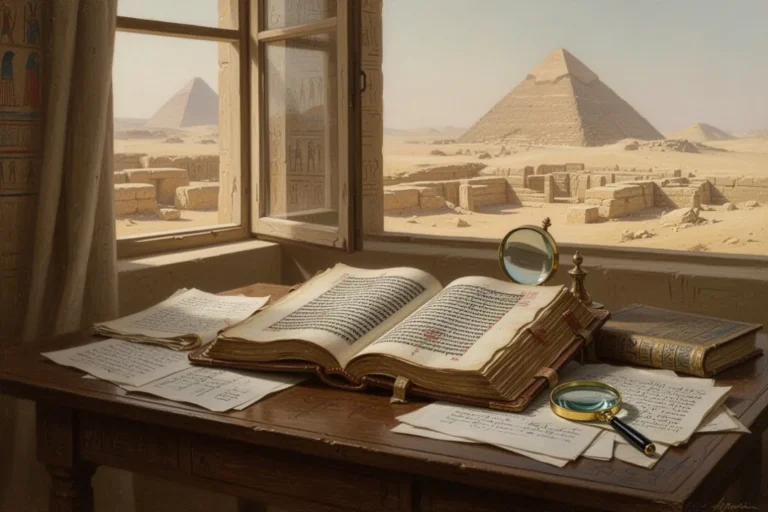
The most famous discovery connected with Gnostic literature occurred near the Egyptian town of Nag Hammadi in 1945. A group of codices, or bound manuscript books, was found containing more than a dozen works in Coptic. The manuscripts were copied in the fourth century, although many of the texts were probably composed earlier in Greek.
The Nag Hammadi library was not necessarily a personal “Gnostic Bible.” It was a collection of different works, and its contents do not all express the same theology. Alongside texts with strongly Gnostic features are works shaped by Platonism, Christian asceticism, mystical interpretation, and other currents of late antique thought.
Other important discoveries and sources include the Berlin Codex, fragments preserved on papyrus, quotations in the writings of early Christian critics, and documents associated with Manichaean and Mandaean communities. A text’s survival in one manuscript does not prove that it was widely accepted, nor does its absence from Nag Hammadi prove that no one valued it.
Dating these writings can be difficult. A manuscript may be centuries later than the composition it preserves, and some works appear to have been revised or combined over time. Scholars therefore compare language, theology, manuscript evidence, and quotations from ancient authors rather than assigning every text a precise date with confidence.
Which books are commonly included in a Gnostic Bible
A modern anthology may contain dozens of texts, but several titles appear regularly. Each one should be read on its own terms rather than treated as a chapter in one unified scripture.
The Gospel of Thomas: A collection of 114 sayings attributed to Jesus. It does not tell the story of Jesus’ death and resurrection in the same way as the New Testament Gospels. Its sayings often emphasize discovery, interpretation, and the hidden meaning of Jesus’ words.
The Apocryphon of John: A revelatory dialogue in which Jesus explains the structure of the divine world, the origin of the material cosmos, and the human condition. It is one of the clearest examples of a Sethian-style Gnostic text.
The Gospel of Philip: A collection of theological reflections, symbolic interpretations, and sayings. It discusses baptism, anointing, the bridal chamber, and the relationship between visible rituals and spiritual realities.
The Gospel of Truth: A meditation on ignorance, error, knowledge, and the revelation of the Father through Christ. Its style is reflective and poetic rather than narrative.
The Hypostasis of the Archons: A retelling of creation and the story of Adam and Eve that gives unusual importance to heavenly rulers, spiritual awakening, and the recovery of knowledge.
The Thunder, Perfect Mind: A striking poetic speech presented through a feminine divine voice. It uses paradoxes to challenge ordinary divisions between weakness and strength, honor and shame, and wisdom and foolishness.
The Gospel of Mary: A fragmentary dialogue in which Mary receives and communicates teachings. The surviving text raises questions about authority, spiritual vision, and conflict among Jesus’ followers.
The Acts of John and other related works: Narrative and visionary writings that may be included in broad collections of noncanonical Christian literature, even when their classification as Gnostic is debated.
Some anthologies also include Hermetic writings, Chaldean material, Mandaean prayers, and passages from Manichaean texts. Their inclusion reflects a shared interest in revelation, spiritual knowledge, and the relationship between the visible world and a higher reality—not necessarily a common institution or doctrine.
What Gnostic teachings say about knowledge and salvation
The word gnosis comes from a Greek term meaning knowledge or recognition. In these traditions, gnosis usually means more than collecting information. It describes an awakened perception of one’s divine origin and a transformed understanding of reality.
A Gnostic text may portray human beings as spiritually forgetful. They live within a world governed by ignorance, confusion, or hostile powers, yet they contain a trace of the divine. Salvation involves awakening to that origin and returning, through revelation, to the fullness of divine life.
This does not mean every Gnostic text teaches that ordinary learning is enough or that private feelings automatically count as revelation. Gnosis is often presented as a gift mediated through a revealer such as Christ. The revealer brings the knowledge that human beings cannot reach through ordinary observation alone.
Salvation language varies considerably. Some writings emphasize escape from cosmic rulers and return to the spiritual realm. Others focus on healing ignorance, recognizing divine presence, or interpreting Jesus’ sayings correctly. A reader should avoid turning one text’s explanation into a definition of every Gnostic group.
How Gnostic texts describe God, creation, and the material world
Many Gnostic writings distinguish between the highest, unknowable God and a lower creator or ruler associated with the visible cosmos. The highest God is often described as transcending ordinary categories. From the divine fullness, spiritual beings or emanations arise, sometimes called aeons.
In the Apocryphon of John, for example, the figure known as Yaldabaoth creates or governs the material world while lacking true knowledge of the supreme God. Other texts offer different accounts. Some present the creator as ignorant, some as arrogant, and some treat creation with greater ambiguity.
This is why the popular claim that “Gnostics believed the world was evil” needs qualification. Certain texts regard material existence as a prison or a flawed construction. Others criticize ignorance rather than matter itself. The Gospel of Thomas, for instance, is less interested in presenting a detailed myth of a wicked creator than in urging readers to recognize the meaning already present in Jesus’ sayings.
Gnostic writings can also be deeply symbolic. Names such as Sophia, Wisdom, Barbelo, and the archons do not always function like characters in a modern fantasy story. They may express relationships among divine qualities, cosmic principles, psychological conditions, and stages of revelation.
How Jesus appears in Gnostic writings
Jesus remains central in many texts associated with Gnostic Christianity, but his role may differ from the one emphasized in the canonical Gospels or in later Christian creeds. He is often the revealer of hidden knowledge, a heavenly messenger who helps souls remember their origin.
Some texts present Jesus speaking after the resurrection to a small group of disciples. Others preserve sayings, mystical dialogues, or symbolic interpretations attributed to him. The focus may fall less on a public ministry in Galilee and more on what Jesus discloses to those prepared to understand.
Views of Jesus’ body and suffering also vary. Some Gnostic-leaning traditions regarded the divine Christ as only apparently embodied, while others maintained a more physical understanding. The ancient evidence does not justify the simple statement that all Gnostics denied Jesus’ humanity.
Texts such as the Gospel of Thomas also complicate the idea that every noncanonical Gospel rejects Jesus’ Jewish or ethical teaching. Its sayings include themes of mercy, self-knowledge, vigilance, and radical reinterpretation. Its distinctive feature is not merely that it is “secret,” but that it expects the reader to work through difficult and often enigmatic sayings.
How the Gnostic Bible differs from the canonical Bible
The canonical Bible is a collection of writings recognized as authoritative within particular Jewish and Christian communities. Its contents differ among Jewish, Protestant, Catholic, and Eastern Orthodox traditions, although the New Testament’s 27 books are shared across most major Christian traditions.
A Gnostic anthology has a different basis. It gathers writings that were not included in the standard Christian canon and organizes them for modern readers. The texts were produced across different periods and communities, often in languages and settings far removed from one another.
The differences include more than a list of books:
Literary form: The canonical Bible contains historical narratives, letters, poetry, wisdom literature, prophecy, and apocalyptic writing. Gnostic collections often add revelatory dialogues, secret sayings, mystical homilies, and cosmic myths.
Authority: Canonical books gained recognition through long community use, liturgical reading, theological acceptance, and other historical processes. A modern anthology’s inclusion reflects editorial judgment, not ancient universal agreement.
Creation: Many canonical texts affirm creation as belonging to God, even when they criticize human sin. Some Gnostic works portray the material cosmos as defective or controlled by lesser powers.
Salvation: The New Testament presents several interconnected ways of describing salvation, including forgiveness, resurrection, reconciliation, faith, love, and participation in Christ. Gnostic writings frequently emphasize awakening and knowledge of divine origin.
Jesus’ teaching: Canonical Gospels provide extended narratives of Jesus’ ministry, death, and resurrection. Many Gnostic works focus instead on private instruction, sayings, visions, or symbolic interpretation.
“Noncanonical” does not automatically mean “Gnostic,” and “Gnostic” does not automatically mean “more authentic.” Those are separate questions. A text may be noncanonical because it was written later, served a limited community, used a different literary form, or failed to become authoritative within the churches that shaped the canon.
Why these writings were not included in the Christian Bible
There was no single meeting where church leaders simply removed every Gnostic book from an already complete Bible. The development of the Christian canon was gradual and involved many communities, languages, regions, and debates.
Church leaders such as Irenaeus of Lyons, Tertullian, and Hippolytus criticized specific teachings and texts in the second and third centuries. Their writings are valuable evidence, but they should be read as arguments made against opponents. They do not provide neutral descriptions of every group they challenged.
Several factors influenced canonical recognition: connection to apostles or their close circles, agreement with widely used Christian teaching, repeated reading in worship, and acceptance across different communities. Some books later included in the New Testament were disputed for a time, while some respected writings were never treated as scripture everywhere.
Gnostic authors and communities were also diverse. A particular text might be used by one group but ignored by another. The absence of a work from the canon therefore reflects a long historical process rather than a simple act of censorship by one institution.
Read with historical care: Modern claims that the church “hid the real Bible” flatten a complicated history. The surviving manuscripts show competing interpretations, not one suppressed canon that all early Christians secretly shared.
Practical tips for reading a Gnostic Bible
These writings can be rewarding, but they are easy to misunderstand if you expect a continuous narrative or a uniform creed. A few habits make the reading more useful.
Check the text’s background. Before reading, find out whether the work is associated with Sethian, Valentinian, Hermetic, Manichaean, or another tradition. If its classification is debated, keep that uncertainty in mind.
Read the editor’s notes. Good editions explain manuscript condition, translation choices, unusual names, and the difference between a complete text and a reconstruction from fragments.
Separate date from setting. A fourth-century manuscript may preserve an earlier composition. Do not assume the physical age of a codex is the age of the ideas inside it.
Compare themes, not isolated lines. A single saying can sound similar to the New Testament while the surrounding work gives it a different meaning. Read the whole passage and observe its view of creation, salvation, and Jesus.
Expect symbolic language. Aeons, cosmic rulers, heavenly realms, and spiritual seeds often carry theological meaning. Treating every image as a literal map can obscure the author’s purpose.
Use more than one translation when a passage matters. Coptic and Greek texts can be difficult, and translators must sometimes supply words or choose among possible meanings.
Keep ancient and modern spirituality distinct. A contemporary interpretation may be personally meaningful without being the same interpretation held by the ancient community that produced the text.
Common mistakes when searching for the Gnostic Bible
Search results often mix reliable scholarship with modern spiritual claims. The following mistakes are especially common:
Assuming there is one lost volume: The ancient evidence points to multiple writings and movements, not one universally accepted Gnostic Bible.
Calling every noncanonical Gospel Gnostic: The Gospel of Peter, Infancy Gospel of Thomas, and other works have different origins and purposes. Noncanonical is a broad category.
Treating Nag Hammadi as one author’s library: The codices contain varied materials copied by different hands and likely collected over time.
Using “secret” to mean deliberately hidden for centuries: Some works describe secret revelation within the story, but that does not prove a coordinated historical cover-up.
Reducing gnosis to intelligence: In these texts, spiritual knowledge is usually transformative recognition, not academic information or membership in an elite.
Assuming all Gnostics rejected the body: Attitudes toward matter, embodiment, sexuality, and ritual differ across texts and communities.
Reading modern fiction as ancient evidence: Novels, films, and internet summaries may borrow Gnostic names while reshaping the theology for contemporary purposes.
Which edition should you choose
A first-time reader generally benefits from a collection that includes an introduction, notes, a glossary, and information about each manuscript. Readable translations make the texts approachable, while scholarly notes help you see where the evidence is certain and where reconstruction is involved.
The Gnostic Bible edited by Barnstone and Meyer is one accessible starting point because it gathers a broad range of related material in one volume. Its wide scope is useful, but it also means that the collection includes traditions that are not identical and should not be treated as one theological system.
Readers who want a narrower focus can begin with a translation of the Gospel of Thomas, the Apocryphon of John, or the Gospel of Philip. A specialized edition may provide more detailed commentary on language, manuscript history, and the relationship between the text and early Christian debates.
Look for editions that identify the manuscript basis and distinguish translation from editorial restoration. In fragmentary works, brackets or notes may show where words are missing and scholars have supplied likely readings. That transparency helps you understand both the text and its limits.
What the Gnostic Bible can teach modern readers
These writings show that early Christianity was not intellectually or spiritually uniform. Christians argued about the meaning of creation, the identity of Jesus, the value of the body, the role of women, the purpose of ritual, and the relationship between faith and knowledge.
They also demonstrate how religious texts develop through copying, translation, interpretation, and community use. A manuscript is not only a container for ideas; it is evidence of the people who preserved, arranged, and read those ideas.
For some readers, the most compelling theme is the possibility of awakening from spiritual forgetfulness. For others, the texts are valuable because they reveal the diversity and conflict of late antique religious life. Both approaches can be productive when they respect the historical evidence.
The Gnostic Bible is therefore best approached as a doorway into a large and varied body of literature. Read individual works closely, compare them with one another and with the canonical Bible, and resist explanations that make every ancient voice say the same thing.
Frequently asked questions
Is the Gnostic Bible a real ancient Bible?
No. “Gnostic Bible” is a modern label for collections of ancient writings, not the name of one Bible used by all Gnostic Christians. The texts come from different communities and periods. Some were discovered at Nag Hammadi, while others survive in separate manuscripts or quotations. Their teachings overlap in places but are not fully consistent.
What is the most important Gnostic Gospel?
No single text is universally considered the most important. The Gospel of Thomas is widely read for its collection of Jesus’ sayings, while the Apocryphon of John is especially useful for studying Gnostic creation myths. The Gospel of Philip and Gospel of Truth offer different perspectives on ritual, revelation, error, and spiritual transformation.
Can Christians read the Gnostic Bible?
Yes. Christians may read these writings as historical, literary, or theological sources without treating them as scripture. They can illuminate how early communities interpreted Jesus and salvation. Readers should distinguish between studying a text and accepting its claims, especially because modern anthologies combine works from traditions that do not share one complete belief system.
Are Gnostic teachings still practiced today?
Some modern religious and spiritual groups draw inspiration from Gnostic ideas, but they do not necessarily reproduce an ancient movement exactly. Mandaeans preserve a distinct living religious tradition with ancient roots, while other contemporary groups use Gnostic language in new ways. Modern practice should not be assumed to represent every ancient text.



Leave a Reply