Who wrote the Gospel of Matthew? What scholars say
Who wrote the Gospel of Matthew? What scholars say
The Gospel of Matthew does not name its author. Christian tradition identifies the writer as Matthew the apostle, the tax collector called by Jesus, while many modern scholars describe the book as an anonymous work later associated with Matthew.
That distinction helps answer the question accurately. The traditional view is not based on a signature inside the Gospel itself. It comes from early Christian testimony, especially the writings of church leaders who connected the Gospel with Matthew. Modern conclusions also consider the Gospel’s language, structure, use of earlier sources, and knowledge of Jewish Scripture.
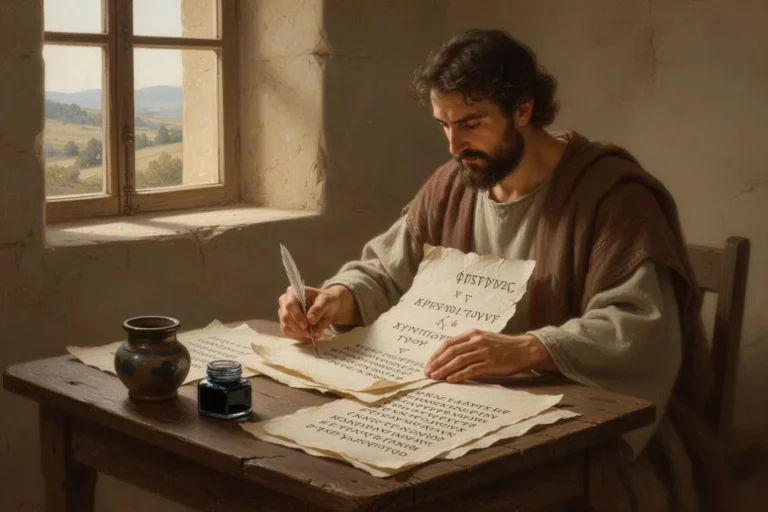
The Gospel of Matthew never says, “I, Matthew, wrote this book.” It presents the story in the third person and gives no author’s name in its opening lines or closing passage. Like the other canonical Gospels, it circulated without an explicit internal signature.
The book does mention a disciple named Matthew. In Matthew 9:9, Jesus calls a tax collector named Matthew to follow him. The passage describes Matthew leaving his tax booth and becoming a disciple. In Matthew 10:2–4, Matthew appears in the list of the Twelve apostles.
The parallel accounts in Mark 2:14 and Luke 5:27–28 name the tax collector Levi rather than Matthew. Matthew’s Gospel may be identifying Levi with Matthew, or it may preserve a different form of the tradition. That difference has contributed to later questions about whether the apostle Matthew personally wrote the Gospel bearing his name.
The Gospel also includes a detail that may seem favorable to apostolic authorship: Matthew 13:52 compares a trained disciple to a household owner who brings out both new and old treasures. Some readers have viewed this as a subtle reference to Matthew’s former work as a tax collector, but the connection is uncertain. The passage does not identify its speaker or author.
Why Christians traditionally attribute the Gospel to Matthew
The attribution to Matthew appears in early Christian tradition, not in the text itself. By the second century, church writers commonly referred to the work as the Gospel according to Matthew. The title means that the Gospel was associated with Matthew’s testimony or authority; it does not by itself prove that Matthew personally wrote every sentence.
One important witness is Papias of Hierapolis, a Christian leader usually dated to the early second century. The church historian Eusebius later preserved a statement attributed to Papias saying that Matthew compiled or arranged sayings in a Hebrew dialect, with later interpreters translating or explaining them as they could.
Papias’s statement has generated considerable debate. The surviving wording is brief, and it is not entirely clear whether Papias meant the canonical Gospel of Matthew, a collection of Jesus’ sayings, or another related work. The Greek term often translated as “oracles” can refer to sayings, declarations, or sacred messages. It does not necessarily describe a complete narrative Gospel in its present form.
Other early writers also connect the Gospel with Matthew. Irenaeus, writing in the second century, names Matthew as one of the evangelists. Origen and later church authors repeat the attribution. Over time, the four familiar Gospel names became firmly established in Christian manuscripts and teaching.
Useful distinction: “According to Matthew” identifies the Gospel’s traditional association, while “Matthew personally wrote the final text” is a stronger claim that the Gospel itself does not explicitly make.
What modern scholars mean by an anonymous Gospel
When scholars call Matthew anonymous, they are describing the evidence inside the document. They are not necessarily accusing its writer of hiding information or suggesting that the Gospel had no known authority among its first readers. The point is simply that the original text does not identify its author by name.
The four Gospel titles appear to have become standard as the writings circulated together. In the earliest surviving manuscripts, the titles function as identifying labels for the books. They distinguish “according to Matthew” from “according to Mark,” “according to Luke,” and “according to John,” but they do not provide an autobiographical statement from each writer.
Ancient books were not always signed in the way modern publications are. A work could be recognized through community tradition, a teacher’s authority, or a connection with a respected witness. Even so, the absence of a named author means that historical certainty about Matthew’s direct role is limited.
Many scholars therefore use careful language: the Gospel is traditionally attributed to Matthew, but the identity of its final author or editor cannot be established with confidence. Some scholars still defend apostolic authorship, while others argue that the work was produced by a later Christian teacher or community connected to Matthew’s tradition.
What the Gospel’s use of Mark suggests about authorship
A major reason many scholars question direct authorship by the apostle Matthew is the Gospel’s apparent use of the Gospel of Mark. Matthew reproduces much of Mark’s narrative material, often following Mark’s sequence while expanding, shortening, or rearranging particular scenes.
For example, Matthew, Mark, and Luke share accounts of Jesus’ ministry, healings, conflicts, death, and resurrection. Matthew often includes more teaching material than Mark and presents Jesus as a teacher who authoritatively interprets God’s will. The close verbal and structural relationship between Matthew and Mark suggests that Matthew’s writer worked with an earlier written source.
If the apostle Matthew had been an eyewitness of Jesus’ ministry, some scholars ask why he would depend so extensively on another Gospel rather than writing independently from personal memory. That question does not disprove apostolic authorship. An eyewitness could use an earlier account for organization, wording, or public teaching. It does, however, make the evidence more complicated than a simple eyewitness memoir.
Many researchers also think Matthew used a second source, often called Q, to explain material shared by Matthew and Luke but absent from Mark. Q has not survived as a separate document, and its existence remains a scholarly reconstruction rather than a discovered manuscript. Matthew may also have drawn on distinctive oral traditions or other written material.
The author’s method resembles that of a careful compiler and theological interpreter. He takes inherited traditions, arranges them into a coherent narrative, and adds teaching blocks that shape how readers understand Jesus. This literary activity could have been carried out by an apostle, a close associate, or a later member of a community preserving apostolic teaching.
What the Gospel’s language and setting reveal
Matthew was written in Greek, the language of the surviving text. Its Greek is generally more polished than Mark’s, and it frequently reshapes Mark’s wording. The writer knows Jewish Scripture well, but also addresses readers living in a wider Greek-speaking environment.
The Gospel contains many quotations and allusions to Israel’s Scriptures. It repeatedly explains events in Jesus’ life as fulfilling what was spoken through the prophets. Matthew’s distinctive formula, often translated as a statement that something happened “to fulfill” Scripture, shows that the writer wants readers to see continuity between Jesus and Israel’s story.
At the same time, the Gospel reflects tension between Jesus’ followers and some Jewish leaders. Matthew criticizes particular groups and disputes, but those conflicts should not be turned into blanket hostility toward all Jewish people. Jesus, his disciples, the Scriptures he quotes, and the earliest Christian movement are presented within a Jewish setting.
Scholars often place Matthew after the destruction of Jerusalem and its temple in A.D. 70, though proposed dates vary. The Gospel’s treatment of the temple, its relationship to Mark, and its developing church structures are among the reasons for a date in the late first century. A later date is possible according to some interpreters.
A late-first-century setting would make it less likely that Matthew the apostle personally composed the final Greek narrative as a young contemporary of Jesus, though it would not make apostolic influence impossible. The apostle could have supplied traditions that were later organized and edited by another writer. Historical arguments depend on how one evaluates early testimony alongside internal evidence.
How Matthew’s portrait of Jesus relates to the authorship question
The Gospel presents Jesus as the Messiah, Son of David, Son of God, and authoritative teacher. It highlights Jesus’ fulfillment of Scripture and arranges large sections of his teaching into memorable collections, including the Sermon on the Mount in Matthew 5–7 and several later teaching sections.
Matthew also emphasizes the kingdom of heaven, a phrase used frequently in this Gospel. Its parables explain different responses to God’s reign, while its stories show Jesus healing, forgiving, confronting hypocrisy, and commissioning disciples. The final commission in Matthew 28:18–20 sends the disciples to make disciples among all nations and to teach Jesus’ commands.
These themes can fit an apostle who wanted to preserve Jesus’ teaching for later believers. They can also fit a learned Jewish-Christian teacher who organized inherited traditions for a community facing questions about Scripture, identity, mission, and obedience.
The Gospel’s presentation of Peter, the Twelve, and the church has sometimes been used to argue for an early apostolic perspective. Matthew 16:18–19 gives special attention to Peter, and Matthew 18 discusses the responsibilities of the community. Yet these themes do not identify the author. They reveal the concerns of the writer and the community for which the work was shaped.
Why the apostle Matthew remains a possible candidate
Traditional authorship should not be dismissed simply because the Gospel is anonymous. Early Christian testimony consistently connects the book with Matthew, and that tradition arose relatively early in the history of the church. If the attribution were entirely random, it is reasonable to ask why Matthew, a less prominent apostle than Peter or John, would have been selected.
Some defenders of Matthew’s authorship argue that a prominent apostolic connection explains the book’s authority and acceptance. They also point out that an apostle could have worked with assistants, translators, scribes, or later editors. Ancient authorship did not always require one person to draft every word without collaboration.
The Gospel’s interest in money, accounting, debts, and financial images has occasionally been viewed as compatible with Matthew’s former occupation as a tax collector. Examples include discussions of debts, treasures, taxes, and stewardship. These details may reflect the writer’s interests, but they are not strong proof. Jesus’ teaching naturally includes economic images, and such topics were familiar throughout the ancient world.
Another argument is that Matthew’s special attention to Jesus’ teaching could reflect an apostle who remembered and organized the Master’s words. This is possible, especially in a culture where oral teaching and memorization were important. Still, the same feature can be explained by a later teacher preserving and arranging community traditions.
Why many scholars favor a later writer or editor
The strongest case for a later author combines several observations rather than relying on one detail. The text is anonymous, uses Mark as a written source, is composed in fluent Greek, and appears to address circumstances that developed after Jesus’ lifetime. Together, these features lead many scholars to distinguish the apostle Matthew from the person responsible for the final literary form.
The Gospel also seems to know a developed Christian community. Matthew 18 discusses restoring a member, handling serious disputes, and listening to the congregation. Matthew 16 uses language about the church, though the meaning and dating of those passages are debated. These instructions may reflect a community that had developed practices over time.
Matthew 22:7 includes imagery about a city being destroyed in connection with a parable. Some interpreters see this as an allusion to Jerusalem’s destruction by the Romans in A.D. 70. Others argue that the language can be understood as part of the parable’s dramatic story or as a prophetic tradition. It is evidence that must be weighed, not a precise timestamp.
Many scholars therefore describe the author as a Jewish-Christian writer who knew Scripture, used Mark and other traditions, and shaped them for a particular community. Some call this writer “Matthew” as a convenient label, while stressing that the name refers to tradition rather than confirmed personal identity.
Common mistakes when answering who wrote Matthew
Claiming the Gospel names its author: It does not. The name Matthew appears in the narrative as an apostle, but the narrator never identifies himself as that disciple.
Treating tradition as either proof or worthless rumor: Early testimony matters, but it must be compared with the text’s language, sources, and historical setting.
Assuming anonymous means unreliable: An anonymous ancient work can preserve valuable historical, theological, and communal traditions. Anonymity limits what can be proven about its writer; it does not settle every question about its contents.
Assuming use of Mark rules out Matthew completely: An apostle could use another written account, dictate material, or work with an editor. Source use raises questions but does not function as a mathematical disproof.
Calling Q a discovered Gospel: Q is a proposed source inferred from material shared by Matthew and Luke. No separate copy of Q has been found.
Using the tax collector detail as decisive evidence: Financial language may be compatible with Matthew’s background, but it is not a signature or independently verified autobiographical clue.
Reading “Matthew” as a modern publishing byline: Ancient titles could communicate a work’s connection with a recognized tradition, teacher, or authority without describing modern individual authorship.
How to describe the authorship accurately
The clearest answer depends partly on whether you are explaining Christian tradition or current historical scholarship. In a church setting, it is reasonable to say that the Gospel is traditionally attributed to Matthew the apostle. In an academic setting, the more cautious description is that the text is formally anonymous but was associated with Matthew from an early period.
A balanced answer can include both points: the apostle Matthew is the traditional author, while many scholars believe the final Greek Gospel was written by an unknown Jewish-Christian author who used earlier sources and preserved Matthew’s tradition.
That wording avoids overstating what can be demonstrated. It also recognizes that early Christians may have preserved a genuine connection to Matthew even if the final document was composed, edited, or transmitted by others.
Best short answer: Tradition says Matthew the apostle wrote the Gospel, but the text itself is anonymous, and many modern scholars attribute its final form to an unknown late-first-century Christian writer connected with Matthew’s teaching.
What the authorship question means for reading the Gospel
Knowing the authorship debate can sharpen your reading without reducing the Gospel to a name. Pay attention to how the writer arranges Jesus’ teachings, connects events with Scripture, and portrays the relationship between Jesus’ followers and the wider Jewish world.
It also helps to distinguish three related questions. First, who was Matthew the apostle? Second, who preserved the traditions associated with him? Third, who composed the Greek narrative that has come down to readers? The evidence may support different levels of confidence for each question.
If Matthew personally wrote the work, it could represent an apostolic witness shaped for a later audience. If a later author composed it, the Gospel still represents an early community’s serious effort to preserve and interpret Jesus’ life. Either way, its distinctive voice comes from the way it joins narrative, Scripture, teaching, and communal instruction.
The historical evidence does not permit a completely certain identification of the final author. The traditional name remains significant in Christian history, while the anonymous character of the text remains significant for responsible scholarship. Both facts belong in a careful answer to who wrote the Gospel of Matthew.
Frequently asked questions
Did Matthew the apostle write the Gospel of Matthew?
Christian tradition says he did, and early church writers associate the Gospel with him. The text itself, however, does not identify its author. Many modern scholars think the final Greek work was written by an unknown Jewish-Christian author who used earlier sources, including material from Mark. Others allow that Matthew supplied traditions or that an associate edited material connected with him.
When was the Gospel of Matthew written?
Many scholars place it after the destruction of Jerusalem and the temple in A.D. 70, often in the late first century. The precise date is disputed because the Gospel does not give a clear publication date. Its relationship to Mark, references to the temple, and descriptions of Christian community life all contribute to proposed dating arguments.
Why is Matthew called a Gospel if its author is unknown?
“Gospel” describes the kind of Christian writing it is: a narrative announcing and interpreting Jesus’ good news. The traditional title “according to Matthew” identifies the work’s early association with Matthew’s authority or tradition. Ancient works could circulate under such an attribution even when the surviving text did not contain a modern-style author signature.
What sources did the writer of Matthew use?
The writer appears to have used Mark extensively and probably drew on additional sayings and traditions. Many scholars propose a source called Q for material shared by Matthew and Luke but absent from Mark, although no separate Q manuscript survives. Matthew also uses Israel’s Scriptures and may preserve oral or written traditions unique to his community.


Leave a Reply