Masoretes: the Jewish scribes who preserved the Hebrew Bible
Masoretes: the Jewish scribes who preserved the Hebrew Bible
The Masoretes were Jewish scholars who carefully preserved the text, pronunciation, and interpretation of the Hebrew Bible between roughly the sixth and tenth centuries CE.
They did not write the Bible from scratch or replace its earlier wording. Their work created a detailed system for copying, checking, vocalizing, and annotating the Hebrew Scriptures, giving later readers a reliable form of the text known as the Masoretic Text.
The word Masoretes comes from the Hebrew term masorah, commonly understood as a tradition of transmitting the biblical text. The Masoretes were not a single school gathered in one place. They were generations of Jewish scribes and scholars who worked in several centers, especially in the lands of the ancient Near East.
Their activity followed earlier periods of biblical copying by many centuries. By the time the Masoretes began their work, the Hebrew Bible already had a long history of transmission in handwritten scrolls and codices. The Masoretes inherited that tradition and developed methods for protecting the text from accidental changes.
Most Masoretic activity is associated with the period from about the sixth through tenth centuries CE. Two major centers are especially important:
Babylonia: Scholars in the eastern Jewish communities developed their own systems of vowels and accents.
Tiberias: Masoretes in the Galilee produced the system that eventually became the dominant form used in printed Hebrew Bibles and modern scholarship.
Other Jewish communities also preserved biblical manuscripts and interpretive traditions. The existence of different systems does not mean that one group simply invented the text. It shows that scholars in different regions were recording how their communities read and transmitted an already ancient Hebrew tradition.
The Masoretes were therefore both scribes and textual specialists. They paid attention to individual letters, unusual spellings, word divisions, pronunciation, chanting, and the relationship between written and spoken forms of the text. Their work combined practical copying with a highly developed concern for accuracy.
Key distinction: The Masoretes preserved and annotated an inherited Hebrew text; they were not the original authors of the biblical books.
What the Masoretic Text contains
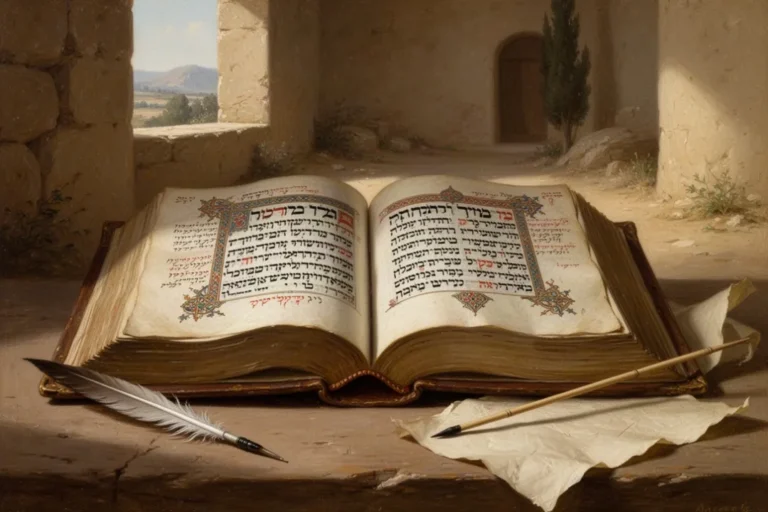
The Masoretic Text is more than a sequence of Hebrew consonants. It includes the written consonantal text together with a system of vowel signs, cantillation marks, and notes that guide pronunciation, reading, and textual control.
Ancient Hebrew writing generally recorded consonants without the full set of vowel symbols used in modern Hebrew. Readers who knew the language and the synagogue reading tradition supplied the vowels from memory. As Hebrew became less widely spoken in some Jewish communities, written guidance became increasingly useful.
The Masoretes added small marks around the consonants to represent vowel sounds. These symbols are called vowel points, or niqqud. They do not normally alter the consonantal wording. Instead, they preserve a particular reading tradition by showing how the written words were pronounced.
They also developed cantillation marks, sometimes called accents or te'amim. These signs indicate patterns used in the public chanting of Scripture. They can also mark divisions within a sentence and help clarify how a passage should be read aloud.
In this way, the Masoretic system records several layers of information at once:
The consonantal text, which forms the written base of the Hebrew words.
The vowel tradition, which indicates pronunciation.
The chanting tradition, which guides public reading and can reflect the structure of a sentence.
The Masorah, a body of notes that helps scribes preserve the text consistently.
The vowel points and accents should not be mistaken for modern punctuation. Some of their functions overlap with punctuation, but they belong to a much older reading system. Their primary purpose was to preserve pronunciation and chanting rather than to reproduce the punctuation conventions used in English.
The Masoretic tradition also preserves information about how words were divided. Hebrew manuscripts can represent certain expressions in ways that raise questions about whether words should be read together or separately. The Masoretes recorded such details with great care, because even a small change in spacing or spelling could affect interpretation.
How Masoretic notes protected the biblical text
The Masoretes created a network of notes known collectively as the Masorah. These notes appear in different locations around the main text. Notes written in the margins are often described as the Masorah parva, or “small Masorah,” while longer notes placed above or below the text are called the Masorah magna, or “great Masorah.”
Some manuscripts also contain an extended form called the Masorah finalis, placed at the end of a book or section. These notes could summarize patterns that would have been difficult to fit beside individual lines. Together, the notes formed a practical system for checking a manuscript against established tradition.
A Masoretic note might identify a word that appears only a certain number of times, point out an unusual spelling, or distinguish between similar forms. It could also record a word that should be read in one way even though the written form appears another way. These traditions are often discussed using the terms ketiv and qere.
Ketiv refers to what is written, while qere refers to what is read. In some cases, the consonants on the page were preserved, but readers were instructed to pronounce a different form. The Masoretic notes allowed both aspects of the tradition to remain visible rather than silently changing one into the other.
This approach reflects a central feature of Jewish textual transmission: the written form and the traditional reading could be treated as related but distinct. The Masoretes recorded that distinction so future scribes would not lose either part of the inherited practice.
Masoretic notes also served as a kind of error-control system. A scribe could use lists and observations to check whether a passage had been copied correctly. If a rare word appeared in an unexpected form, or if a particular spelling occurred only once, the note drew attention to it.
The notes were not always easy to interpret. They use abbreviations and assume knowledge of the scribal tradition. Later scholars have sometimes disagreed about the meaning of individual Masoretic annotations. Even so, the overall system demonstrates an unusually deliberate effort to preserve textual details across generations.
Why the notes matter: They often preserve information about rare spellings and reading practices that would be easy for a copyist to overlook.
The Tiberian tradition and the major Masoretic families
Several Masoretic systems existed, but the Tiberian tradition eventually became the most influential. It is associated with scholars working in Tiberias, a major center of Jewish learning in the Galilee. The Tiberian system supplied the vowel signs and cantillation marks now familiar from scholarly editions of the Hebrew Bible.
The Tiberian tradition is especially connected with the Ben Asher family. The name refers to a lineage of Masoretic scholars who worked across generations. Aaron ben Moses ben Asher is often regarded as the most important representative of this family because of the high status later Jewish and scholarly traditions gave to his work.
Another important name is Ben Naphtali, associated with a different Masoretic tradition. The differences between Ben Asher and Ben Naphtali were generally matters of details such as vowel placement, accents, and particular readings rather than completely different versions of the Hebrew Bible.
These differences show that the Masoretic tradition was not mechanically identical everywhere. Communities preserved related but sometimes varying reading systems. As scholars compare manuscripts, they can identify where traditions agree and where they diverge.
The Tiberian system became especially influential because it was transmitted through respected manuscripts and later adopted by editors and printers. Modern editions of the Hebrew Bible often use Tiberian vocalization even when the underlying consonantal text has a more complicated history.
It is useful to separate three things that are sometimes blended together:
The consonantal text: The letters that make up the written Hebrew passage.
The vocalization: The signs that represent a traditional pronunciation.
The manuscript tradition: The particular copies and scribal families through which the text has been transmitted.
These layers are closely related, but they are not identical. A printed Hebrew Bible may display all of them together, making the page look like a single unified object. Historical study, however, examines how each layer developed and how different manuscripts preserve it.
Important Masoretic manuscripts and codices
The Masoretes worked primarily with handwritten manuscripts, and several medieval codices are central to the study of their tradition. A codex is a bound book with pages, unlike a scroll. The codex format made it easier to include extensive marginal notes and to organize larger portions of the Hebrew Bible in one volume.
The Aleppo Codex is one of the most famous witnesses to the Tiberian Masoretic tradition. It was produced in the medieval period and was associated with the work of Aaron ben Asher. For centuries, it was treated as an exceptionally authoritative manuscript within Jewish communities.
Parts of the Aleppo Codex are missing today. The surviving sections remain extremely valuable, but the loss means that scholars cannot use it alone for every book and passage of the Hebrew Bible. They compare it with other manuscripts and with earlier textual evidence.
The Leningrad Codex, dated to 1008 or 1009 CE according to its colophon, is the oldest complete surviving manuscript of the Hebrew Bible. It is a major source for modern scholarly editions, including editions that reproduce the full biblical text with Tiberian vocalization and accents.
The Leningrad Codex is not necessarily identical in every detail to every other Masoretic manuscript. Its importance comes from its completeness, age, and well-preserved form. Scholars still examine it critically rather than assuming that one manuscript answers every textual question.
Earlier biblical manuscripts, including the Dead Sea Scrolls, provide a valuable comparison. Most of the Dead Sea Scrolls predate the Masoretes by many centuries. Some passages resemble the later Masoretic Text closely, while others reflect different textual forms known from other ancient traditions.
This comparison helps clarify what the Masoretes did and did not do. Their work preserved one major stream of the Hebrew biblical tradition with remarkable detail, but the existence of earlier variants shows that textual transmission had a longer and more varied history.
Other evidence can also contribute to textual study, including ancient translations and quotations by early Jewish and Christian writers. These sources may preserve clues about Hebrew forms that differ from the later Masoretic wording. Scholars weigh such evidence alongside the medieval manuscripts rather than treating any single source as automatically decisive.
The Masoretes matter because most modern readers encounter the Hebrew Bible through a form of the Masoretic Text. Jewish editions, academic Hebrew Bibles, Bible translations, and biblical studies all rely on this tradition to some degree.
For Jewish communities, the Masoretic tradition helped preserve the text used in synagogue reading. The combination of consonants, vowels, accents, and reading customs supported a consistent public reading practice even as Jewish communities became geographically distant from one another.
For translators, Masoretic vocalization can affect the meaning of a Hebrew word. Hebrew consonants may sometimes support more than one possible pronunciation or grammatical interpretation. The traditional vowels provide important evidence about how the word was understood by the Masoretic reading tradition.
For textual critics, the Masoretic Text is a major witness rather than an unquestionable shortcut. A textual critic compares manuscripts and ancient versions to ask how a reading developed, which form may be earlier, and whether a difference arose through copying, interpretation, or regional tradition.
That process does not mean that every disagreement makes the Hebrew Bible unreliable. Most differences are small, and many do not change the central meaning of a passage. At the same time, responsible scholarship does not hide variation. It identifies differences and explains what evidence supports each reading.
The Masoretes also remind readers that preservation involves more than copying letters. A text can carry several kinds of information at once: spelling, pronunciation, public performance, word division, and interpretive tradition. The Masoretic system attempted to protect all of these layers in a compact written form.
When you see tiny marks around the letters in a printed Hebrew Bible, you are seeing the result of centuries of learned transmission. Those marks are not decoration. They reflect a carefully preserved tradition about how the text was read and chanted.
Studying the Masoretes therefore gives a clearer picture of how biblical texts reached the modern world. Their achievement was not the creation of a new Scripture, but the disciplined preservation of an inherited text and the reading tradition attached to it.
Frequently asked questions
Did the Masoretes change the words of the Hebrew Bible?
Their main task was to preserve the inherited consonantal text and record its traditional reading. They did not generally rewrite biblical books. They sometimes supplied vowel signs, accents, and notes that made pronunciation and interpretation more explicit. Manuscript differences existed before and during their period, so scholars compare Masoretic manuscripts with older evidence rather than attributing every variation to the Masoretes.
Are the Masoretes the same as biblical authors?
No. Biblical authors and editors belonged to much earlier periods, while the Masoretes worked mainly from about the sixth through tenth centuries CE. The Masoretes were later Jewish scribes and scholars who transmitted, checked, vocalized, and annotated the Hebrew Scriptures. Their contribution concerns preservation and reading tradition, not the original composition of the biblical books.
What is the difference between the Masoretic Text and the Hebrew Bible?
The Masoretic Text is the traditional Hebrew form of the Jewish Scriptures preserved with Masoretic notes, vowels, and accents. “Hebrew Bible” can refer more broadly to the collection of biblical books in Hebrew, including earlier manuscript forms and textual traditions. In practice, many modern editions of the Hebrew Bible present a Masoretic form of the text.
Why do scholars compare the Masoretic Text with the Dead Sea Scrolls?
The Dead Sea Scrolls are much older than the medieval Masoretic manuscripts and preserve evidence from an earlier stage of textual transmission. Some passages closely match the Masoretic tradition, while others show different readings or spellings. Comparing them helps scholars trace how the Hebrew text was transmitted and assess particular readings without assuming that every tradition was identical.






Leave a Reply